In what DC has described as the first major crossover of the "Rebirth" era (sorry, "Night of The Monster Men"!), the team that starred in Warner Bros' last big super-team movie is pitted against the team that will star in Warner Bros'
next big super-team movie. They are totally going to fight, as you can tell from the "Vs." part of the title. DC Comics wanted to be
very clear about the fact that they would be fighting, hence they went with "Vs." instead of their parent company's vague, more legalistic formulation of "V" (See
Batman V. Superman: Dawn of Justice; actually,
don't, if you can help it).
What might the two teams have to fight about? Plenty, since one is comprised entirely of supervillains, and the other entirely of superheroes. The Justice League's roster has been remarkably steady over the course of the five fictional years between when the first story arc of The New 52
Justice League was set and the second story arc, as well as over the course of the five
real years (and a handful of change) that have passed since 2011's
Justice League #1 ushered in a new, post-
Flashpoint continuity.
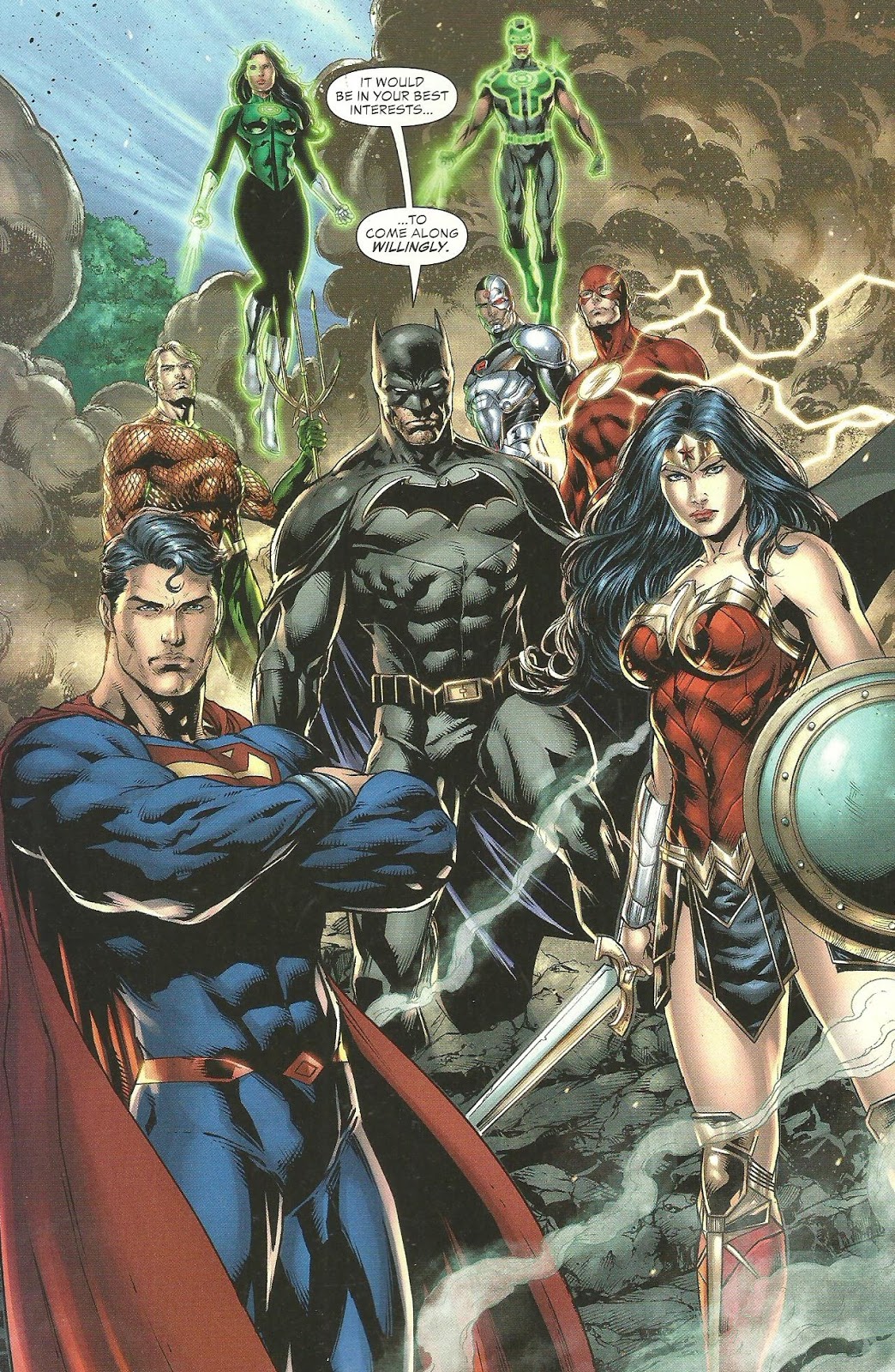
Currently, the League consists of founding members Batman, Flash, Wonder Woman, Aquaman and Cyborg. They have been recently re-joined by former Power Ring, current Green Lantern Jessica Cruz, who, at Green Lantern Hal Jordan's behest, now has her Green Lantern Corps partner Simon Baz at her side on the roll call (Baz was briefly on a different, short-lived, government-run Justice League, the one that appeared in
Justice League of America). Pushing their numbers up to eight is their newest recruit, Superman.
Not the Superman that founded this League with his peers, that Superman, the New 52 Superman, is dead; this is the
new Superman (not to be confused with the New Super-Man), who is actually the old Superman, the one who ended up in The New 52-iverse by way of
Convergence (Look, it's complicated). I have no idea what happened to
Captain Marvel Shazam; the "Darkseid War" line-up dissipated, and while explanations of some of that roster's whereabouts were explained, he has just kind of gone missing, and the rest of the team doesn't seem to have bothered to go looking for him.
As for the Suicide Squad, they just recently--as in around the time their movie hit the big screens and DC relaunched their entire line with new #1 issues--settled on a new line-up reflective of the one in the movie: Harley Quinn, Deadshot, Captain Boomerang, Killer Croc, El Diablo and The Enchantress, lead by Colonel Rick Flag and Katana. Oh, and they added Killer Frost in the back-up to the last issue of
Suicide Squad to see publication prior to the start of this crossover. But she won't be there long, judging by the covers of the upcoming
Justice League of America book.
The Justice League has been appearing in the pages of
Justice League, by writer Bryan Hitch and pencil artists Tony S. Daniel, Jesus Merino, Neil Edwards, Matthew Clark and Tom Derenick. I made it through the first seven issues, but it was a real slog. I wouldn't recommend it, but then, one hardly needs know the ins and outs of the Justice League's ongoing monthly to make sense of them and their presence here; if you read comics or watch TV or movies, you know everyone's deal on the Justice League.
The Suicide Squad has been appearing in the pages of
Suicide Squad, by writer Rob Williams, pencil artist Jim Lee and plenty of guest-artists, who contribute the back-up, solo stories. It has been remarkably good since the "Rebirth" re-launch, definitely the best
Suicide Squad since the Giffen-written second series, if not the original, John Ostrander-written one (Given the relatively poor quality of the two New 52 series that preceded this one though, I understand that's not saying
much, but there you have it).
Given those creative teams, you might expect Hitch and Williams to be writing this, or at least Steve Orlando, who is writing the new
JLoA book this is apparently leading in to. You would be wrong, though. Joshua Williams is handling the writing duties (the teams' parent books do offer tie-ins by their regular writers though), and each issue is drawn by a different artist, including a few who have previously contributed to
Justice League, like Merino and Daniel.
Now I know what you're probably thinking, because it's what I thought when I first heard about this series: Those aren't very evenly matched teams
at all. The Flash could KO the whole Squad in a second, and Superman could take them all out with the sonic waves from a clap (Really, only The Enchantress stands a chance against Superman). These two teams fighting for as few as six panels is probably going to include a few panels of padding; how can Williamson stretch it out for six
issues?
Well, I suppose we will have to read it to find out! (Spoiler alert: He accomplishes it the old-fashioned way, by pitting the two conflicting sides against a third participant that will require their working together).
Justice League Vs. Suicide Squad #1 by writer Joshua Williamson, artist Jason Fabok and colorist Alex Sinclair
The first issue goes to artist Jason Fabok, who is no stranger to big, New 52iverse throwdowns, having drawn the "Darkseid War" arc in Geoff Johns'
Justice League book. He's got 32 pages to draw here, but Williamson's script makes it easy on him, with four double-page splashes (one of which is turned over entirely to the credits) and three single-page splashes. Fabok's cover doesn't give us a whole lot to go on in terms of what the issue might contain other than drawing the casts of both books all just kinda posing, with the two biggest stars drawn biggest, front and center.
But wait, who is that squinting guy in the background?
He's bigger than even Batman and Harley Quinn, even if he's not fully colored. Is that just Flag, or someone else? (I'm just playing; I know who it is).
We open in Death Valley, California, with a quote from John Steinbeck in the first panel (Ooh, literary!). A mysterious man in boots, always shown only in silhouette or mostly off-panel, descends a stair case and walks into a facility that looks remarkably like Belle Reve, Jedi mind-tricking his way past guards and a doctor in a lab coat that releases the prisoners for the man. Well, I say Jedi mind trick, but I guess it's more like outright mind control, as he asks two guards to kill one another and they do.
When a crowd of guards rush in, the off-panel freed prisoners slaughter them all, revealing only hints of their identities--a fist holding a flaming sword here, a blast of emerald energy there--and then they destroy the facility. The man leads the away. These are presumably the villains revealed in that eight-page, accordion pull-out ad that ran in like all of DC's comics the week before this series started. As most of those villains were redesigned in some way or another though, and not explicitly named, I don't know who they all are for sure. One looks as much like Dr. Impossible as he does Doctor Polaris, for example. Anyway, we only see them in extreme long-shot. Drama!
That leads us to the first of the double-page splashes, the one just featuring the title of the series stretched diagonally over a black field, with the creator's credits. For the penny-pinching among you (like, um, me), I should note that counting this spread, there are 32-pages in this $3.99 comics; the other issues all have 30 story pages. So DC didn't charge any extra, or subtract any panels, in order to make room for this giant logo and credits spread.
Turn the page and...it's
another double-page splash! This one featuring most of the Suicide Squad--Captain Boomerang, Deadshot, Enchantress, Harley Quinn, Killer Croc, Killer Frost and El Diablo--fighting some goons in matching uniforms and machine guns on a beach. A box in the upper lefthand corner tells us we're in Badhnisia, which Google says is not a real place. It sounds bad, though!
Back at Belle Reve, Amanda Waller exposits to Flag, who is mad that she sent the Squad out without him: A generic bad guy named Apex, head of a generic bad guy cult called The Brotherhood of
Evil Mutants Brimstone has a generic maguffin machine, with which he plans to destroy the island of Badplaceia as a sacrifice to his generic bad guy god.
As the Squad kills their way through them, text appears next to each of them by way of identifying them (Example: "Enchantress. Witch. Scary." Another example: "Deadshot. Expert marksman. Has a death wish."*). Their dialogue goes a little further to define them for us--Killer Frost is new to the team, Captain Boomerang is a jerk, etc--and lets us know what their whole deal is. Covert missions that the United States government doesn't want it's fingerprints on, they're kept in line by microscopic bombs Amanda Waller placed in their heads and can detonate with the push of a button and so on.
Meanwhile, the Justice League is having a meeting!
They are all standing around a circular table on their satellite headquarters. Why are they all standing, rather than sitting? No chairs. Perhaps Fabok doesn't like drawing chairs, or people sitting. Or perhaps they are just showing off their endurance by standing. I don't know. I like when they have chairs with their icons on the back, though. That's like my favorite thing about the Justice League headquarters, and this particular HQ is missing it.
They too are introduced by a few lines of text, although it's hard to imagine that many readers don't know who Batman or The Flash are, and that they are "Dark Knight Detective" and "Fastest Man Alive," respectively. The subject of their meeting is, coincidentally enough, the Suicide Squad.
Batman is introducing the concept to the League, which seems kind of strange to me, as I know certain members of the League have crossed paths with iterations of the Squad before. As Batman explains it, the idea is not simply to use completely expendable operatives for suicide missions, but that by using colorful supervillains, Waller gets a built-in cover story: It will just look like a gang of villains up to no good. This doesn't sit well with the Leaguers, as they don't like the idea of people they might have captured being given, in Flash's words, hall passes, and/or being pressed into service for the government, rather than being rehabilitated, which is kind of the point of prison.
What they don't know is that the Squad members have bombs in their heads. What they
do know is that while everyone was talking, Cyborg super-Googled "incarcerated convicts" and "sightings of two or more together," and he found...the previous action scene in Badislandville. Fight scene, here we come!
The Squad stops Apex just as he's in the process of destroying the island with an earthquake--via Deadshot sniper-ing him to death from the roof of a nearby building, and pointing out to Waller it would probably be easier just to send Deadshot to assassinate these people solo--but the aftershocks start toppling buildings and threatening the population.
Seeing no way out, Deadshot jumps to his death...but Superman catches him. And the Green Lanterns and Flash save all the buildings and people in another two panels. Then they all regroup behind Batman, where they can all pose for a splash page and the Dark Knight says threateningly, "Task Force X is
over, Deadshot. It would be in your best interests... ...to come along
willingly."
Hmm, I wonder where they are going to
take them, willingly or unwillingly? I mean, if they turn them over to pretty much any legal system, won't the same thing just happen again? Waller did pluck them out of the prisons and/our homes for the criminally insane they were sentenced to for this whole thing in the first place.
There's some tense discussion, during which El Diablo says "Slow your roll, Batman" (a phrase I don't think I've ever heard, in all my years of Batman-reading), and Baz disses Captain Boomerang's boomerang motif. I'm not real clear on why the Squad is so resistant, given that the League offers to help them--they're not supposed to
like being forced to serve on suicide missions or have their heads blown off, right?--but they aren't crazy about the idea, and none of them mention the bombs. Waller, meanwhile, orders them to fight the League, with this funny little line: "Do
not let the Justice League take you alive.
Or you're DEAD.."
They don't try to parse out whatever the hell that means, but instead FIIIIIIGGHHT!
As I mentioned previously, Justice League Vs. Suicide Squad isn't exactly a fair fight. At least, not
this Justice League, which is
all big guns, and
this Suicide Squad, which is almost
no big guns. (When the Squad fought the JLI incarnation of the League in 1988, they were much more evenly matched**). With no speedster of their own and no way to counteract a speedster, The Flash should be able to take the entire Squad down solo; instead he's merely shown running at Captain Boomerang, who he has given enough time to throw a boomerang at him (
This Boomerang, like the one in the movie, just uses razor-sharp boomerangs, rather than a variety of trick ones).
Superman, who is as fast as The Flash but
also has like eight other super-powers too, could similarly take them all down between panels, with only The Enchantress able to fight him, given his vulnerability to magic. In this spread, he's shown flying right at Enchantress, and throwing a punch, while she dodges and throws green lightning around.
Wonder Woman could probably also take most of these guys down in just about as fast, but she merely runs at Harley Quinn, sword drawn, as if she's going to chop her down (that fight should last all of one punch, really).
These two Green Lanterns have been consistently portrayed as new and unused to their powers--Jessica Cruz went an arc or so of
Green Lanterns unable to make a construct--so I suppose it makes some sense that they don't just straight up will the Squad into green bubbles or whatever.
Still, the matches proposed here are kind of silly. Flash and Wonder Woman should finish Boomerang in Harley by the time we turn the page. Baz is fighting El Diablo, whose fire powers can't touch him through the ring's force field. Killer Frost is throwing icicles at Cruz, but they can't penetrate her force field. Aquaman is fighting Killer Croc, which might have been a good match pre-
Flashpoint, but New 52 Aquaman is as strong and invulnerable as Golden Age Superman; one punch would take Croc out.
The only fights that could plausibly last long are the ones between Superman and Enchantress, and the one between Batman and Deadshot.
Cyborg, meanwhile, doesn't
have anyone to fight, as in addition to vastly overpowering the Squad, the League
also outnumbers them. He's shown running at Killer Frost with a hand outstretched.
I suppose this will all be over on the next page, as the other six Leaguers turn their attention to helping Superman and Batman with their opponents.
But no! We cut away to a castle in the Swiss Alps, where the guy who rescued the prisoners in the first scene is still speechifying to them. There's a page showing tight close-ups on the five rescued prisoners, revealing a clue as to who they might be, and then a turn of the page takes us to another double-page splash, revealing what the man wants of them: To kill Amanda Waller.
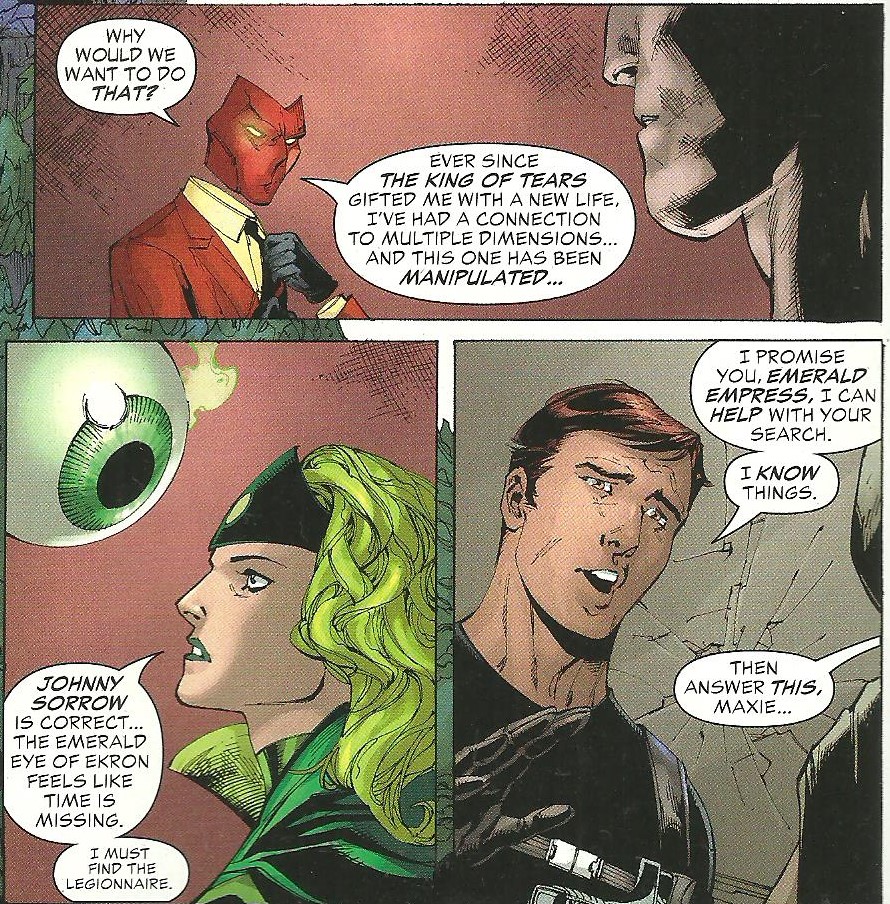
And who is "them"...? Emerald Empress, a Legion of Super-Heroes villain whose green motif makes her a little too visually similar to this version of The Enchantress; Doctor Polaris, a magnetically-powered Green Lantern villain whose New 52 redesign renders him unrecognizable here; Johnny Sorrow, a
JSA villain whose "power" is that if you see his true face you go mad and/or die horribly; Rustam, a flaming scimitar-wielding villain of the original, well-written
Suicide Squad of the 1980s; and, finally and most unexpectedly, Lobo, who here looks like he did during his 1990s heyday and whose continuity is crazy-confused in the New 52 (I
think there were three Lobos prior to him in the current continuity, and at one point "Lobo" was a role instead of the name of a particular character? Remember, he was a supposedly sexy young man for a while, rather than a white-skinned super space biker with a cigar and hook).
Now
this is a group of bad guys that could trouble the Justice League. Lobo has taken on Superman mano-a-Supermano plenty of times, and Polaris has fought the entire League before. What is more noteworthy about this particular team, however, is the sources they are drawn from. Emerald Empress is supposedly from a millennium in the future, in a continuity that gets rejiggered during every cosmic realigning, continuity rebooting event (we
did see a Legion flight ring during the
DC Universe: Rebirth special, remember). I
think Polaris, Sorrow and Rustam are all making their post-
Flashpoint debuts here, but, in any case, Sorrow's previous origins and stories established him as a character from the Golden Age of superheroes--an age that
Flashpoint erased (But, again,
DC Universe: Rebirth indicated that the Golden Age might have still happened, and just been mostly forgotten by the people of the New 52-iverse).
Is it possible that the presence of some of these characters is meant to not only suggest the previous, pre-
Flashpoint DCU, but indicate that parts of that lost continuity, including its past and far-flung future settings, are coming back? I don't know. But there's one more surprise in store, as the issue's final page is a splash page revealing the identity of the mind-controlling mystery man: Maxwell Lord, bleeding from his nose as he does whenever he pushes his mind-control powers, dressed just as he was after his retcon-enabled heel turn a decade ago (!!!) in
Countdown to Infinite Crisis, and,
according to some people who aren't me, he may even be standing in front of a crack meant to suggest this particular castle in the Swiss Alps is the very same one in which he killed Blue Beetle Ted Kord in that same comic.
What could
that mean...? I don't know!
Well, at least now he know how Williamson is going to fill all these pages. After the League crushes the Squad and removes their bombs (Hey, can Flash just vibrate his hand and snatch the bombs out of their brains safely, or does this current version of Barry Allen not have the power to pass through solid objects by vibrating his molecules?), they can all team up to fight Max Lord's team of mind-controlled supervillains and, I don't know, maybe then fight the Watchmen and reboot the DC Universe again. Exciting!
Justice League Vs. Suicide Squad #2 by writer Joshua Williamson, penciller Tony S. Daniel, inker Sandu Florea and colorist Alex Sinclair
This comic is done playing coy with its villains, with Daniel's cover art showing everyone more or less clearly (even if Max is maybe not immediately identifiable without anything else to go on), and the tag declaring the five villains "The Nightmare Army of Max Lord!"
Splash pages remain the order of the day, as we open with a full-page splash of Waller shouting eight words of dialogue, a splash immediately followed by a double-page splash, depicting Daniel's version of the Squad vs. League splash that Fabok drew at the climax of the previous issue. There are some changes in the arrangement, of course, but among the more significant is that Wonder Woman has lost her shield, sheathed her sword and now attempting to subdue Harley Quinn with her magical lasso, and that now Cyborg is fighting Killer Frost, while The Green Lanterns double-team El Diablo.
For some reason, The Flash, Superman and Aquaman have not yet taken down their opponents; in Flash's case, that fact is almost comical, as he's drawn running circles around a Captain Boomerang but not, like, punching him or handcuffing him or pants-ing him or anything.
Waller reiterates the plot to her Squad (Hey, how come Superman isn't overhearing their conversations with his super-hearing?), adding that Colonel Rick Flag is on his way to Bad Land, but in the meantime the Squad is supposed to fight The League to the death.
From there, Williamson starts getting into individual match-ups, like Killer Frost and Cyborg trying to blast one another, Killer Croc and Aquaman posing in one another's immediate vicinity and Batman and Deadshot trading blows and lines of dialogue. This last bit is pretty poorly choreographed, as when Batman throws a handful of Batrangs at Deadshot and one panel shows them flying past him, but the next shows Deadshot shooting them out of the air; I guess Deadshot dodged them all, turned around and shot the Batarangs down because he thought it would look cool, even though that meant turning his back on Batman?
At Deadshot's command, the Squad scatters in an attempt to make the League chase them. This...is kind of a dumb plan in that the League and Squad had pretty much already paired off, and it's not like they have any real chance of outrunning the League. With the exception of Batman, the whole League can either fly or do something quite close to it
and possess something between enhanced speed (Aquaman, Cyborg) and flat-out super-speed. Again, Flash and/or Superman should have all these people unconscious and/or in cuffs by now.
Williamson perhaps wisely cuts to a different scene here, so we don't contemplate things like Captain Boomerang trying to run away from The Flash any further. We return to the Swiss Alps, where Lord is still trying to talk his "nightmare army" to nightmare march to his nightmare orders. Close observers of the ever-malleable DC continuity will want to pay special attention to this conversation.
Johnny Sorrow tells Lord he has been to multiple dimensions, "and this one has been
manipulated." Emerald Empress agrees, saying her Eye of Ekron "feels like time is missing," and then mentions her need to find "The Legionnaire." They are referring pretty directly to
DC Universe: Rebirth, which revealed that Doctor Manhattan and/or other characters from Alan Moore and Dave Gibbons'
Watchmen had altered the DC Universe in the wake of
Flashpoint in order to deliberately weaken it, in part by stealing time from it.
Less clear is what it means when Lord tells his nightmare soldiers that "The Justice League and I are
old friends." He may be referring to his past continuity, or just to unrevealed elements of his "new" past. At any rate, he gets them all on board with his not-yet-revealed-master plan, even though it's clear it takes the use of his psychic powers to push some of them into agreeing to go along with them.
But this comic is called
Justice League Vs. Suicide Squad, not
Max Lord Holds A Meeting, so it is time to return to the fighting.
Superman vs. Enchantress! She manipulates Superman into lowering his guard, and then calls him a cretin and blasts him with a green coloring effect, at which point she realizes that "the mighty hero has a weakness...
magic."
Cyborg vs. Killer Frost! You know that she doesn't just shoot ice like most ice-powered heroes and villains, but needs to drain heat energy from victims in order to use her power and/or stave off hunger and pain, making her a sort of heat vampire? Well, if not, the comic will make sure you do. Well, she drains some heat from Cyborg's human half, but apparently his machine parts keep him alive through the process.
The Green Lanterns vs. El Diablo! The pyrokinetic bad guy creates a giant fire construct of a three-headed, fire-breathing dragon (at this point, I realize that the movie/New 52 version of El Diablo is basically like Green Lantern Kyle Rayner's villain Inferno), but the Lanterns trap him in a green energy bubble, snuffing out the oxygen needed to fuel the flames. That fight takes all of three panels, making it perhaps the most realistic match-up.
The Flash vs. Captain Boomerang! While Williamson never gets around to explaining what The Flash is doing if he's not capturing Boomerang--What is he, a cat, playing with him?--he does finally have Boomer throw some boomerangs at some innocent beach-goers (not sure why they are still on the beach after all the earthquakes and gun shots and whatnot), making him chase something else for a few panels. Boomerang then immediately caves and starts telling Flash everything.
Aquaman vs. Killer Croc! Croc jumps into the ocean in an attempt to escape Aquaman (?), and there's a curious reference I didn't understand. Croc says he encountered Aquaman at Amnesty Bay before, but Aquaman doesn't have any memory of it, for some reason. ("
Amnesty Bay? Have we met before?"). I have no memory of it either! Aquaman summons a giant great white shark to attack Croc (Just punch him, man! You're like 100 times stronger than him! Batman takes this guy out on the regular!) and, in a very unconvincingly drawn panle, Croc rips the shark in half...? He then circles around Aquaman in the cloud of shark blood and tries to bite the Aquatic Ace's elbow, which only breaks his teeth.
Then Aquaman finally punches him out.
Batman vs. Deadshot! After throwing punches and insults for a while, Floyd eventually starts shotting Batman right in his armored bat-symbol, but Batman marches through the pain in order to punch Deadshot so hard he breaks his face mask off. Man, where were you in 2011, Bats? His
old new costume needed torn apart much more urgently than this less-bad version!
Wonder Woman vs. Harley Quinn! She might be able to fly, she might have super-speed, but Wonder Woman is still unable to catch Harley before she gets on a motorcycle and speeds away. Harley seems to refer to the events of
Harley's Little Black Book #1, which is weird only in that the Amanda Conner/Jimmy Palmiotti Harley seems like an entirely different character with an entirely different continuity than the one in
Suicide Squad, and, after briefly distracting Wonder Woman, Harley attacks her by driving a motorcycle right into her. One of them walks away unscathed, the other unconscious. Can you guess which is which?
And that's pretty much it! The League has taken the Squad down with no real problems, and Waller's just about to blow their heads up when The Enchantress throws an unconscious Superman into the sand, having apparently exhausted her self taking him down. Waller then commands Killer Frost to absorb Superman's life-force, and she does so; this doesn't kill
him either, even though he turns into a mummy for one-panel, but his solar-powered
super-life-force powers her up to incredible rates, allowing her to freeze everyone on the beach. In a stunning upset, the Suicide Squad has won!
The Leaguers awake to find themselves each in an especially crafted tube-shaped cell designed to counteract their powers and abilities. Superman, for example, is under red lights, probably red sunlight generating lamps, the Lanterns have weird metal masks encasing their heads, and so on. Not sure what they did to Wonder Woman, as she's basically just tied up in her own rope, which isn't a thing I thought could happen to her. Anyway, they are totally captured and at the mercy of Amanda Waller, who crosses her arms on the last page, another Waller-focused splash, and declares "Welcome to the
SUICIDE SQUAD."
So there you have it.
Justice League Vs. Suicide Squad has ended with the Squad victorious, and it looks like--Oh, woah, woah, woah, wait. This is only the end of the second issue, huh? There are still four more issues of this to go? Huh.
Justice League Vs. Suicide Squad #3 by writer Joshua Williamson, pencil artist Jesus Merino, inker Andy Owens and colorists Alex Sinclair and Jeremiah Skipper
Jesus Merino and company's cover for this issue is at least somewhat reminiscent of that of 1960's
The Brave and The Bold #30, and later homages to it, showing as it does the various Justice Leaguers all captured in tubes kept improbably enough side-by-side. On that long ago cover, they were in special chambers that were siphoning off their superpowers and then redirecting them into the colorfully dressed android, Amazo. Here they are merely captured in some very uncomfortable-looking tubes, while Amanda Waller looks in on them, projecting a shadow that reads "Prisoners Of Amanda Waller!"
After two pages of Flag and Katana visiting The Catacombs prison where Lord freed his bad guys, stepping over all the corpses and retrieving the "black box" they were sent there for, we jump to Belle Reve, where the Justice Leaguers are being kept quite uncomfortable. Batman is trussed up in a straight jacket and muzzle and bound to a big-ass dolly, like the kind Hannibal Lecter (and occasionally The Joker) are moved around on. He of course immediately breaks out, beats up six guys and runs to Waller's office to demand answers from her. Being the World's Greatest Detective, he knows that she can't really have been planning to induct them all into her Suicide Squad (He doesn't mention it, but one good clue? The guards didn't even bother removing his mask, cape or utility belt when securing him).

Meanwhile, the triumphant Suicide Squad goes to visit the caged Leaguers, essentially to tap the glass on their fishbowls and annoy them. While everyone is laughing at Captain Boomerang, Superman calls Killer Frost aside and has a long-ish, two-and-a-half-page chat with her, asking her why she wasn't behaving as ruthlessly as he had expected her to, and she tells him about a time before she became Killer Frost, back when she was just plain old Caitlin Snow (whose surname all but guaranteed she would get cold powers of
some kind eventually), she saw him flying one day and he inspired her: "I thought... ...If a man could
fly... I could stay in college."
He tries further inspiring her to be a hero instead of a villain (and it must work, because by the time I finally post this and you're reading it, she will all ready be appearing in
Justice League of America). Deadshot cuts Superman off, though, with a cynical
un-spirational speech.
Half a world away, on a tiny island in the South Pacific shaped suspiciously like a crescent moon, most of Max Lord's team is posing over a pile of dead shamans, while Max and Polaris try a combination of psychic persuasion and torture to get information off the high priest, who looks exactly like all the other shamans, save for a white beard (Which makes them a somewhat Smurf-like societu, I suppose). They talk cryptically about a "him" who can't be let free, who Max thinks he will be able to control with his powers and the priest disagrees. Max eventually gets what he wants, but it happens off-panel, so we readers don't know exactly what it is yet.
Waller then releases the Justice League, and she and Batman bring both teams to look at the security footage recovered by Katana and Flag. It shows Lord's team killing the guards in various horrible ways, and she informs the united super-people that all those terrible villains are on their way to Belle Reve to kill Waller, and she needs them to protect her. Everyone has a good laugh about this...
...even Batman seems bemused. Then Waller drops her next bombshell: Those five villains were "the
first Suicide Squad!" (Sorry Rick Flag, Sr., Jess Bright, Karin Grace and Dr. Hugh Evans!)
You know what happens next, right? In traditional superhero team-up formula, the League and Squad have fought, so now it's time to team-up to fight a greater threat.
Justice League Vs. Suicide Squad #4 by writer Joshua Williamson, artist Fernando Pasarin and Matt Ryan and colorists Alex Sinclair and Jeremiah Skipper
A blast from the Eye of Ekron ("BOOM") and some purple magnet power ("KKRRTSSSHH") opens a big wide hole in Belle Reve prison for Max Lord and his team to dramatically march through, where a two-page spread shows both the League and the Squad waiting for them, a small army 18 super-people people strong. There's a little bit of talking, where Superman seems to know everyone better than everyone else, having memories of pre-
Flashpoint Lobo and Maxwell Lord, and then the fighting starts.
Lord attacks Enchantress' mind taking her out of the fight, Emerald Empress uses her Eye to blast Baz through like five walls, and then Sorrow...bumps his fists together in front of his mask, summoning an army of creepy looking monsters. This turns out to be a good thing for the comic, as it gives everyone something to do. After all, while some of Max's people are pretty powerful, the League alone should be able to stop them fairly quickly, but from a pure fight choreography point of view, 18 versus five is probably a pretty difficult thing to build a series of comic book scenes around, so the monsters provide a convenient excuse for what so-and-so might be up to while Williamson and Pasarin focus on some smaller melees within the battle.
So we get Rustam and his flaming scimitar sword-fighting with Katana and her cursed katana; Superman and the Green Lanterns fighting the Emerald Empress until foreshadowing for future stories causes her to disappear (there's even an asterisk in a box addressing Superman, letting him know that he will have to deal with her later in the pages of
Supergirl); Harley and Wondy vs. Johnny Sorrow (the ladies win, making him and his monsters ultimately disappear); and Cyborg, Aquaman, Killer Croc and El Diablo vs. Doctor Polaris (Cyborg uses science to send Polaris flying out of the comic book).
The two most dramatic encounters are those involving Lobo and Lord. Lobo chases down Waller, with Batman and Deadshot between them. Williamson's take on Lobo's powers is...kinda weird. I remember him having, like, Superman-level invulnerability, but these guys blow huge holes in him with Cable-sized guns and he just grows limbs and chunks of himself back with a super-fast healing factor...kinda like Wolverine, but faster. Batman finally stops him by injecting him with a Suicide Squad-brand brain bomb injected into him through his neck (again, should a syringe even be able to pierce Lobo's invulnerable flesh?) and then, um, doing this:
Pretty hardcore, Batman.
Did the World's Greatest Detective figure out that Lobo could grow his head back, or was he trying to kill an opponent here?
Meanwhile, Lord avoided all of the various fights and headed directly for some mysterious vault in the basement, with the only one trying to stop him being Killer Frost, whose mind he immediately takes over. And here's where things start to go pretty wrong, at least in terms of everything I knew--or thought I knew!--about this particular subject (which, to be fair, has been pretty damn fluid since around the time of
Infinite Crisis, when DC adopted a more cavalier attitude about continuity and the "rules" of their universe in a more make-it-up-as-you-go-because-we-can-always-just-reboot-it attitude).
While Lord enters the vault and the rest of the super-people race to stop him, Waller explains that what Lord is
really after is a powerful diamond called "the 'Eclipso Diamond'" or "the
Heart of Darkness."
Longtime DC readers will know Eclipso as a Silver Age creation by Bob Haney and Lee Elias, who had a feature in
House of Secrets. A sort of Jekyll and Hyde, hero-and-villain in one, Eclipso was a bad guy that solar scientist Bruce Gordon would transform into whenever there was an eclipse, a state of affairs brought about after he was stabbed with a black diamond by an evil jungle witch doctor.
In the 1990s, he got a series of dramatic retcons. The 1992 summer annual crossover event reimagined him as one of the most powerful villains in the DCU, able to possess others, and not just his original host Bruce Gordon. That was followed by a surprisingly good if short-lived ongoing series written by Robert Loren Fleming and Keith Giffen and, later, the John Ostrander/Tom Mandrake
Spectre series revealed that Eclipso was actually The Spectre's predecessor as a cosmic force of vengeance (He did the Great Deluge, but had stopped exacting divine vengeance by the time of the plagues of Egypt).
I...don't know what's been going on with him in post-
Flashpoint. I think he was revealed to have something to do with Gemworld? And the black diamond had appeared at some point in...
Catwoman?
Team 7? I don't know.
Anyway, what's Max want with the diamond prison of Eclipso?
Here, I'll let Waller explain:
If Max can use his abilities to control the Heart of Darkness. He won't just be able to suggest people to obey him...
...Max will be able to force everyone to become the worst versions of themselves.
And so, on the penultimate page, Lord says "
Stop." And the various Leaguers all fall down, making exertion noises. The Squad are unaffected, because, Lord says, he doesn't
want to control them when he has the League. That seems like poor planning, as if you
can control everyone, why not do so? Wouldn't that be easier than just controlling the most powerful folks and having them beat up weaker folks for you?
And then we get another splash page, this one showing an eclipsed--i.e. possessed by Eclipso--Max Lord, clutching a big, glowing, purple chunk of crystal with his fingertips, surrounded by the entire Justice League (excepting Batman), all of whom are similarly Eclipsed. Now, when Eclipso was reinvented in the early '90s and took someone, the hues of their costumes would grow darker, their ears pointier, their eyes red and their faces "eclipsed."
Here they look fairly similar, save for the fact that their ears don't get pointy and their faces get cracked and wrinkly throughout the eclipsed portion.
Also, the way Eclipso "worked" during the "Darknesss Within" event series of 1992 and his monthly was that when someone came in contact with a black diamond shard of the Heart of Darkness and thought thoughts of vengeance or anger, it would allow Eclipso to take over their bodies and minds; he didn't "control" them so much as they became him. The only way to drive Eclipso out of an eclipsed hero was to expose them to sunlight (There was another, lesser effect, in which someone holding the diamond and thinking ill of someone else would summon some sort of Eclipso entity that would single-mindedly attempt to exact whatever form of vengeance the person inadvertently summoning Eclipso was thinking about; it mostly depended on the needs of the story which happened).
Here things are...different. Lord still seems to be himself, rather than having turned into Eclipso. He says: "And now with the
Eclipso Diamond, the Justice League will help make the world safe...
...MY WAY." While
he is shown touching the diamond, at no point did any of the Leaguers touch it, and here it's unclear if they are simply being mind-controlled by Lord, or if they
are Lord. Or Eclipso.
I guess we'll find out next issue...?
Justice League Vs. Suicide Squad #5 by writer Joshua Williamson, pencil artist Robson Rocha, inkers Jay Leisten, Daniel Henriques, Dandu Florea and Oclair Albert and colorists Alex Sinclair and Jeremiah Skipper
This issue opens with a five-page sequence in which the eclipsed Justice League has taken over the world and placed Lord in the White House in just under 13 minutes. I continue to not really get how Eclipso "works" now. The various scenes show the League operating at night, but in the final page, a full-page splash, we see the eclipsed Lord with his feet up on the president's desk in the Oval Office, while Superman is carefully positioned behind a curtain. Sunlight is shown streaming in the windows, here and on the next page, but the light doesn't affect Lord. And while Superman is hiding from it, he flew Lord there in the daylight, and was thus presumably exposed to sunlight on the way to the White House.
Additionally, the pair talk. Lord is apparently still Lord, and the Leaguers are all mind-controlled, but their minds aren't overwritten by that of Lord
or Eclipso. I guess Williamson has reimagined the diamond as some sort of mind-control booster...?
Meanwhile, Waller, Deadshot and Batman wake up buried beneath the rubble of Belle Reve, next to Lobo's still decapitated body. Superman digs his way in, at which point Batman sees his face. He pulls out his Kryptonite ring and gets ready to box the Man of Steel, but Supes just tosses him aside, apparently no longer weakened by Kryptonite (?), and he has a short conversation with Batman, demonstrating that he is totally still Superman, just under Lord's influence.
Weird.
He grabs Waller and flies away.
At that point, Lobo wakes up, his head back, and Batman said blowing up Lobo's brain so he could regrow it from scratch was the only way to break Max Lord's control of his mind. Oh that Batman, he
did know that Lobo could regrow his head all along! Batman knows everything!
After contending with Cyborg, whose robot half is fighting the eclipsed human half and is explaining to Batman, Lobo and the Squad what's what, Batman recluctantly recruits them all to the Justice League. Although given that there are more Squad members than Leaguers, maybe it's more like Batman has joined the Suicide Squad...? Well, whatever. It's gonna be a Justice League vs. Suicide Squad rematch, I guess, except now the League are the bad guys and the Squad are the good guys!
Back in D.C., Max is gloating to Amanda about how he has brought peace and security to the U.S. and how he will similarly save the rest of the world, but she just backhands him, grabs him by the scruff of the neck and rubs his face in the chaos outside the White House. He realizes belatedly that the diamond/Eclipso is somehow influencing him, and was clouding his mind.
Oddly, a bunch of civilians are eclipsed, and they are fighting and killing a bunch of non-eclipsed villains. Again, not sure how eclipsing
works here, but wouldn't it be easier to just eclipse
everyone? Like, if Max had just taken over the Squad at Belle Reve too, it would have been game over. Now he's gotta deal with Batman, Lobo and the Squad Boom Tube-ing into DC, where they start to fight the eclipsed League.
It doesn't last more than a few dramatic poses, however, as the sun itself suddenly becomes eclipsed, Max Lord vomits up a bunch of viscous black ink and then his body transforms into that of Eclipso himself, who floats above the fighting super-people and declares his intention to corrupt all of creation...!
The best part of the entire issue, however, is when Killer Frost looks up at the sun being weirdly eclipsed and asking what's happening, and Captain Boomerang responds with the most cartoonishly Australian response possible: "That's the sign the
dingo just ate our
baby, Luv."
Justice League Vs. Suicide Squad #6 by writer Joshua Williamson, artist Howard Porter and colorist Alex Sinclair
This is it! The thrilling conclusion! One-time
JLA artist Howard Porter takes the artistic baton to bring us on home, and he is inking himself here. Porter's art can look pretty different from project to project, depending on who he's working with and, I would assume, deadline, but it looks better here than it has in a while, in my opinion, and its quite welcome after the rather lackluster two previous issues.
Eclipso's influence has spread world-wide, with the sort of eclipsed-on-eclipsed violence leading to rioting and looting in London, Australia and...somewhere in Asia...? I think that the writing on the neon signs in the third-panel is Korean, but I don't know; all the lights make me think Japan, but I guess it doesn't really matter, huh? The point is, Eclipso is taking over the world now.
And our heroes are all busy fighting, across a two-page spread in which Batman, Lobo and the Squad fight the Eclipsed Justice League; this fight is about as silly all the previous ones, with The Flash still running circles around Captain Boomerange without, like,
hitting him or anything. Again, not sure why Eclipso doesn't just eclipse them all, but it's a pretty cool fight scene. I like how Wonder Woman throws a swing at Harley and misses, punching a big-ass hole in the turf in the White House lawn.
In the midst of the fray, Batman comes up with a plan. Remembering that Waller had used sunlight to neutralize the Eclipso diamond when it was in storage, he thinks aloud about where they can get some sunlight now that the sun has been eclipsed, and he looks to Superman, currently blasting Lobo with his heat vision.
"Superman's cells are
supercharged from our
yellow sun," Batman tells Frost, who, remember, is also a scientist. "Can you create a
prism to trap his heat blast and convert it into
sunlight?"
I...don't know about that, Batman. That science seems a little fishy to me. But I am no scientist, so I can't argue with you on this point. I'll just have to assume Superman's heat-vision is indeed yellow sunlight altered by his eye-parts, and that it can therefore just be prism-ed back into sunlight.
By this time, Eclipso has realized he can just, like, takeover everyone's minds, so he possesses the entire Squad...except Frost. She makes a big prism, Batman stands in front of it and smack-talks Superman, getting him to allude to an Alan Moore script from 1,000 years ago ("
Burn."), because so much of DC Comics' storytelling model seems to be based around trolling Alan Moore for whatever reason. And this plan that's so crazy it just might work...actually works!
Superman shoots his heat beams at Batman, Batman jumps out of the way and the beams hit the prism and sunlight washes over all the eclipsed super-people and makes Eclipso say "
ARGH!"
But it's not enough! The prism begins to melt, and despite Batman barking at Frost to keep it from melting, she's running out of the heat-energy fuel she needs to covert into ice power to keep the prism the right...prism-ness. Batman offers to let her absorb his life-force for energy. Then Superman floats over and tells her to "take the energy from
all of us."
This shared sacrifice, cheesy as it is, ends up being enough and "FWOOM," "RRAAAGH!" the day is saved! The sun, the world and even Max Lord have all been de-eclipsed (
declipsed?).
And that's that...but there's still 12 pages of comic left. So there's a lot of denouement and setting-up of Steve Orlando's
Justice League of America series yet to go. So the issue transitions into "stay tuned for coming attractions" mode.
Everyone goes back to Belle Reve, for a series of chats. Superman gives a slowly recovering Frost another inspirational speech and congratulates her for helping save the day, Batman tells Waller he's taking Frost with her because she was so good at being a good guy during the course of this series ("Think of it as early parole for
good behavior") and that maybe he and the League are cool with her running the Suicide Squad after all and then Batman has a heart-to-heart with Lobo.
Since Batman knocked him free of Lord's mind-control, Lobo offers Batman "one freebie" job while reminding Batman that the Main Man never, ever breaks his word. Batman calls the favor in immediately, saying he already has a job for him, to "work alongside a new kind of Justice League."
I guess that works, although "joining a Justice League" seems like a lot different than doing
one job. Sounds a lot like a "wishing for more wishes" kind of exploitation, but as pages of
JLoA reveal, it works on Lobo.
Meanwhile, Max Lord wakes up in some kind of crazy trap/contraption, where he immediately begins monologue-ing at Waller, about how he just realized that the events of this series were
all orchestrated by Waller, as a way to convince Batman and the League to accept her and the Squad,
and to get her hands on Lord.
He then ticks off a series of "loose ends", which are things that will be followed up on in other books. There's a panel of Emerald Enchantress mentioning her hunt for Saturn Girl, and maybe it would be easier to do it as a fivesome (as in The Fatal Five! The name of her supervillain team in the future! As the asterisk in a previous issue said, this will be followed up on in the page of
Supergirl). There's a panel showing Johnny Sorrow's mask in some facility, where a lady in a lab coat tells a guy in a lab coat that the mask "whispering--about a lost
society..." (like the Justice Society!). There are also panels focusing on Doctor Polaris (who has since shown up in the pages of
Green Lanterns), Rustam (the focus of the current story arc in
Suicide Squad) and another of a little boy finding the/a Eclipso diamond.
Then there are two more pages of Waller and Lord, in which Lord says he assumes Waller has kept him alive so that he can use her in Task Force X, and she struts away, saying, "Your talents would be
wasted in
Task Force X...."But you're perfect for... ...TASK FORCE XI."
Oh hey, the X in "Task Force X" isn't the letter X, but the Roman numeral for "ten," and thus "Task Force XI" is actually "Task Force Eleven."
Huh. Kinda like when Grant Morrison revealed that the "X" in the "Weapon X" program was the Roman numeral for "ten."
And that, finally, is
that. We can now join Steve Orlando's
Justice League of America, already in progress.
*
Technically not true. As Deadshot himself has previously clarified, it's not so much that he has a death wish, it's that he doesn't care overmuch if he lives or dies. After all, if he really wished for death, well, it would be pretty easy for a guy who has machine guns on his wrists and a remote-controlled bomb in his brain to make his wish come true at pretty much any point.
**
If you missed it, you can catch it in Suicide Squad Vol. 2: The Nightshade Odyssey
. The League consisted of Batman, Martian Manhunter, Green Lantern Guy Gardner, Captain Atom, Black Canary, Rocket Red, Mister Miracle, Booster Gold and Blue Beetle. The Squad consisted of Rick Flag, Javelin, Vixen, Duchess, Nightshade, Bronze Tiger, Captain Boomerang and Deadshot. Again, the League would seem to vastly overpower the Squad, but some of their most powerful members spent the encounter talking to their friends on the Squad, and this was during the period where Gardner was suffering from a blow to the head that made him sickeningly sweet and thoughtful, rather than a violent and aggressive jackass.