Thursday, October 08, 2015

Comic Shop Comics: October 7

Batman & Robin Eternal #1 (DC Comics) I rather sorely missed the weekly Batman Eternal when it finally wrapped up, so used to getting a new, usually pretty good issue of a Batman comic every single Wednesday for so long. This is the sequel series, and it's just different enough in cast, premise and creative team that how well it will live up to its predecessor is still an open question.

The story still comes courtesy of Scott Snyder and James Tynion IV, although they've swapped the order in which they're credited here, and Tynion handles the script as he often did in Batman Eternal. There will be a new writing staff taking turns scripting, however, although none are credited with this issue.

Additionally, in the current status quo, Batman is no longer Bruce Wayne, who lost his memory at the end of Snyder's "Endgame" story arc, but former police commissioner James Gordon, wearing a mechanical battle-suit. Robin is...well, the current Robin isn't in this issue at all; technically, the official Robin of the moment is the recently resurrected Damian Wayne, but he's out of the country for at least a year, as chronicled in his own book, Robin: Son of Batman. It seems as if the focus will be on former Robin (and former Batman) Dick Grayson, and his fellow former Robins Jason "Red Hood" Todd and Tim "Red Robin" Drake. Some other Batman lieutenants will also apparently play a role, as well: Harper "Bluebird" Row appears extensively in this issue, Stephanie "Spoiler" Brown is mentioned, and Cassandra Cain makes her very, very stupid New 52 debut.

So, here's what happens in this comic book.

"Several years ago" in Cairo, Batman's origin is visited upon a young Egyptian boy: His parents are gunned down as they leave a movie theater with him.

We then flash to "Then," where Batman is swinging through Gotham with a heavily armored Robin who looks like he's wearing a combination of Tim Drake, Damian Wayne and NFL SuperPro's costumes (this being the darker, grittier, more serious, more "realistic" New 52-iverse, the original Robin costume never existed). Then we flash to "Now," where artist Tony Daniel draws a completely inept, unintelligible, five-page action scene in which the former Robins are all introduced.

Dick Grayson, now just going by "Grayson," is chasing a bad guy up the side of a building on some kind of super-motorcycles. Red Hood, waring his newer, dumber costume, appears to be rappelling from...somewhere...shooting up, while his bullets rain down. Then the bad guy crashes his motorcycle, but there's no such thing as gravity...? So he sticks to the side of the building. And then Red Robin swoops in, and he sticks to the side of the building like Spider-Man, too (Having read, re-read and re-re-read this scene, I think I've figured out what Daniel was trying to draw, but there's no establishing shot to communicate what the building looks like, and the lay-outs are sub-amateur; just pin-ups shrunk down to a size that a comic book page can accomodate three-to-five of them. It's really poor storytelling; this was the book I was most looking forward to this week, and it was by far the worst-drawn).

That's followed by a scene in which the current Batman tries in vain to bust Bluebird, but is soundly defeated by her. Then Dick puts on a Clark Kent disguise and attends an event at a school where he and Batman once fought the Scarecrow many years ago, when he was still Robin (and by "many" I mean, like, maybe five), but something goes weird...there are a bunch of creepy kids with guns, and one of Dick's Spyral allies betrays him.

And then this happens:


It took me a really long time to figure out what the fuck Cassandra Cain (that's Cassandra Cain, by the way) is supposed to be posing on in that last panel. My best guess is that she's standing in an open dumpster, that is under a bridge for some reason. Why she's standing in a dumpster, I can't imagine.

She knocks Dick around for nine panels that make little sense (at one point she punches him down into the dumpster she was just posing in), while Daniel's art tries to suggest some kind of Cass vision by highlighting random parts of Dick's body with little red circles (I think these are meant to be his tells, but, again, there's no real logic to which ones are chose; sometimes they seem to be where she's striking, while at other times they seem to be what she's focusing on to predict his moves).

When Dick talks to her, she says "Mother" a few times and then hands him a flash-drive that Batman apparently gave her specifically to give to Dick. Why did she kick him off a motorcycle and beat him up first? I don't know...?

Then new villain The Orphan, who looks a little too much like The Scarecrow from the Arkham games, shows up in Harper's apartment to kill her.

Then Dick arrives in the Batcave, and opens the flash drive that Cassandra gave him, and there's a list of names, including Richard Grayson, Jason Todd, Timothy Drake, Harper Row, Cassandra Cain and six half-names (one of which is "Jean-P," with the rest cut off; Jean-Paul? As in Valley?).

Then Batman appears via hologram to tell Dick some rambling, vague clues. And then we flash back to Egypt, where we see the shooter of the boy's parents...Oh my God it's Batman himself and he has a smoking gun what is even going on?

So, Tynion and Snyder have given us a bit of a mystery to puzzle over, here: Who's this "Mother" everyone keeps referring to, who's The Orphan, what was up with those mind-controlled kids, what might this have to do with The Scarecrow, what's the deal with Batman's apparent child-stalking of potential sidekicks, what's going on in Cairo, etc.

It's kind of too bad Daniel got to draw the first issue. Presumably, the artists will change with some frequency, as they did in Batman Eternal, but Daniel just doesn't have the drawing chops to handle much more than covers or splashes, so much of the art is just visual gibberish. That said, the first issue of Batman Eternal was pretty poorly drawn to, with a key moment drawn in such a way that it was completely ruined, and it got better as time went on.

One of the virtues of the previous weekly was that it allowed for so much focus on all of the many interesting Batman characters that didn't get much spotlight in the Batman-starring books, and Tynion and Snyder seem poised to run with that idea here, as Batman himself is unavailable to appear in this title at the moment. By necessity, then, this has to focus on all his sidekicks, partners and allies.

I'm not so sure that's going to work out that great, however, as focusing on Batman and Robin history is only going to keep calling attention to the fact that it doesn't really make sense. Bruce Wayne only became Batman somewhere around six or seven years ago (five years between Justice League #1 and Batman #1, plus one year between Detective Comics #1 and "Death of the Family") and, in that time, we've now had three Batmen and four Robins.

I'm intrigued enough by the questions to want to keep reading, and confident enough that the art will change for the better that it will likely be worth slogging through the rough stuff like this. But man, this was a very rough start...


Jughead #1 (Archie Comics) Well, the first three issues of the new, rebooted Archie were not a fluke, nor was the fact that they were so good due entirely to the efforts of writer Mark Waid and artist Fiona Staples. Or, at least, Waid and Staples aren't the only creative team capable of telling a fun, funny, all-ages story in the new, more modern, more representationally-drawn milieu of post-reboot Riverdale. Because writer Chip Zdarsky and artist Erica Henderson (whose work I last saw on the excellent Squirrel Girl, maybe Marvel's best ongoing that isn't Ms. Marvel) knocked the first issue of Jughead right out of the park.

While Henderson's style is pretty far removed from Staples', she manages to keep the designs all consistent, even if her Juggy is a little less jagged and pointed. This Jughead is also a little sharp than the one in Archie, but then, his role is different; there, he's Archie's best friend, conscience and ally, while here, he's the star of his own comedic comic, in which Archie is merely a relatively minor supporting character.

The 20-page story re-reintroduces Jughead, as a slothful, gluttonous, blase teen with a great deal of imagination and smarts that he never really employs...unless a dire situation calls for it. Zdarsky gives him one such situation.

He ignores Betty's attempts to gather signatures to stop Hiram Lodge from developing a local forest, and he could care less about Mr. Weatherbee being replaced by a new principal...at least until that principal makes some changes in the cafeteria.

After a first-third introducing the players and the conflict, Zdarksy and Henderson detour into an extended fantasy/dream sequence (a Game of Thrones parody entitled "Game of Jones"...which must work if you're wholly ignorant of the source material, as I am and most of the kids reading this will presumably be), and then return to reality where Jughead learns an incredibly important life lesson–It turns out, you can make food.

Jughead seems to be set a little further in the future than Archie is, as the Veronica, her dad and Reggie are all firmly established here, while they're still being introduced and integrated in the book's sister title, but it's very much of the same style and tone of Archie. And, more importantly, of the same level of quality.

Paying $3.99 for a 20-page Archie comic seems a little wrong to me, but thankfully Archie softens the blow by including a reprint of an eight-page classic Jughead story introduced by Zdarsky, and keeping the handful of ads at the back of the book. If we must have $4 comics, this is the way to do them, I guess.


Paper Girls #1 (Image Comics) I've heard creators enthuse about the Image model, and I've heard creators unhappy with how it works out for them financially. As a reader though, I certainly appreciated getting a 40-page, ad-free comic, followed by a two-page letter col and a four-page character pin-up section, for just $2.99. Particularly on a Wednesday in which Marvel was selling first issues of new series featuring Dr. Strange, Iron Man and Spider-Man for $4 a pop.

This is the latest by writer Brian K. Vaughan, working with artist Cliff Chiang, for a sort of dream team team-up of an EDILW-favorite writer with an EDILW-favorite artist. Set in (fictional) Stony Stream, Ohio, an apparent suburb of (real) Cleveland, it stars 12-year-old Erin, who gets up before 5 a.m. to deliver the (fictional) Cleveland Preserver.

She's rescued from some bully boy teenagers by a trio of fellow paper girls, and they decide to do their route together that night/morning. Things go awry in a very weird way though, and gets weirder and weirder until a sci-fi twist ending that seems to allude to time travel of some sort.

The year is 1988, and the trappings are all pretty 1988–from Erin's Far Side desk calendar to bad girl Mac's causal use of "faggot" as a slur. Erin has a Monster Squad poster in her room, and that's a pretty good signifier for what Vaughan and Chiang seem to be going for here, in terms of tone and content: Normal, suburban kids dealing with the fantastic.

Chiang's art is, as always, unfuckwithable, and while Vaughan's story is clearly still unfolding in a way that makes the premise difficult to assess (as a first, draw-you-in issue though? Strong stuff), I liked it well enough to want to read the next issue. That said, as an Ohioan who was a pre-teen in the 1980s and read the Cleveland Plain Dealer, there's a pretty good chance I'm biased in favor of this book's surface trappings.


Scooby-Doo Team-Up #12 (DC) This actually came out last week, but I missed it. As you can see from the cover, Harley Quinn is now so goddam popular that she gets to have her own crossover with Scooby-Doo, putting her in rather rarefied company (Previous DC super-people team-ups have included only the A-List of the DC Universe: Batman and Robin, Superman, Wonder Woman and the Superfriends version of the Justice League).

Actually, while I've no doubt it's Harley's newly found market muscle that lead to this particular team-up–I look forward to seeing the sales data from this month, to see if Scooby-Doo Team-Up received any noticeable Harley bump–the cover actually reads, "Featuring: The Gotham Girls!"

And, in fact, Harley's roommate and partner in crime Poison Ivy isn't the only other Gotham gal to show up in this issue. Regular writer Sholly Fisch has Scooby and Mystery, Inc standing atop a building in Gotham City near a gargoyle, expecting to meet Batman. Instead they meet Harley and Ivy, who want to have the teen sleuths help them deal with a haunting: Ever since they stole a particular opal, they've been haunted by bad luck, to the extent that Harley believes they're being cursed by a ghost.

Spoiler alert: They're not.

Artist Dario Brizuela uses the character designs from the first season of Batman: The Animated Series for the Gothamites who appear...or, at least, their costumes. The guest-stars are all drawn in a more Scooby-Doo-lie, more straight, unfiltered Brizuela design, then Bruce Timm-derived designs.

Not the best issue of the series so far, but interesting in both its choice of guest-stars and in how Brizuela chooses to render them.


Sensation Comics Featuring Wonder Woman #15 (DC) This 30-page issue bears a generic but not-terrible cover by Jenny Frison (what's up with that eagle though? It seems to be in the background, but it's flying in front of the lasso in the foreground...?), which, given Sensation's history of covers, counts as a good one.

Speaking of generic, the lead story is written by Adam Beechen and drawn by Jose Luis Garcia Lopez, whose typically stunning pencil work is inked by first Kevin Nowlan and then Scott Hanna. Beechen's story opens in court, as a crusading attorney questions Wonder Woman about her latest battle with The Cheetah (Debbi Domaine version), as he wants to see the super-villain put away in a maximum security super-prison, rather than transfered to some easier-to-escape-from place where she can get psychiatric help.

It's an interesting enough story about supervillan recidivism, and the way that the cyclical, serial nature of superhero narratives inevitably means no villain ever really gets better or goes straight or even just stays locked up, but escapes to commit more crimes in the future.

The thing is, it's not really a Wonder Woman story, despite the fact that Wonder Woman and The Cheetah are in it–Beechen could have plugged any superhero and supervillain into the story, and nothing of note would have changed, only which characters Garcia Lopez drew. In fact, this seems more like a Batman story than one for any other hero, as he's the superhero whose villains are almost uniformly assigned to a place meant to cure them of their criminal insanity only to escape a few months later...or, given the sheer number of Batman comics published these days, a few weeks later. Notably, Beechen uses The Scarecrow in a flashback explaining why the attorney is so strident in making sure supervillains get locked up as tightly as possible.

Actually, using Wonder Woman–a hero with relatively few well-known repeat-business supervillains who are of the sort that could be jailed–probably works against the drama of Beechen's story. Particularly since he's using the Domaine version of The Cheetah, who has only appeared in a handful of stories and no stories that I can think of post-Crisis, rather than the more well-known Priscilla Rich or Barbara Minerva versions.

The artwork on this opening story is predictably solid, but suffers a bit from the weird spacing that some of DC's digital-first books do, with a distractingly wide gutter that splits each page lay-out in half.

The back-up is a 10-pager written and drawn by Carla Speed McNeil. The set-up's a little on the unusual side. There's a guy who had a pet lion, but the lion got hard to take care of, and he became a shitty lion-owner, and so after mistreating the lion for a long time, he's going to unload it...until Wonder Woman stages an intervention...?

Points for originality, anyway.

Speed McNeil does showcase one of Wonder Woman's least-used powers–her ability to talk to animals–in an amusing way, and there's a neat four-and-a-half-page sequence set during Diana's girlhood on Themyscira, which is so often a great source for good Wonder Woman comics (as Sensation has ably proven; I guess it's nice that Wondy appears in Superman/Wonder Woman as well as Wonder Woman these days, but the second Wonder Woman book that DC really needs to do is a Wonder Girl one...as in Wonder Woman's adventures as a girl).

Her art is just as good as Garcia Lopez's, although her style is vastly different.


Transformers Vs. G.I. Joe #9 (IDW Publishing) This issue is a departure from the eight previous ones in several respects, one of which that writer/artist/colorist/letterer Tom Scioli handles the entire 20 pages solo, with his regular co-writer John Barber MIA until the two-page story commentary at the end of the issue. It's also a departure in terms of content, as we leave the present for a "spotlight" issue focusing on the history of Destro and his clan, dating back to ancient times. Actually, the book begins with a two-page splash in which the Autobots' ark spacecraft lands on Earth in pre-human history, and then we jump ahead to ancient times, where Destro's ancestor Laird Mac Cullen seeks the counsel of the mysterious serpent priests who guard a "cave of the gods," the ruins of that ship from the first spread.

As with so much of the book to date, this issue finds Scioli drawing unusual, unexpected connections between the two franchises (and, here, history) that, once laid out, actually kind of make a sort of perfect sense...like the origins of Destro's mask, for example. While the bulk of the issue is set in ancient times, it jumps ahead through the history of the Destro clan, coming to its conclusion in "the last fading moments of the 20th century," where Cobra Commander strikes a deal with Destro, and we get a bonkers final page that looks like something out of a Ben Marra comic.

And speaking of Ben Marra, guess who drew one of this issue's three covers!
Benjamin Marra, of course. Coincidence?
The other dramatic departure in this particular issue is just how straightforward Scioli's storytelling is. In fact, it's downright traditional (there are even pages with nine-panel grids!), with little of the volcanic experimentation that's characterized the rest of the series so far. But then, this is a break from the story thus far, a kinda sorta origin of elements of Destro's origin and place in the world, but also hints of various aspects of the ever-widening mythology of Transformers Vs. G.I. Joe. It's the kind of issue that probably never would have been made were this a limited series, rather than an ongoing.

We Stand On Guard #4 (Image) Do you like those robot dogs that artist Steve Skroce has designed for this near-future U.S. vs. Canada war? Me too. Well, in this issue, he draws about a million of 'em.

Tuesday, October 06, 2015

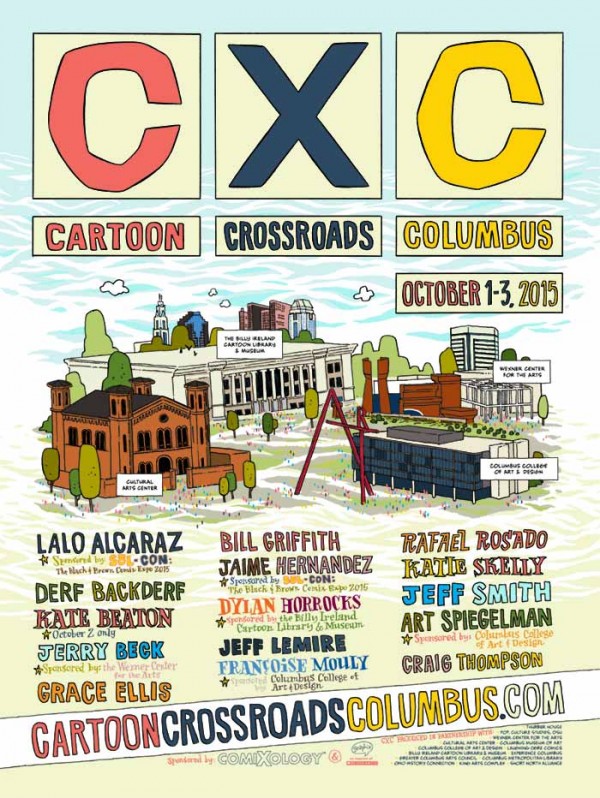
Some notes on Cartoon Crossroads Columbus, which I attended only very little of (but got an awful lot out of)

This weekend was the very first of what will hopefully be many Cartoon Crossroads Columbus conventions. If you missed it entirely this year, I'd definitely urge you to consider attending next year.

I have a kind of weird relationship with the city of Columbus, which I lived in from 2000-2010, and have only been back a handful of times in the last five years; now doing so has the same sort of surreality of returning to your old high school or college campus years after graduating. Because of that, and the fact that when CXC was first announced, this year's version was expected to be a somewhat small, trial balloon-like scrimmage of a convention, I had only planned on attending one of the three days. I decided to go on Saturday, as that was the day Kate Beaton was going to be there, and she was the first announced guest that I was most interested in seeing and hearing (and had not seen or heard previously).

Well, I regretted not better planning my trip almost immediately upon arrival. As I said, I only attended one day–four events total, which was less than half of those that occurred on that day–and they were all great. There were at least two instances where, when an event ended, I felt like running out of the room, jumping in my car, speeding the two hours and five minutes it takes me to get from my current home in northeast Ohio to Columbus (and vice versa) and leaping to my dust-covered drafting table to start making comics (This was in sharp contrast to the way my relationship with comics started that very day; I woke up at 8:30, took a quick click around the comics Internet, and was so disgusted by much of what I saw that I seriously reconsidered what I was doing with my life, exactly, and maybe just quitting writing and reading about comics altogether. The lesson? Maybe I should only read the comics Internet once a year, or attend events like CXC daily; one.)

Now, because I lived in Columbus for such a large percentage of my life, and because I haven't been there for any great length of time for so very long, I keep getting tempted to write about the city, and myself and how both have changed, which I realize isn't really of any great interest to anyone, particularly in this post. So I keep starting and re-starting this post in my head (I started this post on Saturday; I am just now posting it at 2 a.m. Monday night/Tuesday morning, though; I expect it to be riddled with typos). I'll try my best to stick to comics here, though, and do it in a lazy, bullet-point format.

But the most important thing I wanted to stress is that I attended just a fraction of the events, and even that small sub-division of the event was one I found enormously rewarding and inspirational, so I can only imagine what the entire package would be like...especially if, unlike me, you are more of a socializer (I introduced myself to one of the two people I know of only as presences online; I almost introduced myself to Tom Spurgeon a couple of times, but in each case he was talking to someone else. I've never spoken to Spurgeon, but I read his site daily, and it's like, one of the last places on the Internet devoted to comics exclusively...in addition to being well-written and a good resource of comics news. There were a couple of parties planned though, where you could presumably tell Art Spiegelman you like his vest or that he's been spelling word "mouse" wrong for years now and mingle with cartoon and comics enthusiasts and professionals).

So, bullet points:

–This was my first visit to the Billy Ireland Cartoon Library & Museum. When I was based in Columbus, I went to the Ohio State University's cartoon library exactly once, when the Wexner Center and the museum collaborated on a big Jeff Smith/Bone/cartooning exhibit (Jeff Smith: Bone and Beyond). I remember it feeling like the library was, at the time, a rather crowded hallway piled high with stuff. Now it's a nice, big, modern-looking building, named after a Columbus newspaper cartoonist who I wrote about at least once before on the blog (and who information on was incredibly hard to come by in public libraries and/or the Internet at the time).
There's a replica of Billy Ireland's signature–a shamrock–in a stone on the floor right by the entrance. There's a reading room, for research purposes. There's a big gallery, where there are currently two shows going on (What Fools These Mortals Be: The Story of Puck, Seeing The Great War and an ongoing Treasures From The Collection... exhibit), and a few classrooms, one of which (named The Will Eisner Seminar Room) was being used for a series of presentations they were calling "Talk and Teach Classroom Presentations").

–I attended the second "Talk and Teach" presentation, presented by cartoonist Katie Skelly, an emerging favorite of mine, whose work includes Nurse Nurse, Operation Margarine, a mini-comic my friend brought me back from SPX last year entitled My Pretty Vampire and a mini-comic my friend brought me back from SPX this year, Agent 9. The subject of her talk was "Influence As Education."

–I always expect cartoonists to look like their drawings, whether they are autobiographic cartoonists or not, at least until I see them (Yes, when I used to imagine "Rob Liefeld" I saw a hulking, screaming figure in spandex sitting at a drawing table, a gigantic gun leaning in the corner while he drew). Skelly therefore did not meet my mental picture at all. She did was not smoking a cigarette, wearing a leather jacket or bad-ass boots; she did not enter on a motorcyle.

–After a brief intro by OSU's Jared Gardner, mostly consisting of Skelly's bibliography, Skelly plunged into her presentation, which included a few slides, but was mostly a talk-talk. If you've read her works, you'll note that they are all rather heavily inspired and influenced by other works, mostly from other mediums. She talked a bit about the process of using influcene as it's applied to those works; for example, with Nurse Nurse, she took the "shell" of something she really liked (Barbarella), but then hollowed it out, and injected stuff she liked better, stuff that was her stuff into it, transforming it.

–Much of what she discussed is the sort of things that everyone does somewhat subconsciously, but she broke it down into a somewhat rigorous, step-by-step process, that one can apply and follow in a conscious manner: Looking at things you like and figuring out what you like about them, so you can borrow that element; looking at things you don't like and figuring out what you don't like about them, so you can avoid those elements; looking at two examples, one thing you like and one you don't, side-by-side (She chose Female Trouble and The Royal Tennenbaums) and picking out what you like about one vs. the other, to help narrow down your approach to making your own stuff.

–She recommended looking at fashion photography. Those are very powerful images specifically created to communicate a direct and convincing message to the viewer ("Buy this stuff"), and thus good examples of direct, visual communication.

–She also jokingly referred to how it's totally okay to steal from fashion photography, since they're trying to sell you a $3,000 coat or something, so to hell with them.

–She shared an anecdote about being 13 and working in her parents' newsstand and looking at the magazines, struggling to make sense of the fashion lay-outs. She would see the sequences of related images, but would always have trouble finding a "story" in what was happening between the images, that lead from one to another. At the time, she didn't know that "buy this stuff" pretty much was the story, and approached them as sorts of frustrating visual puzzles to be mulled over.

–I didn't do a headcount as I likely would have if I were covering this event for the paper I used to work for when I lived in Columbus, but it seemed like an okay crowd. We almost filled the room. It seemed to be rather equally divided to people like me (grown-up cartoon/comics enthusiasts), art teacher of one kind or another and art students, identifiable by their extreme youth and colorful fashions. Most of these were sketching. I noticed that I was probably the only person in the room without an open notebook and writing utensil. Almost everyone else, particularly the younger folks, were scribbling notes and sketches throughout the entire presentation.

–Skelly was immediately followed by Dylan Horrocks, whose presentation was on "creative blockage." The Museum's Caitlin McGurck facilitated, although once more this mostly consisted of an introduction, during which she praised Horrocks' Hicksville as an all-time great work, and noting that she and her fellow Billy Ireland employees have found a way to essentially live in a version of Eltingville (just in case you weren't already convinced they had someof the best jobs in the world). Horrocks also wrote a decent run on Batgirl (Cassandra Cain version) and one of Vertigo's several attempts to spin an ongoing out of The Books of Magic. He referred to Hunter: The Age of Magic as "Harry Potter on steroids" and Batgirl as "pretty much just steroids."

–Horrocks, who hails from New Zealand, had a rather soft-spoken voice with a hint of an accent. He didn't look much like his drawings either, but maybe a little closer to his character designs than Skelly to hers. I really liked the sound of his voice, and it made his mostly deadpan jokes all the funnier.

–He presented seven points, each illustrated with examples from his own career, which I really wished I would have taken notes on, as that would make this "report" all the more valuable. Let's see if I can remember them:

1.) You can draw

2.) You might not be able to draw the way you'd like, but you can draw.

3.) No one else can draw exactly like you.

4.) You draw with your whole body.

5.) Drawing is a collaboration.

6.) Nope, I can't do it...I forget this one...Maybe it was "draw comics"...? (See below).

7.) Enjoy.

As for five, he was referring to the fact that drawing isn't just something that takes place between your head and hand, but also involves your body, your pen, your paper, your desk, your mood, the room you're in and so on. There are innumerable factors that can impact and effect your drawing, for better or worse.

As for the final one, he pointed out that if you're not enjoying what you're doing, don't do it. It takes an incredible amount of time and energy to draw, and it shouldn't be something that makes you miserable to do. Otherwise, why are you doing it.

–He noted that he sees lots of students who, when he asks to see their work, will show him their portfolio–or, more often than not these days, open up Deviant Art or Tumblr on their phones–and they show him character drawing after character drawing. These are often great drawings, but they're not comics. And if you want to draw comics, you should draw comics, meaning you should draw image after connected image, telling stories.

–He shared some advice from a comic...that I was sure I would remember the name of and the creator of, but I do not. In it, a young girl character is upset because she wants to read a particular book that doesn't exist, so she realizes it's up to her to write it, but she doesn't think she's good enough a writer to attempt it. Her older brother advises her, "If something's worth doing, it's worth doing badly." This, like Horrock's "You can draw" bit, reminded me of what James Kochalka wrote in his Cute Manifesto. This was the first time of the day I felt like rushing home to just start making comics.

–When Horrocks opened it up for questions, I was tempted to start asking a bunch of questions about Batgirl, because I thought that would be funny, but I did not.

–I retreated to a few blocks north, looking to see the few places that hadn't been eaten, digested and transformed by the super-gentrification that's occurred in the area over the last decade–Used Kids is still there, so's Bernie's–to Buckeye Donuts, one of the places I miss most about Columbus. I drank coffee, ate doughnuts, read from a book about Bigfoot and looke dout the window at college kids rushing back and forth in the cold rain for about two hours.

–The next event I attended was one of the few ticketed events (and the only one I attended). It costs $5 to see Tom Spurgeon in conversation with Jeff Lemire–or a dollar more than most of Lemire's superhero comics cost.

–I was a little surprised to find the auditorium, the Film/Video Theater in the Wexner Center From The Arts, a one-minute walk from The Billy Ireland, wasn't fuller than it was. Lemire got his start as an indy/art/literature/non-genre cartoonist, but has since become a prolific writer of sueprhero and science-fiction comics for DC, Marvel and Valiant. I therefore expected to see a lot of folks here who might not have been interested in the other stuff, but, now that I think of it, while Lemire has written a lot of genre stuff, it's mostly been second or third-tier: pre-New 52 Superboy, New 52 Frankenstein, Agent of SHADE, Green Arrow, post-Fraction Hawkeye and so on. With a pair of X-Men-related books in the wings, Lemire's profile might rise even higher, but for whatever reason–time of day, focus of the festival–this audience was more of an Essex County than an Animal Man one.

–Lemire did not look like I imagined him to look (the protagonist of The Underwater Welder, basically), but was well-dressed, quiet, humble and handsome. Spurgeon looked almost exactly like the Sam Henderson drawing on Comics Reporter, which is awfully damn weird, as Henderson's style isn't exactly representational. That's a testament to Henderson's cartooning skills, I guess.

–Lemire did not have a Canadian accent. I'm always disappointed that Canadians aren't as exotic in real life as they seem in my mind.

–Spurgeon asked several questions about Lemire's incredible workload, which has included working on as many as eight monthly books at a time (as a writer), plus drawing. Lemire's output does seem incredible, and the number of books he writes or has written at various points was large enough that he had to count on his fingers when answering which book's he's writing at the moment, or how many he was writing at the height of his output, and so on. When an audience member asked which books Lemire had written for DC, other audience members had to chime in to remind him of a few he had written.

–Lemire seemed awfully ambivalent about a lot of the writing he did, saying he usually only has about one good story for each superhero that he's written, and would prefer to get to write that one and get out, when it comes to such assignments.

–He noted the difficulty involved in writing for corporate superheroes, and that the importance of getting a good editor. There can be two kinds: The editor that wants you to be you and write your story, and the editor who would rather be the writer themselves, and, obviously, the latter can be very difficult to work with, as everything is a struggle. (For Sweet Tooth, Lemire had three different editors; he wasn't talking about that book in particular, but the question arose because Spurgeon noted that seemed like a lot of different editors to work with on a book).

–He also noted that the way DC Comics is set up now is very writer-oriented, and that a book would first go to a writer, and then the writer might have to fight to get a good artist, as if they get a bad one, it can really sink the book. He used Andrea Sorrentino, his Green Arrow partner, as an example of a good artist he worked well with, and one he had to fight to get on that particular book. I was kind of surprised to hear that, only because I dislike Sorrentino's art so much, and find the books he's drawn (including Green Arrow with Lemire), all but unreadable.

–Regarding the number of books he writes, he said it's not a financial decision to simply take as much work as he can, and that he does in fact turn work down if he can't think of a good take on a character. There was one really big book he recently turned down, one that he thinks a lot of people would think he was crazy for turning down. Spurgeon asked what it is, and while Lemire considered for a few seconds, he eventually said he'd better not say.

–The corporate superhero books, despite some of the hassles, are easy and fun to write, Lemire said, because as a writer you get a good amount of the story already done. Like, the character already exists, is pretty well defined, and so on. He liked inheriting the pieces, and then trying to assemble them into something he found interesting. He didn't use this expression, but the way he was describing the process, I thought of it as something like a Lego kit.

–He did say he's getting close to the point where he won't take on so many superhero books and hopes to, eventually, be like Warren Ellis, where he just writes six issues of a Marvel comic every five years for fun.

–Spurgeon and he both conjured an image of Warren Ellis jumping up in bed in the middle of the night and declaring, "That's it! Karnak! I have to write Karnak for six issues!"

–Lemire is drawing a graphic novel for Scott Snyder–Scott Snyder's first original graphic novel, and his first non-genre comic–that Lemire says Snyder is writing specifically for him, and that plays to the strengths of both creators. I don't think I had heard this before, nor had I realized how rare it is for Lemire to draw for another writer, but he said he'd only done it once or twice, and the Legends of the Dark Knight 10-pager he did with Damon Lindelof.

–After that event, I power-walked the mile and half between the Wexner Center and a flower shop my friend works at in the Short North in the cold and rain to visit her, marveling at the changes in that stretch of High Street. The entire city block that the house I lived in for much of my time in Columbus–the setting of my first mini-comic–has been leveled, and is now a construction site. I stopped for bubble tea (if they sell that anywhere in Cleveland, I don't know where), to buy a new man-purse from Cousins Outdoor Army Navy Store (I bought my last one there 15 years ago, and it's just now falling apart) and to check and see if Adriatico's was still on campus (It is, thank God).

–I took advantage of some downtime to look at the museum's exhibits. Man, the drawings in the Puck exhibit were just plain amazing. Presidents Taft and Theodore Roosevelt are some of the best damn political cartooning subjects in the history of U.S. Presidents, I should think. I mean, George W. Bush and Barack Obama have big ears, but those two had everything. I particularly enjoyed the few cartoons they appeared in together. The above image is a 1910 one by Joseph Kepler Jr. entitled "Goodness Gracious I Must Have Been Dozing!" Kepler has another great one from 1912 called "Stop! Look! Listen!" in which a giant Taft sits upon a throne like a Buddha while a giant Roosevelt runs at him, head down, like The Flash; the gag is something about an irresistible force and an unmovable object.

–The final event I attended was the evening presentation, "A Conversation With Kate Beaton and Craig Thompson." This was held in Mershon Auditorium, connected to the Wexner Center. I had previously seen Ani DiFranco and Belle and Sebastian play in the venue, which is a pretty decent sized one with folding, theater-like seating.

–When I arrived, a man that turned out to be Craig Thompson was seated at a table signing books for a handful of people, while a woman who turned out to be Kate Beaton was standing at the front of a sizable line of people of all ages, clutching books. Apparently, Beaton stood and went to the line, in order to work through it faster as the time of the talk approached (from what I heard, she did sign everyone's stuff).

–Before the scheduled event, some representative of the U.S. Postal Service were there to unveil the Peanuts Christmas special forever stamps, on sale now.

Note to self: Bring your camera next year, too
–Jeff Smith conducted the talk, so it was essentially Smith, Beaton and Thompson. Those are three very different cartoonists with three very different perspectives, careers and modes of work. All three were groundbreakers of different kinds though, and it was interesting to see how they happened to be staggered in terms of where they fall in the recent history of the industry and medium.

–Kate Beaton is short. Her feet did not touch the ground when she sat in the big comfy chair, and so she scooted a coffee table in front of her to hide her shame. She did not have an accent either.

–Smith started out asking them each specific questions related to their work, and then they sort of all three started reflecting on the same subjects.

–Beaton was a very fun and funny presence, even when she wasn't talking. It was interesting to watch her face, as she tended to make very big expressions in reaction to what Smith and Thompson said. When Smith was talking about how exhausting cartooning can be, describing his process, she interjected at one point, "Wow, you guys work too hard."

–Smith said that when they were casting about for names for CXC, one they thought of and rejected early on was "Arch City Comics," as Columbus has been trying to re-brand itself with the nickname "The Arch City," which it was once referred to long ago. But after saying "Arch City Comics" out loud about ten or fifteen times, they noticed the problem with that name.

–Thompson talked a little about the creation of his Carnet de Voyage, which he drew on what was supposed to be his post-Blankets vacation. His plan was to spend a few months in Europe resting and recharging, but his European publishers co-opted his travel plans to turn them into what was essentially a three-month book tour. When he talked to his U.S. publishers about doing Carnet de Voyage, they apparently loved the idea–and solicited it almost instantly, before Thompson had even started. He ended up assembling and proof-reading it with two people who didn't speak English as a first language before sending it to the states for publication, thinking that it probably should not be published. It turned out really well though, I thought, especially given the circumstances.

–This was the second event of the day in which Warren Ellis came up. Beaton, in talking about her career trajectory, noted that he mentioned her on his blog or newsletter or whatever one day, and suddenly she had 7,000 more followers. That's all it takes to get famous in comics, a nod from Warren Ellis, they noted.

–In talking about how they each got into comics, Beaton shared an anecdote about how small her school was, and the fact that everyone there knew everyone. She recalled being in kindergarten and trying to read a Calvin and Hobbes collection there, but being told by a classmate that it was "for boys only," and she couldn't read it. Same went for Mad magazine, so she had to read Cracked instead. Because she's still friends with some of her classmates, she asked one of them if he remembered not letting her read these comics because she was a girl and he said, 'No, I was a five-year-old. But that's cool you've kept a weird grudge about it all these years.'

–Smith apparently got into comics as a young adult at Monkey's Retreat in the Short North. He didn't mention it by name; just a seedy comic shop in the Short North with a cat in the widow, some porn over here, some weird art books over there and comics in the back. Monkey's Retreat jut closed down within...what, the last two years?

–Plenty of time was left for questions. The point I found most interesting was when someone asked a general question about where the three thought comics were going, which lead to Smith reflecting on the battles he himself had seen in comics, as when he started comics–comics like Bone–could only be sold in comics shops. Librarians and book stores had to be gradually, slowly won over and, one of the last battles was with literary critics (that is, book critics outside of the comics press), which they did (and which Smith credits Blankest with). This lead to a moment where all three said they appreciated comics as a scrappier, outsider medium and, for the first time, I really found myself thinking about the fact that comics is losing, if it hasn't already lost that. Is that important to the medium? The art form? The industry? I don't know. I guess we'll see...

–As time ran out, Smith announced they would take three more questions, then added, "Well, four more, as I see the last one's a kid." Two microphones were set up on stands, and questioners had stood in the aisles before the microphones waiting to ask questions. Hearing that, a pre-teen stood up and went to stand in the other line.

–The first last kid's question was if they ever drew a character really well the first time, but then had trouble drawing it as good the second time. I was surprised to find I knew exactly what he was talking about from being his age. They each said a few encouraging words about practicing, and sympathizing with that frustrating feeling, with Thompson rather seriously saying that sometimes it takes a lot of drawings just to figure out what a character will look like, and you might have to draw them for 500 pages before you know what they look like, and then you have to go back and re-draw their faces on all the earlier pages.

"But you won't have to worry about that for a while," Beaton said.

–The last last kid, the one who stood up upon hearing Smith was making an exception for kid questions, asked the trio about Marvel's Secret Wars, but he did so without ever actually saying Secret Wars, just that Marvel was "flipping over" all their characters and starting over again.

Smith had started to say "Well, that's all we have time for," after the previous last kid's question, but Beaton had noticed this kid and said, "Wait, wait, we have one more." There was a second where I'm sure they wished they had not called on the Secret Wars kid.

Thompson asked if this had something to do with Thor being a lady, and the kid clarified yes, but that they would be doing it for all of the characters. They all struggled to answer rather charmingly. Thompson said something about continuity, which he pronounced "continue-itty." Smith said, "Well, what do you think?" And Beaton asked if they were making Wolverine a lady too, and when the kid responded that yes, actually, they were, she said "All right!" and Smith stood up, faux indignant, and ripped off his microphone, throwing it to the ground.

–Then I went back to Buckeye Donuts, bought a hummus falafel, french fries, large coffee and chocolate frosted doughnut, ate it in my car and drove two hours and five minutes back to Mentor, missing all the cool shit that went on the next day (including a tabled event where there was going to be a bunch of stuff for sale, so it's probably good I didn't go) and Smith repeating the format of Friday night's event with Art Spiegelman and Francoise Mouly about Raw, as well as spotlight talks with Grace Ellis, Jaime Hernandez, Horrocks, Thompson and Derf Backderf.

–While at the flower shop, I asked my friend if I could stay with her for the whole weekend next year. You should look into it to. Not staying with my friend–they've only got the one guest bedroom, and I've called dibs–but visiting Columbus for the weekend.

UPDATE: Spurgeon has started assembling his "Collective Memory" post of links regarding the show, which you can find here. That should provide a good source to better posts than the one you just got done reading here.

Friday, October 02, 2015

Review: Justice League #42 ("The Darkseid War" Part 2)

Batman finally lets the sales figures go to his head.

Previously in "The Darkseid War"...

•Justice League #41 ("The Darkseid War" Part 1)


THE COVER

Once again artist Jason Fabok goes for a movie poster-like image, spotlighting many of the characters involved rather than a specific instant or incident within the story. Front and center-ish is Wonder Woman, in her new "Darkseid War" costume (not to be confused with her new Wonder Woman costume). The image is intersected by long, diagonal, panel-like shapes, kind-of-but-not-really containing particular images within them (several figures touch these shapes, but aren't bound to them). We see Apokolips, a perturbed Superman cradling the limp, bleeding body of Luthor (remember, his sister Lena shot him repeatedly at the end of the last issue), the new New 52 Mister Miracle, Metron in his Mobius Chair and then Batman and Green Lantern Hal Jordan, the latter drawn a few times larger than the former for some reason.

Everyone looks really unhappy. I know there's a war brewing and all, but man, being a superhero must be the absolute pits.

PAGE 1

A stacked tier of seven horizontal panels, each stretching the width of the page. "Widescreen," they call it. The first (and thinnest) is all black, with the words "The Gods are coming" floating in the middle of it. In the rest of them, we see Superman cauterizing Luthor's bullet wounds with his heat vision, telling Luthor that the bullets are made from a metal he'd never seen before and that his sister shot him.

A still addled Luthor asks where they are...

PAGE 2

...and artist Fabok and writer Geoff Johns answer with a full-page splash of a decrepit urban landscape, dotted with large pits from which bright, red smoke seems to seep. "We're on Apokolips," Superman says.

PAGES 3-5

Darkseid looks out the very big window of what I assume is his penthouse office, overseeing the same red-skied, urban hellscape that Luthor and Superman were just taking in. Behind him, two lieutenants talk strategy with him. These are Desaad and Steppenwolf, both of whom have been previously introduced in the pages of Earth 2 and its spin-offs. Desaad now looks like a burn victim with glowing eyes and a hooded cloak. Steppenwolf wears red and black armor, a beard a funny hat and a goofy horned skull belt buckle. He looks a little like a heavy metal fan's idea of a Medieval warrior.

They are pretty dramatic redesigns.

BEFORE–


AFTER–


Steppenwolf is all like "I'm going to go kill the hell out of Superman for you, is that cool Darkseid?" and Darkseid's all "No way man, I want his soul."

Darkseid is apparently playing a long game with Superman, intending to corrupt the Man of Steel rather than destroy him outright. This couldn't possibly come back to bite Darkseid in the ass later on.

PAGES 6-10

Meanwhile, back on Earth, Wonder Woman resumes narrating, but she doesn't say anything of real import, merely recapping the events of the previous issue (The Justice League fought Darkseid's daughter Grail, and then The Anti-Monitor and a bunch of shadow demons appeared in the sky).

She and Grail prepare to go at it, but they are intteruped by The Anti-Monitor, who lands between them. He's big, but not as big as the Crisis version; maybe three Wonder Woman's tall...?

She asks The Anti-Monitor what he is, and he responds that he's desperate.

Have you tried...Tinder?
Just then Metron Boom Tubes in and then Boom Tubes out, taking the Justice Leaguers away with him.

PAGES 11-15

We now cut to Athens, which is apparently where Mister Miracle landed last issue, at the feet of Myrina Black and her pet Griffin, Griff. She refers to MM as The Escapist, and he immediately corrects her. Was she expecting The Escapist?

She walks Scot (It's just Scot with one t now, as that apparently sounds more realistic than an alien super-god named Scott with two Ts) through her Myrina Black cave, which is full of tropies like giant skeletons and tanks and suits of armor and gold coins and suchlike.
What this room really needs is a mechanical dinosaur.
She explains that she was an assassin for the Amazons, whose mission had something to do with to saving the world from war by killing Darkseid, and she decided to do so by creating an ultimate weapon against him in the form of a daughter, Grail.

Now, I'm no assassin, but if she had Darkseid in the position to, um, make a baby with her, couldn't she have just, like, stabbed him then or something? Wouldn't that be more efficient than raising his daughter to fight Darkseid?

The various players' motivations are all a little unclear here. Her plan, apparently, involved having Grail bring The Anti-Monitor to Earth to fight a war against Darkseid here. (So Grail is on her side, and against Darkseid? So why was she fighting the Leaguers? Shouldn't they all be allies?)

Scot isn't down with the whole let's-have-a-cosmic-war-on-Earth plan, as it could lead to the deaths of billions, so Myrina decides to kill him with a spear. He Boom Tubes away.

This sequence is most notable for some classic Wonder Woman villain name-dropping (Red Panzer, Minister Blizzard) and for the first images of Fabok drawing Griff in his entirety. I'm not the biggest Fabok fan but, again, the guy draws good Griffins.

PAGES 16-22

We meet Metron and the LEague at The Rock of Eternity, apparently, although as Fabok draws it, it's just a dimly lit stone room with a few pillars.

There's a bit of bickering between Green Lantern and Metron, as they've previously met during a kind of dumb Green Lantern franchise crossover storyline. Metron tells the Justice League they should probably collect their friends and get off-planet, as the world's going to get pretty destroyed when The Anti-Monitor and Darkseid start warring there, but they're not having it.

Wonder Woman magic lassos him in an attempt to get information about him, but after a few panels of questioning, it's clear that he doesn't have the answers, but the chair does, and he is compelled to tell her that the only way to get the information she seeks is to "take the chair" from him.

So she yanks him off his chair, and as it begins to Boom Tube itself away, Batman jumps on it and says "ARRGHHHH!!!" while it starts PING-ing. Each PING reveals a new image to him.

PING! He sees Steppenwolf leading an army of Parademons. PING! He sees Superwoman, still super-pregnant and in a cell somewhere. PING! He sees Grail, Shadow Demons and The Anti-Monitor.

Freaking out a little, and realizing he has the ability to answer any question he has, Batman asks who killed his parents (Joe Chill), and then "What's The Joker's true name?"

He gets an answer to that as well, but he doesn't seem to like it–"NO. That's not possible."– but he doesn't share it with the readers. Hopefully Johns does at some point, because that's a hell of a thing to tease, particularly given Batman's response.

By the time the dust settles, Batman has some new, glowing Tron lines on his costume, and a new font; his dialogue bubbles are now the same coloration as those of Grail and Darkseid.

And so ends the second part of "The Darkseid War."

Wednesday, September 30, 2015

Comic Shop Comics: September 30

All-Star Section Eight #4 (DC Comics) This was actually released a few Wednesdays ago, but my shop had sold out and it wasn't on my pull-list, so the re-ordered issue didn't arrive until this Wednesday.

The special guest-star (and prospective eighth member of Section Eight) is, as you can no doubt tell from Amanda Conner's cover, is Wonder Woman. She arrives at Noonan's Sleazy Bar simply to tell off Sixpack and his teammates, storming out with the words "The only superheroine signing up with Section Eight is going to be one suffering from brain damage." And then Baytor, who is trying to hang a sign over the door with a cartoon mallet, accidentally WHHAAMMs Wonder Woman on the head, rendering her, well...
Still slightly more dignified then her portrayal in the Finchs' run on Wonder Woman.

This issue is extremely fraught, with various members of Section Eight discussing ethics, feminism ("I never hearda that") and that you can't say "retarded...it's not cool anymore." The fact that writer Garth Ennis has his various characters speaking both sides of many arguments on these matters is a pretty good indicator that he's making fun of the participants in some of the conversations and his own characters more than anything else, but it's still a bit of a minefield for a comics writer in the era of social media to traipse through. The Grapplah, in particular, seems to contradict himself constantly, stating the exact opposite point of view in alternate lines of dialogue.

So Wonder Woman has essentially been reduced to the mental age of a little girl, commencing a tea party with Dogwelder II ("How do you like your tea? I bet you like it with dogs welded to it!") and, upon meeting Bueno Excellente and Guts, she convinces them all to hold a wedding between the two. When she starts constructing a hotel/fort for the honeymoon, however, Baytor applies a well-known cure for head injuries sustained in all forms of pop fiction: He hits Wonder Woman in the head with the hammer again.

I suppose it's a good thing that Wonder Woman spends a majority of her panel-time addled out of her brain, as Ennis writes the non-brain-damaged Wonder Woman as a humorless, violent bully without an ounce of compassion (you know, like everyone else writers her in all of her other appearances outside of Sensation Comics). Artist John McCrea draws his own version of Wondy's costume; while the one on the cover is basically just her original New 52 get-up, McCra mysterious guide takes him beyond the bounds of life itself and into the mystical realea gives her a pair of biker shorts-like shorts rather than the bathing suit bottoms, and these are blue rather than black, and her top lacks the ribbing its usually drawn with.

Finally, this issue also contains a Tommy Monaghan cameo...sort of. A photo of him is seen hanging on the wall of Noonan's in the background of one panel.
I'm not sure which hero is guest-starring in the penultimate fifth issue, but the next issue box says "Yo, What's Up, Vertigang!" and the solicitation mentions "a mysterious guide" who takes Sixpack "beyond the bounds of life itself and into the mystical realms," so I'm guessing Phantom Stranger, John Constantine or someone from the Trench Coat Brigade...? "Vertigang" makes it sound plural though, so maybe we'll be getting cameos from whichever former Vertigo characters Ennis and McCrea are allowed to mess around with. I certainly wouldn't mind seein what McCrea's Swamp Thing looks like...


Archie #3 (Archie Comics) It's Veronica Lodge's first day at school, and Archie volunteers to show her around...only to discover she has sufficient dirt on him to make him her willing slave, although he seems like he probably would have happily handed her a leash anyway. Jughead attempts to come to the rescue repeatedly, and he spends the entire issue trying to prevail on Betty to get involved as well.

I liked the way writer Mark Waid handled Veronica's introduction to the school and, in particular, her meeting with Betty, as they begin on the inevitable road to frenemies. Betty accidentally sees Veronica at her lowest and, being a decent human being, tries to reach out and help her; she's seen enough of Veronica to know she too is human and in need of a real friend. At the same time, Veronica almost immediately rebuffs her and makes her feel bad for helping. And then there's the small matter of Veronica's stranglehold on Archie.

It's only three issues in, and already Waid has done a pretty fine job of establishing a sizable chunk of the core cast, and how they relate to one another.

This issue also includes a classic reprint (and $3.99 for just 22 pages, it damn well better!), which was Veronica's first appearance. It's probably the strongest and funniest of the reprints that have been featured in the backs of these issues so far.


Batgirl #44 (DC) Bad news? Babs Tarr, this book's main selling point, is MIA this issue. Good news? Taking up drawing duties in Bengal, the artist responsible for the Endgame tie-in one-shot and a chunk of the Batgirl annual. And Bengal is really good at drawing things, even if Batgirl's mask looks slightly off to me around the cheeks, and there was a confusing panel or two in the climactic action scene.

This seemingly concludes The Velvet Tiger story arc, while pushing along several unrelated storylines, like a developing relationship between Babs and Luke Fox (son of Lucius and formerly Batwing II) and Frankie's ongoing quest to become the new Oracle. She doesn't actually use that name, but writers Cameron Stewart and Brenden Fletcher tease it as hard as they have yet, with Frankie having sent a package with the return address of "Delphi."

I understand the temptation to make Oracle a part of a Barbara Gordon comic, but I really don't like the idea of a new character becoming Oracle, and thus making Oracle a legacy character. With the DC Universe's timeline so ridiculously compressed now, to the point that there aren't any heroic legacies, something that's been a key part of the DC Universe for a really damn long time now, it seems weirds that, say, Barry Allen was the only Flash ever, for example, but we've already had three Batman, four Robins, two Catwomen and two Batwings in just five years. I mean, I guess Frankie would be the only Oracle post-New 52, but we'd still have to, like, talk about her as the second Oracle. Talking about DC Comics characters can just be so exhausting sometimes, you know? Everything needs a qualifier or three.


Providence #5 (Avatar Press) In which Alan Moore, Jacen Burrows and our protagonist Robert Black visit "The Dreams in The Witch House," and take a detour to visit the setting of "The Colour out of SPace." Chances are there are a whole mess of other references I didn't catch, beyond those introduced in previous issues, as Moore goes about connecting pretty much everything H.P. Lovecraft wrote into a mega-narrative with a shared setting, like the Lovecrafts body of work was the 1960s Marvel Universe or something.

This issue includes Brown Jenkin, here called "Mr. Jenkins," one of the more disturbing of Lovecraft's creations in terms of pure visuals, if you ask me. He behaves...differently, in a more graphic way htere that is in keeping with witch-lore, if not Lovecraft's exact portrayals. I liked the Elspeth character, who appears only briefly.

Tuesday, September 29, 2015

Review: Amazing X-Men Vol. 3: Once and Future Juggernaut

The third and final collection of the troubled Amazing X-Men comic includes issues #13-#19, plus the 2014 annual. It also serves as a pretty good example of how confused and formless the book ended up being. It launched with some fanfare in 2014, with writer Jason Aaron and artist Ed McGuinness telling a story about the resurrection of Nightcrawler, then they moved on and Marvel had to scramble to fill pages until the advent of Secret Wars gave them a good excuse to cancel the book.

During its 19-issue run, Amazing X-Men had five different writers: Jason Aaron (six issues), Kathryn Immonen (one), Craig Kyle and Chris Yost (four as a team, with Yost writing six more solo) and James Tynion IV (one). The annual featured two short stories, by two different writers. In retrospect, the book contained three story arcs–"The Quest For Nightcrawler," "World War Wendigo" and "The Once and Future Juggernaut," with a couple of fill-in issues and an annual that functioned as another fill-in issue. Each collection therefore has a complete story arc in it, but these last two have also had a lot of filler.

Visually, the book had even more cooks in the kitchen. There were seven different artists in those 19 issues: McGuinness (six), Cameron Stewart (one), Paco Medina (one), Carlo Barberi (four), Iban Coello (two), Jorge Jimenez (one) and Jorge Fornes (five). And, again, the annual had two additional artists. You'll note that the math doesn't quite add up with the artists, of whom I'm only counting the pencil artists and/or artists who don't work with inkers, but that's because several issues had more than one artist drawing them.

This book is the most incoherent of the three collections, featuring as it does the work of four different writers, six different pencilers/primary artists, two inkers and three colorists (although Rachelle Rosenberg handles almost all of the coloring; only the two stories from the annual have different colorists).

Let's first dispense with the fill-in material–which, of course, translates to filler when the serially-published material is republished in trade format–bookending the title story.

The first is James Tynion and Jorge Jimenez's "Charm School," which features one of the Jean Grey School students who hasn't really appeared in the book at all previously, Anole (I had to look him up; he's the green guy on the cover, and he has lizard powers). He runs away from the school to the city, in order to go on a date with a boy he's been talking with online, but he chickens out, afraid he'll be rejected for his looks (a not unreasonable worry, given the fact that he's green and scaly and, as drawn by Jimenez, has a giant right arm that looks to be about eight times larger than his left arm).

Nightcrawler eventually prevails upon Northstar to go the city to look for Anole, and they find him. This being a superhero comic, they also find a supervillain to fight. Here one of Mastermind's daughters, who has a front-less costume that makes her look like she might be Emma Frost further experimenting with the color black.

Tynion apparently chose those two particular characters to send after Anole because they both relate to the young mutant in different ways: Northstar is also gay, Nightcrawler is also a mutant who can't hide his mutation to blend in with humans.

It's basically a decent Anole story, with an inspiring be yourself and love yourself message, but, as with Kahtryn Immonen's fill-in issue that kicked off the previous trade, it's a story that can seemingly have appeared almost anywhere (Wolverine & The X-Men, Nightcrawler, any random X-Men annual or one-shot). It's a nice, dynamic-looking comic, from an artist who would go on to draw DC's Earth-2: Society book (which I hate; it's even worse than the previous Earth-2 and I wish they'd cancel it and pretend that world and those characters don't exist).

That's followed by another nothing-to-do-with-anything one-issue story, an Axis tie-in by Yost, Barberi and Coello (two artists who previously shared duties on a chapter of "World War Wendigo"). While in the pages of Axis proper the X-Men "inverted" by the PC alignment switcheroo just all went genocidally insane and decided they needed to follow Genesis/Evan/Apocalypse and kill all humans, in their solo outings the inverted X-people at least take on more individual tasks.

Here it's Nightcrawler (the only member of the Amazing cast to appear in the issue/chapter), who has decided to return to Winzeldorf, Germany in order to exact his revenge on the humans who hated, feared and persecuted him before he became an X-Man. His inverted mother Mystique, who is now as good as Nighcrawler is bad, spends the issue trying to stop him; in particular, to stop him from killing anyone. She succeeds, and the book moves on without mentioning any of these events, as Yost and Amazing X-Men have fulfilled their crossover tie-in duties.

The collection closes out with the annual. This consists of a 20-page story entitled "Goddess" and a 10-pager called "Art History." The former is a straightforward X-Men-as-superhero team story, with Storm and Wolverine leading Firestar, Iceman, Nightcrawler and Beast against a super-villain targeting members of Storm's tribe over an affront she may or may not have committed when she was a child. That story's drawn by Salvador Larroca and written by Monty Nero.

The latter is a Firestar story written by Marguerite Bennett and drawn by Juan Doe. Unusual in format, it's a series of five, two-page spreads with a drawing of a character in the upper left-hand corner, and then imagery meant to be read as drawn or assembled by that character in various styles, while narration discusses Firestar, with Doe chameleonically aping a child's crayon drawings, Hellion's sketches, photos in her dad's scrapbook, and so on (I liked Hellion's observation that "She's like the only teacher you don't have to worry might murder you"...the only teacher at The Jean Grey school, that is).

That leaves the title story, then, the five-issue, Yost-written, Fornes-drawn "Once And Future Juggernaut."

As long-time readers now, I'm not much of an X-Men expert, despite the dozens of trade collections I've read at this point, and I don't really follow the goings-on of the entire franchise, which strikes me as something of an impossibility, really. But apparently at the time this story takes place, there is no Juggernaut; Cain Marko is no longer Juggernaut, nor is Colossus. The opening chapter seems to be a very in-progress one, as if picking up on scenes from other comics it's assumed we would have read, or at least been familiar with.

Colossus is suddenly living at the Jean Grey School, sneaking girlfriend Domino in (if I recall correctly, Colossus was on one of the several X-Force teams post-Avengers Vs. X-Men), Wolverine is had died between volumes 2 and three of this series of collections and the Amazing team is show doing some actual teaching of teenage mutants, here Pixie, as a way of introducing her, as she'll be involved later in the story.

Beyond the plot and character specifics, Yost has some clever ideas about the god Cyttorak, the patron deity of the magic gem that creates the Juggernaut, who is supposed to be his avatar on Earth. The Juggernaut is kind of a difficult villain for repeat business, even though he is one of the bigger, more recognizable X-Men villains. His whole deal is that he's supposed to be unstoppable, but seeing as how he's a villain and he only appears in superhero narratives, he always gets stopped. Hard to believe the character has lasted 50 years now given the fact that his central trait is disproved in pretty much every appearance, but then I suppose that explains why writers have tried various things with him over the years, including making him a good guy for a while and passing his mantle (and silly hat) on to Colossus for a while).

Essentially, Cyttorak wants humanity to worship him, and so he created this monster of destruction as a way of proving how fearsome and worthy of worship he is. Thing is, his avatar always loses, proving Cyttorak's ineffectuality as a god. Would be worshippers would be better off praying to Wolverine, Spider-Man or the 8th Century Iron Fist, shown defeating him an ancient avatar in a flashback.

Yost makes Cyttorak's motivation, and an epiphany about what he really wants, central to the story, reinventing the character of The Juggernaut in the process (admittedly a strange thing to do in the lame-duck final arc of a canceled title, especially given that neither Yost nor a new-and-improved Juggernaut seem to be scheduled to show up anywhere after Secret Wars and the X-Men line gets a massive overhaul (reduced to just two books, as discussed during our last look at Marvel's previews).

So: Cyttorak sends out a call of some sort through his cartoon gem, which is so big and perfectly cut it looks like something Scrooge McDuck might have in his money bin. According to a couple of narration boxes:

The call of Cyttorak goes out. Heard by the strong. Heard by those filled with rage. Those who Cyttorak felt could be controlled. Those who would show this world his power. As well as those who knew what to listen for.

In other words, it's heard by Cain Marko, Colossus (who alerts his new old teammates) and as random an assemblage of minor Marvel villains as you could imagine, three of whom were brand new to me: Crossbones, Man-Killer, Jinn and The Living Monolith. (Is this too meant to reflect Cyttorak's weakness? That these are his best candidates for an avatar from the Marvel Universe?) Oh, and Rockslide too, I guess, who wants to be the new Juggernaut, but he was along for the ride with the X-Men already.

Storm forbids Colossus from going to the South Asian temple where the gem is, on account of the fact that she doesn't exactly trust him, which is fair (Colossus is the only one of the five characters to have been possessed by the Phoenix Force to not throw in with Cyclops at the New Xavier school or be Namor), especially since he's been the Juggernaut before and also seems rather willing to get himself killed saving others (a trait that ties in to Yost's plotting).

She takes Nightcrawler, Northstar, Iceman, Rachel Grey, Firestar and Rockslide with her to the Temple of Cyttorak, where the various villains all arrive at the exact same time. Colossus manages to talk Pixie into teleporting him there. Most of the villains (and these weird red monsters that guard the temple) are dispatch pretty easily, but in the fray The Living Monolith gets the gem, and it powers him up to a giant-size stone Juggernaut, leaving only the de-powered, gun-toting Cain Marko and the X-people to deal with it.

In the arc's early climax, Storm deals with this new complication by...just sitting down and ignoring it. Reluctantly at first, they all join her, and spend about a half-dozen pages just sitting around talking, ignoring the giant monster-man rampaging away.
It's a pretty awesome scene, really, and a pretty great one for the final arc in a book that's about to end, as the various X-people reminisce and bust one another's chops (Northstar's filter-less conversation skills are especially appreciated here; he and Namor should get their own team-up book, that's just these two pointy-eared, dark-haired mutants being total dicks to everyone all the time).
Eventually, Colossus comes up with a plan to strip the Monolith of his power–the X-Men spend exactly nine panels fighting him–resulting in Marko once again becoming the Juggernaut, albeit a newly-designed, more powerful than ever version. His first act of business? Kill Cyclops for killing his brother Xavier, after killing all these X-Men for standing in his way. Despite the power upgrade, the unstoppable Juggernaut is, once again, stopped, although Yost and company at least portray it as a delay more than a defeat.

And then...the book ends. It's a pretty great Juggernaut story, and a great X-Men story (probably a little more so for those more familiar with the ins-and-outs of the franchise and its a history), it's just a little lost in this particular collection, and in this particular series.

*********************

Far be it for me to argue with another writer-about-comics or, more likely, whoever put that blurb on the cover of this trade, but I don't think this is a great jumping-on point for new readers. In fact, I think the last third of a canceled comic is probably the worst jumping-on point for new readers.

Monday, September 28, 2015

Wait, does DC Comics pay writers by the page, or by the word?

Based on page 9 of Patrick Gleason's Robin: Son of Batman #4, I suspect it may be the latter.