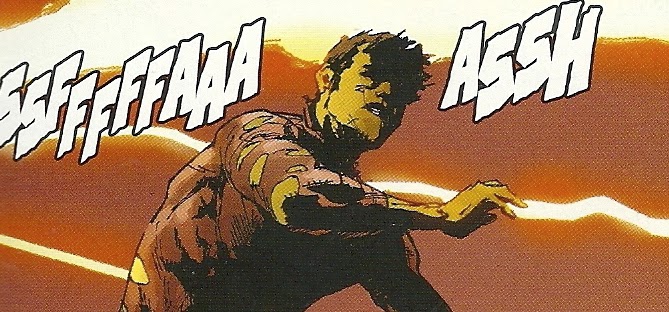
The comics industry of 1993, it goes without saying, was a much different one than that of 2014. In fact, it was likely almost as different from today's as it was from 1984's, which is the industry that Kevin Eastman and Peter Laird launched their Teenage Mutant Ninja Turtles comic series into, coming up with a surprise hit that had myriad, unpredictable consequences, not the least of which was making that unlikely collection of nouns into a household name.
Looking back from the year 2014, it's difficult to tell, or even guess or theorize as to what exactly went wrong with Eastman, Laird and their Mirage Studios' second volume of Teenage Mutant Ninja Turtles, a full-color series that launched in the wake of the 13-part "City At War" storyline that brought the first volume, which ran for 63 issues over almost a decade, to a close.
Sure, it had new #1 issue (generally thought of as a good thing, even to this day), and yes, it was now in full color for the first time ever (Certain Turtles specials and reprint projects aside). The logo was new-ish, but it was the same one that had been adorning Mirage's TMNT book since "City At War" kicked off with the fiftieth issue. The creative team hadn't really changed at all since "City At War"; Jim Lawson was still drawing and writing it (Eastman and Laird were apparently overseeing he storyline closely, but didn't get writing credits). Jason Tumjin Minor was still inking it, when other Mirage regulars like Eric Talbot weren't.
Heck, "City" cover artist A.C. Farley even provided the first cover, although after that cover duties were taken over by Peter Laird and Kevin Eastman, who would really be the ideal artists to draw covers for a Teenage Mutant Ninja Turtles comic, no?
And, like the last year or so of the first volume (and the fourth volume, that would follow almost a decade later, in 2001), there weren't really discrete story arcs with beginnings, middle and ends, but rather,t he storyline just kept going on in an old-school, truly serial fashion.
So why did the second volume of Eastman and Laird's TMNT last only 13 issues, the same length as "City At War"...?
I have no idea, and I wonder if it might not have had more to do with external forces than any particular rejection of the book by the comics market of 1993-1995, or any sort of creative exhaustion of the concept.
Reading it all at once for the first time though, I can tell you that it was not very good. Of the three Mirage-produced volumes of the series, it is probably the weakest, but I'm guessing it was something more akin to external forces that cut the series short, based on the fact that Lawson really seemed to be setting up future directions for the characters, as the four title characters were starting to go their own ways, even finding new places to live, before they were quite quickly brought back together to resolve all of the dangling plotlines in a rather abrupt fashion.
The series begins more-or-less where the last ended. Donatello, who broke his leg in the climactic fight with the Foot Clan in "City At War," is living in a cave in rural Massachusetts with Splinter. The other three Turtles are living in New York City, in the basement of the new apartment building owned by April and Casey, who are living together as a couple and raising Shadow, the baby Casey adopted from his dead lover Gabrielle, as their own.
This first issue—the one with the striking, wraparound Farley painting of the Turtles racing through a dimly-lit sewer for a cover—is entitled "Memories of the Future," and serves as a sort of dreamy preview of the series, consisting almost entirely of scenes of the cast between disturbing visions and dreams, some of which presage events to come in the following 12 issues, some of which ultimately go nowhere—perhaps because plans changed, or perhaps because the book ended earlier than intended.
Splinter dreams of himself bloody and beaten at the feet of one of the Turtles, whose right hand is stained in blood. When he and Donatello meditate on it further, Don sees himself in Japan in the future, but he can't imagine why he was there; "To bury me," Splinter tells him.
Casey dreams of a big, monstrous verson of himself in a black hockey mask; a sort of Casey Jones-specific grim reaper.
April has a nightmare of her old, evil boss Baxter Stockman rescuing her from marauding Mousers.
Raphael is running around the sewers, where he encounters a giant rat. Leonardo is strapped to a table, a blue (Blue? I always thought they were orange) Triceraton and an alien injecting him with a shot. And Michalengelo? He was watches TV.
Though the creative team doesn't change too significantly throughout the rest of the series—Talbot will occasionally ink, colorist Eric Vincent will occasionally get assistance from "Altered Earth,"—this is for whatever reason the best-looking book of the volume. Perhaps it owes to the fact that there was the greatest lead-time, given even the apparently always-fast Lawson time to linger over the pages longer than usual, or perhaps it owes simply to the fact that story and plot are almost incidental to the issue, making for a greater emphasis on visuals.
For whatever reason, the story of the second volume begins in earnest in the next issue.
The Turtles start to go their own ways, with Raphael deciding to move out (he finds a nice abandoned storage attic atop a cathedral, but never actually gets to move in), Leonardo returning to the sewer lair (where he has an adventure of his own featuring a gigantic, monstrous, almost Gamera-sized snapping turtle and a fish-creature akin to those from TMNT #28 and/or the syndicated newspaper comic strip. Michelangelo, for his part, plans to stay in the basement apartment, close to Shadow.
The main villain of this volume is the mad robotocist and Mouser inventor Baxter Stockman, not seen since the first handful of issues of volume one (The current IDW series, and the cartoon shows, made much greater use of the character). He has apparently been held all this time at a secret Defense Advanced Research Projects Agency facility, where he built himself an incredibly powerful robot body...and then cut his own brain out and installed it into the body. From there, he headed towards New York City, to finally get his revenge on April and the Turtles.
Federal agents and a mysterious bald guy are, understandably, interested.
Stockman's revenge on April involves jabbing her with a syringe full of...something (it would take ten years for that to resolve itself in Vol. 4), but the battle with the Turtles is a bit more traditional, involving guns and rockets on rooftops.
The three Turtles are eventually joined in the battle by Donatello and their Massachusetts vigilante friend Nobody (now sporting a very '90s costume, one which replaces the cape with a bunch of pouches and makes him look more like an off-model Snake Eyes than a logo-less or branding-free Moon Knight or Batman type vigilante).
The good guys win, and Stockman's robot body (and the human brain inside it) are eventually completely destroyed, but not before Stockman can hurl Raph off a rooftop.
He survives, but ends up being taken by...someone.
The final few issues of the series deal with the Turtles and their friends—Nobody, Casey, and a mysterious bald psychic fellow who is able to deus ex machina them the location of Raph—arriving in the Nevada desert to infiltrate the DARPA facility and free him.
It turns out Raphael's being kept with a veritable menagerie of various aliens, including an off-model Aliens alien and a Triceraton (orange again). Despite the number of ninjas in the group, their entrance is very loud generates a great deal of attention, meaning they will have to try and fight their way out. Making matters worse, the Triceraton proves somewhat treacherous, and he has a ship full of allies not too far away, ones who would rather attack Earth in a kamikaze, world-ending fashion than admit defeat.
So what begins as an action-packed infiltration scene eventually transforms into a save-the-world type scenario.
Suffice it to say, nobody dies—well, Nobody dies, but nobody other than Nobody dies—the world is saved, and their new psychic friend even manages to put everyone back together with little memory of what actually happened. In the final scene, Leonardo awakes as if from a dream, and Casey has no memory of what just occurred. (I think it worth noting here too that the interior art really rallies in the last few issues, when Lawson begins inking his own work, and a great deal of detail returns to the pencil art that wasn't there in some of the previous issues).
I had mentioned that the book wasn't very good, but what, precisely, was wrong with it? Well, the little editorial-like introductions to the issues often signed by Peter Laird, and what commentary I've read from he and Eastman elsewhere indicated that with "City At War" and this volume they wanted to reassert control over the lives and stories of their characters, as the book had become more-or-less an anthology title for much of what occurred between #12 and #47 of the original series, with different creators offering wildly different takes and tones, some of which clearly didn't fit within anything resembling a greater continuity (Michael Zulli's three-issue arc, for example), even if they were awesome comics.
It's true, of course, but then, even when Eastman and Laird were doing pretty much everything themselves on the title, in the first dozen issues or so, it didn't exactly read like an ongoing storyline with a long-term plot or consistent direction. The characters were introduced, their origin told, they met their archenemy and killed him—end issue #1. The next few issues, they met a human friend in April, fought some robots, the end. They went into outer-space for a few issues. They travelled back in time—or to another comic book's universe—to meet and fight alongside Dave Sim's Cerebus the Aardvark, for one issue.
The series, from the beginning, was one that occurred more-or-less in fits and starts, with little in the way of issue-to-issue continuity. I think Rick Veitch's three-issue "The River" run was about as long as any storyline Eastman and Laird produced before "City At War." The Turtles characters, at least in the Mirage books, seemed to be a group of character that, collectively or individually (remember, key points of their history—the introduction of Casey Jones, the return of the Foot Clan and "The Shredder"—occurred in single-issue "micro-series) had weird stuff happen to them, quite often at something approaching random.
That's what made "City At War" seem so unusual and, I suppose, Volume Two so strange. It's another 13-part story arc, featuring characters that only quite rarely had story arcs, and almost never of that length, rather full of call-backs to earlier continuity which, again, isn't something that was too often encountered in Turtles comics.
Could that have been what went wrong? I don't know. Read all at once like this, the plot holds together fairly well, despite the few paths suggested and abandoned, but I imagine it was incredibly frustrating when read on its original monthly—or bi-monthly, I suppose—schedule, when the free-form, punctuation-free, endless narrative would likely seem to meander quite a bit (particularly at a time in comics when, if "writing for the trade" hadn't yet emerged as an everywhere-you-look phenomenon, at the very least story arcs were the dominant form of serial comics storytelling. Also,t hat weird first issue where nothing really happened that wasn't a dream likely didn't help get anyone too excited about issue #2, two months hence).
Personally, I enjoyed the plotting just fine (this time around), but there was little-to-no character development, which seemed rather strange given the big events in the characters' lives, like the four brothers being separated for the first time, or April and one-time practically insane vigilante Casey Jones being in a relationship with one another and trying to raise an orphaned child. Perhaps it's silly to want more out of a comic book called Teenage Mutant Ninja Turtles, but I felt like the plot and sophistication of the comics-making might have grown as I grew, but the storytelling hadn't...certainly not enough to justify scrapping the book Teenage Mutant Ninja Turtles had become before "City" in an attempt to recapture a book it never really was, whether that was what it's original creators intended it to be or not.
I additionally found it a little weird that Splinter never reappears after the first issue, April has almost nothing at all to do for the entirety of the series and Casey goes mask-less and bat-less throughout, even when fighting, as in one instance where he attacks some federal agents...
and in the assault on DARPA plot that fills the last few issues, wherein he spend the entire time brainwashed into thinking he's Arnold Schwarzenegger.
"I planted a suggestion in Casey's brain that he was the world's best assault team leader," the mysterious bald psychic man says, by way of explaining some of Casey's action heroics.
I don't think color helped much, although I did appreciate the look of it in the first and final issues (Color on Lawson art is, I realized, something I've very, very rarely seen). The color on the covers tends to look pretty sickly though, which I think may have been more a result of the coloring technology of the time period than any sort of misapplication. Comics coloring was moving in leaps and bounds at that time period, and a lot of ugly-looking comics resulted. I like Laird's art, I like Eastman's art, I like the way their collaborative art looks, but a lot of these covers are pretty terrible-looking.
************************
Most of the issues contain back-up stories of varying degrees of quality. The first of these is "I.M.P." It's a three-part story by Eric Talbot and Lawson about a little black cat with white "socks" of fur trying to escape a high-security facility and doing so, despite all the guns fired at it.
A much longer one is the seven-part "Bog: Swamp Demon" by writer Ryan Brown and artists Matt Roach, which features a Swamp Thing/Man-Thing/Heap-like swamp creature, albeit one with a decidedly more supernatural and demonic twist. The Bernie Wrightson-like art features a "star" who looks more-or-less like your standard muck man from the neck down, but has a horrifying skull-like visage (atop of his head is actually see white skull peeking up out of the dark green skin), and a crown of gnarled branches emanating from its head.
The writing and art are very reminiscent of 1970s horror comics from superhero publishers, as Bog deals with his own tragic origin, fighting a human serial killer that isn't actually human, and plenty of other monsters and demons, including Satan himself.
The story is a little hard to follow, and not helped any by the fact that its chapters are printed out of order. The coloring shifts from dark and muddy at the beginning, to sharp and clear at the end, making it a lot easier to appreciate Roach's artwork.
I was tempted to devote a whole blog post to Bog, if only to provide more swamp monster content for comics retailer, blogger and muck-encrusted mockery of a man enthusiast Mike Sterling, but it sounds like he may be pretty busy in the near future.
Monday, September 15, 2014
Saturday, September 13, 2014
Comic shop comics: September 10
Batman Eternal #23 (DC Comics) Well, here's one DC Comics title that isn't being subsumed by Futures End at all this month...
This issue is a Dustin Nguyen and Derek Fridolfs drawn one which is, of course, another way of saying it's a particularly good issue. As if the cast introduced so far wasn't enough to convince a reader that Scott Snyder, James Tynion and their three collaborators on the writing team were aiming for some kind of greatest hits type Batman story, blending villains and elements from past crossover event stories, this issue involves a massive earthquake and talk of declaring martial law in Gotham City, just to remind one of "Cataclysm" and "No Man's Land," I imagine.
As for the events of this issue, it opens with two particularly vile Gotham City criminals engaged in particularly vile acts who come into conflict; the Ibanescu family is involved in dogfighting, and are about to introduce a snow leopard cub into the ring when dealer-in-endangered species Tiger Shark enters to shoot up the joint. Catwoman tries and fails to save the cub.
Meanwhile, Batman beats up The Architect, the villain behind The Architect quotes Aristotle, and Catwoman takes a meeting with her father, who tries to talk her into becoming the queenpin of Gotham crime. She refuses, but that sure seems like a foregone conclusion, given the "flash-forward" issue of Batman and the upcoming solicitations for Catwoman we've seen.
The New 52: Futures End #20 (DC) This issue is mildly interesting simply because of how poorly it lines up with Worlds' Finest: Futures End #1. Both tell a similar story: Power Girl fights Deathstroke and Fifty Sue on Cadmus Island, but they are opposite from one another in almost all other ways, including the costume Power Girl's wearing, Power Girl's hairstyle, what Deathstoke's wearing, who starts the fight and, importantly, whether or not Power Girl is being mind-controlled via an implant Brother Eye has hijacked.
In his column, Tom Bondurant made the case that Worlds' Finest must have taken place a few issues before this week's issue of Futures End, but there's nothing in either issue to indicate that is the case (both just say they are set "Five Years From Now"), but I don't know; Power Girl was shown in a cell (with her shorter hair and the "boob window" costume) way back in Futures End #9, so either that was an art mistake or...I don't know, all of Worlds' Finest: Futures End #1 was a mistake...?
In other events in this issue, drawn by pencil artist Scott Eaton and inkers Drew Geraci and Dan Green, Batman Beyond finally pulls off that heist he's been planning for, like, 20 issues now, a cosmic entity tells Ray Palmer he must form a new iteration of StormWatch and Lois Lane decides to run her story about the real identity of the masked Superman.
I really liked how awful the article is, in the simple terms of a piece of news-writing. One of the weird conceits of the DC Universe has always been that Lois Lane and Clark Kent are supposedly really great reporters and writers, and yet whenever a sample of one of their stories shows up in a comic, it is generally a piece of shit.
You'll note that there's no evidence given in the lede to her big bombshell story, and there actually isn't any evidence, as she personally is the only one who knows thatCaptain Marvel Shazam has been masquerading as Superman, and none of the others who do know—Shazam, Stormguard—would confirm that to her.
SpongeBob Comics #36 (United Plankton Pictures) Behold! The cast of SpongeBob, as rendered realistically by Jerry Ordway. Sandy looks rather darling, but everyone else looks pretty horrifying, don't they...?
This issue features the epic conclusion of the epic Derek Drymon/Jerry Ordway five-part serialized story, the first multi-part story in SpongeBob Comics history. Who won the first battle between Mermaid Man and the Esperanto-speaking Viro Reganto becomes immaterial when the retirement home they share is attacked by an old villain of theirs. Luckily, through the Power of Friendship, they are able to regain their youth and powers, defeat the badguy, and fix up the place...one side-effect being that SpongeBob and Patrick get caught up in the Power of Friendship, and they too are transformed into realistic Ordway drawings, rather than their usual cartoon style.
This issue is also notable for the presence of Tony Millionaire, illustrating a four-panel gag strip by Joey Weiser. I can't recall Millionaire appearing in these pages before, which actually seems quite odd, given how perfectly suited he is to the "nautical nonsense" that is such a big part of the IP's appeal.
Rounding it out are the usual contributions from James Kochalka, plus strips by David DeGrand (that one actually made me laugh out loud), David Lewman and Vice DePorter and Travis Nichols.
This issue is a Dustin Nguyen and Derek Fridolfs drawn one which is, of course, another way of saying it's a particularly good issue. As if the cast introduced so far wasn't enough to convince a reader that Scott Snyder, James Tynion and their three collaborators on the writing team were aiming for some kind of greatest hits type Batman story, blending villains and elements from past crossover event stories, this issue involves a massive earthquake and talk of declaring martial law in Gotham City, just to remind one of "Cataclysm" and "No Man's Land," I imagine.
As for the events of this issue, it opens with two particularly vile Gotham City criminals engaged in particularly vile acts who come into conflict; the Ibanescu family is involved in dogfighting, and are about to introduce a snow leopard cub into the ring when dealer-in-endangered species Tiger Shark enters to shoot up the joint. Catwoman tries and fails to save the cub.
Meanwhile, Batman beats up The Architect, the villain behind The Architect quotes Aristotle, and Catwoman takes a meeting with her father, who tries to talk her into becoming the queenpin of Gotham crime. She refuses, but that sure seems like a foregone conclusion, given the "flash-forward" issue of Batman and the upcoming solicitations for Catwoman we've seen.
The New 52: Futures End #20 (DC) This issue is mildly interesting simply because of how poorly it lines up with Worlds' Finest: Futures End #1. Both tell a similar story: Power Girl fights Deathstroke and Fifty Sue on Cadmus Island, but they are opposite from one another in almost all other ways, including the costume Power Girl's wearing, Power Girl's hairstyle, what Deathstoke's wearing, who starts the fight and, importantly, whether or not Power Girl is being mind-controlled via an implant Brother Eye has hijacked.
In his column, Tom Bondurant made the case that Worlds' Finest must have taken place a few issues before this week's issue of Futures End, but there's nothing in either issue to indicate that is the case (both just say they are set "Five Years From Now"), but I don't know; Power Girl was shown in a cell (with her shorter hair and the "boob window" costume) way back in Futures End #9, so either that was an art mistake or...I don't know, all of Worlds' Finest: Futures End #1 was a mistake...?
In other events in this issue, drawn by pencil artist Scott Eaton and inkers Drew Geraci and Dan Green, Batman Beyond finally pulls off that heist he's been planning for, like, 20 issues now, a cosmic entity tells Ray Palmer he must form a new iteration of StormWatch and Lois Lane decides to run her story about the real identity of the masked Superman.
I really liked how awful the article is, in the simple terms of a piece of news-writing. One of the weird conceits of the DC Universe has always been that Lois Lane and Clark Kent are supposedly really great reporters and writers, and yet whenever a sample of one of their stories shows up in a comic, it is generally a piece of shit.
You'll note that there's no evidence given in the lede to her big bombshell story, and there actually isn't any evidence, as she personally is the only one who knows that
SpongeBob Comics #36 (United Plankton Pictures) Behold! The cast of SpongeBob, as rendered realistically by Jerry Ordway. Sandy looks rather darling, but everyone else looks pretty horrifying, don't they...?
This issue features the epic conclusion of the epic Derek Drymon/Jerry Ordway five-part serialized story, the first multi-part story in SpongeBob Comics history. Who won the first battle between Mermaid Man and the Esperanto-speaking Viro Reganto becomes immaterial when the retirement home they share is attacked by an old villain of theirs. Luckily, through the Power of Friendship, they are able to regain their youth and powers, defeat the badguy, and fix up the place...one side-effect being that SpongeBob and Patrick get caught up in the Power of Friendship, and they too are transformed into realistic Ordway drawings, rather than their usual cartoon style.
This issue is also notable for the presence of Tony Millionaire, illustrating a four-panel gag strip by Joey Weiser. I can't recall Millionaire appearing in these pages before, which actually seems quite odd, given how perfectly suited he is to the "nautical nonsense" that is such a big part of the IP's appeal.
Rounding it out are the usual contributions from James Kochalka, plus strips by David DeGrand (that one actually made me laugh out loud), David Lewman and Vice DePorter and Travis Nichols.
Thursday, September 11, 2014
Meanwhile...
I had two pieces at Robot 6 this week, if you're looking for some Caleb-written material to read tonight.
The first was a review of the Monte Beauchamp book Masterful Marks: Cartoonists Who Changed the World, which consists of 16 comics-format biographies of some of the most influential cartoonists of different varieties of all time, told by a fairly all-star roster of contributors. Whether you read my review of it or not, you should definitely read that book. It is good.
The other R6 piece was another handful of reviews of a handful of DC's Futures End one-shots, which this week were pretty uniformly Not Very Good and, rather surprisingly, contradictory of each other and/or Futures End (Also? Poorly edited. I was kinda surprised to find typos in more than one DC book this month).
I also had a review at Good Comics For Kids this week, of Kevin Sherry's The Yeti Files: Meet The Bigfeet. That is a comics-format book about Bigfoots and other cyrptids written and drawn by a children's book author, so I'm pretty much it's ideal demographic, despite the fact that I am not a little kid.
The first was a review of the Monte Beauchamp book Masterful Marks: Cartoonists Who Changed the World, which consists of 16 comics-format biographies of some of the most influential cartoonists of different varieties of all time, told by a fairly all-star roster of contributors. Whether you read my review of it or not, you should definitely read that book. It is good.
The other R6 piece was another handful of reviews of a handful of DC's Futures End one-shots, which this week were pretty uniformly Not Very Good and, rather surprisingly, contradictory of each other and/or Futures End (Also? Poorly edited. I was kinda surprised to find typos in more than one DC book this month).
I also had a review at Good Comics For Kids this week, of Kevin Sherry's The Yeti Files: Meet The Bigfeet. That is a comics-format book about Bigfoots and other cyrptids written and drawn by a children's book author, so I'm pretty much it's ideal demographic, despite the fact that I am not a little kid.
Tuesday, September 09, 2014
The Batman/Judge Dredd Collection Part 4, Die Laughing
The fourth and final of the Batman/Judge Dredd pairings, and the climax of DC Comics and 2000 AD's 2012 collection of those stories, was 1998's Die Laughing, which was, appropriately, the biggest of the four stories. Not just in scale—featuring as it did The Joker teaming up with Judge Death and the other Dark Judges to slaughter 10,000 trapped civilians—but also in size. While the first three Batman/Dredd books that John Wagner and Alan Grant wrote were single-issue affairs, Die Laughing ran for 90 pages spread across two issues.
Like two-thirds of the previous outtings, this one was fully painted, featuring art by Glenn Fabry, Jim Murray and Jason Brashill, and the narrative included scenes in both Gotham City and Mega-City One, and villains and characters from both Batman and Dredd's regular milieus.
Die Laughing opens with a five-page sequence set in Gotham. Fabry's red-eyed Batman has tracked down The Joker, who is outfitted in a green suit and matching fedora, both covered in a pattern of red lips (not his best suit, honestly). The Joker has just gotten his hands on the Dimension Jump Belt from 1991's Judgement on Gotham crossover, and he uses it to escape from Batman.
But something goes wrong. The belt malfunction sends The Joker's intangible spirit to Mega-City One, leaving his now all-gray, semi-lifeless body in Gotham. That will prove rather important to the story.
Meanwhile, in Mega-City One, there are two big news stories dominating the airwaves. One is that the huge, 10,000-strong "Seventh Day Hedonists" cult is preparing to seal its members eternally in "The Megasphere," where they plan to spend the rest of their days in their hedonistic pursuits, completely separated from the outside world.
The other is that Mega-City One's judges are preparing to transfer the evil, incorporeal beings known as The Dark Judges—Judge Death from Judgement, and his fellows Judge Fear, Judge Fire and Judge Mortis—to a special, hidden tomb where they will never be heard from again. They are eacb encased in "glasseen crystals," which are promptly stolen by a new master criminal on the scene:
The Dark Judges are freed, and they strike a deal with The Joker: He provides them with new bodies, and they will make him immortal, although the manner of his immortality isn't quite what he had in mind, as he becomes the fifth Dark Judge, Judge Joker.
Their wicked plan involves having Judge Mortis possess Chief Judge Herriman and ordering the arrest of first Judge Anderson (who is, remember, capable of finding and capturing the Dark Judges in her own brain, at least temporarily) and, later, Dredd. Anderson manages to escapes to Gotham City in order to find the expert in defeating The Joker.
Some exposition and fight scenes later, and the stage is set for a big action scene, as Batman and Dredd ride those massive Lawgiver motorcycles to the Megasphere, where the Dark Judges plan to seal themselves in with the Hedonists, who they can kill at their leisure, free of all interference from the law.
The entire second half of the story is specifically designed to be completely over-the-top, with completely insane visuals that make Judge Dredd and Batman look like the most normal and vanilla of elements in the story.
Each of the Dark Judges has a striking appearance and manner of killing. We've already met Judge Death, of course. Judge Fear wears a special helmet which disguises his true face, so horrible it scares those who look upon it to death:
Judge Fire, is, perhaps self-explanatorily, a constantly burning, skeletal judge, who kills with fire:
Judge Mortis has steer's skull for a head, and kills via corruption; one of the running visual gags in the book is the way his infection of Judge Herriman causes his host to gradually rot until he's practically falling apart:
And as for the new Judge Joker?
The sound of his laugh can now cause heads to explode.
Batman and Dredd must race through the Megasphere—filled with strange rooms to cater to bizarre fetishes and hobbies that make for wild set-pieces, and peopled by cartoonish characters in all manner of strange costumes—destroying the Dark Judges' host bodies and capturing their spirits in different, inventive and, occasionally, slightly silly ways.
As for Judge Joker, Dredd blasts his host body to pieces until The Joker's spirit jumps ship...landing bak in his own body, already strapped to a chair in Arkham Asylum.
As with all superhero crossovers then, Die Laughing featured incredibly high stakes, but ended pretty much where it began, with nothing really changing...unless you count Dredd and Batman hating one another less then they did during their first meeting as change.
In terms of highlighting particular aspects of each of the stars and their home comics, and fitting them together in interesting ways, this turned out to be a really rather perfect crossover story. The fact that Grant and Wagner spent literally years building up to it, with the story calling back to both Judgement and Vendetta in Gotham, only made it more so. It's easy to imagine that, with some tinkering, this could have served as the only Batman/Dredd crossover story, and served rather well.
But the fact that Grant and Wagner gradually introduced the threats, with one Dark Judge proving a challenge in the first story, and that menace multiplied by five in this one, and gradually built up a relationship between the two title characters and (to a lesser extent, Batman and Anderson) really helped get this one over as a big story with a real sense of occasion.
It therefore almost seems too bad that the collection keeps going after Die Laughing ends.
As previously noted, The Batman/Judge Dredd Collection includes not only all four Batman/Judge Dredd stories, but also 1995 one-shot Lobo/Judge Dredd: Psycho-Bikers Vs. The Mutants From Hell, which does not feature Batman, but does feature another Grant and Wagner-written Dredd story in which the Judge meets a character from Batman's home universe.
It is not very good, but then, Lobo comics are a pretty acquired taste. A dumb, ultra-violent space-biker/bounty hunter, my favorite stories featuring the character have been the ones that find their humor in making fun of the character, and/or feature the work of artists I like quite a bit, like Doug Mahnke, Simon Bisley, Kevin O'Neill or even Vince Giarrano.
I like the work Val Semeiks, who pencils this story, quite a bit too, and his pencils look great under John Dell's inks, but, eh, this isn't really my kind of thing, and probably isn't helped any by coming after four far superior stories.
Lobo has been hired to serve as the body guard of a children's entertainer (in space), who turns out to actually be a shape-changing mutant from Mega-City One who is impersonating the children's entertainer, who is dead. When the mutant's fellow mutants show up to kill him, he escapes back to Mega-City One, and Lobo follows.
The mutant's brother is trying to acquire a pair of special rings that give him incredible powers, with which he hopes to start a mutant revolution. Lobo ends up fighting them alongside Mean Machine and Dredd.
There's a lot of shooting and fighting and, when all is said and done, Dredd and the less-bad bad guys win.
There's not much to it, but Semeiks draws a mean Mean Machine...
...a nice stereotypically-proportioned comic book babe...
...and a pretty awesome flying space motorcycle...
...which actually looks space-worthy.
Like two-thirds of the previous outtings, this one was fully painted, featuring art by Glenn Fabry, Jim Murray and Jason Brashill, and the narrative included scenes in both Gotham City and Mega-City One, and villains and characters from both Batman and Dredd's regular milieus.
Die Laughing opens with a five-page sequence set in Gotham. Fabry's red-eyed Batman has tracked down The Joker, who is outfitted in a green suit and matching fedora, both covered in a pattern of red lips (not his best suit, honestly). The Joker has just gotten his hands on the Dimension Jump Belt from 1991's Judgement on Gotham crossover, and he uses it to escape from Batman.
But something goes wrong. The belt malfunction sends The Joker's intangible spirit to Mega-City One, leaving his now all-gray, semi-lifeless body in Gotham. That will prove rather important to the story.
Meanwhile, in Mega-City One, there are two big news stories dominating the airwaves. One is that the huge, 10,000-strong "Seventh Day Hedonists" cult is preparing to seal its members eternally in "The Megasphere," where they plan to spend the rest of their days in their hedonistic pursuits, completely separated from the outside world.
The other is that Mega-City One's judges are preparing to transfer the evil, incorporeal beings known as The Dark Judges—Judge Death from Judgement, and his fellows Judge Fear, Judge Fire and Judge Mortis—to a special, hidden tomb where they will never be heard from again. They are eacb encased in "glasseen crystals," which are promptly stolen by a new master criminal on the scene:
The Dark Judges are freed, and they strike a deal with The Joker: He provides them with new bodies, and they will make him immortal, although the manner of his immortality isn't quite what he had in mind, as he becomes the fifth Dark Judge, Judge Joker.
Their wicked plan involves having Judge Mortis possess Chief Judge Herriman and ordering the arrest of first Judge Anderson (who is, remember, capable of finding and capturing the Dark Judges in her own brain, at least temporarily) and, later, Dredd. Anderson manages to escapes to Gotham City in order to find the expert in defeating The Joker.
Some exposition and fight scenes later, and the stage is set for a big action scene, as Batman and Dredd ride those massive Lawgiver motorcycles to the Megasphere, where the Dark Judges plan to seal themselves in with the Hedonists, who they can kill at their leisure, free of all interference from the law.
The entire second half of the story is specifically designed to be completely over-the-top, with completely insane visuals that make Judge Dredd and Batman look like the most normal and vanilla of elements in the story.
Each of the Dark Judges has a striking appearance and manner of killing. We've already met Judge Death, of course. Judge Fear wears a special helmet which disguises his true face, so horrible it scares those who look upon it to death:
![]() |
| Did Judge Fear steal this gag from Beetlejuice, or vice versa? |
Judge Fire, is, perhaps self-explanatorily, a constantly burning, skeletal judge, who kills with fire:
Judge Mortis has steer's skull for a head, and kills via corruption; one of the running visual gags in the book is the way his infection of Judge Herriman causes his host to gradually rot until he's practically falling apart:
And as for the new Judge Joker?
The sound of his laugh can now cause heads to explode.
Batman and Dredd must race through the Megasphere—filled with strange rooms to cater to bizarre fetishes and hobbies that make for wild set-pieces, and peopled by cartoonish characters in all manner of strange costumes—destroying the Dark Judges' host bodies and capturing their spirits in different, inventive and, occasionally, slightly silly ways.
As for Judge Joker, Dredd blasts his host body to pieces until The Joker's spirit jumps ship...landing bak in his own body, already strapped to a chair in Arkham Asylum.
As with all superhero crossovers then, Die Laughing featured incredibly high stakes, but ended pretty much where it began, with nothing really changing...unless you count Dredd and Batman hating one another less then they did during their first meeting as change.
In terms of highlighting particular aspects of each of the stars and their home comics, and fitting them together in interesting ways, this turned out to be a really rather perfect crossover story. The fact that Grant and Wagner spent literally years building up to it, with the story calling back to both Judgement and Vendetta in Gotham, only made it more so. It's easy to imagine that, with some tinkering, this could have served as the only Batman/Dredd crossover story, and served rather well.
But the fact that Grant and Wagner gradually introduced the threats, with one Dark Judge proving a challenge in the first story, and that menace multiplied by five in this one, and gradually built up a relationship between the two title characters and (to a lesser extent, Batman and Anderson) really helped get this one over as a big story with a real sense of occasion.
It therefore almost seems too bad that the collection keeps going after Die Laughing ends.
As previously noted, The Batman/Judge Dredd Collection includes not only all four Batman/Judge Dredd stories, but also 1995 one-shot Lobo/Judge Dredd: Psycho-Bikers Vs. The Mutants From Hell, which does not feature Batman, but does feature another Grant and Wagner-written Dredd story in which the Judge meets a character from Batman's home universe.
It is not very good, but then, Lobo comics are a pretty acquired taste. A dumb, ultra-violent space-biker/bounty hunter, my favorite stories featuring the character have been the ones that find their humor in making fun of the character, and/or feature the work of artists I like quite a bit, like Doug Mahnke, Simon Bisley, Kevin O'Neill or even Vince Giarrano.
I like the work Val Semeiks, who pencils this story, quite a bit too, and his pencils look great under John Dell's inks, but, eh, this isn't really my kind of thing, and probably isn't helped any by coming after four far superior stories.
Lobo has been hired to serve as the body guard of a children's entertainer (in space), who turns out to actually be a shape-changing mutant from Mega-City One who is impersonating the children's entertainer, who is dead. When the mutant's fellow mutants show up to kill him, he escapes back to Mega-City One, and Lobo follows.
The mutant's brother is trying to acquire a pair of special rings that give him incredible powers, with which he hopes to start a mutant revolution. Lobo ends up fighting them alongside Mean Machine and Dredd.
There's a lot of shooting and fighting and, when all is said and done, Dredd and the less-bad bad guys win.
There's not much to it, but Semeiks draws a mean Mean Machine...
...a nice stereotypically-proportioned comic book babe...
...and a pretty awesome flying space motorcycle...
...which actually looks space-worthy.
Labels:
alan grant,
batman,
fabry,
john wagner,
judge dredd,
the joker
Monday, September 08, 2014
Review: Dragonfly
How's that old saying go? You can take the comic book artist off the Turtles, but you can't take the Turtles out of the comic book artist? Something like that?
Jim Lawson has drawn more pages of Kevin Eastman and Peter Laird's Teenage Mutant Ninja Turtles characters than any other comics artist, including Eastman and Laird. He drew the first volume of Tales of The Teenage Mutant Ninja Turtles, a healthy chunk of the original volume of Teenage Mutant Ninja Turtles (including the last 15 issues) and the entirety of volumes 2 and 4, in addition to some of Archie Comics' Teenage Mutant Ninja Turtles Adventures...and a syndicated newspaper comic strip featuring the characters.
At this point, one might think Lawson would be sick of drawing anthropomorphic turtle men, which is why I was so surprised to find out that the main character in Lawson's self-published (through Kickstarter) graphic novel Dragonfly is...an anthropomorphic turtle man.
I guess when you've been drawing them for so long, it gets to be a hard habit to break?
This turtle man isn't necessarily teenage or ninja, and it's unclear whether or not he's a mutant. His name is John, and Lawson distinguishes him from his other turtle men in little ways (John has four fingers rather than three, and three forward facing toes, rather than two) and big ways (his head is much more fully articulated and human-looking).
In addition to a walking, talking turtle, Dragonfly has another thing Lawson apparently loves to draw in it: Dinosaurs.
The story is, at the end of the first 82-page volume, still very much in the mysterious, set-up phase. John awakens from a brief, three-page dream to find himself trapped in some kind of weird containment cube, on a field strewn with the wreckage of a ship of some kind. He's not alone. There's a talking dog (who he will later name Ketch) and a woman whose arm was lost in the crash (who they will decide to call Dragonfly, after the tattoo on her shoulder). Oh, and there are also raptors, prowling the wreckage for a meal.
All three characters have no idea who they are or how they got here, and, the next morning, things get more mysterious still, when Dragonfly apparently re-grows her lost arm in her sleep. They all assign each other names until they can remember their own, and set about trying to figure out their situation.
New players quickly enter, including two cute little aliens, Plak and Ploo. They explain that they were part of the crew assigned to transfer the three—and a fourth character—to this artificial replica of prehistoric Earth, sans their memories, per the request of their client, of whom they can't say anything.
As for the fourth, he is an apparent Edward Cullen parody named Edgar, whose true vampiric form is a rather bizarre alien form, but, when in front of Dragonfly, he typically looks like a handsome young man in tight black clothes...or as handsome a young man as Lawson's style allows for.
That style is as sharp and refined here as it has ever been, which is most evident in his human characters. Dragonfly has a body shape that Barbie herself would likely find over exaggerated, with ankles and wrists thinner than her lips, and a waist thinner than her neck. Big, big eyes and a comic strip-style half-circle nose give her an exaggerated, abstracted look that makes Lawson's drawings of his Guzzi Lemans character or Eastman and Laird's April O'Neil and Renet look highly representational.
Lawson's Edgar is just as exaggerated, the muscles bulging and the joints shrinking...tracing a line around the characters Lawson creates in them result in something akin to a jittery electrocardiogram.
His dinosaurs are, of course, top-notch. These seem slightly toned-down from the highly-realistic ones that populated his Paleo series, but not by much. In addition to the raptors, there are plenty of pterosaurs, including a Quetzalcoatlus, and a Tyrannosaur, which Edgar fights and kills in a pair of hand-to-hand battles.
It's difficult to judge a story that's so clearly just getting started, but Lawson's art is certainly a treat, and this is certainly Jim Lawson at his Jim Lawson-iest. There's definitely potential here; his dialogue for the excitable little dog Ketch is generally genuinely funny, and the premise is intriguing, although, of the sort that could pay-off well or fizzle, depending on the future execution and eventual explanation.
This being a Kickstart-ed project, I have no idea if there's a volume two coming or not and, if so, when, but I hope the answers are "yes" and "soon."
*************************
Lawson-drawn Turtle Man Comparative Anatomy:
Jim Lawson has drawn more pages of Kevin Eastman and Peter Laird's Teenage Mutant Ninja Turtles characters than any other comics artist, including Eastman and Laird. He drew the first volume of Tales of The Teenage Mutant Ninja Turtles, a healthy chunk of the original volume of Teenage Mutant Ninja Turtles (including the last 15 issues) and the entirety of volumes 2 and 4, in addition to some of Archie Comics' Teenage Mutant Ninja Turtles Adventures...and a syndicated newspaper comic strip featuring the characters.
At this point, one might think Lawson would be sick of drawing anthropomorphic turtle men, which is why I was so surprised to find out that the main character in Lawson's self-published (through Kickstarter) graphic novel Dragonfly is...an anthropomorphic turtle man.
I guess when you've been drawing them for so long, it gets to be a hard habit to break?
This turtle man isn't necessarily teenage or ninja, and it's unclear whether or not he's a mutant. His name is John, and Lawson distinguishes him from his other turtle men in little ways (John has four fingers rather than three, and three forward facing toes, rather than two) and big ways (his head is much more fully articulated and human-looking).
In addition to a walking, talking turtle, Dragonfly has another thing Lawson apparently loves to draw in it: Dinosaurs.
The story is, at the end of the first 82-page volume, still very much in the mysterious, set-up phase. John awakens from a brief, three-page dream to find himself trapped in some kind of weird containment cube, on a field strewn with the wreckage of a ship of some kind. He's not alone. There's a talking dog (who he will later name Ketch) and a woman whose arm was lost in the crash (who they will decide to call Dragonfly, after the tattoo on her shoulder). Oh, and there are also raptors, prowling the wreckage for a meal.
All three characters have no idea who they are or how they got here, and, the next morning, things get more mysterious still, when Dragonfly apparently re-grows her lost arm in her sleep. They all assign each other names until they can remember their own, and set about trying to figure out their situation.
New players quickly enter, including two cute little aliens, Plak and Ploo. They explain that they were part of the crew assigned to transfer the three—and a fourth character—to this artificial replica of prehistoric Earth, sans their memories, per the request of their client, of whom they can't say anything.
As for the fourth, he is an apparent Edward Cullen parody named Edgar, whose true vampiric form is a rather bizarre alien form, but, when in front of Dragonfly, he typically looks like a handsome young man in tight black clothes...or as handsome a young man as Lawson's style allows for.
That style is as sharp and refined here as it has ever been, which is most evident in his human characters. Dragonfly has a body shape that Barbie herself would likely find over exaggerated, with ankles and wrists thinner than her lips, and a waist thinner than her neck. Big, big eyes and a comic strip-style half-circle nose give her an exaggerated, abstracted look that makes Lawson's drawings of his Guzzi Lemans character or Eastman and Laird's April O'Neil and Renet look highly representational.
Lawson's Edgar is just as exaggerated, the muscles bulging and the joints shrinking...tracing a line around the characters Lawson creates in them result in something akin to a jittery electrocardiogram.
His dinosaurs are, of course, top-notch. These seem slightly toned-down from the highly-realistic ones that populated his Paleo series, but not by much. In addition to the raptors, there are plenty of pterosaurs, including a Quetzalcoatlus, and a Tyrannosaur, which Edgar fights and kills in a pair of hand-to-hand battles.
It's difficult to judge a story that's so clearly just getting started, but Lawson's art is certainly a treat, and this is certainly Jim Lawson at his Jim Lawson-iest. There's definitely potential here; his dialogue for the excitable little dog Ketch is generally genuinely funny, and the premise is intriguing, although, of the sort that could pay-off well or fizzle, depending on the future execution and eventual explanation.
This being a Kickstart-ed project, I have no idea if there's a volume two coming or not and, if so, when, but I hope the answers are "yes" and "soon."
*************************
Lawson-drawn Turtle Man Comparative Anatomy:
![]() |
| Lawson draws Michaelangelo falling in 2002's TMNT Vol. 4 #2 (with inks and tones by Peter Laird). |
![]() |
| Lawson draws John falling, in 2013's Dragonfly. |
Sunday, September 07, 2014
Comic shop comics: September 3
Batman Eternal #22 (DC Comics) Minor Bat-villain "The Architect" returns from the pages of the surprisingly good Batman: The Gates of Gotham (which was also a surprisingly good argument for why the Bat-books didn't need rebooting, thankyouverymuch, and, given its usage of an extended Bat-family, something of a kinda sorta prequel to this series, I guess).Also returning is a minor major Bat-villain, a fairly widely-loathed character to emerge from probably one of the better-selling Batman story arcs of the last few decades. Still not sure if it counts as a spoiler to discuss him (or her!) in any great detail here, despite last week's reveal. As I said somewhere then, the character is only really intriguing in that I think he's supposed to be the main, "boss" villain (but, because of that character's odd history, might end up being a surprise mini-boss) and also because I think this might be the character's New 52 debut, but I can't get any confirmation of that (If you know, a simple yes or no in the comments will suffice).
So in this issue, Batman fights The Architect (which sounds a bit like the greatest, conceivable the greatest conceivable David Mazzucchelli-made Batman crossover), Alfred's daughter discovers her dad's secret life (and Bruce Wayne's secret life), and the villain behind the other villains is re-revealed.
A Jorge Lucas provided the art, with a Brett Smith handling colors. I didn't care for it much. The Architect's costume has a sickly, fake-photo-realistic look about it, which contrasts sharply with the appearances of the civilian characters, and he dresses so much like his henchmen that there's at least one confusing scene where it took me a while to figure out that Batman wasn't yet fighting The Architect.
This wasn't a terribly strong issue all around, but I still dig the series in general, and I appreciate the way it fulfills my desire/need for a decent Batman comic on a weekly basis, while waiting for trade collections of the other Batman series I like and read (Batmaan and Batman and Robin, at the moment).
Batman '66 Meets The Green Hornet (DC) Four issues in, it's becoming increasingly apparent that this series probably doesn't need to be six issues long, as that gives it a scale and scope more akin to a film or a chunk of a season of a TV show than of a pair of TV shows, but the writing team of Kevin Smith and Ralph Garman continue to do a remarkable job of scripting the series, steering quite clear of the easy satire one normally associates with Smith's work, and Ty Templeton's art remains a treat. Certainly I'd prefer if he were working a little more loosely rather than restraining himself to the character designs established by the actors who played these characters on television and the various elements of set and costume design, but his style as employed here is really rather perfectly suited for the deadpan delivery of this version of Batman.
The storyline continues to follow frenemies Batman and Robin and Green Hornet and Kato as they pursue villains The Joker and Gumm, with the early climax of this issue involving the two dynamic duos fighting one another to a stand-still using a series of their silly, patented gadgets.
Lumberjanes #5 (Boom Studios) This was the best issue of this series by far, and, considering how strong it started out, that's great news for anyone following it (And, if you're not following, I hope a hearty recommendation to start). I was already fairly convinced that this was shaping up to be the best issue of the series by the time I hit page seven, bemusedly curious as to what a raccoon rodeo was and for the first time in my life considering making a friendship bracelet, and then I turned the page to see this:
The sight of which elicited in me a similar feeling to that which Ripley expresses here:
But I say this is the best issue of Lumberjanes so far not just because this one had dinosaurs in it, although, just to lay my cards on the table here, the presence of dinosaurs generally increases my appreciation of anything, but there is something equally awesome on almost every single page of this issue, and with a 22-page page-count, that's a lot of awesome things in a single comic book.
New 52: Futures End #18 (DC) Presumably this series will be kicking into high gear this month, as DC suspends publication of their regular superhero line to make room for a 42 tie-in one-shots starring most of their heroes. Some of them are good, some are bad; I didn't really like Green Arrow: Futures End #1 much, but it was nicely scheduled to provide background on this issue of the main, weekly series, and at least give me an idea of who the hell this Emiko lady is supposed to be (The costume she wears in this issue, with dragons winding themselves around her breasts, is pretty terrible).
Georges Jeanty pencils this issue, while Dexter Vines and Karl Story handle the inks. What happens? Superman (the real, original one) does like he did in Kingdom Come to cope with his sads, only on a much smaller, less super-scale; Stormguard rescues Lois Lane and the hero who had been posing as Superman from Rampage; Emiko, Big Barda and a character from the Arrow TV show get a big surprise; King Faraday and Fifty-Sue both have conversations with Brother Eye, independently; and Batman Beyond still hasn't fucking broken into TerrifiTech yet. I don't think it took the Founding Fathers this long to craft the Declaration of Independence; all these guys are doing is breaking and entering.
Scooby-Doo Team-Up #6 (DC) This is a comic book in which the Super Friends (the original line-up) call in Scooby-Doo and the gang to help them, because the Hall of Justice is haunted by The Rainbow Ghosts, who turn out to be The Legion of Doom in disguise.
If you can find a part of that one sentence plot summary that is not awesome, well then, you and I certainly grew up watching different cartoons. And that's what makes this perhaps the strongest issue of the series, at least since the first couple, in which the gang re-teamed with Batman and Robin, as Super Friends was a cartoon series of its own, also produced around the time of Scooby-Doo and by the same animation company and, in some ways, this reads like a somewhat truncated version of a long, lost episode of the The New Scooy-Doo Movies.
Writer Sholly Fisch continues to wring comedic possibilities out of the pairings in this book, producing stories that, generally speaking, maintain a tone that is true to both of the franchises that are teaming up. Artist Dario Brizuela also generally does a strong job of maintaining the designs and looks and making them fit together, although it's maybe worth noting that, costuming aside, many of the Super Friends characters look slightly off-model, at least compared to how they appeared on their original show (it was a little weird to see The Scarecrow show up wearing his Super Friends costume, when we've previously seen him dressed in his Batman: The Animated Series costume).
There was at least one pretty serious art mistake in this issue, in which Supergirl—dressed in her 1970s outfit, and appearing to fill-in for a missing Superman—is drawn in the background of a panel following a scene in which she is captured and removed from the action, and some of the "acting" is a bit off in at least one more scene (Daphne is so non-plussed by the appearance of the Legion of Doom, for example, she doesn't even remove her hands from her jutting hips).
These are quibbles, of course. So, here's the story: The Hall of Justice is being haunted by ghosts of various colors, and one of them took Superman. So Scooby and the gang, who have previously worked with Batman and Robin and, last issue, with Wonder Woman. In order not to arose suspicion, the Super Friends have the members of Mystery Inc don the costumes of their previous junior member Super Friends:
Huh. I wouldn't have thought Velma could fit into Wendy's clothes. Or that the Super Friends would have wigs and fake, pointy ears so people could dress up as The Wonder Twins, but you know that Batman—always prepared for anything.
As previously spoiled, The Rainbow Ghosts are unmasked, and turn out to be something even scarier under their disguises: The Legion of Doom. The kids aren't much match for seven of thirteen of the most sinister villains of all time, but luckily they are able to rescue the Super Friends in time to help them save the day.
That, and Sinestro's fear-fueled yellow poer ring flies from his finger to induct the these two into the Sinestro Corps—
—since they have the power to instill great fear. Even if it is only ever put to use in scaring themselves and/or one another.
There are some weeks in which I'd declare this my favorite release of the week, but this week there were just so many good comics, it's hard to say...
She-Hulk #8 (Marvel Entertainment) This issue was one instance in which I wish I didn't read all the solicitations for DC and Marvel comics a few months in advance, as the big surprise ending for this issue, including why exactly Matt Murdock was being so cagey and weird with Shulkie over the phone, was already pretty thoroughly spoiled by the solicits. The way writer Charles Soule structures the issue, however, it is clear that it was meant to be a big surprise.
In this issue, drawn once again by regular(-ish) artist Javier Pulido, Captain America Steve Rogers—now an old man for some reason—is being sued for wrongful death in California, and he's engaging Jen Walters' services. She and her team prep for the trial, which includes finding a legal firm she can work out of (Luckily, one of Jamie Madrox's dupes is an entertainment lawyer).
The plot in this issue is mostly set-up, but with lots of gags. It's Pulido's fine details which bring many of the best jokes to life; I really enjoyed watching and reading Hei Hei's movements and expressions in the backgrounds. Oh, and Stark's private jet is nice; the Stark-ian robot hover-stewardesses, whose bodies end shortly below the thigh, are a particularly nice touch.
That's really one of the great pleasures of this book. It's a book set in a particularly lived-in and interconnected Marvel Universe, filled with fun little details, all of which are expertly designed and rendered. With another artist on the book, I think it would still make for a pretty great book, but Pulido really makes it sing.
Superior Foes Of Spider-Man #15 (Marvel) I may have mentioned this before, but while this is not the last issue of the series (although that is coming up), it is a great cover for the last issue of the series, with our protagonists flicking off the readers who just didn't buy it in great enough quantities to keep it going indefinitely.
When we last left the four members of The Sinister Six, they had just been attacked by The Shocker, who made up the fifth person in their still-less-than-six-member line-up. Shocker, through a series of mishaps, had his hands on the severed but still living head of Silvermane, which automatically gives whoever possesses it the right to lead the New York mob.
He's understandably pissed at Boomerang for trying to kill him, and, well, Boomerang tries to kill him again. This time with the help of the rest of "The Six," and in a particularly scary and brutal way (it gave me the willies, even though I knew that a) The Shocker's not really real and b) He probably wasn't going to really die anyway; I guess that's just one of those primal fears).
Meanwhile, Hammerhead reacts violently to the implication that his quest for the help of a psychologist is maybe a little cliche, the four members of the Sinister Six win a bar fight against a chunk of their one-time allies in their one-off Sinister Sixteen gang, and, having finally found the true value of working together, they all immediately make plans to betray one another.
Man, I'm gonna be sad to see this book go, but going out on the top of your game is generally the best way to go, isn't it? And, this being Marvel Comics, there's always the chance for future, short-lived runs. I mean, how many times did Runaways and Young Avengers get launched, canceled and relaunched...?
Tiny Titans: Return to the Treehouse #4 (DC) The Tiny Titans continue to search for a new treehouse base of operations, while simultaneously touring the DC Universe, this time searching underwater. This issue sees the return of some little-seen characters (anywhere, at the moment), including Lagoon Boy and Offspring, along with some of the more often-present Tiny Titans, like Robin, Batgirl, Wonder Girl, Beast Boy, Miss Martian and Aqualad.
Commissioner Gordon, Aquaman, Black Manta and all of Aquaman's many Super-Pets guest-star.
Thursday, September 04, 2014
Meanwhile...
I have two reviews up at School Library Journal's Good Comics For Kids blog this week. One is of Fantagraphics' new(-ish) softcover presentation of Charles Schulz's The Complete Peanuts Vol. 1: 1950-1952. I will never get used to how goddam cute Snoopy was at the dawn of that strip. The other is of the latest in Bongo Comics' generally pretty excellent One-Shot Wonders series, Kang & Kodos. I'm not much of a Simpsons fan anymore, but you can't really go wrong with Bongo's Treehouse of Horror annuals and One-Shot Wonders books, depending on which character is featured and how much you like that character, of course.
And over at Robot 6, I reviewed all of the Futures End one-shots I got this week, which was only five of them (they published 10 of the 42 they announced this week). That still seemed like a whole lot, but hey, how about that Grayson special, huh? That was some good stuff.
Wednesday, September 03, 2014
I kinda hate to be that guy...
...particularly when it comes to a comic book by writer Geoff Johns and John Romita Jr. They both seem like decent human beings and hard-working professionals, and I generally respect and like a lot of their output. In the case of JRJR, I think he's one of the best superhero artists working regularly today, and one of the all-time greats of that part of the comics industry.
So it kinda sorta pains me to point this out, but I can't help myself. Check out this page from the latest issue of the pair's generally pretty good run on Superman:
That is not the way the human eye works, as Johns, Romita, the inker, the colorist or the editor could have discovered by laying on their sides and looking at a chair, with or without someone sitting in it.
On the other hand, Superman is Krpyptonian, so maybe his eye works differently than ours do, but I get the feeling this was the creative team shooting for something sort of cinematic, and ending up fucking up something fairly basic.
So it kinda sorta pains me to point this out, but I can't help myself. Check out this page from the latest issue of the pair's generally pretty good run on Superman:
That is not the way the human eye works, as Johns, Romita, the inker, the colorist or the editor could have discovered by laying on their sides and looking at a chair, with or without someone sitting in it.
On the other hand, Superman is Krpyptonian, so maybe his eye works differently than ours do, but I get the feeling this was the creative team shooting for something sort of cinematic, and ending up fucking up something fairly basic.
Tuesday, September 02, 2014
Just the one...?
Well, it was either an extremely slow month for dismemberments, or I just didn't read any of the right comics, because the above image is the only image of an arm being cut or torn off of a character in a DC comic that I personally encountered in August.
As you can probably figure out, those two pages were part of a facing spread, and so the arm-ripping-off ran horizontally along the top of a two-page spread, and was thus bigger than my scanner. If you're wondering what the heck is happening in it, that's the Doomsday-possessed Superman (who I think they're calling "Superdoom," at least in the branding on the covers) ripping the left robot arm off of The Cyborg Superman.
This occurred in Superman/Wonder Woman Annual #1, which was written by Charles Soule. I couldn't tell you who drew the image, as there are five pencil artists and five inkers all credited; I'm pretty sure that Benes pencilled the above pages, but that's as close as I can narrow it down.
As to what's really going on, like, more specifically than Superdoom ripping off Cyborg Superman's arm, man, I don't know how to even begin explaining this crazy-ass plot.
Remember (if you are an old, like me, or if you have read the collections) when Doomsday first appeared and fought Superman to their deaths? (And by deaths I of course mean "deaths.") Remember how Doomsday was originally conceived as basically just The Hulk, but they gave him some bone spikes and a terrible haircut to differentiate him from The Hulk? Well, this current Superman crossover story, engulfing the whole Superman line except for the Geoff Johns/John Romita Jr. book, is going further with the Doomsday-is-basically-just-the-Hulk thing, positing a take where Superman is to Bruce Banner as Doomsday is to The Hulk. It's pretty dumb. But, on the plus side...
Well, I haven't found a plus side. It's pretty dumb.
As you can probably figure out, those two pages were part of a facing spread, and so the arm-ripping-off ran horizontally along the top of a two-page spread, and was thus bigger than my scanner. If you're wondering what the heck is happening in it, that's the Doomsday-possessed Superman (who I think they're calling "Superdoom," at least in the branding on the covers) ripping the left robot arm off of The Cyborg Superman.
This occurred in Superman/Wonder Woman Annual #1, which was written by Charles Soule. I couldn't tell you who drew the image, as there are five pencil artists and five inkers all credited; I'm pretty sure that Benes pencilled the above pages, but that's as close as I can narrow it down.
As to what's really going on, like, more specifically than Superdoom ripping off Cyborg Superman's arm, man, I don't know how to even begin explaining this crazy-ass plot.
Remember (if you are an old, like me, or if you have read the collections) when Doomsday first appeared and fought Superman to their deaths? (And by deaths I of course mean "deaths.") Remember how Doomsday was originally conceived as basically just The Hulk, but they gave him some bone spikes and a terrible haircut to differentiate him from The Hulk? Well, this current Superman crossover story, engulfing the whole Superman line except for the Geoff Johns/John Romita Jr. book, is going further with the Doomsday-is-basically-just-the-Hulk thing, positing a take where Superman is to Bruce Banner as Doomsday is to The Hulk. It's pretty dumb. But, on the plus side...
Well, I haven't found a plus side. It's pretty dumb.
Monday, September 01, 2014
Review: Infinity
| This is, however, a terrible cover, saying nothing about the book other than that Thanos is in it, and that he takes excellent care of his teeth for someone obsessed with death. |
At least in the form in which I read it, the form of a gigantic, 630-page hardcover collection with the size and scope to truly deserve being called "a graphic novel." Even though it is a collection of serially-published comics: A half-dozen issues each of New Avengers and Infinity and 10 issues of Avengers.
The thing about the modern Marvel event series—DC has temporarily abandoned the field after The New 52, only offering one true big event in favor of smaller, franchise-sized crossovers and line-wide theme months—is that while the publisher does lay out a buffet of comics under the umbrella title of the event, it's up to the reader to basically curate their own experience. If you want to read it monthly, then you can choose to just read Infinity. Or just Infinity and its more important tie-ins (Here, Hickman's two Avengers books). Or everything with the word "Infinity" in the title. Or just the books featuring characters, creators or premises you like with the word "Infinity" in the title. Or some other configuration.
You could also wait for the collection, in which Marvel more-or-less pre-curates your Infinity experience for you. That's what I did with this book; I waited long enough for the dust to settle and the important parts of the story to emerge and get put together between a single set of covers (Yes, it costs a $75 fucking dollars, but that's what public libraries are for, if you feel no particular compulsion to own the book, and you probably shouldn't).
(One could also follow along by simply reading Andrew Wheeler's amusing summaries at Comics Alliance.)
I mention that merely because I suspect my experience of reading it in this particular form—one big, continuous narrative only occasionally broken up by the need to eat or sleep or go to work—made it a much more enjoyable one than it would have been were I reading it in 20-80-page installments once a week or once a month, over the course of half a year or so, likely picking up all sorts of puzzle pieces that I would only later find didn't really have anything to do with the final story (I ran across the Guardians of the Galaxy tie-in issue in the collection Guardians of the Galaxy Vol. 2: Angela, for example; that had almost nothing to do with the story of Infinity, it turns out, and was so insignificant to the story that it merits a two or three-panel dramatization within this collection).
Also, the not paying for it has got to help a lot. I know from reading Secret Invasion and Civil War how frustrating it is to pay too much money for a branded tie-in that has no real import or no real pay-off in the story itself. I suspect that if I had attempted to read Infinity the good old-fashioned, Wednesday Crowd reading way, I would have hated what little I made it through before giving up entirely.
But 600 pages of curated comics, for the free? Yeah, that's a good way to read the story.
The presentation here is pretty unique too, I think. There are two byzantine credits pages at the beginning, saying who did what in which comic book collected—Hickman wrote almost all of it, with Nick Spencer-co-writing a handful of Avengers issues; artists included Mike Deodato, Stefano Caselli, Jim Cheung, Jerome Opena, Dustin Weaver, Leinil Francis Yu and others—but unless you're very diligent, and, for some reason, decide to keep referring back to those credits pages while reading, it's difficult to tell which comic book the section you're reading originated in.
That is, there are no individual covers and story titles and credits demarcating the end of one issue and the beginning of the next. Rather, it's presented like a novel. There will be an all-white page with a chapter title on it—"Orbital," "The Last Lesson," "Plans and Intentions"—and then a few pages of comics before the next chapter. It's all rather seamless.
The artwork, if you're familiar with the names of the above artists, changes noticeably, but also changes so often that a sort of baseline aesthetic is established, and even an experienced reader will likely go a few pages before noticing a different artist is drawing, and generally only, say, when you see the way Yu draws an eyeball, or the way Deodato abuses his computer to drop blurry photos into the backgrounds in the most unnecessary of ways (For example, one panel had a photo of the moon in the back. Just draw a fucking circle! Use a compass if it's too hard! If we see a large, luminous circle in a black sky, we'll figure out it's the moon; we don't need to see all the craters).
The surprisingly seamless (or seam-lite) feel of the artwork may have something to do with the fact that the cast is largely an unfamiliar one. Well, it's large for one thing, and while most of the names are familiar, there are a lot characters in here who aren't exactly Spider-Man and Wolverine (both of whom appear briefly in the opening, and then disappear); there are a lot of Inhumans and space guys and new Hickman creations and Thanos' "The Black Order/Cull Obsidian" (almost none of whom are dark in color or where much black, oddly enough) that I didn't know if they were new or not, because the extremities of the Marvel Universe isn't my bag.
It may also have something to do with the fact that while I named some of the artists who contribute the most work, there are quite a few more, and those weren't counting the inkers and colorists. The book has the look of a studio work; not in the sort of uniform, page-to-page look that a manga studio might be able to produce, sure, but neither in the sort of "All hands on deck! Deadline's in six hours, guys!" look of some of the rougher DC Comics with more than three artists involved.
As for the story, it is appropriately big for a book called Infinity, but also, once it gets going, rather simple.
It involves a convergence of the two plot-lines in Hickman's two ongoing Avengers books, both of which I like quite a bit, from what I've read to them previous to this.
The simpler of the two would seem to be New Avengers, which should really be called The Illuminati, as it features the Brian Michael Bendis-created concept of a cabal of the smartest and most influential Marvel Universe leaders secretly meeting and pulling strings behind the scenes. The current incarnation—Doctor Strange, Namor, The Black Panther, Mister Fantastic, Black Bolt, Iron Man and the X-Men's Beast, the latter of whom is in for the temporarily dead Charles Xavier—are currently trying to secretly deal with a fantastic problem with mind-boggling moral implications.
Apparently, alternate Earths from neighboring dimensions keep appearing close to their own Earth (the one we call 616) and, with no Spectre to push the world's apart, Gardner Fox-style, they have to come up with a solution to save their world. The best they've been able to come up with is to destroy the alternate Earths, before they collide into their own Earth, destroying both.
Namor, who is, remember, a dick, and Black Panther, whose little sister now rules Wakanda as queen and is advised by a bunch of dicks, find their countries at war on account of the events of Avengers Vs. X-Men, which makes playing nicely on the same team somewhat difficult for the pair.
In Hickman's Avengers book, he's introduced the biggest and most powerful Avengers line-up I've seen, in a book that is probably the closest thing to Grant Morrison's '90s run on JLA with Howard Porter, John Dell and occasional fill-in creators that I've yet found. Iron Man invents a sort of Avengers machine to recruit members, and the huge line-up has swelled to include Captain America, Captain Marvel, Thor, Hyperion, The Hulk, Spider-Man, Spider-Woman, Black Widow, The Falcon, Shang-Chi, Hawkeye, Wolverine, former X-Men Sunspot and Cannonball (who have taken the Wally West/Kyle Rayner comic relief/POV character role from JLA), Manifold, a new Smasher, a weird new take on Captain Universe and new characters—or new versions of old characters, in perhaps one case—Abyss, Nightmask, Ex Nihilo and Starbrand. Whew!
Those last four were later additions, and the earlier books of the series have dealt with the already pretty huge Avengers line-up dealing with them, as they showered Earth with "origin bombs" and pulled all kinds of crazy cosmic bullshit.
As for that simple plot that powers Infinity, it goes like this. An ancient race known as The Builders, whom Abyss and Ex Nihilo were kinda sorta in the employ of at one time, are destroying the galaxy, wheat thresher style, on their way to Earth, which they would also like to destroy. "The Galactic Council" (i.e. The Illuminati...but in space!) rally all kinds of Marvel alien races and band together to try to stop The Builders in Star Wars-dwarfing space battle after Star Wars dwarfing space battle, and The Avengers recruit their most powerful recent antagonists (Ex Nihilo, et al) and head into space to join the fight.
Meanwhile, learning that Earth is currently Avengers-free, Thanos decides to attack, with a somewhat ambiguous goal (looking for an Infinity Gem, and/or collecting bags of heads) masking his true goal—to find and kill his son, who is hidden on Earth among the Inhumans.
So it's a war on two fronts, with the away team pretty outmatched, despite entire space empires worth of cosmic help, and the home team dealing with Thanos' armies, lead by the five super-powerful members of the Black Order (this bit actually reminded me a bit of the also decidedly simple, and better than most stories in its class, Fear Itself, at least in the way Thanos' Obsidian generals mirrored the hammer-wielding Worthy).
The remaining Earth heroes and The Illuminati have to deal with the Thanos mess, and hope to hold him off long enough for the space war to wrap up and the other Avengers come back to help beat-up Thanos. Meanwhile, Blackbolt is up to something. And of course, an alternate Earth could materialize at any moment and obliterate the world...or compel the Illuminati to commit planetary genocide.
So lot of big ideas thrown about at machine gun pacing, with clever uses for powers and comic book science being employed as tactics in the course of the wars.
I do hate to keep bringing up Grant Morrison—or at least, Grant Morrison circa the turn of the century—as I get the feeling Hickman gets unfairly compared to him far too often already, but Hickman's take on the various super-characters reminded me quite a bit of Morrison's take on the JLA, in which the characters are very remote and, a few jokes or a single character trait apiece aside, don't have all that much in the form of personalities, but rather are interchangeable soldiers, functionaries who are so caught up in the escalating scales of the threats they face that there's no real need to concern ourselves with any personal conflicts they might be facing.
Are Captains Marvel and America confident, or do they feel out of place fighting among god-like aliens in battles in which worlds live and die? Who cares? They're kinda wrapped up in the fighting of those battles at the moment.
This isn't the case with the Thano/Illuinati side of the plot. Many of the characters have semi-silly magnetic poetry names, and speak in florid pronouncements, but there is a much (relatively) smaller scale to plots like the invasion of a single planet by a single invasion force, for example, or Thanos wanting to kill his son, or Black Bolt not wanting to let Thanos kill a bunch of his people, and so forth. The motivations and conflicts among m any of these characters are still quite grand, but things like wars between nations and geo-political rivals are at least human in scale.
For all of the talk one hears about the unlimited special effects budget of the comics page, I found the art somewhat ill-suited for depicted space battles between armadas of huge space ship. At their best, we get a sense of scale in large drawings of huge numbers of ships, but they don't move, and the artists rarely give us more than establishing shots—there are no dogfights or anything akin to that. The scale here dwarf that of your biggest Star Wars battle, but it doesn't move or sing and thus doesn't thrill like even the most dryly staged and unimaginative Star Wars battle scene.
At best, the space ship fights work in extreme long shot, as we see chunks of gray and white metal in the background, laser beams like Christmas tree lights between them.
The supehero battles are a lot more successful, of course, and Hickman and his collaborators do some weird and strange things with the space team of Avengers. They are outnumbered by their many alien allies—Gladiator, Ronan The Accuser, etc—but appear in the fray with odd bits of armor and masks, occasionally astride weird little vehicles. My favorite out-of-place character in this is probably The Falcon, who gets a big, bizarre, vaguely prehistoric bird-shaped helmet that allows him to participate in space fights.
![]() |
| Also note Spider-Woman on a speeder-bike thingee with Hawkweye behind her, fighting alien spaceships with a bow and arrow in space. |
Again, like Morrison's JLA, the story ends with a sort of exciting, sort of depressing note—as bad as all this might have seemed for our heroes, it was nothing compared to what it could have been, and what it will be next time. The end of the world (or galaxy or universe) doesn't just appear and win or lose once, but it's something that's always coming, more persistently and more insistently each time, and requires constant fighting. Entropy is an inevitability, and superhero fights, like life itself, is basically just a stalling tactic.
******************
A cheery thought, I know.
So let's end on a fun note. A Lockjaw note.
Lockjaw is, of course, the giant bulldog with a tuning fork on his head and a handsome mustache that serves as the Inhumans' modes of transportation, given his ability to teleport himself and others. He is awesome.
He appears throughout the book, generally in a seemingly small role, as he helps Black Bolt and Black Bolt's brother Maximus The Mad in their bizarre machinations.
![]() |
| Lockjaw: The only reason an Inhumans movie might be a good idea. |
Fuck yeah, Lockjaw!
********************
Hey, is it weird that in a hand-to-hand fight against one of Thanos' generals, the orange guy in gray armor called Blackdwarf, that Black Widow's costume gets torn up a lot more than Shang Chi's?
Ha ha ha ha! No, of course not! He wears spandex and she wears crepe paper. It's a simple matter of the materials they make their costumes out of, and has nothing to do with artists preferring to draw women with their clothes torn off then men with their clothes torn off. Obviously.
Subscribe to:
Posts (Atom)