Forever Evil: Akrham War #3 (DC Comics) About halfway through this issue, when Bane takes another meeting with The Penguin, which, again, involves him lifting the tiny Oswald Cobblepot a few feet off the floor, The Penguin tells Bane the reason he can't defeat the Arkhamites with his army of soldiers is that "BANE IS NO BATMAN...THEY DON'T FEAR YOU."
It's a strange thing to say, since, immediately prior to that, Bane has proven pretty adept at taking down the Arkhamites all by himself. In the previous scene, Emperor Penguin (who is on the Blackgate/Bane side of the war) defeats Clayface, maybe Arkham's most powerful super-villain, and then Bane defeats Poison Ivy, maybe the other most powerful super-villain (He just sort of throws her down though instead of killing, incapacitating or capturing her...again writer Peter Tomasi and the art team of Scot Eaton and his inkers fail to show what happens after an important conflict; last issue, it was unclear if Bane had captured Scarecrow and Man-Bat, and we had to wait until dialogue this issue to learn Bane apparently walked away from his fallen foes. But again, he totally beat those guys, without being Batman).
Anyway, Bane takes The Penguin's advice to heart, goes into the basement of Blackgate for a page or two of dramatic blacksmithing, and builds himself the completely ridiculous Batman costume seen above, declaring himself the new Batman, perhaps the most un-Bane-like thing it is imaginable for Bane to do.
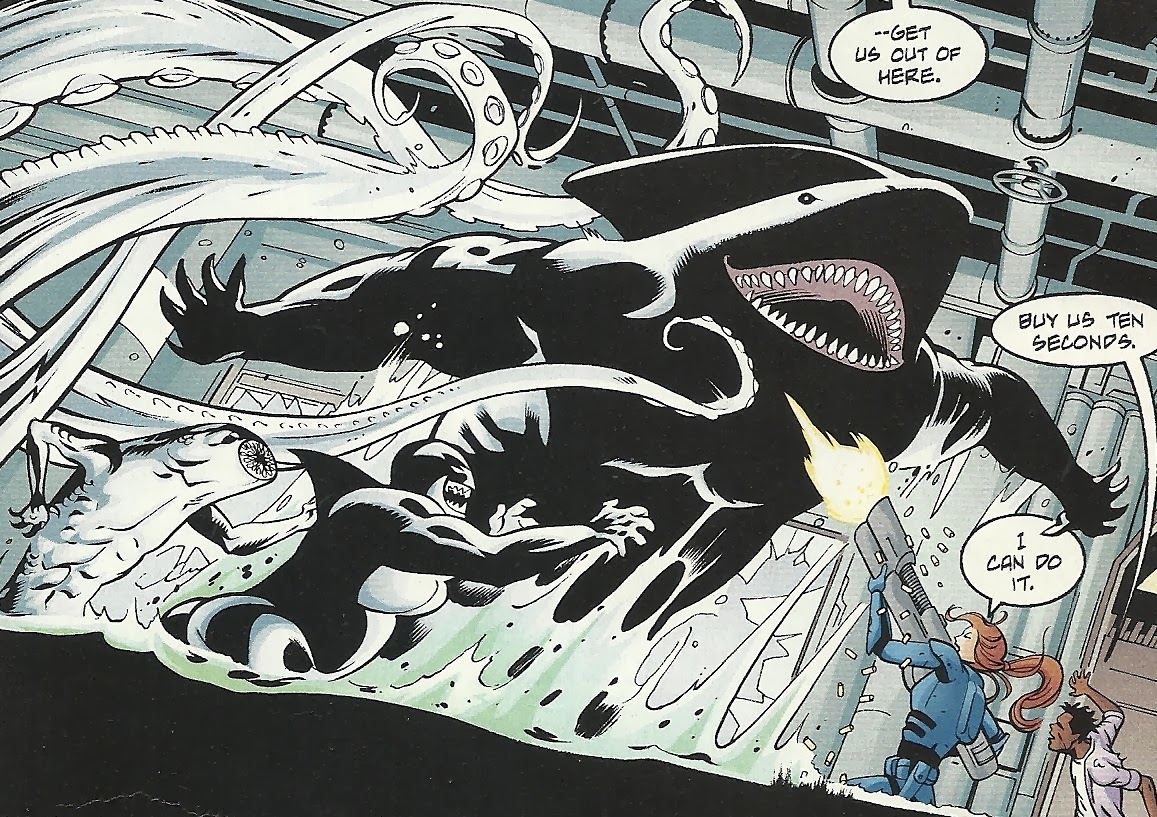
Dressed as Batman, he confronts Killer Croc, who, upon seeing him, says, "--BATMAN?!" Bane, of course, looks nothing like Batman. Eaton gives him a Dark Knight Returns, Superman-fighting helmet and a tattered cape, but he's still as big as a house, with a too-small head atop a massive body that dwarfs that of the imposing Killer Croc. Surely nobody will be fooled into thinking Batman has suddenly grown two feet, gained 300 pounds and started wearing short sleeves, will they?
And if dressing a little like Batman was meant to intimidate Croc, it doesn't seem to work; Croc fights back brutally, breaking part of Bane's metal helmet and taking a big bite of his meaty shoulder before Bane beats him into unconsciousness with a giant Batarang and throws him off a roof.
And hey, what's this?
The Penguin says Ogilvy has done a lot to him "over the past year"....? And Ogilvy didn't even make his move until the midst of "Death of The Family," the Batman story arc that takes place explicity one year after The Joker's appearance in Detective Comics #1...that's two years since the launch of The New 52! Stop speeding up time, Bat-books! You've already stretched the New 52's sliding, 5-6 year timeline into a sliding, 7-8 year timeline! At this rate, DC will need to do another reboot in...ah, I see what you guys are doing now. Bravo, Bat-writers...
But this, this is my favorite part of the issue, even moreso than its title ("Das Bat," for no reason at all):
Not only did that gigantic Killer Croc cradling the tall Jonathan "The Scarecrow" Crane in his arms like a babydoll somehow emerge from a clearly much too small hold in the ground, he did so while wearing the manhole cover like a hat.
I love that panel. Great job, Scot Eaton.
Justice League 3000 #1 (DC) Jeez, even the characters in this book aren't sold on its premise!
Now, on a normal week, I wouldn't have purchased this comic at all, as DC's pre-release marketing campaign for it was essentially a warning to anyone who pays attention to such things to back off, this was going to be a last-minute, half-assed effort, and its creation would have included an extremely questionable editorial decision that would make most reasonable readers particularly leery of editorial taste and competence.
If you've completely forgotten what I'm talking about, DC announced and solicited this book as the Justice League reunion of the creative team behind the seminal, late-80's reinvigoration of the franchise: Writers Keith Giffen and J.M. DeMatteis and artist Kevin Maguire. Then— a few months after they announced it, remember—they then announced they didn't like the direction it was going under Maguire, and he was no longer drawing the book; instead, they would be replacing him with Howard Porter, Grant Morrison's partner during his seminal, late-90's revival of the franchise (This move particularly baffled me, given not only its timing, but the fact that Maguire's about as known a quantity as there can be in comics).
Beyond that, Giffen, DeMatteis and Porter haven't really distinguished themselves lately on any of their many books for DC (Giffen and Porter especially seem employed when speed is needed above all else), and an alternate, future iteration of the Justice League in redesigned costumes didn't really thrill me as an idea (DC's currently publishing three Justice League books set in the present I'm not reading on a regular basis) and, finally, this being set in the 31st century makes me suspicious that it will ultimately have something to do with the Legion of Super-Heroes, a franchise I generally try to avoid, due to fear and confusion regarding them.
All that said, I drove all the way to the shop today in the dark and wind and snow, and they ran out of copies of Krampus, didn't order any of Fearless Dawn: Jurassic (of which I know nothing, other than that Steve Mannion draws awesome ladies and monsters; Fearless Dawn is the name of a lady character he created, and "Jurassic" promises dinosaurs) and they forgot to order a copy of SpongeBob for me. So what the hell, I figured, I'll try the first issue of the new Justice League comic by a bunch of guys whose Justice League comics I used to read and like.
(And thus ends my preface to the review, which may end up being as long or longer than the actual review.)
After having read the first issue, I was extremely curious to see what Maguire's issue might have looked like, or why he left the book and how the writers might have changed the story or script to go in that different direction, as this really reads like the sort of book written specifically for Maguire.
After a five-page opening involving a mysterious future lady in a standard, generic future setting running away from the authorities, and narrating about mysterious things, we get a two-page splash of the new Justice League, locked in 3-4 pages of battle with The Collective, some kind of mental villain that possesses a mob of civilians for them to fight, allowing for the standard introduction of superheroes through combat. Throughout the battle and its aftermath, the constantly bickering Leaguers drop hints that they may or may not be the original heroes, and a pair of young identical twins named Teri and Terry, but calling themselves "The Wonder Twins" (They have white hair, un-pointed ears and dress in red and white, in case you're wondering) talk to one another about the League, who they are apparently responsible for, and the mysterious lady from the opening, who went rogue from their organization, Cadmus.
While the humor isn't of the "Bwa ha ha" variety, the book is definitely leaning toward fun and funny, even if it is more of a straightforward superhero action book than a comedy. Much of the humor comes from Superman and Batman's arguing with one another, and the often off portrayals of the characters (Wonder Woman, for example, seems like she's supposed to be a parody of Wonder Woman, but given how often Wonder Woman is now written as a ruthless warrior, this seems more like Giffen and company turned a dial from 8 to 9, rather than exaggerated it for parodic effect, although I guess "our" Wonder Woman probably wouldn't say of Batman, "...Bruce? A night in my bed and he'll be ready for anything.")
Thankfully, Giffen and DeMatteis don't hang the mystery of who exactly these characters are over readers' heads for longer than an issue: They're clones, resurrected from the DNA of the five original heroes. And though they go by the names, both professional and personal, of their predecessors, some of their personalities are wonky, they don't have their full power sets (Superman lacks heat-vision, The Flash is missing his friction-proof aura, etc) and they're missing chunks of their memories. So there are still a lot of questions for readers to be kept in suspense about, but at least the creators get the premise down in the first issue.
Anyway, given the light-hearted nature of the story, and, especially, the focus on personality clashes and inter-character conflict, it's sort of baffling to see panels like this
or this
and think that Maguire, a master of facial expressions, was somehow blowing it.
And, of course, there's this two-page sequence in which each page is divided into nine-panel grids which, glowing computer-y panel borders aside, looks like it could have come from any previous Giffen/DeMatteis/Maguire comic:
And, it's worth noting, probably be better; out of costume, Porter's Clark Kent and Bruce Wayne are virtually identical, and you have to look at the background or dialogue for clues as to which of them is talking.
It's a perfectly decent mediocre superhero comic, full of cliches employed effectively enough, but missing some sort of spark to distinguish it from all the other perfectly decent mediocre superhero comics. Hell, if you look at just Justice League comics, DC has Justice League, ...of America and ...Dark, there's an alternate Justice League in Earth 2, an alternate future League in Injustice and yet another one in Batman Beyond Universe (Oddly, Batman 3000 makes for a third alternate Batman in red and black).
The Superior Foes of Spider-Man #6 (Marvel Entertainment) Finally, we end our Wednesday night on a high note, with a really good superhero comic.
Sometimes when I'm reading a really good comic book, I'll finish a panel and think, "Wow, what a great panel. I will scan that one and use it as an example of how great this comic book is, when I write about it on my blog later."
Well, I thought that when I read the last panel on page five, when Fred "Boomerang" Myers makes an allusion to Michael Fassbender's penis. And again on the third panel of the very next page. And again in the panel in which artist Steve Lieber draws the movie poster for The Ugly Truth starring Katherine Heigl and Gerard Butler. And on the page after that, when Boomerang's patrol officer attempts to make a dramatic exit (Oh, and when his parole officer first visits, a page or so earlier, and Boomerang volunteers to help him track down his own legacy villain).
Basically, there are a lot of really great panels, a lot of really great sequences in this comic. And it's only 20 pages! Right now, here's what Marvel looks like to me: There's Hawkeye, there's Superior Foes and then there's everything else.
Thursday, December 12, 2013
Tuesday, December 10, 2013
I liked Yanick Paquette's Batgirl design from "Rotworld: The Green Kingdom"
I recently read Swamp Thing Vol. 3: Rotworld: The Green Kingdom, and I didn't really enjoy it much, in large part because I had previously read Animal Man Vol. 3: Rotworld: The Red Kingdom, which included much of the same contents, including the climax of the conflict (DC's repeating content in mutliple trades is something I discussed in a little more detail, using these books as an example, here).
One thing I did like though was that when Swamp Thing and Animal Man get separated for a while in Rotworld, Swamp Thing finds his way to what's left of Gotham City, and there he meets Barbara "Batgirl" Gordon. She has survived the rotpocalypse thingee by injecting herself with Kirk Langstrom's Man-Bat serum, making her at least part animal and giving her a connection to "The Red," the mystical life web that binds all animal life (Yeah, I know, humans are animals too; writers Jeff Lemire and Scott Snyder didn't really address why humans didn't count as animals in the context of this story).
On the last page of the collection, DC shares a couple of Paquette's designs for the story, including a character design for Poison Ivy, and these two pages, devoted to Gordon or, as he refers to her here, Man-Bat-Girl:
I appreciate how much thought went into designing what is essentially a cameo appearance in a larger story, particularly because the hands of Man-Bat (and the many other characters who have taken Man-Bat serum over the years) always really bug me—you really shouldn't be able to have bat-wings and arms simultaneously, unless you're some kind of magical creature with six limbs, like a demon or dragon or whatever. Paquette just adds fingers, so Man-Bat-Girl has six or seven digits per hand. That works; I probably woulda given her one "human" finger and thumb, and three elongated wing-fingers, but, still, nice to see so much thought put into something like that for once.
Additionally, Paquette gave some thought into what sort of clothing would fit on a body like that, on that, in this case, can change back and forth, so that sometimes it has huge bat-wings and sometimes it doesn't. So he designed her costume around that. Again, another nice solution to the problem and one that, incidentally, gives Pacquette an excuse to draw a particularly sexy Gordon with a great deal of her flesh exposed.
Here's how his Barbara Gordon looked in the final story, when in human form (Note that these pages are non-consecutive, and I'm just posting them here to look at, not read, as they don't really make much sense if you do read them like this):
Unfortunately, we don't get to see what Pacquette's Man-Bat-Girl would have looked like when she was in bat-mode, as she only appears in parts of the book drawn by other artists (there are a lot of artists involved in this story arc), including two panels by Marco Rudy and in sequences by Steve Pugh, Timothy Green II and Joseph Silver and Andrew Belanger. During those scenes, her carefully conceived costume seems to have been forgotten, and she's shown wearing something that looks more like a diving suit, with a back to it.
One thing I did like though was that when Swamp Thing and Animal Man get separated for a while in Rotworld, Swamp Thing finds his way to what's left of Gotham City, and there he meets Barbara "Batgirl" Gordon. She has survived the rotpocalypse thingee by injecting herself with Kirk Langstrom's Man-Bat serum, making her at least part animal and giving her a connection to "The Red," the mystical life web that binds all animal life (Yeah, I know, humans are animals too; writers Jeff Lemire and Scott Snyder didn't really address why humans didn't count as animals in the context of this story).
On the last page of the collection, DC shares a couple of Paquette's designs for the story, including a character design for Poison Ivy, and these two pages, devoted to Gordon or, as he refers to her here, Man-Bat-Girl:
I appreciate how much thought went into designing what is essentially a cameo appearance in a larger story, particularly because the hands of Man-Bat (and the many other characters who have taken Man-Bat serum over the years) always really bug me—you really shouldn't be able to have bat-wings and arms simultaneously, unless you're some kind of magical creature with six limbs, like a demon or dragon or whatever. Paquette just adds fingers, so Man-Bat-Girl has six or seven digits per hand. That works; I probably woulda given her one "human" finger and thumb, and three elongated wing-fingers, but, still, nice to see so much thought put into something like that for once.
Additionally, Paquette gave some thought into what sort of clothing would fit on a body like that, on that, in this case, can change back and forth, so that sometimes it has huge bat-wings and sometimes it doesn't. So he designed her costume around that. Again, another nice solution to the problem and one that, incidentally, gives Pacquette an excuse to draw a particularly sexy Gordon with a great deal of her flesh exposed.
Here's how his Barbara Gordon looked in the final story, when in human form (Note that these pages are non-consecutive, and I'm just posting them here to look at, not read, as they don't really make much sense if you do read them like this):
Unfortunately, we don't get to see what Pacquette's Man-Bat-Girl would have looked like when she was in bat-mode, as she only appears in parts of the book drawn by other artists (there are a lot of artists involved in this story arc), including two panels by Marco Rudy and in sequences by Steve Pugh, Timothy Green II and Joseph Silver and Andrew Belanger. During those scenes, her carefully conceived costume seems to have been forgotten, and she's shown wearing something that looks more like a diving suit, with a back to it.
Monday, December 09, 2013
I finally saw The Wolverine...or is it meant to be pronounced Thee Wolverine...?
I just saw the latest Wolverine movie, The Wolverine, on DVD this weekend. I had meant to see it in theaters this summer, but I had the impression it wasn't playing in theaters for very many weeks. Maybe it was, and it was only during weeks when I was sort of busy and not thinking about spending a few hours in a theater, though. Anyway, I find it interesting that we've now reached a point in not only comic book movies, but comic book superhero movies that it's possible for even someone like me—who, remember, not only reads the damn things, but spends a significant part of my life writing about them for an insignificant amount of money—no longer feels compelled to go see them in theaters, like, opening weekend (I similarly failed to get to the theater in time to see Amazing Spider-Man before it stopped playing).
The Wolverine seemed really, really, really good to me. I think that was in large part due to how bad the previous Wolverine film, 2009's X-Men Origins: Wolverine was. That struck me as a pretty terrible movie, the only good parts I remember being that Hugh Jackman was in it and he's really good at being Wolverine in movies, and that the part where he fought a helicopter was pretty funny. Oh, and Liev Schreiber was pretty good in it too, I guess, looking more like Jackman's evil counterpart than Tyler Mane did in the original X-Men film
Part of X-Men Origins: Wolverine's problem, aside from having about two words too many in its title, seemed to be that it was re-covering ground already covered in 2002's X2...in fact, X2 seemed more like a Weapon X moive than X-Men Origins: Wolverine was (Also? Wolverine: Weapon X is a better film title than X-Men Origins: Wolverine), part of it was filling a Wolverine movie up with X-Men who weren't the X-Men from the previous, better movies, and then basically doing nothing at all with them (Why bother casting and introducing Gambit if you're only going to have him make a few cameos, for example?Why create new characters like John Wraith and Agent Zero when there are something like 12,450 pre-existing X-Men characters?).
(Oh, and what was up with that part where Wolverine met John and Martha Kent, they gave him a jacket and motorcycle, and then got totally blown up a few seconds later?)
At any rate, The Wolverine is the best movie with the name "Wolverine" in the title by far, is what I'm trying to say, but that's not really saying a whole lot*.
•I was a little thrown by the fact that it was set after the events of 2006's X-Men: The Last Stand, which I barely remember (Like, I guess I forgot that Wolverine killed Jean Grey in it...?), and I guess my X-Men movie timeline was also a bit discombobulated by the fact that the last two movies—X-Men Origins: Wolverine and X-Men: First Class—were set before the other three X-Men movies, in terms of chronology, and I just sort of assumed the Japanese setting of this meant it would take place before them as well, that it would be a sequel to origins and a prequel to the X-Men trilogy.
•I was additionally surprised by the presence of Famke Janssen's Jean Grey, in a small but key role. It was nice to see her, as that character and actress sort of got the short end of the stick in the previous films (ditto poor Cyclops; the franchise lost a lot of energy when that love triangle collapsed under the weight of Wolverine's popularity). She was rather well-employed here, I thought, and that particular plot-line was among the artier aspects of the film. It was one of several aspects that made it seem like a movie-movie, rather than just a silly superhero movie, although it would certainly get sillier as time went on.
For example:
•When Brian K. Vaughan put Wolverine in Japan for the dropping of an American atomic bomb, I thought that was pretty crass and tasteless. Perhaps it was because BKV managed to desensitize me to it a bit, or perhaps film seems a better medium for it, being somewhat less exploitive of the poor audience member (it was a few minutes of a film I watched for free in one sitting; not part of a $12, three-month storyline).
•I only read the 1982 Chris Claremont/Frank Miller Wolverine miniseries once, long, long ago, and didn't really like it at all (It was pretty Claremont-y, and the Miller who drew it hadn't yet become the Miller of Dark Knight Returns), so I don't know how much this movie was based on it, but I recognized a lot of the Japanese people's names.
•It was sort of weird seeing Wolverine's big Japanese adventure set in the present, or after all of his X-Menning, rather than as part of his mysterious past. This isn't a fault of the film or anything, just an observation: As a reader of Marvel comics, it was weird for me to see a Wolverine who couldn't speak Japanese, ate with a fork instead of chopsticks and didn't know how to hold a samurai sword.
•Rila Fukushima's Yukio, a red-haired maybe-mutant (a word only used once in the whole film, in Japanese dialogue), was a nice addition to the film, playing Wolverine's kinda sorta sidekick. She slotted quite nicely into the young girl-sidekick-to-grumpy-old-Wolverine role played in the comics at various points by Kitty Pryde, Jubilee, Armor and so on, and in the original X-Men movie by Anna Paquin's Rogue (Watching stretches of this, I found myself hoping the next Wolverine movie would feature him teamed with either Kea Wong's Jubilee, confined to two cameos in X2 and Last Stand. or, less likely, Ellen Page's Kitty Pryde).
•Tao Okamoto, who played Mariko, was pretty.
•Is Viper a new character? I can't think of any X-folks with that name or power-set, but I'm not an X-Men expert by any stretch of the imagination. (Wikipedia offers me a confusing answer on a Viper's existence in Marvel comics; I guess movie Viper is an original remix of several versions of different characters, maybe...?)
•The bullet train fight scene was pretty cool, I thought. It certainly bordered on the ridiculous, and occasionally stepped/flew over that border, but for all the fight scenes set atop trains in action film history, one set atop a bullet train was, of course, inevitable, so good on The Wolverine for going there. Hell, it may not even be the first fight set on top of a bullet train, but it is the first one I saw.
•The Silver Saumurai was fucking ridiculous (see above), and I had a hard time wrapping my head around the exact plan to steal Wolverine's healing powers from him...apparently, if you chop off the adamantium claws, you can use the claw holes of his knuckles as, like, access ports with which to siphon out his immortality. Or something?
•Unless Wolverine was all special effect between Hugh Jackman's neck and waist, that dude is in really fucking great shape. And he's a decade older than me! I went to bed after planning to do so many push-ups the next morning! But I ended up sleeping in and then not having time to work out.
•Ninjas don't really work in live-action movies, do they? They seemed super-cheesy in this. And, as I was thinking about it, I can't recall any movies—at least made in America ones—where ninjas didn't look at least a little like men in pajamas playing dress-up. In comics though? Ninjas work just fine in comics.
•You know the part when that one bad guy asks Wolverine what kind of monster he is and he says "The Wolverine" and pops his claws into his throat...? He totally should have said "The (Whatever That Japanese Monster Mariko Told Him Her Grandfather Said He Met At the Bottom of the Well With the Claws, The Monster That Would Always Protect Her)." That, or "The (Japanese Monster). The Wolverine."
•So I wonder what's next for Wolverine, in terms of solo movies? An eye-patch and Madripoor? Tyger Tiger? I hope so; I really like the name "Tyger Tiger," and would love to hear highly-paid actors say it out loud repeatedly in a movie theater.
•It looks like the X-Men people are taking a page from the Marvel Studios people, and teasing their next film during the credits for whichever one just finished, as Professor X and Magneto show up for a few minute scene with Wolverine in this, apparently teasing Days of Future Past.
•After I finished watching the movie, I watched the trailer, which is something of a habit I have. When I did so, I noticed a few elements that didn't make it into the final cut:
Wolverine: Smoking!
Wolverine getting beat up by a motorcycle! Okay, you can't really tell from this image, but, at the film's climax, Wolvie must fight his way through a snowy village full of ninjas before he can get to the boss level and fight The Silver Samurai. In the final cut, this basically entails him running while ninjas shoot arrows at him, until they hit him with so many ropes-attached-to-arrows that he is pulled to the ground.
In the trailer, there are a few glimpses of ninja's on motorbikes, including a moment where one of them pops a wheelie on the front tire, and smacks Wolverine across the face with the back tire.
•And then I watched the trailer for Days of Future Past, which looks sort of intriguing, although I was sad that X-Men I would most like to see more of—Alan Cummings' Nightcrawler, Taylor Kitsch's Gambit, James Marsden's Cyclops, the aforementioned Wong's Jubilee—aren't in it, but Halle Berry's dumb-ass Storm is. And Havoc. And, ugh, Bishop too.
*Disclaimer: I've never seen this 1921 silent movie called The Wolverine, but I'm pretty confident it is not about the mutant with the funny hair and claws named Logan.
The Wolverine seemed really, really, really good to me. I think that was in large part due to how bad the previous Wolverine film, 2009's X-Men Origins: Wolverine was. That struck me as a pretty terrible movie, the only good parts I remember being that Hugh Jackman was in it and he's really good at being Wolverine in movies, and that the part where he fought a helicopter was pretty funny. Oh, and Liev Schreiber was pretty good in it too, I guess, looking more like Jackman's evil counterpart than Tyler Mane did in the original X-Men film
Part of X-Men Origins: Wolverine's problem, aside from having about two words too many in its title, seemed to be that it was re-covering ground already covered in 2002's X2...in fact, X2 seemed more like a Weapon X moive than X-Men Origins: Wolverine was (Also? Wolverine: Weapon X is a better film title than X-Men Origins: Wolverine), part of it was filling a Wolverine movie up with X-Men who weren't the X-Men from the previous, better movies, and then basically doing nothing at all with them (Why bother casting and introducing Gambit if you're only going to have him make a few cameos, for example?
(Oh, and what was up with that part where Wolverine met John and Martha Kent, they gave him a jacket and motorcycle, and then got totally blown up a few seconds later?)
At any rate, The Wolverine is the best movie with the name "Wolverine" in the title by far, is what I'm trying to say, but that's not really saying a whole lot*.
•I was a little thrown by the fact that it was set after the events of 2006's X-Men: The Last Stand, which I barely remember (Like, I guess I forgot that Wolverine killed Jean Grey in it...?), and I guess my X-Men movie timeline was also a bit discombobulated by the fact that the last two movies—X-Men Origins: Wolverine and X-Men: First Class—were set before the other three X-Men movies, in terms of chronology, and I just sort of assumed the Japanese setting of this meant it would take place before them as well, that it would be a sequel to origins and a prequel to the X-Men trilogy.
•I was additionally surprised by the presence of Famke Janssen's Jean Grey, in a small but key role. It was nice to see her, as that character and actress sort of got the short end of the stick in the previous films (ditto poor Cyclops; the franchise lost a lot of energy when that love triangle collapsed under the weight of Wolverine's popularity). She was rather well-employed here, I thought, and that particular plot-line was among the artier aspects of the film. It was one of several aspects that made it seem like a movie-movie, rather than just a silly superhero movie, although it would certainly get sillier as time went on.
For example:
•When Brian K. Vaughan put Wolverine in Japan for the dropping of an American atomic bomb, I thought that was pretty crass and tasteless. Perhaps it was because BKV managed to desensitize me to it a bit, or perhaps film seems a better medium for it, being somewhat less exploitive of the poor audience member (it was a few minutes of a film I watched for free in one sitting; not part of a $12, three-month storyline).
•I only read the 1982 Chris Claremont/Frank Miller Wolverine miniseries once, long, long ago, and didn't really like it at all (It was pretty Claremont-y, and the Miller who drew it hadn't yet become the Miller of Dark Knight Returns), so I don't know how much this movie was based on it, but I recognized a lot of the Japanese people's names.
•It was sort of weird seeing Wolverine's big Japanese adventure set in the present, or after all of his X-Menning, rather than as part of his mysterious past. This isn't a fault of the film or anything, just an observation: As a reader of Marvel comics, it was weird for me to see a Wolverine who couldn't speak Japanese, ate with a fork instead of chopsticks and didn't know how to hold a samurai sword.
•Rila Fukushima's Yukio, a red-haired maybe-mutant (a word only used once in the whole film, in Japanese dialogue), was a nice addition to the film, playing Wolverine's kinda sorta sidekick. She slotted quite nicely into the young girl-sidekick-to-grumpy-old-Wolverine role played in the comics at various points by Kitty Pryde, Jubilee, Armor and so on, and in the original X-Men movie by Anna Paquin's Rogue (Watching stretches of this, I found myself hoping the next Wolverine movie would feature him teamed with either Kea Wong's Jubilee, confined to two cameos in X2 and Last Stand. or, less likely, Ellen Page's Kitty Pryde).
•Tao Okamoto, who played Mariko, was pretty.
•Is Viper a new character? I can't think of any X-folks with that name or power-set, but I'm not an X-Men expert by any stretch of the imagination. (Wikipedia offers me a confusing answer on a Viper's existence in Marvel comics; I guess movie Viper is an original remix of several versions of different characters, maybe...?)
•The bullet train fight scene was pretty cool, I thought. It certainly bordered on the ridiculous, and occasionally stepped/flew over that border, but for all the fight scenes set atop trains in action film history, one set atop a bullet train was, of course, inevitable, so good on The Wolverine for going there. Hell, it may not even be the first fight set on top of a bullet train, but it is the first one I saw.
•The Silver Saumurai was fucking ridiculous (see above), and I had a hard time wrapping my head around the exact plan to steal Wolverine's healing powers from him...apparently, if you chop off the adamantium claws, you can use the claw holes of his knuckles as, like, access ports with which to siphon out his immortality. Or something?
•Unless Wolverine was all special effect between Hugh Jackman's neck and waist, that dude is in really fucking great shape. And he's a decade older than me! I went to bed after planning to do so many push-ups the next morning! But I ended up sleeping in and then not having time to work out.
•Ninjas don't really work in live-action movies, do they? They seemed super-cheesy in this. And, as I was thinking about it, I can't recall any movies—at least made in America ones—where ninjas didn't look at least a little like men in pajamas playing dress-up. In comics though? Ninjas work just fine in comics.
•You know the part when that one bad guy asks Wolverine what kind of monster he is and he says "The Wolverine" and pops his claws into his throat...? He totally should have said "The (Whatever That Japanese Monster Mariko Told Him Her Grandfather Said He Met At the Bottom of the Well With the Claws, The Monster That Would Always Protect Her)." That, or "The (Japanese Monster). The Wolverine."
•So I wonder what's next for Wolverine, in terms of solo movies? An eye-patch and Madripoor? Tyger Tiger? I hope so; I really like the name "Tyger Tiger," and would love to hear highly-paid actors say it out loud repeatedly in a movie theater.
•It looks like the X-Men people are taking a page from the Marvel Studios people, and teasing their next film during the credits for whichever one just finished, as Professor X and Magneto show up for a few minute scene with Wolverine in this, apparently teasing Days of Future Past.
•After I finished watching the movie, I watched the trailer, which is something of a habit I have. When I did so, I noticed a few elements that didn't make it into the final cut:
Wolverine: Smoking!
Wolverine getting beat up by a motorcycle! Okay, you can't really tell from this image, but, at the film's climax, Wolvie must fight his way through a snowy village full of ninjas before he can get to the boss level and fight The Silver Samurai. In the final cut, this basically entails him running while ninjas shoot arrows at him, until they hit him with so many ropes-attached-to-arrows that he is pulled to the ground.
In the trailer, there are a few glimpses of ninja's on motorbikes, including a moment where one of them pops a wheelie on the front tire, and smacks Wolverine across the face with the back tire.
•And then I watched the trailer for Days of Future Past, which looks sort of intriguing, although I was sad that X-Men I would most like to see more of—Alan Cummings' Nightcrawler, Taylor Kitsch's Gambit, James Marsden's Cyclops, the aforementioned Wong's Jubilee—aren't in it, but Halle Berry's dumb-ass Storm is. And Havoc. And, ugh, Bishop too.
*Disclaimer: I've never seen this 1921 silent movie called The Wolverine, but I'm pretty confident it is not about the mutant with the funny hair and claws named Logan.
DC Universe Vs. Masters of The Universe #3: It comes to this
To recap, DC Comics recently published DC Universe Vs. Masters of the Universe #1 and #2, part of a miniseries event-tacular, in which the characters from the Masters of the Universe universe come to the universe of the DC Universe, where He-Man's redesigned archenemy Skeletor and DCU footnote Black Alice are attempting to siphon off all of the mystical energy forces, at the behest of a mysterious collaborator.
In an effort to save the day, He-Man's mom teamed-up with John Constantine, and then He-Man, Teela and Evil-Lyn teamed up with them, and then they all teamed up with Batman, and then Skeletor possessed the Justice League and sicced them on Batman and He-Man, and so He-Man had to totally stab Superman to death.
Which brings us to the third issue, where two more Justice Leagues join the adventure, more Masters arrive on Earth-New 52, and Skeletor's unseen ally is finally revealed to be the most hilariously dumb villain imaginable.
Also of note, the creative team continues to grow, always a sure sign that things are going just great behind the scenes. For the first issue, Keith Giffen did all the writing and Dexter Soy handled all of the art, right down to the colors.
For the second issue, Giffen plotted, Tony Bedard scripted, Soy handled almost all of the art, but took on a co-colorist.
For this issue, Giffen plots, Bedard scripts, Soy is credited for the art on 16 pages, while Derlis Santacruz and Andres Ponce are credited with art on 6 pages, and there are still two colorists.
COVER:
This installment's cover, drawn like those of the previous two by Ed Benes, features Wonder Woman fighting Teela, as does not happen at all in this issue, but sort of did last issue (The fight was a little more one-sided than this cover implies, though; Wonder Woman flying kicked Teela's apparently invincible spine from behind, and then started trying to strangle her apparently invincible throat with the magical lasso of truth).
Their fight occurred in front of Wayne Manor, although for the purposes of this cover, it is taking place in front of a smashed up tank (?) in front of....some pretty vague buildings. I'm no architecture expert, but the vague buildings look a little more Eternian than Earth-ian to me, but, like I said, I don't know.
PAGES 1-6:
After Cyborg paraphrases South Park—"Good God, they killed Superman!"—and He-Man looks a little sad about impaling Superman, Constantine tries to talk sense into the possessed Leaguers, while using as many signifiers of the fact that he's British as possible: "You must have been talking about this Skeletor bloke that He-Man and his mates are looking for." They were just about to check the boot of the lorry, but it was almost tea time, and they had to have a kip before getting kitted out to continue looking for that Skeletor wanker.
"Stop trying to confuse me, John Constanine," Wonder Woman says, crying out glowing Skeletor possession energy like floating energy bubble tears. Women! Always being confused, by emotions! "I don't know anyone named 'Skeletor,' but I saw damned well who stabbed my man through the heart!" I'm still getting used to the idea of Wonder Woman and Superman dating. But I don't think I will ever get used to the idea of Wonder Woman calling Superman (or anyone, really) "my man."
He-Man surrenders himself to the five Leaguers who aren't Batman, SHA-KOOM-ing himself from He-Man mode back into Prince Adam mode, and preparing to hand over his sword. Evil-Lyn isn't having any of it though, and calls upon the four elements, including the flame from Constantine's lighter—ever notice how he always seems to be lighting up a cigarette, but never smoking one or putting one out?—to cast a spell that teleports Teela, Prince Adam, He-Man's mom, Constantine, Xanadu and herself away to Metropolis...againt Adam and Teela's will.
Xanadu proposes a new course of action: The Eternians search for Skeletor, while the two DC magic folks summon help from their associates.
PAGES 7-8:
While Batman bickers with the League about who they should be hunting—Skeletor or He-Man—Superman's bloodless chest wound starts to leak lightning, and he totally disappears in a cloud of dust. Wonder Woman's arm-bands, which number two on this particular page for some reason, also disappear, as she's not wearing any on the next page. Is that too part of "a curse on He-Man's magic sword," as Aquaman wonders, or just another example of the hurried, careless, far below sub-standard art on the series?
Seeing the rest of the League still aren't thinking clearly, Batman says something funny, which I won't spoil, as the book offers so few legitimately pleasurable moments.
Apparently, Batman and the surviving Leaguers are splitting up as well.
PAGES 9-10:
Perhaps Cyborg took the time to fire off a press release before he and the Leaguers went off to hunt down He-Man...? (Good thing there were no media present too, as the fight took place in front of the house of Gotham City billionaire philanthropist playboy Bruce Wayne, and created a gigantic hole leading directly into the Batcave).
This is all according to Skeletor's plan. The heroes of Earth will hunt He-Man instead of him, allowing his magic siphons to do their work.
PAGES 11-13:
Back on "Eternia," as the caption says, we finally get a fairly decent introductory image of what the Masters apparently participating in this series. Man-At-Arms, Moss Man, Stratos, Battle Cat and Roboto all pose as Man-At-Arms uses one of the Horde's "infernal machines" to make the one-way journey from their world to the DCU, where they hope to find their lost allies, and a way bring them back to their own world.
They arrive in Greenwich Village, where the roaring giant green tiger wearing a mask scares all the bystanders away. Man-At-Arms manages to grab a little boy who has forgotten all he's learned about stranger danger by the wrist, and he and his compatriots quiz him.
Moss-Man, for some reason, apparently wears sexy metal pants now.
That seemed somehow off to me, so I later went to have a look at the original, which was just the Beast Man mold covered in green, lint collecting fuzz and smelling of pine.
(Moss Man was, I believe, the first and only action figure that was also an air-freshener. If I had a double, I would have hang it from my rearview mirror in lieu of one of those flat, cardboard air-fresheners).
Anyway, he wore a metal belt, furry under pants, and carried a brown, metal mace. So I guess there is precedent for Moss Man not wearing plant-based loin coverings. Still strikes me as weird, though, like Swamp Thing wearing chainmail.
And hey, speaking of Swamp Thing...
PAGE 14:
At "The House of Mystery, Headquarters of Justice League Dark," we see the associates Constantine and Xanadau had in mind: Swamp Thing, Frankenstein, Deadman and Red Cabbage.
Well, we may not get to see match ups like Mer-Man vs. Aquaman, Beast Man vs. Animal Man, Buzz-Off vs. The Red Bee (or, more likely, Bumblebee) or Sy-Klone vs. Red Tornado, but hey, at least a Moss Man vs. Swamp Thing confrontation seems likely...!
PAGE 15:
Before Man-At-Arms' group can find the Justice League, the Justice League finds them...well, a Justice League finds them. In this case, it's a faction of Steve Trevor's Justice League of America, consisting of Hawkman, Green Arrow, Martian Manhunter and Green Lantern Simon Baz.
Then Man-At-Arms makes the mistake of mentioning the name He-Man.
PAGES 16-17:
"They're with the killers," Trevor spits, TAKE THEM!" Instead of panels showing the two groups of combatants in combat, these two pages are devoted to a splash involving the characters all about to fight (Which should really be a short fight. Green Lantern or Manhunter should be able to defeat the super-powerless Masters in about two, maybe four seconds).
The creators apparently tried to match the two sides up, which doesn't really work, as the flying Hawkman and the flying Stratos are the only two characters who have anything in common. Green Lantern creates a robot-looking ginat green arm to reach for Robot, Man-At-Arms and expert archer Green Arrow fire at one another at point-blank range (M.A.A. misses; I assume when GA releases his arrow, he's going to miss too, although I hope he has a razor arrow in his quiver and manages to take out Man-At-Arms' mustache with it next issue), and J'onn J'onnz is left to deal with Battle Cat...maybe because they're both green? To make himself more suitable still to fight a giant green tiger, J'onn uses his amazing shape-changing powers to...grow cat ears...?
Moss Man is off-panel; perhaps he'll be fighting Trevor, who doesn't appear in the splash page either.
PAGES 18-20:
Black Alice quizzes Skeletor about his mysterious master again, who has so far only appeared as a pair of floating eyes or a voice. That ally is finally revealed in a hilarious final page splash as, get this, Orko.
Oh, I'm sorry, "Dark Orko."
If you are either too old or too young to know who or what Orko is, he was a comic relief character created for the original Filmation cartoon series He-Man and the Masters of the Universe (a character that later made his way into the toy line; unlike most of the line, Orko was a cartoon character first and then a toy, rather than vice versa).
As for what he was, other than the most annoying aspect of the cartoon, the floating longsleeve t-shirt, eyes, scarf, hat, ears and hands was supposedly a "Trollan," which is kind of like a troll, but with an "-an" at the end, and he was a magical emigree to Eternia from a different dimension.
Orko looked like this:
His redesign is thus even more dramatic than He-Man and Skeletor's.
In addition to being one of Adam's besties and one of only three individuals (on the show, anyway) who knew of his dual identity as He-Man, Orko served as the court jester to King Randor. That makes his dramatic comment to Skeletor in the last two panels particularly weird: "They always laughed at me, you know? Tell me, Skeletor, who's laughing NOW?"
Well me, for one.
In an effort to save the day, He-Man's mom teamed-up with John Constantine, and then He-Man, Teela and Evil-Lyn teamed up with them, and then they all teamed up with Batman, and then Skeletor possessed the Justice League and sicced them on Batman and He-Man, and so He-Man had to totally stab Superman to death.
Which brings us to the third issue, where two more Justice Leagues join the adventure, more Masters arrive on Earth-New 52, and Skeletor's unseen ally is finally revealed to be the most hilariously dumb villain imaginable.
Also of note, the creative team continues to grow, always a sure sign that things are going just great behind the scenes. For the first issue, Keith Giffen did all the writing and Dexter Soy handled all of the art, right down to the colors.
For the second issue, Giffen plotted, Tony Bedard scripted, Soy handled almost all of the art, but took on a co-colorist.
For this issue, Giffen plots, Bedard scripts, Soy is credited for the art on 16 pages, while Derlis Santacruz and Andres Ponce are credited with art on 6 pages, and there are still two colorists.
COVER:
This installment's cover, drawn like those of the previous two by Ed Benes, features Wonder Woman fighting Teela, as does not happen at all in this issue, but sort of did last issue (The fight was a little more one-sided than this cover implies, though; Wonder Woman flying kicked Teela's apparently invincible spine from behind, and then started trying to strangle her apparently invincible throat with the magical lasso of truth).
Their fight occurred in front of Wayne Manor, although for the purposes of this cover, it is taking place in front of a smashed up tank (?) in front of....some pretty vague buildings. I'm no architecture expert, but the vague buildings look a little more Eternian than Earth-ian to me, but, like I said, I don't know.
PAGES 1-6:
After Cyborg paraphrases South Park—"Good God, they killed Superman!"—and He-Man looks a little sad about impaling Superman, Constantine tries to talk sense into the possessed Leaguers, while using as many signifiers of the fact that he's British as possible: "You must have been talking about this Skeletor bloke that He-Man and his mates are looking for." They were just about to check the boot of the lorry, but it was almost tea time, and they had to have a kip before getting kitted out to continue looking for that Skeletor wanker.
"Stop trying to confuse me, John Constanine," Wonder Woman says, crying out glowing Skeletor possession energy like floating energy bubble tears. Women! Always being confused, by emotions! "I don't know anyone named 'Skeletor,' but I saw damned well who stabbed my man through the heart!" I'm still getting used to the idea of Wonder Woman and Superman dating. But I don't think I will ever get used to the idea of Wonder Woman calling Superman (or anyone, really) "my man."
He-Man surrenders himself to the five Leaguers who aren't Batman, SHA-KOOM-ing himself from He-Man mode back into Prince Adam mode, and preparing to hand over his sword. Evil-Lyn isn't having any of it though, and calls upon the four elements, including the flame from Constantine's lighter—ever notice how he always seems to be lighting up a cigarette, but never smoking one or putting one out?—to cast a spell that teleports Teela, Prince Adam, He-Man's mom, Constantine, Xanadu and herself away to Metropolis...againt Adam and Teela's will.
Xanadu proposes a new course of action: The Eternians search for Skeletor, while the two DC magic folks summon help from their associates.
PAGES 7-8:
While Batman bickers with the League about who they should be hunting—Skeletor or He-Man—Superman's bloodless chest wound starts to leak lightning, and he totally disappears in a cloud of dust. Wonder Woman's arm-bands, which number two on this particular page for some reason, also disappear, as she's not wearing any on the next page. Is that too part of "a curse on He-Man's magic sword," as Aquaman wonders, or just another example of the hurried, careless, far below sub-standard art on the series?
Seeing the rest of the League still aren't thinking clearly, Batman says something funny, which I won't spoil, as the book offers so few legitimately pleasurable moments.
Apparently, Batman and the surviving Leaguers are splitting up as well.
PAGES 9-10:
Perhaps Cyborg took the time to fire off a press release before he and the Leaguers went off to hunt down He-Man...? (Good thing there were no media present too, as the fight took place in front of the house of Gotham City billionaire philanthropist playboy Bruce Wayne, and created a gigantic hole leading directly into the Batcave).
This is all according to Skeletor's plan. The heroes of Earth will hunt He-Man instead of him, allowing his magic siphons to do their work.
PAGES 11-13:
Back on "Eternia," as the caption says, we finally get a fairly decent introductory image of what the Masters apparently participating in this series. Man-At-Arms, Moss Man, Stratos, Battle Cat and Roboto all pose as Man-At-Arms uses one of the Horde's "infernal machines" to make the one-way journey from their world to the DCU, where they hope to find their lost allies, and a way bring them back to their own world.
They arrive in Greenwich Village, where the roaring giant green tiger wearing a mask scares all the bystanders away. Man-At-Arms manages to grab a little boy who has forgotten all he's learned about stranger danger by the wrist, and he and his compatriots quiz him.
Moss-Man, for some reason, apparently wears sexy metal pants now.
That seemed somehow off to me, so I later went to have a look at the original, which was just the Beast Man mold covered in green, lint collecting fuzz and smelling of pine.
(Moss Man was, I believe, the first and only action figure that was also an air-freshener. If I had a double, I would have hang it from my rearview mirror in lieu of one of those flat, cardboard air-fresheners).
Anyway, he wore a metal belt, furry under pants, and carried a brown, metal mace. So I guess there is precedent for Moss Man not wearing plant-based loin coverings. Still strikes me as weird, though, like Swamp Thing wearing chainmail.
And hey, speaking of Swamp Thing...
PAGE 14:
At "The House of Mystery, Headquarters of Justice League Dark," we see the associates Constantine and Xanadau had in mind: Swamp Thing, Frankenstein, Deadman and Red Cabbage.
Well, we may not get to see match ups like Mer-Man vs. Aquaman, Beast Man vs. Animal Man, Buzz-Off vs. The Red Bee (or, more likely, Bumblebee) or Sy-Klone vs. Red Tornado, but hey, at least a Moss Man vs. Swamp Thing confrontation seems likely...!
PAGE 15:
Before Man-At-Arms' group can find the Justice League, the Justice League finds them...well, a Justice League finds them. In this case, it's a faction of Steve Trevor's Justice League of America, consisting of Hawkman, Green Arrow, Martian Manhunter and Green Lantern Simon Baz.
Then Man-At-Arms makes the mistake of mentioning the name He-Man.
PAGES 16-17:
"They're with the killers," Trevor spits, TAKE THEM!" Instead of panels showing the two groups of combatants in combat, these two pages are devoted to a splash involving the characters all about to fight (Which should really be a short fight. Green Lantern or Manhunter should be able to defeat the super-powerless Masters in about two, maybe four seconds).
The creators apparently tried to match the two sides up, which doesn't really work, as the flying Hawkman and the flying Stratos are the only two characters who have anything in common. Green Lantern creates a robot-looking ginat green arm to reach for Robot, Man-At-Arms and expert archer Green Arrow fire at one another at point-blank range (M.A.A. misses; I assume when GA releases his arrow, he's going to miss too, although I hope he has a razor arrow in his quiver and manages to take out Man-At-Arms' mustache with it next issue), and J'onn J'onnz is left to deal with Battle Cat...maybe because they're both green? To make himself more suitable still to fight a giant green tiger, J'onn uses his amazing shape-changing powers to...grow cat ears...?
Moss Man is off-panel; perhaps he'll be fighting Trevor, who doesn't appear in the splash page either.
PAGES 18-20:
Black Alice quizzes Skeletor about his mysterious master again, who has so far only appeared as a pair of floating eyes or a voice. That ally is finally revealed in a hilarious final page splash as, get this, Orko.
Oh, I'm sorry, "Dark Orko."
If you are either too old or too young to know who or what Orko is, he was a comic relief character created for the original Filmation cartoon series He-Man and the Masters of the Universe (a character that later made his way into the toy line; unlike most of the line, Orko was a cartoon character first and then a toy, rather than vice versa).
As for what he was, other than the most annoying aspect of the cartoon, the floating longsleeve t-shirt, eyes, scarf, hat, ears and hands was supposedly a "Trollan," which is kind of like a troll, but with an "-an" at the end, and he was a magical emigree to Eternia from a different dimension.
Orko looked like this:
His redesign is thus even more dramatic than He-Man and Skeletor's.
In addition to being one of Adam's besties and one of only three individuals (on the show, anyway) who knew of his dual identity as He-Man, Orko served as the court jester to King Randor. That makes his dramatic comment to Skeletor in the last two panels particularly weird: "They always laughed at me, you know? Tell me, Skeletor, who's laughing NOW?"
Well me, for one.
Friday, December 06, 2013
Will it help to talk about it?: Processing our grief over the demise of PictureBox
I found that image at TCJ.com on one of the occasions upon which I've googled "King Kong" and "Tezuka," which I've done every so often since I learned that Osamu Tezuka made a King Kong manga of some sort. It was apparently posted by Ryan Holmberg. Relatively high on a list of things I love most in this world are King Kong and Tezuka's comics, so this is one of those dream comics of mine that I've wanted to be able to read, preferably translated into English, ever since I became aware of its existence. Perhaps it would ultimately prove disappointing, like Tezuka's Lost World (which Dark Horse published a few years back), but, worse comes to worst, it would still be a Tezuka comic with a giant gorilla in it.
The last time I heard mention of it was in the Ryan Holmberg translated and edited The Mysterious Underground Men, part of Holmberg's Ten Cent Manga series being published through PictureBox, the intent of which was to highlight western influence in post-war, mass-market Japanese comics. Only two volumes have been released; Tezuka's The Mysterious Underground Men, a breathless, digest-sized adventure comic I just covered at Robot 6 yesterday (click here, and scroll 4/5ths of the page down), and Shigeru Sugiura's crazy-ass, comedy cover version of Last of the Mohicans (reviewed here; second one down).
They were both great fun to read, and, like everything PictureBox published, great-looking books. I was really looking forward to future installments of Ten Cent Manga, and hoping that before long we'd see a King Kong entry into the series; after all, King Kong is a western film, and Tezuka's adaptation came out in 1947 (i.e. post-war), and Holmberg already included one Tezuka book, and, he seems to own a copy of it...or at least to have taken a picture of a copy of it to post on TCJ.com.
So when I read this the other day, fell to my knees, raised my balled fists to the heavens and screamed "Nooooooooo!", it was in part because my dream of a a Ten Cent Manga version of King Kong was evaporating (Which part? The sixth, seventh and eighth of the o's in "Nooooooooo!").
By the way, did you click on that last link? You should click on that last link. It will take you to The Comics Reporter, where you'll find Tom Spurgeon interviewing Dan Nadel about the demise of PictureBox. Good news? It doesn't seem like it has anything to do with lousy sales or the market place rejecting Nadel's business model or anything like that. Rather, it seems like Nadel is going to focus on things in his life that aren't PictureBox. Bad news? No more PictureBox. Silver lining? Hopefully many of the artists associated with the publisher have, by this point, established themselves to find other publishers willing to take on their future work (And hopefully someone picks up Holmberg's Ten Cent Manga line; King Kong adaptation or no, that seems like a wonderful line that shows a lot of promise).
Here are, I think, the three great things about PictureBox, and the three things I'll miss the most.
1.) They published great-looking books. I'm not talking about the interior art, although that tends to be pretty damn good, but the design of their books. PictureBox certainly seems to have taken the book-as-objet d'art approach to publishing, and nearly every publication of theirs that I've read is the kind that I like to hold and look at. The kind that doesn't just sit on a bookshelf or night stand or coffee table, but decorates it.
I have a bookshelf full of New 52 trades, and another bookshelf full of Marvel trades from a few years back. They all have uniform designs, and, spine out on a bookshelf, they look disgusting (Well, that's a strong word; they don't look pretty though). They certainly don't look as lovely as my bookshelves containing Drawn and Quarterly or Fantagraphics or AdHouse or Oni or First Second books. Or PictureBox books, obviously. If I were a set-designer or interior decorator and needed to have some comics books strewn about, I'd more than likely use PictureBox releases (And some D+Q books, probably).
Although, there is that goddam Lauren Weinstein Goddess of War comic, which has been a thorn in my side since I brought it into my home...four homes ago. Don't get me wrong, it's a great comic, and I loved reading it, but it is sooooo big (It's a floppy, but a floppy the size of a New York City efficiency apartment) I've never figured out where and how to store it. Originally, I slipped it back in the gigantic cardboard envelope it was shipped in, and hid it behind a bookshelf and the wall, as that was the only place it fit and wasn't in the way.
It is currently in my a closet at my mother's house, resting atop a stack of a little cardboard igloo of eight longboxes containing DC superhero comics, blanketed by framed original art from local Columbus artists that I no longer have the wall space to hang.
Anyways, Goddess of War is never far from my thoughts, whenever I think about different comics formats, and worry about moving my comics midden.
2.) They published the work of comics artists that other publishers probably wouldn't have. Are you familiar with the work of Yuichi Yokoyama? PictureBox just published his World Map Room, in which a bunch of mysterious figures with oddly shaped heads travel through a mysterious city for a mysterious purpose, and take a meeting. It's fucking nuts, but also kind of hypnotic, addictive and beautiful. A few years back, they published Yokoyama's Garden and Color Engineering. I didn't read that last one, but Garden? Holy shit. I've never read anything like it. (After some consideration, although World Map Room seems to have more story and to be funnier—thanks to the author's notes at the end—I think I prefer Garden as both the more fun of the two, and the better of the two).
It's hard for me to imagine another publisher publishing such work.
Not that PictureBox was the only publisher to publish avant garde work, of course, or that all of the artists they publish work from were so "out there" that no one else would touch them—I've already mentioned Tezuka, who is one of the most mainstream artists in the whole history of comics; PictureBox has also published a book by Brandon Graham (whose work has also been published by Tokyopop, Image, Oni and Alternative Comics), Renee French (who recently published a kids book with Toon Boooks), and books involving artistic folks better-known that most folks in the entire field of comics (The band Wilco, for example).
In fact, as Spurgeon's article makes clear, some other publisher's are at least interested in some of these folks' work continuing under their umbrellas.
Still, there are a lot of PictureBox books, like those of Yokoyama's, for example, or Brian Chippendale's If 'n Oof or French's H Day or CF's Powr Mastrs that I have a hard time imagining reading from another publisher (particularly upon the time of their release).
3.) I was on their press list, and thus got press copies of their books. There are few things more tragic than a source of free—and generally excellent!—comics drying up. Sigh...
As part of his article on the subject, Spurgeon listed what he called "a limited bibliography" of the publisher's publications. One thing I noticed while reading it is that their offerings seemed to get stronger year after year. I don't know if this was truly the case, or just a matter of perception—perhaps I read more of their more recent books than their older books, perhaps my tastes started to gradually align with those of Nadel's over the years—but 2013 seems like their strongest year ever; 2012 seemed stronger than 2009, and so on.
There is one more silver lining to PictureBox's going away. They're having a "massive" 50% off sale. I can personally recommend Gold Pollen and Other Stories (another Holmberg-edited manga collection), the aforementioned Mysterious Underground Men and Last of the Mohicans and Garden, Frank Santoro's excellent historical drama Pompeii and Anya Davidson's hilarious School Spirits (both reviewed in this post), Matthew Thurber's weird drama/adventure 1-800 Mice, Chippendale's If 'n Oof and, of course, Goddess of War, if you don't mind having to find a place to stick it in your apartment. (I'd link to reviews of all of those, but some of 'em were for the now-defunct Blog@Newsarama, which I think recently threw all of its content into the sun, for some reason).
As for me, I'm going to try and get that Brandon Graham art book, if I can figure out how to buy stuff through the website, and maybe some Powr Mastrs (I never read past the first volume) and some more Yokoyama... (UPDATE: Actually, I ordered the Graham book, Brian Chippendale's Maggots and something called Caleb's Adventures in Wonderland, simply because I like the title; I struggled for a while over whether or not to get Negron too, but ultimately decided against it...and now I feel Sean T. Collins judging me from afar).
The last time I heard mention of it was in the Ryan Holmberg translated and edited The Mysterious Underground Men, part of Holmberg's Ten Cent Manga series being published through PictureBox, the intent of which was to highlight western influence in post-war, mass-market Japanese comics. Only two volumes have been released; Tezuka's The Mysterious Underground Men, a breathless, digest-sized adventure comic I just covered at Robot 6 yesterday (click here, and scroll 4/5ths of the page down), and Shigeru Sugiura's crazy-ass, comedy cover version of Last of the Mohicans (reviewed here; second one down).
They were both great fun to read, and, like everything PictureBox published, great-looking books. I was really looking forward to future installments of Ten Cent Manga, and hoping that before long we'd see a King Kong entry into the series; after all, King Kong is a western film, and Tezuka's adaptation came out in 1947 (i.e. post-war), and Holmberg already included one Tezuka book, and, he seems to own a copy of it...or at least to have taken a picture of a copy of it to post on TCJ.com.
So when I read this the other day, fell to my knees, raised my balled fists to the heavens and screamed "Nooooooooo!", it was in part because my dream of a a Ten Cent Manga version of King Kong was evaporating (Which part? The sixth, seventh and eighth of the o's in "Nooooooooo!").
By the way, did you click on that last link? You should click on that last link. It will take you to The Comics Reporter, where you'll find Tom Spurgeon interviewing Dan Nadel about the demise of PictureBox. Good news? It doesn't seem like it has anything to do with lousy sales or the market place rejecting Nadel's business model or anything like that. Rather, it seems like Nadel is going to focus on things in his life that aren't PictureBox. Bad news? No more PictureBox. Silver lining? Hopefully many of the artists associated with the publisher have, by this point, established themselves to find other publishers willing to take on their future work (And hopefully someone picks up Holmberg's Ten Cent Manga line; King Kong adaptation or no, that seems like a wonderful line that shows a lot of promise).
Here are, I think, the three great things about PictureBox, and the three things I'll miss the most.
1.) They published great-looking books. I'm not talking about the interior art, although that tends to be pretty damn good, but the design of their books. PictureBox certainly seems to have taken the book-as-objet d'art approach to publishing, and nearly every publication of theirs that I've read is the kind that I like to hold and look at. The kind that doesn't just sit on a bookshelf or night stand or coffee table, but decorates it.
I have a bookshelf full of New 52 trades, and another bookshelf full of Marvel trades from a few years back. They all have uniform designs, and, spine out on a bookshelf, they look disgusting (Well, that's a strong word; they don't look pretty though). They certainly don't look as lovely as my bookshelves containing Drawn and Quarterly or Fantagraphics or AdHouse or Oni or First Second books. Or PictureBox books, obviously. If I were a set-designer or interior decorator and needed to have some comics books strewn about, I'd more than likely use PictureBox releases (And some D+Q books, probably).
Although, there is that goddam Lauren Weinstein Goddess of War comic, which has been a thorn in my side since I brought it into my home...four homes ago. Don't get me wrong, it's a great comic, and I loved reading it, but it is sooooo big (It's a floppy, but a floppy the size of a New York City efficiency apartment) I've never figured out where and how to store it. Originally, I slipped it back in the gigantic cardboard envelope it was shipped in, and hid it behind a bookshelf and the wall, as that was the only place it fit and wasn't in the way.
It is currently in my a closet at my mother's house, resting atop a stack of a little cardboard igloo of eight longboxes containing DC superhero comics, blanketed by framed original art from local Columbus artists that I no longer have the wall space to hang.
Anyways, Goddess of War is never far from my thoughts, whenever I think about different comics formats, and worry about moving my comics midden.
2.) They published the work of comics artists that other publishers probably wouldn't have. Are you familiar with the work of Yuichi Yokoyama? PictureBox just published his World Map Room, in which a bunch of mysterious figures with oddly shaped heads travel through a mysterious city for a mysterious purpose, and take a meeting. It's fucking nuts, but also kind of hypnotic, addictive and beautiful. A few years back, they published Yokoyama's Garden and Color Engineering. I didn't read that last one, but Garden? Holy shit. I've never read anything like it. (After some consideration, although World Map Room seems to have more story and to be funnier—thanks to the author's notes at the end—I think I prefer Garden as both the more fun of the two, and the better of the two).
It's hard for me to imagine another publisher publishing such work.
Not that PictureBox was the only publisher to publish avant garde work, of course, or that all of the artists they publish work from were so "out there" that no one else would touch them—I've already mentioned Tezuka, who is one of the most mainstream artists in the whole history of comics; PictureBox has also published a book by Brandon Graham (whose work has also been published by Tokyopop, Image, Oni and Alternative Comics), Renee French (who recently published a kids book with Toon Boooks), and books involving artistic folks better-known that most folks in the entire field of comics (The band Wilco, for example).
In fact, as Spurgeon's article makes clear, some other publisher's are at least interested in some of these folks' work continuing under their umbrellas.
Still, there are a lot of PictureBox books, like those of Yokoyama's, for example, or Brian Chippendale's If 'n Oof or French's H Day or CF's Powr Mastrs that I have a hard time imagining reading from another publisher (particularly upon the time of their release).
3.) I was on their press list, and thus got press copies of their books. There are few things more tragic than a source of free—and generally excellent!—comics drying up. Sigh...
As part of his article on the subject, Spurgeon listed what he called "a limited bibliography" of the publisher's publications. One thing I noticed while reading it is that their offerings seemed to get stronger year after year. I don't know if this was truly the case, or just a matter of perception—perhaps I read more of their more recent books than their older books, perhaps my tastes started to gradually align with those of Nadel's over the years—but 2013 seems like their strongest year ever; 2012 seemed stronger than 2009, and so on.
There is one more silver lining to PictureBox's going away. They're having a "massive" 50% off sale. I can personally recommend Gold Pollen and Other Stories (another Holmberg-edited manga collection), the aforementioned Mysterious Underground Men and Last of the Mohicans and Garden, Frank Santoro's excellent historical drama Pompeii and Anya Davidson's hilarious School Spirits (both reviewed in this post), Matthew Thurber's weird drama/adventure 1-800 Mice, Chippendale's If 'n Oof and, of course, Goddess of War, if you don't mind having to find a place to stick it in your apartment. (I'd link to reviews of all of those, but some of 'em were for the now-defunct Blog@Newsarama, which I think recently threw all of its content into the sun, for some reason).
As for me, I'm going to try and get that Brandon Graham art book, if I can figure out how to buy stuff through the website, and maybe some Powr Mastrs (I never read past the first volume) and some more Yokoyama... (UPDATE: Actually, I ordered the Graham book, Brian Chippendale's Maggots and something called Caleb's Adventures in Wonderland, simply because I like the title; I struggled for a while over whether or not to get Negron too, but ultimately decided against it...and now I feel Sean T. Collins judging me from afar).
Thursday, December 05, 2013
Meanwhile, at Robot 6...
Today at Robot 6, I have this month's installment of "A Month of Wednesdays," in which I review weird-ass manga A Centaur's Life (eh), Detective Comics Vol. 3: Emperor Penguin (better than Dark Knight, not as good as Batman, Batman Inc and Batman and Robin), Justice League of America Vol. 1: World's Most Dangerous (a great argument for not waiting for the trade), The Mysterious Underground Men (awesome; see three panels of it above) and Sabertooth Swordsman (awesome, obviously).
Wednesday, December 04, 2013
Comic shop comics: December 4
DC Universe Vs. Masters of The Universe #3 (DC Comics) Hey, look! It is a 100% perfect example of one of the things wrong with modern superhero comics! Dark Orko! I will cover this book at greater length later—as I did with the first issue and the second, because a DC Universe Vs. Masters of The Universe crossover series is so goddam important to me—but I wanted to note that I brought it home from the comic shop today (and thus it gets included in this column) and that it is pretty funny. I think I laughed at—not with, at—it maybe eight times or so, the above splash page being the final of those eight or so laughs. Dark Orko...Jeez. I'm pretty sure I would have found that concept immature back when I was young enough to play with He-Man guys...
It's a fun, funny comic book, as was the first issue, and it's rather delightful how different it is in setting and nature than that first issue, as here The Fox is...well, he's attempting to succeed in the quest that queen told him about. His wife, outfitted as She-Fox, appears in this issue, as well; I kinda like her costume design (for one, it's red, the color of an actual fox), but I'm not so sure about the fox icon on her face like that...it just seems a bit much to have an animal icon on an animal mask, like Batman having his Bat-symbol on his forehead, you know?
The 18-page Fox story, uninterrupted by ads, is then followed by a six-page SHIELD story by J.M. DeMatteis, Mike Cavallaro and Terry Austin, and there are two one-page prose profiles of both heroes, and a two-page prose article by Haspiel...and it's got a heavier, fancier, paper-stock cover...and it only costs $2.99. Remember: Marvel charging $3.99 for their books isn't necessary and is, in fact, monstrously evil. Monstrously!
Young Avengers #13 (Marvel Entertainment) Well, speak of the devils...
So, you know how they're relaunching Fantastic Four, and that will cost $3.99? And how they just canceled Daredevil, which they plan to relaunch with the same creative team, but with a $3.99 price tag...? What if Marvel cancel and replace all of their $2.99 books with $3.99 books, gradually?
Like, this one is only $2.99. And it's being canceled. Sorta. Seems like a planned cancellation. Like, it was originally announced as an ongoing, but is really just a maxi-series, and I would not be at all surprised to learn that there will be a new volume of Young Avengers, probably launched with Young Avengers #1.All-New Now!, or All-New Avengers #Now.001 or some such nonsense.
Anyway, this is the climax to the 13-issue story arc about a new line-up of Young Avengers forming that Kieron Gillen has been writing for about a year or so now. It is super anti-climatic, as just about any comic book spending 200 pages and a year or so building up to a five heroes plus five villains fight scene, with the power of love saving the day, all within a single issue, would almost half to be.
That definition of love offered in a two-panel sequence, though? That was pretty awesome. High five, Gillen!
There's only one issue, left, I think, an epilogue one of sorts. Gillen better hurry up and explain what the F is up with the Patriot-thing and maybe give Miss America some form of characterization or reason for existing at all...!
![]() |
| Hey, look! Paul Pope cover! |
The Fox #2 (Archie Comics) Mark Waid may just be scripting this comic—artist Dean Haspiel wrote the plot—but he sure is working hard on that scripting, apparently devoting all of the energy he saved by not having to handle the plot to that scripting, so that the first page opens with The Fox narrating what he sees in the alien dimension he was press-ganged into using, highly poetic descriptive language and, later, writes a very long passage in the amusingly broken english of the alien queen who did the press-ganging, her speech pattern a sort of elaborate ESL gobbledygook: "You are miracle brought to hero me from evil druid who captive my diamond empire and helpless my husband with horror voodoo spell," she starts, and goes on like that for five pages.
It's a fun, funny comic book, as was the first issue, and it's rather delightful how different it is in setting and nature than that first issue, as here The Fox is...well, he's attempting to succeed in the quest that queen told him about. His wife, outfitted as She-Fox, appears in this issue, as well; I kinda like her costume design (for one, it's red, the color of an actual fox), but I'm not so sure about the fox icon on her face like that...it just seems a bit much to have an animal icon on an animal mask, like Batman having his Bat-symbol on his forehead, you know?
The 18-page Fox story, uninterrupted by ads, is then followed by a six-page SHIELD story by J.M. DeMatteis, Mike Cavallaro and Terry Austin, and there are two one-page prose profiles of both heroes, and a two-page prose article by Haspiel...and it's got a heavier, fancier, paper-stock cover...and it only costs $2.99. Remember: Marvel charging $3.99 for their books isn't necessary and is, in fact, monstrously evil. Monstrously!
Young Avengers #13 (Marvel Entertainment) Well, speak of the devils...
So, you know how they're relaunching Fantastic Four, and that will cost $3.99? And how they just canceled Daredevil, which they plan to relaunch with the same creative team, but with a $3.99 price tag...? What if Marvel cancel and replace all of their $2.99 books with $3.99 books, gradually?
Like, this one is only $2.99. And it's being canceled. Sorta. Seems like a planned cancellation. Like, it was originally announced as an ongoing, but is really just a maxi-series, and I would not be at all surprised to learn that there will be a new volume of Young Avengers, probably launched with Young Avengers #1.All-New Now!, or All-New Avengers #Now.001 or some such nonsense.
Anyway, this is the climax to the 13-issue story arc about a new line-up of Young Avengers forming that Kieron Gillen has been writing for about a year or so now. It is super anti-climatic, as just about any comic book spending 200 pages and a year or so building up to a five heroes plus five villains fight scene, with the power of love saving the day, all within a single issue, would almost half to be.
That definition of love offered in a two-panel sequence, though? That was pretty awesome. High five, Gillen!
There's only one issue, left, I think, an epilogue one of sorts. Gillen better hurry up and explain what the F is up with the Patriot-thing and maybe give Miss America some form of characterization or reason for existing at all...!
Monday, December 02, 2013
Review: Batman: The Joker's Last Laugh
![]() |
| Oracle and Nightwing have feelings, in a few panels drawn by Walter McDaniel |
The two storylines/events were quite different from one another, of course, with "Death" being smaller in scale and scope, and darker and more serious than "Last Laugh" was, but both feature The Joker fighting characters other than—or, more accurately, in addition to—Batman, and both feature The Joker using his chemical expertise to "Joker-ize" various characters.
"Last Laugh" was a 2001 event/story that ran through a six-issue miniseries entitled Joker: The Last Laugh, and took over single issues of pretty much every comic in DC's DCU line at the time, although most of those comics—i.e. those not prominently featuring Batman or a member of the Bat-Family—had rather little to do with the main story, and were simply showing how the heroes of those books were dealing with their particular front on the war against Joker's poisoned army. I don't think DC ever attempted to collect all of the tie-ins, and, now that I think about it, I wonder how many actually made it into any collections, as those issues tended to have little to do with the story arcs preceding or following them. They did collect the main series itself into the trade Batman: The Joker's Last Laugh, and that's the book I went to when I wanted to revisit the book in light of my recent Joker reading.
It was written by Chuck Dixon and Scott Beatty, the former one of the more prolific and influential Batman writers of the 1990s and early 00s, the latter his occasional collaborator on such excellent books as Batgirl: Year One and Robin: Year One. Each issue had a different art team (I want to say it was a weekly series) and, had you asked me about a week ago who drew it, the only artist I would have been able to remember working on it would have been Rick Burchett, who pencilled the last issue. That stuck with me for this dozen years or so because of how great Burchett's art was (it was the best in this series, for sure, even though I don't think he's the best artist to contribute to it) and because of how unusual the style was. Known at the time for his work on the comics based on the Batman cartoons (based on the comics), Burchett devised a sort of compromise style when drawing this issue, so certain characters had a hint of their "animated" selves about them (Harvey Bullock looked like cartoon Harvey Bullock around the eyes and mouth, for example), but were otherwise in a smoother, cleaner, DC Universe style. It was a great looking comic, and it had boggled my mind ever since that I didn't see Burchett get a monthly gig on a Batman book after that.
The other pencil artists involved were Pete Woods (whose work isn't even recognizable as that of the same Pete Woods working today), Marcos Martin (whose work wasn't quite as stylized as it would become, but, even here, the figure work looks like that of Martin), Walter McDaniel, Andy Kuhn and Ron Randall. All are good (well, I didn't care for McDaniel's work here), and several have rather compatible styles, but the book ends up looking like one drawn by six different guys (and inked by five additional guys; McDaniel, Kuhn and Randall inked themselves). It's pretty unfortunate, but at least most of the characters wear costumes through most of the book, so it's easy to tell who is who. The art style changes radically now and then, but it's always readable, so there's that.
The story eventually gets pretty silly at points—this is an incredibly cartoony Joker, and one prone to using props—but it has some solid character work, and represents some big moments in the ongoing character arcs of characters Batman, Nightwing and Barbara Gordon regarding their relationships with The Joker (It probably goes without saying, but I'll say it anyway: None of that matters anymore, as this storyline and those character arcs were rebooted out of existence with The New 52; that's one advantage this has over "Death" though; here, the characters all have history with The Joker, whereas in "Death" we're told they have history between assurances that they don't really).
The premise is this. After his last crime spree (Perhaps after the events of 2000's "Emperor Joker," a Superman storyline featuring The Joker as its main antagonist), The Joker graduated from inmate at Arkham Asylum to genuine supervillain, and is incarcerated along with all of the super-powered super-villains in The Slab, DC's super-max supervillain prison at the time (Now that would be Belle Reeve again). There, a doctor attempts to play a joke on The Joker, either out of spite or to try and shock him into not being such a maniacal mass murderer: He convinces The Joker that he has an incurable, inoperable brain tumor, and hasn't long to live.
Rather than mellowing The Joker out, it inspires him to to instigate his own Crisis-level crime. By manipulating the various chemicals that the screws at The Slab use to inhibit the super-powers of their inmates and control them, The Joker "Joker-izes" them all, so now there's an army of super-villains that have his sense of humor, and also have bleached white skin, green hair, red rictus grins and behave more-or-less like Joker knock-offs.
That's a pretty great idea, providing that alteration-on-the-familiar that we superhero comics fans so adore (see the success of Blackest Night, where various characters got various Lantern-inspired costume makeovers), although sadly the makeovers stopped at the physical (none of the villains started sporting purple, Joker-esque versions of their regular costumes, for example) and the available villains weren't exactly the cream of the crop of DC villainy; of the members of The Legion of Doom from Super Friends, for example, I think only Luthor, Solomon Grundy and Gorilla Grodd appeared Jokerized (and none of 'em in the main series), and the characters appearing in here tend to be minor ones. The Joker's right-hand henchman, for example, is Rancor, a Neo-Nazi character created especially for this series. Other Joker-ized villains prominently featured in this trade included the likes of Hellgramite, Mammoth, Copperhead, Warp, Psimon, Black Mass, Spellbinder II and Doctor Polaris. Not exactly the A-List. Heck, not exactly the J-List.
So, The Joker stages a break out of The Slab, unleashing a small army of super-powered Jokers on the DC Universe (And this is where most of the many tie-ins come in; each tie-in featured the hero of the book dealing with a Joker-ized villain. So in JSA, Stargirl and Jakim Thunder dealt with a Joker-ized Solomon Grundy; in Orion, Orion dealt with the Joker-ized Deep Six, and so on).
![]() |
| Marcos Martin |
Meanwhile, Dick "Nightwing" Grayson had prevailed upon his then-girlfriend Barbara "Oracle" Gordon to go on a mini-vacation with him, in an act of extremely bad timing, keeping her from monitoring The Joker's cell, something she always does. They argue over the morality of killing The Joker, even before the escape gets underway: "It's not revenge so long as you don't kill? Funny, I'm the only one who joined this party without an axe to grind...And look how that turned out," she snaps at Grayson in one scene.
One by one, Black Canary, Blue Beetle II and, belatedly, Nightwing and then Batman try to break into The Slab to stop The Joker from making his escape, but they all fail, and barely escape before The Joker gives new meaning to the term prison escape, sending the entire, mostly emptied facility into a black hole created by Black Mass.
From there, the narrative splits into several different threads, most of which are picked up to some degree in some of the many tie-ins not included here. Inside the prison were Shilo Norman, the one-time protegee of super-escape artist Mister Miracle (who Grant Morrison would make the only Mister Miracle during his Seven Soldiers event a few years later), an federal Marshal Dina Meyer (a minor character Dixon introduced in Birds of Prey), and they have to figure out a way to get themselves back into reality with the help of Multi-Man and Mr. Mind (Dixon and Beatty write a great Mr. Mind), before they are devoured by the few remaining Joker-ized villains in the prison.
![]() |
| Rick Burchett |
Meanwhile, The Joker keeps escalating his plans, eventually having some of his new super-powered followers create a "crazy rain" weather phenomenon, in which Joker venom falls from the clouds—President Lex Luthor retaliates by declaring martial law and declaring war on The Joker.
It all comes to a head in Gotham Cathedral, where Nightwing beats Batman to the final confrontation, intent on finally doing what Barbara has convinced him they should have done all along—kill The Joker. He actually does so, at least technically, but Batman is able to resuscitate The Joker, in what has to be the ultimate example of Batman going out of his way not only to not kill The Joker, but to save The Joker's life.
Much of the Joker's actions in this book are downright silly, and he does little himself in terms of hands-on evil, violence or mayhem, generally directing his army while wearing a variety of silly costumes.
The Shilo Norman bits, on the other hand, are all pretty entertaining, and given the way the book ended, with Norman becoming the temporary warden of The Slab, Multi-Man and Mr. Mind given slightly relaxed punishment and The Slab relocating to Antarctica, where The Joker is completely isolated, watched only by a single computer monitor (because without an audience, he's powerless, Norman says), it's sort of surprising this wasn't shortly followed up by a new series called The Slab.
As for the Bat-Family, it was interesting to see Oracle and Nightwing playing the leads, while Batman is himself something of a supporting character (at least in this series within the larger event), not getting any more panel time than, say, Robin or The Huntress. Like any good crossover, it allowed the spotlight to shine on relatively little-seen corners of the DCU and dust off some under-used characters. It also ended with things not being exactly the same, with not only the status quos of some of the characters changed, but their opinions and thoughts changed. In other words, it didn't start and stop at Point A, nor did it simply set up the next crossover, it was a more-or-less complete story—or at least as complete as the miniseries trunk of a tree-shaped crossover event story can ever really be.
Now let's look at some art, shall we?
First, here's Orca, the whale woman, delivering the only line she gets in the book:
![]() |
| Martin |
(Hey, did Orca show up in that Beware The Batman cartoon? Because Orca would certainly fit the bill of "a Batman villain who has never previously appeared in a Batman cartoon").
Here she is again, with the other "man-eaters" from the Aqua-Level of The Slab. I like this gigantic version of King Shark:
![]() |
| Martin again; I have no idea who the tentacles belong to, or who the sucker-faced guy is. |
I thought this particular panel, in which The Joker is wearing one of the many costumes he puts on throughout the story (He's dressed like Elvis during his battle-to-the-death with Nightwing, for example), was interesting in that it sort of prefigures what he wears throughout "Death of the Family," a sort of carpenter/handyman/repairman get-up:
![]() |
| Ron Randall |
But when the trade was put together, DC had changed their logo to the new, more stream-lined bullet, which is smaller, sleeker and less ball-like, and thus doesn't quite look right, when DC swapped it into the Bolland image to replace the previous bullet:
Not sure how they'd incorporate the current logo, if they published a new edition of this someday...
Labels:
chuck dixon,
marcos martin,
nightwing,
oracle,
scott beatty,
the joker
Sunday, December 01, 2013
Review: Batman Beyond: 10,000 Clowns
Or, "Norm Breyfogle hasn't gotten any less good at drawing awesome Batman comics in the last 20 years or so."
As I recall, the 1999-2001 Batman Beyond cartoon show came about because Warner Bros executive types told the guys who were making the Batman: The Animated series that they wanted to follow it up with a cartoon featuring a new, teenage Batman in the future, and the animators universally hated the idea—but decided to do the show anyway, for fear of someone else doing it and turning it into something as bad as they feared.
And as I've probably prefaced everything I write about one of the spin-off comics with, it wasn't really my thing. I wasn't watching TV during those years, and, when I eventually saw some episodes on Cartoon Network a few years later, I wasn't terribly impressed, although the main character design was a nice, radical departure, and it was admirable how far the producers went in trying to not simply future-ize everything about Batman (Like, he didn't have a robot butler named Alfred 3000, or patrol Gotham Galaxy in the Bat-ship or whatever).
Basically set one generation in the future, during a time in which Bruce Wayne, who seems to be in his 70s or 80s instead of in his 20s or 30s, is so old and injured he's been forced to retire from crime-fighting. Barbara Gordon, a gray-haired old lady, succeeded her father as Commissioner Gordon, but other than that, few of the old Gotham cast seems to be around (Dick Grayson and Tim Drake both appear in this particular story, though).
The new Batman is Terry McGinnis, a teenager who loses his father in a violent crime, and Old Man Wayne gives him a fancy new flying Batman suit and coaches him in the fine art of being Batman.
That's all well and good, I guess. The thing that left me cold about the series was its extremely generic vision of the future, which is, here, a very near future, and yet is at once one that is radically unlikely to transpire in so short a period of time and the very same vision of the future that we've seen in pop culture since, I don't know, the 1940s, maybe...?
Gotham is now Neo-Gotham, a city of huge skyscrapers and various "levels" stacked atop one another. There are flying cars, the fashion is built around goofy neck-lines, the lenses of eyeglasses no longer have frames (apparently, surgery and contact lenses didn't replace eyeglasses), computers project floating holographic monitors, slang is dumb and while our hero doesn't have a jet-pack, per se, he does have jet-boots, which is close enough for horseshoes.
It's all a little...Jetsons, really.
Now, if you've already read Batman Beyond: 10,000 Clowns, or any of DC's more recent Batman Beyond comics, which they published first digitally, then as comic book-comics and then as trade paperbacks, you probably already know all this and are wondering why I'm wasting your time with this tiresome Batman Beyond 101 nonsense.
The answer is that I'm not really writing this post for you; I'm writing it for anyone who doesn't really know or care anything at all about Batman Beyond, but might want to check this one out because either A) Its drawn by Norm Breyfogle, an incredible artist whose 1987-1993 run on various Batman comics cemented his reputation as one of the Dark Knight's definitive delineators (His artwork was my gateway into Batman comics and, through them, superhero comics in general, and he remains my personal favorite Batman artist of all time...edging out even the great Kelley Jones, whose Batman run was phenomenal and still makes me freak out a little whenever I reread any of it, or see his more recent Batman work), or B) It is a pretty awesome superhero comic with great art.
The stories collected in this trade are pulled from 13 issues of Batman Beyond Unlimited, and they're all written by Adam Beechen and drawn by Breyfogle, the artist here making his long-awaited return to the character after the 2011 flirtation of DC Retroactive: Batman—The '90s #1, his art here colored by Andrew Elder. DC, being DC, naturally doesn't put the interior artist's work on the cover; that's a piece by Dustin Nguyen, the cover artist for this volume of Batman Beyond.
They all hold together remarkably well, and read as a single narrative meant to be read as one, big, epic story, although there are a few mini-arcs within the story of "10,000 Clowns," and at least one sub-plot that is introduced in these pages without being resolved before the end of the book (Terry's friend gets recruited into an underground group of computer hackers, which she hopes to infiltrate for the Batmen).
In this near-future, the (presumably late) Joker has become a sort of inspirational, counter-culture hero to young criminals, something akin to a killer clown version of Che Guevara. Every city apparently has its own chapter of a Jokers, and Breyfogle and Beechen give each of these chapters their own distinct, evil clown look (one gang look like a cross between circus strongmen and clowns, another are dapper British dandy clowns, another are done up like punk rock clowns, etc).
They are all gradually convening in Gotham City, and Batman finds himself dealing with them at various crime scenes, but the full extent of the plan doesn't become clear until about half-way through the book, at which point the gangs organize into a sort of Joker super-army, under the leadership of a new character calling himself King Joker who, through mind-control chemicals, has turned the Jokers into an army of terrorists suicide bombing Neo-Gotham. In an unlikely comic book coincidence, this King Joker happens to be the long-lost, black sheep-of-the-family older brother of Terry's estranged ex-girlfriend, Dana.
As the threat mounts, Bruce Wayne is taken out of the game by a failing liver, and he finds himself stuck on his deathbed in the hospital (although he does manage to kick a little ass even there).
And the current Batman finds himself with a bunch of allies, some of whom are rather reluctant to be his allies. These include the new Catwoman (Or do I have to call her "Catwoman Beyond"...?), who can apparently split into nine different bodies simultaneously; Grayson, who in the future will look like Marvel's Nick Fury (with a great butt); Tim Drake, a paunchy, married man who for some reason unknown to me wants nothing to do with Batman anymore (According to the Internet, I think I have to watch Batman Beyond: The Return of The Joker for answers); and, finally, a new version of Vigilante, this one having a secret identity—given as the surprise ending of a solo story interlude—that connects him to both Wayne and McGinnis in ways neither would likely appreciate.
Things end happily...ish. Sure, hundreds die all over the city, but no on with a name, and all the main characters make it out relatively unscathed (Bruce Wayne's health is still up in the air at the point the book ends, but I have a feeling he'll pull through okay, as he was in the first issue of the re-launched version of this book).
Still, there's quite a bit of drama in the final battle between Batman and his allies and King Joker, in large part because this Batman is, rocket boots or no, still a less-skilled teenager compared to the invincible super-Bat of the regular Batman comics and, in larger part, because this is an out-of-continuity, possible future, alternate Batman story, so if, say, Dick Grayson were to fall in battle, well, it would be a surprise, but it's not like this Grayson's carrying a monthly book like the "real" Dick Grayson in the DCU/New 52 line is, you know?
As for Breyfogle's artwork, I was thrilled to see that my appreciation for it wasn't simply colored by nostalgia for the time in which I was reading those first Batman comics I read. He remains really great. He's killer when it comes to action scenes, whether something relatively simple as drawing (almost) the same panel twice with a variation to show how fast an action occurred, or how it occurred mechanically...
...or the thin, angular, all-muscle figure of the cape-less Batman in action, sometimes flying, leaping or jumping heroically about, and sometimes being flung around by his opponents.
It was interesting to see Breyfogle drawing a Batman that wasn't his Batman, as there are quite a few scenes where McGinnis makes faces like those of the old Batman that Breyfogle used to draw (generally when his face is in shadow, and all you see are white eyes and white teeth emoting), or when his legs fade into action lines, as when he's kicking or jumping, but there are also quite a few scenes where McGinnis makes faces Breyfogle's Batman never did: Smirking, smiling, laughing, joking.
That's one pleasure to this Batman, I suppose. While he gets dark and vengeful, his attitude is more akin to that of Nightwing or Robin or even Spider-Man. He's young, he has a sense of humor, and sometimes fighting crime seems like something he enjoys doing. It can be unusual to see a Batman quipping, hectoring his opponents—I think maybe Bob Haney wrote the last Batman I read who actually, actively ribbed his foes while beating them up—but that's a key to making successful corporate superhero comics, giving readers the same thing, but different, which is a lot harder than it sounds and, often, looks.
Another interesting thing about having a guy who used to draw Batman for a really long time return to drawing Batman? Breyfogle already had his Bruce Wayne down, so his variation on the character rings truer. That is, he's better able to draw an old man Bruce Wayne because he had so long ago mastered young man Bruce Wayne, so it was neat seeing how he aged the character with weight and wrinkles, and yet managed to keep his expressions the same.
Finally, I think Breyfogle's time drawing the teenagers of Riverdale for Archie Comics these past few years informed this work rather positively. While his teenage characters never quite look like the Bruce Timm-style designs from the cartoon this series is named after, they do look younger, more teenage, more cartoony—slightly smoother, slightly bigger eyes, a greater range of emotional expressions than I recall from Breyfogle's early '90s Batman work (where Tim Drake and Lonnie Manchin were like the only two teenagers). Max, Dana and the two Dee Dees look a bit like Dan DeCarlo girls filtered through Breyfogle's art, aimed in the direction of Timm designs.
If you've been reading EDILW for very long, then you know how hard I am to please. But this? This pleased me quite a bit.
As I recall, the 1999-2001 Batman Beyond cartoon show came about because Warner Bros executive types told the guys who were making the Batman: The Animated series that they wanted to follow it up with a cartoon featuring a new, teenage Batman in the future, and the animators universally hated the idea—but decided to do the show anyway, for fear of someone else doing it and turning it into something as bad as they feared.
And as I've probably prefaced everything I write about one of the spin-off comics with, it wasn't really my thing. I wasn't watching TV during those years, and, when I eventually saw some episodes on Cartoon Network a few years later, I wasn't terribly impressed, although the main character design was a nice, radical departure, and it was admirable how far the producers went in trying to not simply future-ize everything about Batman (Like, he didn't have a robot butler named Alfred 3000, or patrol Gotham Galaxy in the Bat-ship or whatever).
Basically set one generation in the future, during a time in which Bruce Wayne, who seems to be in his 70s or 80s instead of in his 20s or 30s, is so old and injured he's been forced to retire from crime-fighting. Barbara Gordon, a gray-haired old lady, succeeded her father as Commissioner Gordon, but other than that, few of the old Gotham cast seems to be around (Dick Grayson and Tim Drake both appear in this particular story, though).
The new Batman is Terry McGinnis, a teenager who loses his father in a violent crime, and Old Man Wayne gives him a fancy new flying Batman suit and coaches him in the fine art of being Batman.
That's all well and good, I guess. The thing that left me cold about the series was its extremely generic vision of the future, which is, here, a very near future, and yet is at once one that is radically unlikely to transpire in so short a period of time and the very same vision of the future that we've seen in pop culture since, I don't know, the 1940s, maybe...?
Gotham is now Neo-Gotham, a city of huge skyscrapers and various "levels" stacked atop one another. There are flying cars, the fashion is built around goofy neck-lines, the lenses of eyeglasses no longer have frames (apparently, surgery and contact lenses didn't replace eyeglasses), computers project floating holographic monitors, slang is dumb and while our hero doesn't have a jet-pack, per se, he does have jet-boots, which is close enough for horseshoes.
It's all a little...Jetsons, really.
Now, if you've already read Batman Beyond: 10,000 Clowns, or any of DC's more recent Batman Beyond comics, which they published first digitally, then as comic book-comics and then as trade paperbacks, you probably already know all this and are wondering why I'm wasting your time with this tiresome Batman Beyond 101 nonsense.
The answer is that I'm not really writing this post for you; I'm writing it for anyone who doesn't really know or care anything at all about Batman Beyond, but might want to check this one out because either A) Its drawn by Norm Breyfogle, an incredible artist whose 1987-1993 run on various Batman comics cemented his reputation as one of the Dark Knight's definitive delineators (His artwork was my gateway into Batman comics and, through them, superhero comics in general, and he remains my personal favorite Batman artist of all time...edging out even the great Kelley Jones, whose Batman run was phenomenal and still makes me freak out a little whenever I reread any of it, or see his more recent Batman work), or B) It is a pretty awesome superhero comic with great art.
The stories collected in this trade are pulled from 13 issues of Batman Beyond Unlimited, and they're all written by Adam Beechen and drawn by Breyfogle, the artist here making his long-awaited return to the character after the 2011 flirtation of DC Retroactive: Batman—The '90s #1, his art here colored by Andrew Elder. DC, being DC, naturally doesn't put the interior artist's work on the cover; that's a piece by Dustin Nguyen, the cover artist for this volume of Batman Beyond.
They all hold together remarkably well, and read as a single narrative meant to be read as one, big, epic story, although there are a few mini-arcs within the story of "10,000 Clowns," and at least one sub-plot that is introduced in these pages without being resolved before the end of the book (Terry's friend gets recruited into an underground group of computer hackers, which she hopes to infiltrate for the Batmen).
In this near-future, the (presumably late) Joker has become a sort of inspirational, counter-culture hero to young criminals, something akin to a killer clown version of Che Guevara. Every city apparently has its own chapter of a Jokers, and Breyfogle and Beechen give each of these chapters their own distinct, evil clown look (one gang look like a cross between circus strongmen and clowns, another are dapper British dandy clowns, another are done up like punk rock clowns, etc).
They are all gradually convening in Gotham City, and Batman finds himself dealing with them at various crime scenes, but the full extent of the plan doesn't become clear until about half-way through the book, at which point the gangs organize into a sort of Joker super-army, under the leadership of a new character calling himself King Joker who, through mind-control chemicals, has turned the Jokers into an army of terrorists suicide bombing Neo-Gotham. In an unlikely comic book coincidence, this King Joker happens to be the long-lost, black sheep-of-the-family older brother of Terry's estranged ex-girlfriend, Dana.
As the threat mounts, Bruce Wayne is taken out of the game by a failing liver, and he finds himself stuck on his deathbed in the hospital (although he does manage to kick a little ass even there).
And the current Batman finds himself with a bunch of allies, some of whom are rather reluctant to be his allies. These include the new Catwoman (Or do I have to call her "Catwoman Beyond"...?), who can apparently split into nine different bodies simultaneously; Grayson, who in the future will look like Marvel's Nick Fury (with a great butt); Tim Drake, a paunchy, married man who for some reason unknown to me wants nothing to do with Batman anymore (According to the Internet, I think I have to watch Batman Beyond: The Return of The Joker for answers); and, finally, a new version of Vigilante, this one having a secret identity—given as the surprise ending of a solo story interlude—that connects him to both Wayne and McGinnis in ways neither would likely appreciate.
Things end happily...ish. Sure, hundreds die all over the city, but no on with a name, and all the main characters make it out relatively unscathed (Bruce Wayne's health is still up in the air at the point the book ends, but I have a feeling he'll pull through okay, as he was in the first issue of the re-launched version of this book).
Still, there's quite a bit of drama in the final battle between Batman and his allies and King Joker, in large part because this Batman is, rocket boots or no, still a less-skilled teenager compared to the invincible super-Bat of the regular Batman comics and, in larger part, because this is an out-of-continuity, possible future, alternate Batman story, so if, say, Dick Grayson were to fall in battle, well, it would be a surprise, but it's not like this Grayson's carrying a monthly book like the "real" Dick Grayson in the DCU/New 52 line is, you know?
As for Breyfogle's artwork, I was thrilled to see that my appreciation for it wasn't simply colored by nostalgia for the time in which I was reading those first Batman comics I read. He remains really great. He's killer when it comes to action scenes, whether something relatively simple as drawing (almost) the same panel twice with a variation to show how fast an action occurred, or how it occurred mechanically...
...or the thin, angular, all-muscle figure of the cape-less Batman in action, sometimes flying, leaping or jumping heroically about, and sometimes being flung around by his opponents.
It was interesting to see Breyfogle drawing a Batman that wasn't his Batman, as there are quite a few scenes where McGinnis makes faces like those of the old Batman that Breyfogle used to draw (generally when his face is in shadow, and all you see are white eyes and white teeth emoting), or when his legs fade into action lines, as when he's kicking or jumping, but there are also quite a few scenes where McGinnis makes faces Breyfogle's Batman never did: Smirking, smiling, laughing, joking.
That's one pleasure to this Batman, I suppose. While he gets dark and vengeful, his attitude is more akin to that of Nightwing or Robin or even Spider-Man. He's young, he has a sense of humor, and sometimes fighting crime seems like something he enjoys doing. It can be unusual to see a Batman quipping, hectoring his opponents—I think maybe Bob Haney wrote the last Batman I read who actually, actively ribbed his foes while beating them up—but that's a key to making successful corporate superhero comics, giving readers the same thing, but different, which is a lot harder than it sounds and, often, looks.
Another interesting thing about having a guy who used to draw Batman for a really long time return to drawing Batman? Breyfogle already had his Bruce Wayne down, so his variation on the character rings truer. That is, he's better able to draw an old man Bruce Wayne because he had so long ago mastered young man Bruce Wayne, so it was neat seeing how he aged the character with weight and wrinkles, and yet managed to keep his expressions the same.
Finally, I think Breyfogle's time drawing the teenagers of Riverdale for Archie Comics these past few years informed this work rather positively. While his teenage characters never quite look like the Bruce Timm-style designs from the cartoon this series is named after, they do look younger, more teenage, more cartoony—slightly smoother, slightly bigger eyes, a greater range of emotional expressions than I recall from Breyfogle's early '90s Batman work (where Tim Drake and Lonnie Manchin were like the only two teenagers). Max, Dana and the two Dee Dees look a bit like Dan DeCarlo girls filtered through Breyfogle's art, aimed in the direction of Timm designs.
If you've been reading EDILW for very long, then you know how hard I am to please. But this? This pleased me quite a bit.
Subscribe to:
Posts (Atom)