Thursday, July 25, 2013

Comic shop comics: July 17-24

Classic Popeye #12 (IDW) The best part of this issue is probably the first story, in which the Sea Hag gets her gnarled hands on a magical flute that can control all of the birds of the earth, with which she plans to conquer the world. But not Hitchcock's Birds-style; instead she raises an army of millions of huge vultures, using them to kidnap farmers and force them to raise vulture food to feed more vultures (I'm not entirely sure the Sea Hag knows how vultures work).

Naturally, Popeye saves the world, and does so in part through an epic, mid-air 500 vulture battle, in which one tries carrying him off, he punches it out, another grabs him and continues carrying him and so on until he gets to her island base, he punches out the last vulture and falls hundreds of feet to the ground (Seriously kids; eat your vegetables—you'll be practically immortal).
I was a little surprised when, at the end, Wimpy tells Popeye to be sure and destroy the flute so it can't be put to evil use ever again, as I would have thought its ability to control all birds—particularly ducks—would have been of great interest to Wimpy.

The worst part was the advertisement on the back for the collected editions of this very comic book, which look so big and fat. Looking them up online, it looks like he get about 200 pages for $20 (at least through a particular online bookseller), so about the same page-to-price tag ratio as the comics, but in a sturdier, easier to store format.

So now I'm torn. I guess in the long run I'd prefer to own the trades, but, in the short run, I really enjoy reading this old-timey comic book in its comic book format.


Daredevil #28 (Marvel Entertainment) So here's that issue of Daredevil that came out a few weeks ago, but Diamond apparently shorted my shop on (this week, it's the Hawkeye annual that didn't show up, for whatever reason).

In this issue, the regular, superlative creative team of Mark Waid and Chris Samnee Javier Rodriguez and Alvaro Lopez lean the narrative in a different direction, after the hero's epic, life-or-death battle with his archenemy that composed the last story arc and, to some degree, the last 27 issues or so.

Matt Murdock meets someone from his childhood who knows he's Daredevil, someone Murdock doesn't really want to help one bit, but who needs the help of a lawyer he can trust, as he's been falsely arrested for involvement with the Sons of the Serpent (before my time, but it gave Samnee the artists a chance to draw a flashback panel featuring Son of Satan, so that's cool with me).

In a nice little twist, Waid uses the opportunity to show a young, pre-secret origin superhero through the eyes of one of his antagonists, and we see that while Matt may not have deserved the violent bullying he got, he wasn't exactly a perfect, innocent angel, either (That's the sort of thing that's sort of at the core of Marvel characters, and that separates them from their DC counterparts—rather than paragons of good from day one, they tend to be emotional fuck-ups trying and usually or eventually doing the right thing; it's nice to see Waid conjure scenes where the reader can empathize with the bully and think, "Hey, maybe someone should slap that Murdock kid to shut him up," and nice to see how he and Samnee render that revelation when it hits adult Murdock).

Pages 16 and 17 are your bravura, show-stopping, only-in-comic scene, by the way, and props for an excellent surprising cliffhanger...the second most dramatic one I read this week.


FF #10 (Marvel) This is the pool party issue, the one with the best cover of any Fantastic Four comic that I can remember seeing on a comics rack with my own two eyes. This is a cover that sells a book all by itself, that you kinda wish you had a framed print of and that makes a powerful argument for the return of Marvel's old swimsuit specials.

Unfortunately, the artist responsible for that image is MIA on interiors, but at least Marvel got the excellent Joe Quinones to provide the fill-in art, and Laura Allred's still coloring, giving the book some further visual continuity with the previous, Mike Allred-drawn issues.

Quinones is an excellent artist who acquits himself quite well here (You may remember him from the Green Lantern strip in Wednesday Comics), and I like the way he manages a surprising historical likeness in a surprising guest-star, the slightly geeky, professorial look he gives plain clothes Ant-Man, and the mustache he gives Alex Power. Still, there are a lot of two-piece bathing suits in this issue, which translates to a lot of cheesecake and I prefer Mike Allred's cheesecake to that of many artists.

Matt Fraction has three different narrative strands going in this issue, each with a varying degree of a comedic component. The FF get invited to the penthouse pool of a very rich, influential man who has a proposal for them. Dragonman and the kids frolic in the pool, the grown-ups talk to the man and Bentley-23 makes a movie about his classmates Vil and Wu for a school assignment.

It is, as usual, pretty great comics.

Young Avengers #8 (Marvel) Too bad that Hawkeye annual didn't show up; if it had, I would have read an issue of all four of my favorite ongoing super-comics of the moment today, and it would have been a particularly great Wednesday evening.

In this issue, the team follows the Patriot-shaped monster thingee that captured Speed through a series of alternate dimensions, most of them horrible dystopian sorts of places, in which the young heroes find twisted mirror versions of themselves ("How many Earths did other yous make the capital of a new Kree Empire?" Kate shouts at Noh-Varr at one point; he seems to be behind more than one of those dystopias). The regular creative team of Kieron Gillen, Jamie McKelvie and Mike Norton make it through a pretty remarkable amount of alternate dimensions, partly through a narrated montage, partly through a couple of scenes, in just 12 pages. As with the last two issues, the creators pack a lot of action into a short amount of space, making it seem and read bigger and longer than it actually was.

But, most importantly, Noh-Varr grows a beard.
Oh, and the last page? Pretty unexpected, and a pretty incredible cliffhanger. It's also a textbook example of how to splash pages should be used effectively as narrative devices. You either have to have a very big moment emphasized by the space you're devoting to it, or you have to have a lot of very detailed shit to show the reader; this is a case of the former.

A public service announcement from Popeye and Bud Sagendorf

Hey kids! If someone ever points a gun at you, never, ever stick your finger in the gun's barrel, like Popeye does here:
Not because there's a danger that the the gun might go off, either because the person holding it pulls the trigger or on accident, causing you greivous bodily harm (although that is a conceren), but becaue there's another real danger involved in such an action.
Your finger might get stuck.

Tuesday, July 23, 2013

Apparently, Batman is the most delicious.

My father recently purchased these adorable little toy cars for my 10-month-old nephew, who doesn't realize just how lucky he is. I had to wait until I was in grade school until I had access to toys based on DC's superheroes!

So far, he doesn't seem too terribly interested in discussing superheroes with me. He doesn't even make eye contact when I try to explain to him how silly it is for Superman to drive a car, since Superman can fly (And I don't think it's not just because my nephew's a baby; my father is just as disinterested in my correcting him every time he refers to Green Lantern as Green Arrow or The Riddler).

At this point, my nephew mainly just sucks on their heads.

Batman is his favorite, but I'm assuming that he's basing his preference on the fact that maybe the black plastic tastes the best, or that perhaps Batman's slightly-pointed bat-ears feel more soothing against his teething gums than the plastic, round heads of hair on the other guys.

Sunday, July 21, 2013

Some picture books of note:

A Big Guy Took My Ball! (Hyperion; 2013): Either I don't do these posts often enough, or Mo Willems is just too prolific, because it seems like every time I do one of these, there's at least one of Willems' books included. Wait, what am I saying—Willems? Too prolific? Impossible! I could probably read Willems books all day every day, especially entries in his Elephant & Piggie series of starter reading books, which feature some of the all-around best cartooning you'll find pretty much anywhere you look for high-quality cartooning. I mean, just look at the cover, and the way the illustration tells so much of the story that the title does and doesn't; Gerald and Piggie's postures and expressions tell you their exact reactions to the incident and how they intend to cope with the conflict, and the whole thing looks like it was drawn with a well-sharpened black Crayola crayon!

The fine-print summary on the first page sort spoils the entire story, which I will strive not to do, as the species and specific identity of that "big guy" are quite a surprise, and the main narrative pleasure of this entry in Willems' long-running series. Suffice it to say that the big guy isn't just big in comparison to the rather diminutive Piggie, he's also big in comparison to Gerald who is, remember, an elephant ("That is a BIG guy," Gerald tells Piggie, "You did not say how big he was. He is very BIG").

So what kind of animal is that much bigger than an elephant? Well, the options are limited, and it's neat to see Willems draw this new animal in his series, and to see it sharing page space with Gerald and Piggie, who Willems must render very, very small. I also like the way the big guy's dialogue is all in large font, all-caps.

There's likely a lesson in here about getting along with others who are different from you, not judging books by their covers (metaphorically; you can literally judge this very good book by its very good cover) and sharing and playing together. If you're still young enough to need those lessons. For the rest of us, its instructive in the same way most Willems books are—as an example of world-class cartooning, a demonstration of how one can tell a great story for an audience of any age and for a lesson on the effectiveness of timing in comedy.

The Boy Who Cried Bigfoot (Simon & Schuster; 2013): This book written and illustrated by artist Scott Magoon (Whose name you may recall from reviews of his excellent Spoon and its sorta sequel Chopsticks, both with writer Amy Krouse Rosenthal, which I've reviewed here before; or maybe from the many other books he's written and/or illustrated that I have not reviewed here before).

Its inspiration comes, of course, from the story of the boy who cries wolf, only this boy, Ben, cries the name of a much a more exotic mammal than that of wolf.

Magoon sets most of the story at the edge of a little wood, where Ben and his little dog set up shop. Ben repeatedly cries "Bigfoot!" (sometimes in big, hairy lettering) and his family and neighbors and passersby come to the edge of the wood to see the imaginary Bigfoot, and Ben continues to do things to drum up interest and belief in his tales of Bigfoot, including hoaxing footprints.

As with the boy who cried wolf, Bigfoot eventually does show up, but at a point at which no one believes Ben. Rather than eating all his sheep or killing the boy like the wolf did—the wolf did kill and eat the boy too, right? It's been a while since I've read or had that story read to me—he just steals Ben's bike and dog (Naturally "Bigfoot is stealing My Bike! And my dog!" didn't bring anyone running).

It imparts pretty much the same story as its inspiration, with the same lesson, only with less violence, less aspersions cast toward any poor wolves and with the added benefit of Bigfoot, whose inclusion in pretty much any story of any kind generally improves it. I really like Magoon's artwork, and it's nice to see it applied to some human characters, the natural world and, of course, to the title character, who fits a nice, cartoony, child-friendly version of the most popular descriptions of the legendary beast.

I'd be really interested to hear what a real Bigfooter or enthusiast or believer thought of the book, and if they found the parallels between them and Ben that Magoon suggests as innocent, amusing coincidences, or as jibes (I'm assuming it's the former, as Magoon seems to have a place in his heart for such cryptid creatures; he's previously illustrated a book about the Loch Ness Monster too).

Cat Secrets (HarperCollins; 2011): Like Jon Stone's classic Grover-starring The Monster at the End of This Book or the aformentioned Mo Willems' Don't Let the Pigeon Drive the Bus, Jef Czekaj (of Grampa and Julie: Shark Hunters fame, comics people) has his protagonist directly address the reader in a story that is almost purely participatory and which is about the conversation between character and reader more than anything else.

Here, a trio of cats are about to open up and read or discuss the contents of a big, red, locked book entitled Cat Secrets, but before they do, they have to make sure no one other than cats are reading the book the reader is holding in their hands. To do this, they present a small battery of tests to prove that they are actually cats, the surprise final test being "taking a cat nap."

Apparently, then, this book is really one meant to be read to a small child right before they (probably reluctantly) go to take a nap. That's kind of brilliant, actually, and I do wonder if it would work. Probably the first time, but I wonder how many kids will request the book they know leads directly to a nap the second time.

Cheetah Can't Lose (HarperCollins; 2013): This book by EDILW favorite Bob Shea stars an arrogant cheetah and his two little kitten friends, who have organized a very special series of competitions for the day of "The Big Race."

"Which big race?" Cheetah asks the little orange and blue kittens, whose dialogue appears in blue and orange type, or when they both say the same thing at the same time, in words that alternate blue and orange capital letters, "The one I always win because I am big and fast and you always lose because you are little and cats? That big race?"

The cats have "lots of races so everyone can win," but Cheetah sees it as an opportunity for him to win them all...and he does! But some of them are pie-eating and ice-cream eating races, and some have prizes like "special winner shoes"/cardboard boxes, so by the time comes for the actual big race, the good old-fashioned who-can-run-the-fastest race, Cheetah's not really in any shape or dressed properly to beat anyone, whether he's the fastest land animal on earth or not.

Luckily, absolutely no lessons are learned—well, other than maybe an implied lesson about brains being as important as size and speed, or to not be too arrogant or too much of braggart—and Cheetah remains Cheetah throughout, suffering no real comeuppance that he's even aware of. There's a twist following the twist, making it a doubly charming story.

Chu's Day (HarperCollins; 2013): Neil Gaiman is another writer who apparently writes a lot faster than I can read, and while a decade or two ago I read every word he wrote for public consumption, now I'll quite often come across a book of his that I had no idea even existed until I found it in my hands.

Such is the case with Chu's Day, which Gaiman wrote and artist Adam Rex (responsible for the incredibly illustrated Frankenstein Takes the Cake and Frankenstein Makes a Sandwich, among a bunch of other stuff) illustrated. Chu is the name of a little panda in a world of gorgeously-rendered anthropomorphic animal.

While the title is a kinda clever play on Tuesday, I'm afraid the joke of Chu's name is of much older, less amusing and potentially even offensive vintage. See, Chu is quite a prodigious sneezer, to the extent that he wears a little old-fashioned aviator's helmet and goggles, which he securely places over his little eyes when he begins to "aah- aaah-" before a sneeze.

That's right: He's named Chu, as in "Ah Chu"...although the "Ah" is never assigned to him explicitly in the book.

The story is, as the title says, of his day, which includes going to a series of three places with his parents, being exposed to a potential sneeze-trigger, and managing to stifle two of the three sneezes, the third of which meets the promise of the first line of the story: "When Chu sneezed, bad things happened."

It is, of course, beautifully illustrated, and, as a guy who works in a library, I really appreciated the two-page spread of what the library looks like...
...right down to the little details like the animal ears and snout on the figure in the "library" pictogram and the fact that while the card catalog cabinet is still there, it is now manned—moused?—by mice with computers.

I particularly liked the ladder on wheels though. My dream library job entails one where I get to climb up and down such a ladder.

The lame old Asian stereotype gag of Chu's name aside, the story is a decent one, but is rather disappointing, knowing it's source. Gaiman is a great writer, one of the best, in more than one medium, and this is, from him, a rather pedestrian effort.


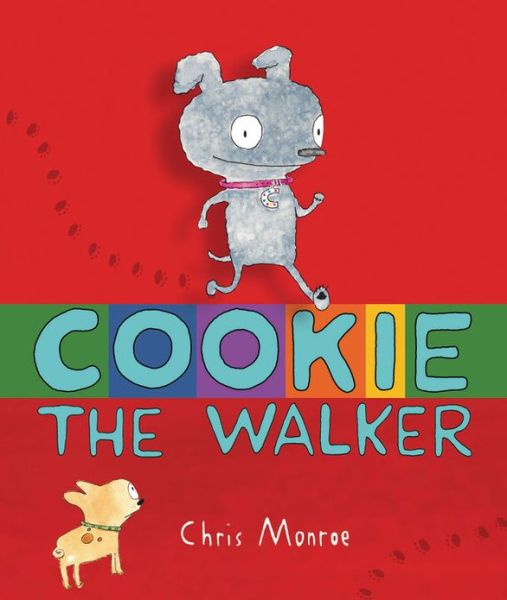
Cookie The Walker (Carolrhoda Books; 2012): Another new book from another favorite maker of children's books, this one's from writer/artist Chris Monroe (Sneaky Sheep, the Monkey With a Toolbelt series), and is one of her better books (Of interest to comics readers perhaps is the fact that this, like her previous works, are told in large part in comics, with panels and dialogue balloons and everything).
Our star is Cookie, a dog who walks, but not on all four legs. As she explains to her friend Kevin on page two, it is not uncomfortable at all, "And it's very handy!" On her hind legs, Cookie can reach the candy dish, look out the window, get herself ice cubes from the ice maker on the fridge door, and more.

What's more, people really seem to like looking at her walking on two legs ("It is pretty cute I guess...")

Soon, her walking on two legs draws the attention of a famous dog trainer, and Cookie gets a job, which brings with it fame and treats. One gig leads to another—a dog show, the circus, reality TV—and the more famous she gets, the more treats she gets, but all that fame and all those treats come at a great price, as she misses aspects of her life before she became Cookie The Walker, something Kevin reminds her of whenever he comes to visit.

Will Cookie throw it all away to walk on all four-legs again? That's the drama of the story, which is wonderfully illustrated with thin, slightly wiggly lines and delicate water-colors. Monroe excels at montages, and filling them either with a great deal or detail, or simply funny little riffs. Here's a page in which we see Cookie as "a big TV star," appearing in various generic reality TV roles:
I particularly like the ghost-hunting one.

Cookie The Walker is another great book from a great maker of great books. If you're only going to read one book discussed in this post, well, that's a silly and arbitrary rule to follow, but this might be the one you should choose to read.

Well this one, more maybe this next one...

The Dark (Little, Brown and Company; 2013): Writer Lemony Snicket teams with artist Jon Klassen (I Want My Hat Back) for a dream-team collaboration. The subject matter? One close to the heart of all children everywhere, as close to their little hearts as that which chills them. One of Snicket's better (and probably most serious) children's books, he writes about the relationship between a little boy named Laszlo and the dark, which lives in Laszlo's basement (although it is often nearby, in corners and closets and, of course, at night, it leaves the basement to spread itself all over the house).

Snicket quite elegantly writes every single, simple line, and he does so in such a way that most of them can have two meanings, so that what he writes is, in one way, quite literally true, but also sounds semi-mythological (like everything does in childhood).

Klassen's art pulls off a very neat trick, depicting Laszlo and the dark's house as "a big place with a creaky roof...and several sets of stairs" as a place unmoored from a particular temporal or geographical setting (this could be your house, and probably is), and of depicting the same locations within the house during the day and during the night, in the dark, in the light, and the dimness in between, transforming them as the dark transforms things, usually for the worse when you're a child. The words are arranged just so on many of the pages, the lettering itself shifting from black to white (depending on whether the page is light or dark, for a sort of perfection of impact (the line "it did," for example).

It's rare to read a book as an adult that speaks so directly and eloquently to the little kid you used to be. It's rarer still for me to read a book, wish I would have read it when I was a little kid and spend very much time at all wondering how that book and that act of reading it might have changed me for the better.

Hen Hears Gossip (Greenwillow Books; 2008): This picture book written by Megan McDonald is essentially a game of telephone framed as gossip being spread across the barnyard. Hen, who loves gossip, hears Cow and Pig talking, and tries to overhear their news. When she (mis)hears it, she runs to her fellow barnyard birds (apparently, the birds all gossip and hear worse than the mammals; I guess the latter may be because they lack exterior ears?), and the news is changed to something increasingly ridiculous, until it comes back as something insulting to Hen herself. The birds then trace the gossip back to its source, investigating each spurious claim (like the cat grew a horn, for example), until they find the truth.

It's a cute "gossip is bad" sort of story, one that offers a lesson that's probably as important to folks that work at libraries as it will prove amusing to little kids who visit libraries for picture books, elevated further by artist Joung Un Kim's delightful artwork, which seems to be assembled of mostly-painted over, re-used papers and cut-up shapes of wallpaper, so type-written words or the music from sheet music will appear along the edges or show through the art. Here are some examples, clipped from the pages and thus, unfortunately, alienated from their context.
I like it a lot. I also like the way she draws some the bipedal characters, like Duck's posture in this image:


The Kindhearted Crocodile (Holiday House; 2008): Writer Lucia Panzieri and artist AntonGionata Ferrari collaborate on a large, sharp-toothed, ferocious-looking crocodile who had a very kind heart (as is noted in the title) and whose dream in life was to become a family pet, like a goldfish or a puppy. Unfortunately for the crocodile, families tended to prefer goldfish and puppies to keeping one of the world's largest and most dangerous predators around the house, so he had to hatch a plan so weird it kinda blew my mind, and I'm still trying to figure out exactly how it worked.

The crocodile snuck into a family's house at night through the pages of an innocent-looking picture book called The Kindhearted Crocodile (Hey! That's this book!) and proved how helpful he would be by picking up, washing the dishes and suchlike. Curious to see who the mysterious, night-time housemaid was, exactly, the family hid, and were surprised when rather than the expected elf or goblin, a crocodile crawled out of a book to do the housework again.

The kids were immediately cool with the croc, as they knew him from his book, The Kindhearted Crocodile, but what was the story of that book, if it deviated so much from the story of the story book, which features the book itself in a pivotal role so very early on? And is the premise that there's only one such book, rather than a bunch? Because, otherwise, would the crocodile be able to crawl out of any copy of The Kindhearted Crocodile? If so, why didn't he crawl out of my copy? While I don't have any toys lying around that need picked up, I pretty much always have dirty dishes that need doing and laundry in need of folding, and I sure wouldn't object to a large reptile bringing me toast and jam and a cup of coffee every morning. What's the deal, crocodile? (And did he aks Panzieri and Ferrari to put him in this book, as a means of sneaking into the family or familes' homes...?

So many questions!

No question it's a great looking book though. Ferrari has a slightly sketchy style and composes figures with sharp, bold, energetic lines. The coloring isn't exactly haphazard, but it's not exact, either, and the crocodile's skin color changes like that of a chameleon, usually some form of speckled green, but sometimes he adopts very un-crocodilian colors, particularly when doing something domestic.

There are a few night scenes which are colored almost all black (the only color being the characters), while the lines the make up the house and furniture are drawn in white (and the color of type is white as well). It's a great-looking book.


The Little Matador (Hyperion; 2008): Writer/artist Julian Hector tells a simple tale of a little boy from a proud family of matadors (boo!), who had a secret passion for drawing that he hid from his parents, who expected him to grow up and carry on in the family business (so much so that they dressed him up like he was in the ring, like, every day; his dad similarly dressed like a matador dresses for work in every image, while his mom just dresses like a fancy Spanish lady—are ladies not allowed to fight bulls? Not that anyone should fight bulls, really). What he likes to draw best is, of course, animals.

I hesitate to say anything more about the plot, but it is, in one way, an echo to Munro Leaf's The Story of Ferdinand, only from the perspective of a bullfighter who doesn't want to fight bulls, rather than that of a bull who doesn't want to fight bullfighters.

Hector's artwork doesn't look much like that in the story of Ferdinand, of course, being much simpler and more abstract, and with very warm colors.


Otter and Odder: A Love Story (Candlewick Press; 2012) How's this for a Romeo and Juliet story? One day Otter, an otter, is looking for food and seems to find it when he finds a fish, but when he looks into the fish's eyes, he begins to fall in love, and asks the fish her name; she says "Gurgle," which he takes to be "Myrtle," and while she was simply looking not to be food, when she looked into Otter's eyes, she fell in love, too.

"Impossible," Otter tells himself, "I am in love with my food source."

Naturally, complications arise, although they mostly consist of otter society gossip and Myrtle's pleading with her otter not to eat her friends and family. Despondent, he swims off until he meets a wise beaver, who offers him an apple, which Otter refuses, asking Beaver if he's ever eaten a fish: "No," said Beaver, "but I suppose I might if I ever fell in love with an apple."

I suppose you can guess where writer James Howe's story goes from there, the writing is simple, but also clever and rather elegant, with almost every word chosen for usage being a word that really counts. After a few complications, it does finally reach a "happily ever after," presumably because neither Otter nor Myrtle want children.

The most striking aspect of the book is artist Chris Raschka's artwork, which is of a very studied, child-like look, in which the fish are triangle-on-oval simple, and the otter's head and body are a figure eight, his tail another, smaller figure eight. The entire thing looks done in crayon, as as if by a child (although the consistency of the imagery and design from page-to-page would make that fairly impossible. Even more simple shapes are used for backgrounds and animals without speaking parts.


That Is Not a Good Idea! (Balzer and Bray; 2013): Hey, it's Mo Willems again!

This non-Gerald & Piggie, pigeon-free* book from Willems is told in a form inspired by a silent movie, a particularly odd choice for a children's book, but then, getting that particular reference isn't necessarily necessary when it comes to enjoying the plot of the book, which revolves around a big, shocking (no seriously; I was genuinely shocked) ending.

A page of art, starring a well-dressed fox and a goose, will be followed by dialogue in an old-timey font, the white text atop a black, silent movie-style title card. The artwork featuring the goose and fox is in full-color, deviating somewhat from the illusion of a silent movie.

As the male fox courts the female goose, inviting her back for a walk in the woods, and then back to his place, and then for soup, a group of goslings, which Willems draws like yellow tennis balls with beaks, dot eyes and triangle wings, yell back at the movie, variations of the title.

For example, when the fox asks the goose, "Would you care to continue our walk into the deep, dark woods?" and the goose replies, "Sounds fun!", Willems will shows us a two-page spread of the goslings, one of them shouting "That is REALLY not a good idea!" at the "screen," as if they're watching the movie the fox and goose are starring in. Kinda like people watching a horror movie and yelling to the protagonist not to go into the basement alone.

The ending is something of a surprise, although there are actually a couple of surprises all braided together into it, none of which I should even think about spoiling here.

Suffice it to say that this is a new Mo Willems picture book, and it's hard to imagine anyone needing much more information than that to know if this is a book for them or not.


This Is Not My Hat (Candlewick Press; 2012): I Want My Hat Back's Jon Klassen further establishes himself as the number one creator of picture books about small animals stealing hats from larger animals. The differences between this book about hat theft in the animal kingdom are many.

First, it's told from the perspective of the thief, rather than the victim. Second, it takes place under water, the cast including only the thief (a fish), the victim (a much bigger fish) and a witness (a crab). And third, the hat is a little, blue derby rather than a little red, conical hat.

Like, I Want, it is very funny, and Klassen does an incredible job of showing big or slight shifts in emotion with slight variations of the drawings of the characters, as when the large fish, for example, wakes up, realizes his hat is missing and we see his immediate reaction.
I'm glad Klassen won the Caldecott for this, because he's a great artist and a funny writer and desrves all the medals he can get, but boy does it's placement really transform that cover, as not it looks like the hat-thieving fish is fleeing not the scene of the crime, somewhere in the deep, black, mysterious ocean, but is instead fleeing the Caldecott medal. Did he steal the Caldecott's hat...?!


*Save for the now customary, half-hidden cameo, of course

My last post on Superior. I promise.

Mark Millar tends to write a lot about political issues, and even includes actual, real-life politicians within his comics (President George W. Bush and members of his cabinet appeared in both The Ultimates and Civil War, for example, President Barack Obama appears in Superior), and war often plays a big role in those comics. But, based on the comics he writes, I have a hard time discerning what sorts of politics Millar himself might hold, aside from being very pro-Millar and very pro-capitalism, particularly in that it can help enrich Millar.

Take Civil War, for example, which was discussed and even, to some extent, sold as a timely dramatization of the post-9/11 security vs. liberty debate as seen through the lens of Iron Man and Captain America punching each other.

Millar cast the security side of the debate as the bad guys, clearly aligned with the Bush administration, the first issue ending with a scene of a trio of Marvel's science dickheads—Iron Man, Hank Pym and Mr. Fantastic (who had just recently been outted in someone else's dumb comic as pro-Joe McCarthy)—promising to capture Captain America and force him and all the other recalcitrant superheroes to sacrifice their liberty in the name of security. They immediately start abusing the constitution, killing someone for resisting an unlawful arrest and even building a superhero version of Guantanamo Bay to indefinitely defer the likes of lawyer-by-day, superhero-by-night Daredevil.

So they're the bad guys, right? But in the last issue, the heroes of 9/11—a sort of Village People version of first responders—tackle Captain America and make him realize that he's the real villain, so he gives up, and Iron Man makes a smug speech about how extra-constitutional power is okay in this instance, because he's a smart guy who will do the right thing with it, so no one should worry.

In the security vs. liberty debate the book was supposedly about, all I could definitely tell about Millar was that he was in favor of Captain America surfing on jet fighters, Goliath getting killed by a robot clone monster and selling as many comics as possible by weird, random, almost-immediately reversed stunt plot points like Peter Parker revealing his secret identity to the world and the dead-from-cancer Captain Marvel appearing out of nowhere all of a sudden for some reason.

The politics of Superior aren't very clear, either, although it's not as concerned with politics as Civil War or any of Millar's Ultimates works have been.

There's just this one scene that sort of sticks out, like a rough edge from an early draft Millar forgot to smoothe out.

Superior, the Superman-analogue who was once a 12-year-old boy with multiple sclerosis named Simon who wished himself into Superman when a little talking monkey in a astronaut's uniform appeared and offered to grant him any wish, is talking to Chris, his only confidant:
Simon's mom was always praying that "America would get fixed again too." Simon/Superior thinks perhaps America really "needed" a superhero at that moment in time.

It's weird because those statements aren't really based on anything we see within the context of what has come before, nor are they really touched on later in the story, after he tells Chris he wants to start doing more to really change people's lives for the better.

Now, at almost any point in American history it's easy to imagine a person, especially a grown-up adult, saying that America needs to be put back like it used to be. It's an essentially conservative position, just by definition of the word conservative, but Simon/Superior never elaborates on what his mom thinks specifically needs fixed again: The economy? The war? Eroding social services and the safety net they provide for the poor? The loss of civil liberties to President Bush and Iron Man? Too much liberties for gays? Too easy access to birth control and abortions? A black guy being president?

No clue.

Prior to that statement, the only things Superior really does to help America are prevent accidents, usually in rather dramatic fashion—he catches a falling space station, he stops a speeding train with his bare hands (although it woulda been easier to just move the dude off the tracks before the train could hit him), he drags a lost Russian submarine to land, he carried off a nuclear power plant reactor as it was melting down, he threatened the bullies that picked on him and Chris and, we're told, he prevented every single accident and crime in New York City for three years.

Perhaps that was what was wrong with America, in his mom's view? Too many accidents and urban crime...?

After Superior meets with Obama to talk to him "about winning the war in Afghanistan," Superior goes ahead and does it solo in a single night's work (one suspects Millar doesn't have the greatest grasp of what the "war" in "Afghanistan" actually entails; here it is basically just a bunch of easily identifiable by X-Ray and telescopic vision Taliban members who can be easily captured and arrested by a Superman). The rest of his super-deeds take place in a two-page montage, in which he helps other countries, like preventing a earth quake in China and a flood of the coast of Australia, and brings "more food and volunteers in a single afternoon than citizens expected to meet in a lifetime..."

So perhaps that was what was needed in America? America needed to be the world's policeman, the world's fireman, the world's aid worker, but it needed to do so infinitely better than it had been doing...?

I don't know. I don't suspect Millar does either. It was just a few errant lines of dialogue setting up a tease about the nature of Ormon. But it's a strange reference that asks a question and then never provides an answer.

Saturday, July 20, 2013

Meanwhile, Superior and "Trinity War"...

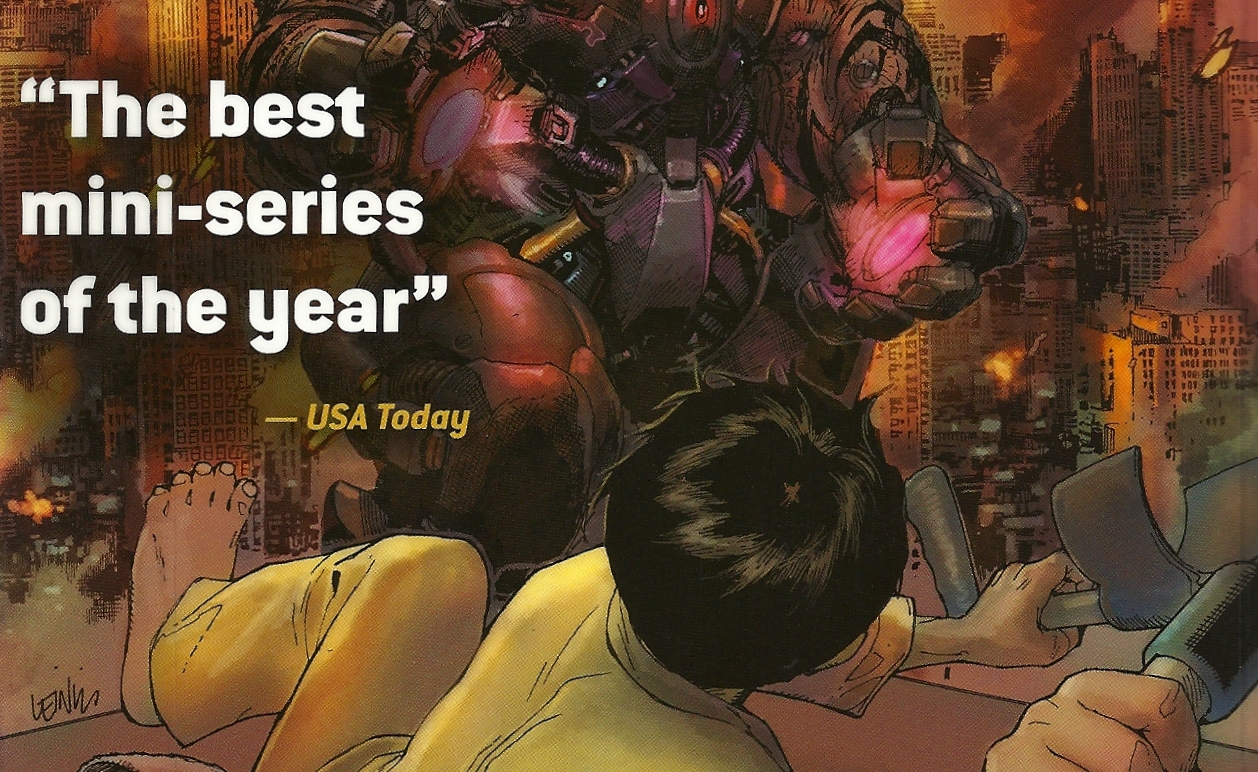
"Well, it looks like someone who writes for USA Today only read one miniseries that year," I thought to myself when I saw this blurb on the back cover of the trade paperback collection of Superior...and that was before I read it, and realized just how creative bankrupt and just how derivative of the Superman character and story the book really was. In essence, it's an elevator pitch for a high concept Superman Elseworlds story—"What if Superman were real?" with a pair of M. Night Shyamalanian twists thrown in (I wrote about Superior this week at Robot 6, if you'd like to read my take on it; given Man of Steel being in theaters now and the sequel to Kick-Ass, which is being produced by the dude who made the first Kick-Ass and has the movie rights to Superior, I thought it a good occasion to take a look at Millar's latest movie pitch-as-comic book series).

Anyway, after I read the book I was even more curious about that "best of the year" blurb on the back, and wondered if maybe Marvel hadn't unscrupulously edited something in a USA Today article to arrive at it; like, perhaps it was an interview with Millar, who said "I guarantee you: Not only is this the best mini-series I've ever written, but it's going to be the best mini-series of the year" or something Millar-esque like that.

So I did some Googling, and it turns out that that is really a real, genuine quote from a real, genuine writer for USA Today! In comes from his end-of-the-year/best-of-the-year piece from 2011, which you can read here.

The writer had this to say of Superior, which won his "Best miniseries" category:
Mark Millar is a master of off-kilter superhero comics—Wanted, Nemesis, Kick-Ass—and, with artist Leinil Yu, mines the theme of wish fulfillment in the story of a boy with multiple sclerosis who gets the chance to be his favorite do-gooder. The rub: The alien monkey giving him the powers is a demon, and the kid has to sell his soul to the devil to keep his new abilities. Everybody wants to be a hero, but Millar deftly explores the consequences of that gift
The only part I actually agree with in that paragraph is the plot-summary, and the last sentence is really hard to swallow. The price of being a hero? For protagonist Simon, it means either selling your soul to Satan to be a literal superhero, or not selling your soul to Satan in order to magically be Superman but instead remain yourself to be a figurative hero. For narrator Madeline Knox, it means potentially sacrificing a potential Pulitzer Prize for not taking advantage of a 12-year-old kid in a state of shock.

The only real hero who pays any kind of price is Simon's best friend Chris, who endures getting made fun of by some school bullies for hanging out with Simon.

Off the top of my head, I can't think of any non-Flashpoint miniseries that came out in the calendar year 2011, so I'm not ready to offer a 60-title deep list of miniseries that were much, much better than Superior by being, you know, any good at all. I think it's worth noting that of the 35 categories the USA Today writer offers, all of 'em go to direct market superhero comics, or genre comics involving super-powers and/or super-science and/or supernatural elements, even the ones that say "non-superhero" in the category.

For example, the non-Marvel, non-DC super-stuff includes Image's Strange Tale of Luthor Strode (its writer, Justin Jordan, was named "Best new writer"), Gladstone's School For World Conquerers ("Best book you may not be reading") and Chew (artist Rob Guillory was the "best non-superhero artist"), IDW's Locke & Key ("Best ongoing series") and Dark Horse's Mignola-verse business (The fictional B.P.R.D. got "Best team, non-superhero category"). To use a media-to-media comparison as Tom Spurgeon often does when writers discussing "comics" focus entirely on a single genre, this would be a bit like a writer covering television for a national newspaper coming up with 35 categories and choosing to award 30 or so of them to network police procedurals, with the remainder going to shows that are about private investigators.
Then again, the headline was "From 'Flashpoint' to 'Fear Itself,' the year in comics 2011" (In other words, "From DC Comics' major, line-wide event comic book series to Marvel Entertainment's major, line-wide event comic book series, the year in comics 2011"), and he named Flashpoint—Batman: Knight of Vengeance #2 the best single issue of the year (that's the comic in which it was revealed that in an alternate reality where Bruce Wayne was shot instead of his parents, his dad became Batman instead and his mom became The Joker for some reason).

So given that pool of comics, I guess What If...Superman dressed slightly different and we called him "Superior" so as to not get sued by DC? might seem like one of the more daring comics concepts of the year, and certainly Yu's a pretty great artist compared to about half the scrubs who turned out a bunch of really shitty-looking Flashpoint art (To be fair, the Batman Flashpoint had some pretty great art in it, despite the silliness of the storyline).

Anyway, I was just amazed to see that something that I regarded as one of the worst miniseries I've ever read being singled out as the best of a particular calendar year by a writer with such a widely-read (if not exactly prestigious or reliable for astute criticism) venue.

It takes all kinds, I guess; even jerks like me.

Aside from writing about Superior, which I promise I'm almost done going on-and-on about (maybe one more short post and then I'll be done, I swear), I also wrote about the second official installment of DC's "Trinity War" crossover story for the second second official installment of my ComicsAlliance series "Trinity War Correspondence." Go read it, please (Or just click on the link; page-views are the coin of the realm).

And since we're talking about weekly contributions to Robot 6 and "Trinity War," you should totally check out Tom Bondurant's column on the first few installments, as it is better, more knowledgeable and more even-handed than, like, everything I write.

Thursday, July 18, 2013

Marvel's October previews reviewed

If you thought my post on DC's October solicits was late then you ain't seen nothing yet! Here's the even later post on Marvel's October solicits, which you can find in full here.

Let's get right to it, as it's Thursday night, about a week since these were originally released for public consumption, and everyone interested in comic books who isn't in San Diego right now is probably eyeballs deep in comics news anyway...


DAREDEVIL #32
MARK WAID (W) • CHRIS SAMNEE (A/C)
THOR BATTLE VARIANT COVER ALSO AVAILABLE
• The Man Without Fear--trapped in a nightmare situation!
• Something final is building in Daredevil’s life--and building fast!
32 PGS./Rated T+ …$2.99


Thor Battle Variant Cover Also Available? Who would want a Thor battle variant cover when the regular cover has all of Marvel's Universal monster analogues on it?

Ooh, unless the Thor Battle variant cover has Thor battling Daredevil and all those monsters on this cover...?


Nice cover for Deadpool #18, Declan Shavley.


Well, that's two more issues than I expected it to last, anyway.


GUARDIANS OF THE GALAXY #8
BRIAN MICHAEL BENDIS (W) • FRANCESCO FRANCAVILLA (A/C)
...
INFINITY TIE-IN
• What will it take for Peter Quill to betray the entire Marvel Universe?
• And if you don’t know Eisner award winning artist Francesco Francavilla yet, you will after this comic!
32 PGS./Rated T …$3.99


Oh come on now, do any of you really not know who Francavilla is yet? Shame on you. Shame on you.


INFINITY #5 (of 6)
JONATHAN HICKMAN (W) • JEROME OPEñA & DUSTIN WEAVER (A)
Cover BY ADAM KUBERT
...
• The Avengers Universe.
• The Heroes of Earth rally to defeat Thanos.
• The war for Earth begins.
32 PGS./Rated T+ …$3.99


"Begins"...? In the fifth issue of a six-issue series? Man, that's gonna be a pretty short war. What have they been doing the last four issues, if not fighting...? It has Hickman's name in front of the W, afterall, not Bendis'...


MARVEL FIRSTS: THE 1980S VOL. 1 TPB
Written by HOWARD CHAYKIN, DENNY O’NEIL, BILL MANTLO, TOM DEFALCO, BRUCE JONES, STEVEN GRANT, MARK GRUENWALD, BOB LAYTON, CHRIS CLAREMONT, JO DUFFY, JOHN BYRNE, JIM OWSLEY & LOUISE SIMONSON
Penciled by HOWARD CHAYKIN, STEVE DITKO, JOHN ROMITA JR., GIL KANE, BOB LAYTON, FRANK MILLER, RICK LEONARDI, BOB MCLEOD, BRET BLEVINS, JOHN BYRNE, MARK GRUENWALD, PAUL SMITH, JOHN BUSCEMA, GEORGE FREEMAN & JUNE BRIGMAN
Cover by VARIOUS
Roll up your jacket sleeves, and dust off your Rubik’s Cube as Marvel heads back to the eighties! From Alpha Flight to Zabu, heroes old and new grab the spotlight in their own titles in this first classic collection of the decade’s most dazzling debuts! All your favorites are here — including Dominic Fortune, Captain Universe and the New Mutants — plus Marvel’s first “event” miniseries! Collecting material from HULK (1978) #21, MARVEL SPOTLIGHT (1979) #9, DAZZLER #1, material from KA-ZAR THE SAVAGE #11, MARVEL SUPER HERO CONTEST OF CHAMPIONS #1, HERCULES (1982) #1, WOLVERINE (1982) #1, VISION AND THE SCARLET WITCH (1982) #1, MARVEL GRAPHIC NOVEL #4, SAGA OF CRYSTAR: CRYSTAL WARRIOR #1, ALPHA FLIGHT (1983) #1, HAWKEYE (1983) #1, CLOAK AND DAGGER (1983) #1, FALCON #1, MAGIK (1983) #1, JACK OF HEARTS #1 and POWER PACK (1984) #1.
472 PGS./Rated T+ …$34.99


Collecting all the first issues of a bunch of comics from a certain time period strikes me as a pretty cool idea (Although, hey, some of those numbers aren't 1s!), even though I'm not really interested in this particular book.


SUPERIOR SPIDER-MAN #20
DAN SLOTT (W) • GIUSEPPE CAMUNCOLI (A/C)
VARIANT COVER BY Milo Manara
• From the fallout of NECESSARY EVIL, comes new beginnings and new twists that will be felt in the pages of Spider-Man for years to come! SUPERIOR SPIDER-MAN #20 is where it all starts! Do NOT miss this one!
• It’s the first ever adventure for the Superior Spider-Man and the Black Cat. Felicia Hardy always cared for the Spider more than the man. But what happens when that man is Otto Octavius?
• Plus: A day Otto has been waiting for is finally here. Is the world ready for “Dr. Peter Parker”... and what he plans to do next?
32 PGS./Rated T …$3.99


I didn't think of it until seeing that cover image, but it really makes sense that if Doc Ock was in Spidey's body these days, he would augment it with four-more mechanical limbs. Nice to see he built four of 'em too, instead of three, as Tony Stark built for Spider-Man during the pre-Civil War (antebellum?) period in which Spidey was wearing the maroon and gold "Iron Spidey" suit, with its three spider-legs, giving him seven limbs total.

I know there was a whole story arc during Matt Fraction's Invincible Iron Man run about whether Doctor Otto "Doctor Octopus" Octavius was smarter than Tony "Iron Man" Stark or not, but based on their ability to count the number of limbs on a spider, I'd say Doc Ock's got the bigger brain.


Clever cover for Superior Spider-Man Team-Up, Paolo Rivera.


THOR: THE CROWN OF FOOLS
THOR & THE MIGHTY AVENGERS
MARVEL UNIVERSE THOR DIGEST
MARVEL UNIVERSE THOR COMIC READER #2
THOR VS. THANOS TPB
THOR: THE WARRIORS THREE — THE COMPLETE COLLECTION TPB
THOR: SUNLIGHT & SHADOWS TPB
JOURNEY INTO MYSTERY FEATURING SIF VOL. 2: SEEDS OF DESTRUCTION TPB


That's an awful lot of Thor collections being released in October. What, is there some sort of movie or something coming out...?


THUNDERBOLTS #16 & 17
CHARLES SOULE (W)
JEFTE PALO (A)
Cover by JULIAN TOTINO
TEDESCO
INFINITY TIE-INS!
• The ’Bolts’ “Perfect Plan” is going off the rails in Thanos’ wake!
• One of the Black Order sets her sights on the Red Leader!
32 PGS. (EACH)/Parental Advisory …$2.99 (EACH)


To be honest, I'm a little surprised they haven't retitled this book The Avengerbolts yet (Similarly, that Fearless Defenders isn't Fearless Avenders yet).


ULTIMATE COMICS SPIDER-MAN #28
BRIAN MICHAEL BENDIS (W)
DAVID MARQUEZ (A/C)
“SPIDER-MAN NO MORE” CONCLUDES
• The end of the first chapter of the MILES MORALES saga
• Miles discovers one of the big secrets of his origin.
• Guest starring CLOAK AND DAGGER and SPIDER-WOMAN
32 PGS./Rated T+ …$3.99


Woah, woah, woah—the twenty-eighth issue of this series is the end of the first chapter?! Not content with being the king of decompression, Bendis is apparently making a bid to become the god of decompression.

Tuesday, July 16, 2013

Man of Steel thoughts

—I arrived pretty late to a 6:55 showing. I live only a few minutes walk from a movie theater, so I didn't even leave my house until 6:56, figuring the excessive amount of previews would give me the time cushion I needed not to miss anything. When I walked in, I saw some some big elephant-esque animal in the foreground and a spaceship in the background on the screen, and wondered what movie this was a preview to. Turns out it was Man of Steel, already underway, and I'm not sure how much I missed. I hope what I missed was Jor-El and Lara and their baby hanging around the house with their dog Krypto. Otherwise, this movie was Krypto-less. And if Jor-El can have a four-winged Avatar dragon pet to fly around on, he can have a Kryptonian space-dog.

—I liked how much they set on Krypton at the beginning, and think it was a smart to choice to go so hard in the direction of science-fiction for the trappings of this film (and by science-fiction, I just mean spaceships and lasers and robots and aliens and shit, not like, whatever the actual, literary definition of science-fiction is, according to people who give a shit about such things). It certainly helped differentiate this Superman film from all the previous ones (as did all the action, violence and destruction) and from so many of the other superhero films that have been made between the original cycle, Superman Returns and this one. So many of the superhero movies have been superhero-genre movies, that making Man of Steel a superhero/sci-fi film seemed like a good choice (Similarly, I think Captain America benefited from being a superhero period piece).

—That said, I was a little disappointed by how unimaginative and generic Krypton looked. It basically looked like every non-Star Wars American live-action science fiction movie made since, I don't know, when did Alien come out...? Or maybe Dune? No color, generic metal junk everywhere, the same damn sound effects on everything. It was drab, with the possible exception of the funny hats the council people wore, and looked just like the locations in, I don't know, Chronicles of Riddick or something.

I don't know that a straight Silver Age Krypton woulda worked, or a John Byrne version either, but it seemed lacking in imagination and didn't really pop as a distinct place.

—Russell Crowe was really good, I thought. Maybe it was just the beard and the accent, but I thought he did a real Sir Alec Guinness job of classing up a big, stupid summer movie.

—I liked when Jor-El put on his armor to Jason Bourne-fight General Zod, who had his suit of armor on, and neither of them wore helmets of any kind. Had this advanced society neglected the invention of a way to protect one's head when one gets in a fist-fight wearing metal from the neck down...?

—Krypton must have the most expensive, most inefficient criminal justice system in the universe, if it literally involves shooting their criminals into space, artificially creating a black hole and shunting them into it.

—Henry Cavill was very handsome, whether bearded, shaven or wearing a light frosting of scruff. A lady I worked with said she found the movie long, boring and remarkably humorless, and it would have been a complete waste were Superman not so easy on the eyes. I think he did a fine job playing this version of Clark Kent, who apparently spent 33 years brooding, and a few weeks fighting aliens.

—I liked the flashbacks to his childhood, rather than having to sit through all that again in another movie, especially since everyone on Earth knows Superman's basic deal at this point, thanks to some 40 years worth of movies and his almost continuous presence on television since, I don't know, my dad was a little boy, maybe...?

—High-five to the casting directors who found all those kids to play Clark at various ages. I thought they did a good job of finding kids who basically all looked like the same person at the same age, and weren't annoying.

—Fat, ginger Pete Ross was a bit of a surprise. A bigger surprise, really, than Smallville's black Pete Ross.

—I wasn't terribly impressed with Amy Adams' Lois Lane. But then, I didn't like her Lois any less than Kate Bosworth's. I'm not terribly familiar with any of the TV Lois Lanes, and while Margot Kidder was the best of the movie Lanes, in my estimation, she's still not the Lois Lane that exists in my head, or that the comics suggest to me—that Lois Lane is essentially Rosalind Russell from His Girl Friday. Of all the non-comics Lois Lane's I've seen, I think the Bruce Timm-designed, Dana Delany-voiced version from the 1996 cartoon version, Superman: The Animated Series, is probably the best.

—Hey, Detective Stabler!

—I am totally okay with Perry White being played by a black guy, but I am not okay with Perry White having a diamond earring.

—Laurence Fishburne did fine, but like every other character in the movie, he lacked much personality, and didn't seem like himself: He didn't say any of his catch phrases, he didn't yell at Jimmy Olsen, he didn't even seem gruff.

—And speaking of Jimmy Olsen, WTF Man of Steel...? I suspect that he was in an earlier draft and became Rebecca Buller's Jenny at some point, perhaps to get another female character in the cast instead of another dude...? That would be cool if DC then publishes a comic entitled Superman's Gal Pal Jenny Olsen or Superman's Totally Platonic Friend Jenny Olsen.

—Kevin Costner's Pa Kent's "maybe" line doesn't sound any better in context.

—And his death by tornado was just silly. I get what they were going for—Superman feeling guilty for not acting, even though he was obeying his father's dying wish—but jeez it made Clark seem like a horrible, horrible person. Man, I woulda ran out there for my dad, and I'm not even indestructible. Maybe if they staged it so that he had to choose between his mom and dad and his dad told him to choose his mom? Or...I don't know. I think this panel from a part-comics/part-prose illustrated review Ryan Alexander-Tanner did for Bitch sums up the silliness of that scene pretty well, though:

—Superman's new costume looked much better on film, in the film, than it does in stills and promotional images and print ads. The darker colors, the weird wristbands, the lack of shorts and yellow belt all made it look more like the costume of an evil alternate Superman from an Elseworlds or possible future (ditto the New 52 suit, with it's high collar and and armor-like appearance) but it looked a lot better here than I expected, given what I'd previously seen. The only really distracting part was the weird belt-like part that hugged his ribs—it made it look like he was wearing some sort of girdle.

—I think using the Kryptonian villains as the first villains in a new Superman cycle of films (if this one makes enough money, I guess) was a bold choice, but probably a good one. It's kinda what they did with the last Batman cycle (building up to his archenemy in the sequel) and it seems to be the approach they're taking with the just-rebooted Spider-Man cycle, with minor villains like The Lizard and, next, Electro in the mix, while Norman Osborn is mentioned and lurking in the background.

—That said, I think it was a mistake to go completely Luthor-less (other than a "Lexcorp" logo on a truck in the background of one scene). I'm not sure where they could have fit him in, exactly, maybe alongside Dr. Emil Hamilton as a more hot-headed, arrogant, fuck-this-alien-guy assistant or co-worker of some kind, and it might have slightly warped the plot a bit, but I guess they could have cut out like 15 minutes of office buildings exploding and collapsing, or some of the crasser 9/11 allusions, to make room for Luthor.

If they make a second one, and they put Lex in it, he's certainly gonna have a pretty good, pretty compelling motivation in hating Superman, as there's a pretty compelling argument to be made that Superman is an alien menace who almost brought about the complete destruction of Earth (even if by accident) and killed, I don't know, thousands and leveled a large portion of Fake New York (Seriously, right before the climactic battle with Zod, Metropolis looked like a wasteland, with only four Daily Planet staffers surviving). (Also, he coulda lost his hair when he got doused in chemicals or set on fire during one of the many fights, thus keeping his comic book origin intact!)

—A lot of the hand-to-hand fighting was clumsily staged, particularly the Jor-El/Zod fight at the beginning, and, oddly enough, the Superman/Zod fight at the end. Matrix Revolutions probably had better Superman fights in it than this Superman film did. The best action scenes by far were probably Faora's super-speed kung fu.

—I was amused to see Clark Kent take a swig of a Budweiser while visiting his mom at the farmhouse, given the fact that DC changed that one cover from that one storyline that heavily-inspired this movie (Along with Superman: Birthright and, I think, some of Kurt Busiek's post-"One Year Later," pre-New 52 run) so that rather than sharing a beer with his father, Clark was sharing a "Soda Pop" brand soda pop:

—I didn't really understand how the yellow sun (Well, they say "young sun" and atmosphere/gravity of earth here) works on the Kryptonians; I thought Superman was so powerful (more powerful than Jor-El calculated) because he was there sucking up solar energy for 33 years, whereas the bad Kryptonians just arrived and were as powerful as Superman lickety-split. I didn't get a lot of the "science" in this though, to be honest.

—Tonight was the first time in my entire life I thought the phrase "Eye-beam him, you idiot!" It was when Zod was down for the count, his senses being overwhelmed by his sudden acquisition of super-hearing and super-vision powers, and his men came to drag him to safety on their spaceship, while Superman just kinda stood there looking at them, not blasting them with heat-vision. Than the U.S. military came and blew up half of Smallville with missiles.

—The collateral damage in this film was just ridiculous. Perhaps because it was a Superman film, and I'm so used to him getting into super-fights with zero civilian casualties from the comics. The last Superman comic I read was Superman Unchained #2, in which he figured out a way to stop a skyscraper full of civilians from crumbling without any of them getting killed during less than twenty seconds, while fighting a giant robot.

—If they do make a sequel, I'm not sure what they'll do as far as giving Superman someone to fight, like he's got here. I mean, I know he's got a rogue's gallery of other super-powered folks to fight, and I suppose they could have Luthor build a Bizarro clone or Brainiac a super-robot body or have one or the other of those two manufacture Doomsday, but with the Phantom Zone villains kayoed, most of the biggest names in Superman's rogues gallery are thinkers and/or 5th dimensional imps, which won't allow for all the punching and and car-throwing we get in this first movie, and generally sequels get more and more action-packed, right...?

—I wasn't as upset by the fact that the climax turned on a sort of 9/11-from-space sequence as at least one of my favorite comics bloggers was (that is, I didn't walk out of the theater; but then, I was in Columbus, Ohio on September 11, 2001—hundreds of miles, seemingly worlds away from the ash-covered, terrified New Yorkers running for, jumping for and losing their lives), but I think Snyder went way too overboard with it. I've seen American cities similarly decimated by alien invaders in a couple of similarly huge summer movies since 9/ll—L.A. in Battleground: Los Angeles, Chicago in Transformers: Dark of the Moon and Manhattan in Avengers come most immediately to mind—but they weren't as obvious nor as ham-fisted in their appropriation of imagery from the 9/11 attacks. I'm not even entirely sure why those scenes are even in the movie, save to give more screen time to the Planet staffers, and to give them something active to do.

It's possible that Snyder and his screenwriters wanted to tie the origin of their new Superman into some sort of 9/11-inspired zeitgeist, but they just did a really poor, really clumsy job of it. Not unlike their efforts to make Superman seem like a Christ-like, savior figure, even right down to his age, his turning the other cheek, his fully human-but-fully god(-like) nature and even framing his face with a stained glass window image of Jesus in a few shots. I mean, yes, they made him pretty Christ-like in a lot of respects—right up until the point where rather than giving himself up to be sacrificed, he rebels, beats the shit out of all his foes and kills a dude. It woulda been like if, in Passion of the Christ, Jesus tore himself off the cross, beat up the Roman Empire, and then snapped Pontius Pilate's neck.

—And speaking of neck-snapping...

What the fuck was that all about? I agree with Chris Sims pretty much 100% here. Fans could argue over what Superman could have or should have done in that instance (I would suggest maybe cover Zod's eyes with his own invincible hand, or turn Zod around so his eye-beams weren't gonna hit those people...dude was able to fly straight up through the gravity beam that was terraforming earth and out-fly a collapsing black hole or whatever by trying really hard; he couldn't push Zod's face into the pavement by gritting his teeth and trying?), but, as Sims pointed out, why on earth would the writers and director put Superman in a position where he had to kill a dude anyway?! They're controlling all the circumstances, after all; have the Phatom Zone hole stay open slightly longer, and have Superman and Zod fight it out until it culminates in Supes tossing Z in right before it closes or something. Jeez.

It was just weird and unnecessary and out-of-place—as Sims pointed out, having Superman execute a guy (which is something Kryptonian society doesn't even do!) on the spot is probably one of the few things they could have done to make a creepier, more morally dubious Superman than the deadbeat dad one trying to break up Lois' engagement to Cyclops and super-stalking her family in Superman Returns.

—Another bold decision was that of keeping Clark Kent out of the equation until the very end. Well, I mean, young Clark Kent is in this, and everyone calls him Clark, but he doesn't become a reporter until the very end of the movie. That's the first time I felt let down by Cavill's performance, by the way (Well, that and the weird exertion faces he made when he was trying to Superman really, really hard). Christopher Reeve completely transformed himself in terms of mannerisms, voice, posture, everything when he went from Clark to Superman to Clark again; Cavill seriously just wears glasses.

—Say, did they actually go this entire film without making any reference to kneeling before Zod? Because that's some accomplishment. No one ever passes up an opportunity to quote or riff on that line...

—I do hope they make a second one of these, if only so they can make a third or more, because I really wanna see some of Superman's other great enemies make it into a film someday, and so far all we've gotten are Luthor, Luthor and the Phantom Zone criminals, a fake Luthor, Luthor and Nuclear Man or whatever, Luthor, and The Phantom Zone criminals again. I'm ready for some Brainiac, Bizarro and (fingers crossed!) Mxyzsptlk some day.

—Ryan Reynolds didn't show up in a teaser mid-way through the credits to ask Superman if he ever thought about forming a League of some sorts, did he? Because I didn't stick around, as the Marvel movies have trained me to do.

—Speaking of the credits, if they're not going to use the Superman theme from the original cycle, or some new version of it, would it really kill them to, like, think of a new theme? This movie had a score of sorts, but unlike that of the originals—or Star Wars ( both trilogies) or Indiana Jones, movies whose themes have been in my head almost my entire life, or the original Batman films, which has been in my head my entire adult life—I can't remember a single bar of the music from this movie I just got done watching about a half hour or so ago.

Sunday, July 14, 2013

Millar, Superior and "The R-Word"

How can a reader tell when something written in a work of fiction represents the author's viewpoint and when it is merely dialogue the author is using to represent the viewpoint of his characters?

That's a tricky question to wrestle with, and, personally, I don't see any reason to ever assume the latter over the former with any degree of confidence.

That said, when an author has three very different characters use the same increasingly rarely used, no longer socially acceptable, completely un-PC term three times in the same relatively short story? Well, that at least can make a readers suspicious of the author.

I bring this up because I just read a trade paperback collection of Superior, the 2011, 7-issue Leinil Yu-penciled series that Marvel Entertainment published on their creator-owned/keep-Bendis-and Millar-happy-at-all-costs Icon imprint. It was written by Mark Millar, no stranger to having folks arch their eyebrows at the words of his narrators and characters and getting uncomfortable about the degree to which the characters speak for the author.

If you haven't read it—and you needn't—Superior is either a rejected pitch for a Superman comic that DC didn't like as much as Millar's Red Son, or it's an idea for a Superman story that Millar had but realized if he just changed some characters and costumes (here, extremely slightly) as he did with Wanted, he could get away with using DC characters for another publisher, and reap the financial reward of the book and/or the movie adaptation. (This isn't a review of the book; I'll get to that in the near future, but this one aspect struck me as so strange and made me so uncomfortable, I thought it worth noting in its own post before proceeding to the formal aspects of the comic and assessments of the overall quality).

This is the narrator of the book, the Lois Lane character Madeline Knox, who starts narrating about halfway through the first issue, but isn't actually introduced until this scene in the third issue:
While there's no indication of how old she is, it would be safe to assume by her profession—a popular, New York City-based television journalist and newscaster—and her success in that field that she's no younger than her mid-twenties, and more likely somewhere in her thirties. In other words, awfully old to still be casually using the word "retard" (Particularly in front of strangers in public, I imagine).

In her defense, she does tell the reader, just two pages prior that, this scene takes place "Back when all I cared about was how much I weighed and what my ratings were...I don't think I was a very nice person back in those days."

No, she doesn't seem like it, and I suppose ranting and raving about "a retard convention" is a decent shorthand to prove just how not a very nice person she was "back in those days" (a strange turn of phrase, since the point in time she's narrating from is just a few weeks later).

Here's another character in the book from a big "twist" scene a few issues later. He's Ormon, and he is a (spoiler, if you do wanna read this book and experience as its writer intended it to be read) demon from hell:
As a demon from hell, I suppose it's not surprising that an evil character would use any hurtful word, although as a 500-year-old demon from hell*, it's a strange example of word usage. "Simpleton" or "fool" sure sounds more like something a demon from the late 16th century might say. Then again, he's talking to a 12-year-old boy, so maybe he's using their language (Do 12-year-old boys still say "gay" and "retarded" to mean "anything negative in any general way," like I, to my shame and regret ,used to when I was in grade-school? Or have those words and their usage in that way been pretty much stamped out?)

Here's another character from the book, an actual 12-year-old boy, although through the infernal powers of Ormon he's been transformed into Superior's arch-villain Abraxas (While the word "Abraxas" has origins that pre-date comics by centuries, it's worth noting that both Marvel and DC have villains named Abraxas; the DC version spelled his name "Abraxis" and appeared in 1992's Armageddon: Inferno, while the Marvel one appeared in a Fantastic Four annual from 2001):
So that's three characters in seven issues saying some derivation of a word I haven't heard spoken since...Tropic Thunder, maybe...? And that I don't think I've ever read in a superhero comic published by Marvel or starring Superman, but I could be wrong. (Actually, I'd bet some money it was used in Millar's Kick-Ass more than once, although I only made it about half-way through that miniseries).

Anyway, three seems a lot for a comic book published in 2011.

*Now that I think about it, maybe he's not 500-years-old, but merely hasn't been able to convince anyone to sell a soul to him in 500 years, and he's actually the same age as all demons; the comic doesn't get too deep into demonic biology or the cosmic origin of angels and demons or anything.

Meanwhile, at ComicsAlliance...

Hey, are you guys reading the big Justice Leagues crossover story, "Trinity War" this summer...?

I am.