Thursday, December 06, 2007

The Further Adventures of Black Canary, Chairperson of the Justice League of America


Source: Justice League of America #15, written by Dwayne McDuffie, featuring art by Ed Benes, Sandra Hope and Pete Pantazis and featuring the expert lettering of Rob leigh; copyright DC Comics

One post, six topics

1.) Meanwhile in Las Vegas...: Everyone’s talking about Garth Ennis’ new series for Virgin Comics, Dan Dare. And so am I. That’s the book featured in this week’s Las Vegas Weekly comics column. Go read it, if you like. I’ll wait here.

Back already? That was fast. Did you get the headline? It was supposed to be a play on “derring do,” but I have a feeling it could just as easily be read as “having sex with Dare” or “making another Dan Dare comic.”


2.) Rare first appearance of Bow-wow: In the corrections department, in discussing children’s book Bow-Wow Bugs a Bug on Monday, I mistakenly claimed that one of its creators, Mark Newgarden, is the author of a graphic novel entitled We All Die Alone.

That’s not exactly true. While Newgarden does have a book entitled We All Die Alone, it’s a collection of biographical information and old gag strips and cartoons by Newgarden, some sequential, but mostly one-panel. It's not a graphic novel. A lot of these strips are hilarious, some of them are tedious, and most of them are pretty avant-garde, making for an interesting book to think about, but not a terribly entertaining one to read.

Newgarden is a huge Nancy fan, he worked with Art Spiegelman and he is the inventor of Garbage Pail Kids. Yes, Garbage Pail Kids. For real.

One reoccurring strip idea Newgarden used was something called “Meet the Cast,” in which he’d fill a panel or series of panels with weird-ass cartoon characters, like Dampy the Effeminate Pancake, Sid The Sea Bishop, Noah the Unhappy Apple, Way Groovy Tom Peacenik of the Moon, and so on. In one installment, I couldn’t help but notice a dog named Bow-Wow…


Let’s take a closer look there…


Bow-Wow sure has mellowed out a bit since 1990, and I think he may even have had some work done to his snout.


Now I wonder if we’ll bee seeing a charming children’s book series starring Shithead O’Leprechaun or Joey Donutfoot the Misanthropic Dead Bakery Assistant in the near future…


3.) Ed Benes Isn't Very Good: Some people apparently like the work of Ed Benes on Justice League of America. I know this to be true, because I’ve read through plenty of message board posts at Newsarama, where you’ll always have a lot of guys saying how awesome it all looks or what a great talent Benes is. Seriously, check it out if you don’t believe me.

Now, everyone is certainly entitled to their own opinion, however I feel compelled to point out that if you’re of the opinion that Ed Benes is a good comic book artist, you are wrong.

I’m not familiar enough with Benes’ entire body of work to say how bad he actually is. I kinda liked a lot of his work on Birds of Prey for example, particularly at the beginning (after his run lasted for a while, his weakness in drawing more than two different body types—male and female—became clearer and clearer). I don’t think Sandra Hope’s inks necessarily do his pencils the best justice, however the pair of them can acquit themselves fairly well when doing big, posed shots, like that cheesy team photo in JLoA #7 (A badly scanned version of which is above). Benes may be a fine pin-up artist or cover artist.

But as a sequential comics artist, illustrating a script? The guy sucks. Now, JLoA is certainly harder than other titles in the number of characters that need dealing with. The team has, what 14 characters on it, now? (I’m not sure if Flash or Geo-Force are actually on the team or not). And in this storyline, they’re fighting about as many super-villains. That’s a lot of costumes to keep straight. So maybe Benes is just on a book too big for him (Well no maybe about it; the number of fill-ins we’ve seen in the first 15 issues shows that he’s definitely on a book too big for him).

But aside from the lack of backgrounds, the lack of variety in characters’ body types and faces, the poor “acting” he does, and the Liefeldian layouts full of characters breaking the borders for no reason, Benes has that one unfortunate tendency of putting a female characters’ butt or breasts or both in the focus of every panel he can get away with it in.

This week’s issue is chockfull of that, but here’s what may be the most egregious example. Ready? Here’s what I think may be the worst panel in a book full of bad panels:


Note Batman’s head sticking out of the top of the panel. Why? No reason. It just is. At least it’s not as hard to read as other border-breaks, like the Vixen/Rocky Guy Thing fight.

Also note the fact that Batman gets off a whole sentence in the time it takes The Joker to fall a few inches. Reading old comics today, we all like to laugh at how Captain America could say paragraphs of dialogue while executing a flip or two, but a) that was a generation or two ago, b) those comics were made for kids and c) Jack Kirby can get away with that shit because it would have been one of the ten thousand panels he drew that month.

This is 2007, and Benes is drawing a comic book read almost exclusively by adults (at least, I hope kids aren’t reading this thing) who read a lot of comics. Why not draw The Joker already on the ground? Or still in Batman’s hand? Why choose to draw the fall in mid-air, if the script tells you there are two sentence of dialogue that will pass the time in which the image is supposed to capture?

But I already know the answer to that. If he drew The Joker on the floor, or being dragged along it by Batman, he might have had to lower the "camera" angle a bit, and then wouldn’t have been able to draw Black Canary’s ass in the panel, or perhaps not as much of it.

And, let the record show, Benes’ guiding principle when composing an image is whether or not he can draw a woman’s ass in it. I mean, look at this image; it’s almost 50% Black Canary’s ass. No one’s talking about her ass, her ass has nothing to do with the story. The subject is Batman disobeying Black Canary’s orders and having gone off into the swamp to retrieve the escaping Joker.

Anyway, it wasn't my intention to turn this into Benes bashin week at the EDILW or anything; I actually drew the previous post a while back, and was saving it for the second Batman's Christmas List post because Wonder Woman's his second best teammate or whatever. It's honestly just a coincidence that I've talked shit on Benes for, like, four posts in a row.


4.) Although Benes is still better than Liefeld: Have you read this article headlined “The 40 Worst Rob Liefeld Drawings” yet? If not, make sure you check it out when you’ve got some free time and are in a place where it’s okay to laugh out loud. I’m not sure if the headline is meant to be taken literally, as there are some very, very bad drawings in here, but I kept expecting to see the Cap With Boobs image, and it never came, and I’m pretty sure that’s worse than some of these. Maybe not.

I’ve always felt a little sorry for Liefeld, on account of making fun of him is just so easy, it feels a little like making fun of the foreign exchange student for talking funny during lunch period or whatever. (And I have very little personal experience with his work; there are exactly two comic books containing Liefeld art work in my long boxes—Darker Image #1 featuring the most shameless rip-off of another character I’ve ever read by Liefeld [Plus, a Sam Kieth Maxx story, the reason teenaged Caleb bought it], and that one Superman Christmas issue by eight different artists, one of which was Liefeld.)

But man, writers “Hanstock and B” (what kind of names are those?) show no mercy, and it gets pretty hilarious. After a while, I began just giggling myself silly at the images themselves, before the commentary would even begin. I mean, look at that panel up there. I was alive and reading comics in the ‘90s—did people really think stuff like that looked cool back then?


5.) I will now comment on that one thing everyone else will also comment on: So J. Michael Straczynski’s not crazy about the latest J. Michael Straczynski Spider-Man story either, huh? Does that make it official? Does everyone hate the idea of rebooting Spider-Man continuity to magically undo his marriage to Mary Jane? Everyone except Marvel Editor-in-Chief and the story’s penciller Joe Quesada, anyway?

If they don’t undo the marriage magically now, I’ll be pretty surprised, because whatever the decision was—to do it or not do it—it must have been made months and months ago, since the new, tri-weekly schedule for Amazing Spider-Man is dependent on the outcome, and, if Marvel’s as on-schedule with ASM as they claim, then the first story arc of that book at least was finished before “One More Day.”

They can still de-re-boot Spider-continuity, as I’m fairly certain they will, given fan reaction, but it may not be for a while yet.

What I find perplexing is that Quesada even took it this far. He’s been talking about his problems with the Spider-marriage for years on Newsarama. No other issue gets talked about as much as the Spider-marriage in this formerly weekly interview columns, Joe Fridays, not even his ban on smoking in Marvel Comics. And his opinion has always been universally disagreed with.

Of course, he is right, a married Peter Parker ages the character and makes him easier for adults to relate to then children—having him marry Mary Jane in the first place may have been a mistake, and should have been undone. But it would have had to be done in, when was it, 1987?

Now, there’s just too much momentum to the marriage, and it’s played too big a role in too many Marvel Comics.

But to stop thinking like a fan and reader for a second, un-marrying Spider-Man no longer makes a lick of sense.

Ultimate Spider-Man (indeed, the whole Ultimate line) was launched specifically to appeal to new and young readers, to bring the spirit of the original Spider-Man comics into the 21st century, and it succeeded wildly. It remains one of the better Big Two comic books being published. It also features a young, unmarried Spider-Man.

Marvel Adventures Spider-Man overlaps with USM quite a bit, in terms of being focused on younger readers and telling stories with much easier jumpingonability, and it also features a young, unmarried Spider-Man.

As does Spider-Man Loves Mary Jane. And large swathes of the stories appearing in anthology Spider-Man Family.

The only version of Spider-Man who is a little older and married is the Marvel Universe one, the one whose primary audience is the dwindling, graying Direct Market crowd, all of whom overwhelmingly prefer a married Spider-Man to a single one.

Making Marvel Universe Spider-Man more like the USM and MA ones just undercuts what makes those books special. So Marvel is risking alienating it’s shrinking Direct Market fan base to make their line of Spider-Man books less diverse, is that it?

But back to JMS, it is pretty weird to see a Big Two Marvel writer, even one as influential as him (he is safe and secure with an exclusive contract at the moment, right?) saying he doesn’t like the direction the story’s going in.

It also strikes me as incredibly insincere. As I mentioned last night, JMS could personally be in some trouble over the poor quality of this story—what’s going on in it aside, those first two issues constituted some of the worst comics writing I’d ever encountered—so it’s understandable that he’d want it on record that this wasn’t all his bright idea.

But at the same time, there’s no gun to his head here. If he thought it was a stupid idea, he didn’t have to write it in the first place. Likewise, if he pitched an idea for a story in which Gwen Stacy’s and Peter Parker’s grown children are the villains, but gets it shot down, he could have just scrapped the story and told another one, he didn’t have to change the father of Stacy’s children to Norman Osborne. If there was any form of compulsion to write the dumb-ass story his boss wanted him to write, it would have been financial and fairly minor (I’m assuming; he was leaving ASM anyway, which means the only “at risk” book would be Thor, right?). Isn’t turning down one story’s arc worth of paychecks worth not looking like a chump?


6.) Countdown to Checkmate getting cancelled :And speaking of popular comics writers speaking out against the grind of editorial fiat, long-time DC writer Greg Rucka isn’t renewing his exclusive contract with the company. In a second post responding to the original post which set off Internet response, Rucka essentially says that if there’s any dirty laundry regarding his relationship with DC, he’s not going to air it.

Fair enough.

Rucka got his comics start after a few prose crime novels, then had a very successful Oni mini Whiteout and, next thing you know, he’s writing Batman for DC, including part of “No Man’s Land” (the last really good Batman crossover?) and a long, successful stint on Detective Comics. After working on DC’s biggest star, he then got to work on their other two biggest stars, Superman (which he actually wasn’t very good at) and Wonder Woman (a title he was kind of mediocre on, but being mediocre on the Wonder Woman monthly is the same as being brilliant on other titles).

He was heavily involved in the Infinite Crisis build-up, including the really shitty OMAC Project, and was part of the 52 team, giving DC one of it’s biggest hits in, what, ever? (Seriously guys, that thing sold 90 to 100,000 or more every single week!)

But since then, it’s clear he’s been somewhat, um, underappreciated by the company. His only ongoing monthly is Checkmate, which seems to be a title he’s well-suited for, but also a title that’s on the verge of cancellation, and seems to be getting monkeyed with quite a bit (I can’t imagine Rucka thinking, “Oh sweet, I love Judd Winick and his goddam stupid book Outsiders! Let’s do a crossover!” Or “Sure, by all means, use these characters I’m supposed to be writing to set up your stupid fucking Salvation Run series; sounds faboo!”*)

He’s publicly mentioned that he wasn’t thrilled to see Renee Montoya, a character DC owns but he’s adopted as her primary writer since his TEC run years ago, appearing in the pages of Countdown (drawn badly off-model to boot), and I see she had at least a one panel appearance in the recent Gotham Underground miniseries, which also ties into Salvation Run.

And then there’s Batwoman, the monthly starring the lesbian vigilante who made such a huge splash in the mediascape a few years back. Originally, her monthly adventures were going to be written by Devin Grayson, and a title logo was even designed, but the book never materialized. Later, Rucka was supposed to be working on her series, and he mentioned frustrations with DC’s reluctance to release the book in interviews on different subjects. There’s still no Batwoman comic book on the schedule, and I wonder if that ended up being the last straw?

Anyway, with Rucka leaving DC, what’s that mean for the company? I’m going to assume John Ostrander is going to be named the new Checkmate writer sometime in the near future, if the book’s not cancelled before then, at which point he’ll get to write it for six months and then it will get cancelled.

I’m also going to assume Batwoman will continue to not come out, and, if anything, is now a lot less likely to ever come out.


*Actually, I can’t imagine anyone saying the word “faboo.”


Wednesday, December 05, 2007

Weekly Haul: December 5th

I’m running a little later than usual this week on account of having gotten a much later start reading than usual, which means this week’s edition of the Internet's most hastily written comics reviews will likely be even more hastily written than usual (I predict a 250% increase in typos—see if you can spot ‘em all!).

On the plus side, you get two posts today…and tomorrow…and at least a couple times a week for the next few weeks, as we present a daily holiday-themed index card and colored pencil extravaganza through the 23rd or so, counting down to Christmas.

But enough preliminary blabbing…these things are late enough already…


Avengers: The Initiative Annual #1 (Marvel Comics) This seems more designed for newcomers than regular readers, as it fills in some gaps regarding certain characters’ origins that didn’t really need filling in, but it succeeds in that respect, as it showcases the title’s greatest attribute—it’s really the Marvel Comic which ties all the other Marvel comics together, so if you’re interested in the whole universe’s story, and want to read as few Marvel comics as possible, this is the one to be reading (Well this or New Avengers; The Initiative is better-grounded in the Marvel Universe as a place and has a deeper cast of characters, but New Avengers seems to set the agenda for all the other titles much of the time, doesn’t it?).

Regular writer Dan Slott and incoming co-writer Christos Gage present five stories, each focusing on a member of the book’s regular cast—There’s the origin of Gauntlet by Salvador Larroca, the origin of Armory by Clayton Henry (weird; I didn’t think we’d see her again), the origin of Hardball by Steve Uy, the origin of MVP and the Scarlet Spiders by Tom Feister 7 Carmine Di Giandomenico, and a look at Pennsylvania’s super-team, The Liberteens. I like some of the characters introduced in the team—although one of ‘em isn’t who he appears to be (see the above the title banner on the actual cover)—which brings us to another attribute of this title. It’s one that is constantly, actively adding new characters to the Marvel Universe.

Also, Flagsmasher is totally in this issue. And I love Flagsmasher.

On the downside, this issue is printer’s mistake-tastic, with several pages smaller than they should be, the bottoms of the bottom tiers of the panels cut off. Nothing vital was missing, but still.


Black Summer #4 (Avatar) I cringed when I first saw the American Prospect cover with the post-assassination John Horus on the cover, and later had friends ask me about the book. See, it’s pretty cool that such an unlikely source for comics coverage would do a comics cover story like that, but at the same time, Black Summer sure seems like one of the least political superhero comics I’ve read—there seems to be more commentary, intentional or not, on the state of war-time America in The Avengers: The Initiative or World War Hulk then Black Summer. David Rees manages more outrage and relevance in a single panel of Get Your War On than writer Warren Ellis and artist Juan Jose Ryp have managed in the last three issues of Black Summer. In fact, the political angle seems to have dropped out of site completely, for bang-up action, explosions and super-fights, with the occasional detour into science jargon sprinkled speculative fiction territory. Are we ever going to see anyone react to the thrilling situation set-up in the first issue? Anyone who isn’t a super-person, anyway?

Really nice hyper-detailed art by Ryp, though. I don’t much chare for his character designs, but he does an incredible job drawing explosions and rubble. When he spends a two-page spread, the reader really seems to get their two-pages worth out of it.


Blue Beetle #21 (DC Comics) Missied it! I completely forgot how much I hated the fact that the new Spectre has a goatee until I read this fill-in issue which came out last week but went un-purchased by me. I’m not really sure what the point of even having a new guy’s soul bound to The Spectre Force is if it doesn’t give the Spectre any sort of personality beyond “I gruesomely kill murderers with grand guignol prop powers for God.” In this story, all Crispus is adding is a goatee. Which looks lame. Spectral lameness aside, this is a strong fill-in, done-in-one in a book known for strong done-in-one’s by the regular creative team.


Justice League of America #15 (DC) For the third issue in a row, writer Dwayne McDuffie tells a chapter of a pretty dumb fight story, a pretty dumb fight story that’s not about anything other than a big, dumb fight. There are hints that the characters know this sort of pointless story is beneath them, as Superman suspects and Luthor confirms near the end, but it would have been nice of McDuffie to let the readers in on it. As is, this is the chapter where all the good guys beat up all the bad guys, and then the Suicide Squad come in to announce everyone’s due to appear in Salvation Run now.

The thing McDuffie does well is write the characters though, and he seems to actually do in-story the sorts of things that his predecessor Brad Meltzer only talked about in interviews. He shows Canary being a leader and actually, like, leading, for example, and has Geo-Force actually use his awesome superpowers for the first time in 15 issues. He even uses both Green Lanterns at once, in a way that seems perfectly natural.

Unfortunately, he’s still working with pencil artist Ed Benes, for whom the best that can be said of is that he’s better than Joe Benitez (who returns next issue). In addition to being lazy (the whole story is backgroundless, as if the characters are actors working in front of a green screen, and the CGI artists never got around to filling it with special effects in post-production), he again manages to work a completely inappropriate shot of a woman’s ass into almost every page. Check out the double-page spread on pages four and five for example—does Black Canary really look like she’s about to fight an army of supervillains there?

Benes likes drawing cheesecake. I get it. But isn’t there a comic book better suited to super-cheesecake than the Justice League one? Is Wonder Woman really a character DC wants depicted as bare-assed in half the panels she appears in?


Justice League Unlimited #40 (DC) The nature of this book—done-in-one stories set outside the DCU line, rotating creators who can only bring so much personality to the property—make it a perfect book to pick up now and the. Miss an issue—hell, miss 20 issues—and you’re not really missing a thing; that 21st issue will still make perfect sense.

I tend to only pick these up when I really like the characters involved. This month, the spotlight falls on Zatanna, with the other half-dozen heroes who appear being more or less interchangeable with any other six heroes in the JLU, although it was the cover image that sold the book to me.

I just love the semi-Scooby-Doo set-up of the image, with the heroes tiptoeing in tight formation, the monster sneaking up behind them (I think it’s the totally scared Martian Manhunter half-hiding behind Wonder Woman that totally makes the cover).

Luckily, the next 22-pages are pretty fun too. Writer Ben McCool crams the old "Zatanna’s Search” plot line into a single issue, one which opens with little girl Zatanna Zatara, wearing fishnets, and telling spooky stories in her treehouse and getting busted by her father Zatara, and then, from there, gets into the Wizard of Ys and Shadow Thief versus the Justice League fight. It’s a lot of story, but it’s so tightly constructed, it doesn’t seem rushed at all, in fact, McCool seems to be killing time with a page and a half epilogue in which the JLU come across as jerks (Which is fair; in the era of comics this one homages, the League were hardcore jerks).

My only complaint? I love the fact that Zatara apparently wears an ascot and top hat around the house, but what’s up with that checkered vest and khaki ensemble? It’s a tuxedo or nothing on the original Z, artist Dario Brizuela! Um, not that I mean it would have been better if Zatara were wearing nothing in this issue, because a nude Zatara would have made a couple scenes in this issue kinda creepy.


Justice Society of America #11 (DC) Thank God JSoA came out the same week as JLoA this month—penciller Dale Eaglesham really is the anti-Benes. Every panel is filled with deep, rich backgrounds, so you can tell the difference between the settings, giving the stories a sense of place. Since the JLA guest-star in parts of this sisue, you see the exact same characters as in JLoA, yet here Wonder Woman has a bit more coverage, and Eaglesham manages to make characters like Black Canary sexy in her posing, body language, expression and neat, Veronica Lake hairstyle—not simply by drawing her costume as skimpy as possible and sticking her butt and boobs into the focus of every shot. Eaglesham also varies his character designs, so that each character has a different build and expression, even when they’re the same characters from different dimensions.

It’s really too bad that DC can’t find an artist of equal caliber for their best-selling book as they’ve already got on their second best-selling book.

As for the plot, this really feels like the end of the set-up for the actual Kingdom Come-Superman-comes-to-the-DCU storyline, as he more or less joins the JSA, Mr. America III (Is that right? III?) joins the who’s-killing-all-these-minor-supervillains-you-need-to-look-up-on-Wikipedia case, and the Society meets Judomaster II.

Geoff Johns really just writes good-old-fashioned superhero comics, with a mixture of action, fisticuffs and a dozen soap opera plots going at once, but I’ll be damned if he doesn’t seem like the very best writer DC’s got on their payroll some weeks. Perhaps his past success has earned him a greater degree of freedom from editorial interference than the rest of his peers, but JSoA seems to be one of the few DC Comics where the creators are telling stories they want to tell, rather than serving bigger storylines.

Confidential to Cyclone: Quit hanging on Superman like you are on the cover, girl. He’s old enough to be your grandfather.


Marvel Adventures Spider-Man #34 (Marvel) Look at that cover. Look at it. How could you not buy it? I don’t have much to say about this issue and how cool it is that isn’t better said by that image.

I should take this opportunity to point out that, however, that for the second week in a row I’ve enjoyed a well-written, well illustrated story about a teenage, unmarried Peter Parker who still lives with his aunt and hasn’t outted himself to the world, and nobody had to make a deal with the devil or go through any goofy-ass continuity contortions to get it to me.


The Twelve #0 (Marvel) This is really just a glorified preview book for J. Michael Straczynski and Chris Weston’s upcoming maxiseries—I’m sorry, their “thrilling novel of tomorrow,” according to the cover copy—most of which you’ve already seen for free on Newsarama.com. There’s the character designs by Weston, a few pages of black and white art and two random color pages from The Twelve #1. Hardly worth $2.99, and I certainly would have left it on the shelf, if it didn’t also contain three tales of three of the Golden Age heroes.

I don’t know if it’s simply because Marvel hasn’t fetishistically incorporated quite as much of their Golden Age character properties into their fictional universe as DC has, or if DC’s buying up other company’s heroes (like Fawcett and Qaulity’s, for example) makes it seem like they have a richer Golden Age catalog, or if these heroes are so much less popular than the ones you see in old price guides and such (like Green Lama, Cat-Man, War Nurse and the like) or what, but these guys seem really, really, really out there, even for characters from such an out-there era.

Short stories include one starring Rockman, Underground Secret Agent (conveniently acronym-ed into USA), drawn by Basil Wolverton (?), who seems like Namor and The Mole Man combined into one bad-ass figure; The Phantom Reporter, who has a double secret identity and appears to be neither a phantom nor a man who does much actual reporting (although it does seem most comic book reporters spend more time fighting crime than conducting interviews and writing stories, doesn’t it?); and The Laughing Mask, who appears to just be a guy who shoots people.

I’m pretty interested in JMS’ upcoming Twelve series, and wonder if, after “One More Day,” if I’m the only one who is. His current Spider-Man arc really does seem like a career-killing one, as based on the reaction to the last issue, it has replace Countdown as the most reviled comics story, no easy feat.


Wonton Soup Volume 1 (Oni Press) Remember what I said about getting a late start? Well, all I’ve read of this so far is the back cover, but the plot synopsis sounds interesting, as does the character name “Citrus Watts” and the question, “And what good is a spatula against space ninjas?” Man, I can’t wait to find out. The art looks pretty cool from the flip-throughs I’ve given it. Expect a real review um…sometime in the future. Maybe next week?


Monday, December 03, 2007

This Is Not A Graphic Novel...Or Is It?: Bow-Wow Bugs a Bug

The same interests that lead me to become so enamored of comic books, writing and drawing, reading and looking at drawings, have also always attracted me to children's picture books, which also generally feature a fusion of word and image in a print format. I spend an awful lot of time in libraries these days, and whenever I see a neat-looking kids' book, I'll usually snatch it, bring it home and give it a read.

The other day, I saw this one:


There's no title on the cover, but it's called Bow-Wow Bugs a Bug (Harcourt Children's Books; 2007). I didn't much care for the extreme close up of the dog on that cover (he's actually much cuter on the insid when you can see his whole head; this cropping out of his snout makes him resemble some kind of old Disney cartoon cow or horse), but I really liked the three-legged, almost featureless bug, so I took it home to give it a looksee.

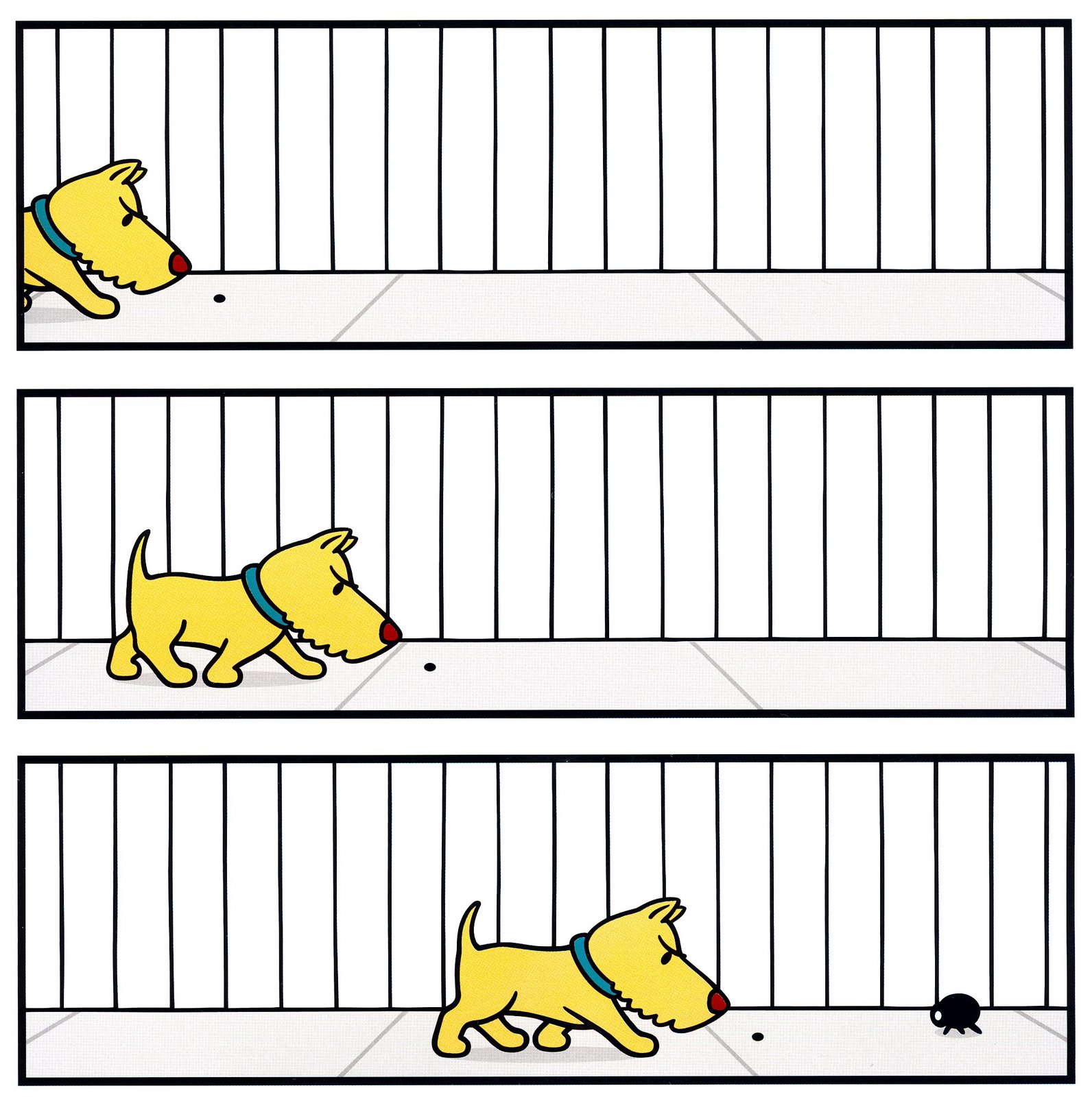
It opens with a full-page image of a little golden dog of the terrier variety cureld up on a little dog bed, sleeping. Then I turn the page, and am greeted by this:


Two pages, each divided into four different panels, with four different images in them.

The majority of the book is told like this. The lay outs on the pages differ greatly—there are full-page images, single images that spread across two pages, pages divied into three vertical panels, pages divided into three horizontal panels, pages with nine-panel grids.

So, is this book a "graphic novel?"

The two local libraries I go to both had it shelved with their childrens' picture books, and its size and shape is such that, without cracking it open, one would assume it's a childrens' picture book (It's nine inches wide and nine inches high, has a spine, is a hardcover, and is only about 50 pages long). There's no suggestions on where to shelve it on the title page or back.

Shelving it with childrens' picture books is certainly the best place to put it, as it will get it into the hands of the intended audience much better than if it were shelved with graphic novels, and I'm not really asking in a practical sense so much as out of curiosity regarding the medium.

The book is wordless, so if the fusion of words and images are integral to graphic novels, then it doesn't seem to fit. But by the most accepted and used definitions of "graphic novels"—which here I'm using to mean "comics" or "sequential art"—Bow-Wow Bugs a Bug seems to be one.

At any rate, it is a great read. It's by Mark Newgarden and Megan Montague Cash. I'm not sure which of them does what, as the credits are a little unclear; Montague Cash designed the book at the least, and Newgarden is a comcis artist with at least one graphic novel to his name (We All Die Alone, which I haven't read yet; but plan to this week on the strength of Bow-Wow).

As you can see in the badly-scanned images above, the book is beatifully constructed, with each panel filled with a clear, sharp image with a nice, thick line, the sort of line that doesn't look drawn so much as simply extant (I really like lines like that, as they give me the impression that the characters they delinieate werent' drawn by artists, but are "real" in the same way you or I are). The images flow perfectly into one another, and the artist/s are in perfect control of the pages, and the way different sizes and shapes of panel effect the flow of the story. For example, big surprises and new encounters always come on the left-hand page, so that the right hand page will set something up, and then you'll turn the page to see womething unexpected.

And the book is pretty muc a series of unexpected encounters. That little black dot in the image aboe is the bug of the title, and Bow-Wow follows it out the doggy door and out into the world. What's going on in Bow-Wow's head isnt' exactly clear. His brow is furrowed as he follows it, but you can't tell if he's angry or just really intensely concentrating on the bug—he doesn't seem to be chasing it as much as following it and looking at it super-hard.

Along the way, he and the bug experience a series of increasingly bizarre situations, like another dog that looks identical to Bow-Wow (save a different color collar) following another book that looks identical to the bug. They met, sniff each other, and then go into the Marx Brother's routine in which the one brother tries to fool the other, thinking he might be a reflection (the bugs play out the exact same sequences in miniature below the Bow-Wows).

I don't really want to spoil any of the weird things Bow-Wow and his bug encounter, as the surreal twists and turns of the story are its cheif pleasure, but there's one of my favorites (note the first image appeared on the right half of the open book, so that you would see something slightly off in the last panel, turn the page and then see the punchline):


That kicks off a sequence of even weirder, more unsettling things.

Apparently, there are two other Bow-Wow books, both of which have really nicely designed covers, and neither of which my local libraries carry, and two more scheduled for next year. If you like what you see here, check out bow-wowbooks.com. It's a kinda tough site to navigate, on account of the lack of words, but it's full of neat images of Bow-Wow and some odd games and suchlike.

Sunday, December 02, 2007

Wonder Woman at her not-very-good-est


The ever quotable Rachelle Goguen of Living Between Wednesdays had this to say in her review of writer Gail Simone’s debut issue of Wonder Woman:


Now, a lot of people have said lately that certain writers have "ruined" Wonder Woman. This is simply not true. Wonder Woman was NEVER GOOD IN THE FIRST PLACE. Please tell me when exactly the Wonder Woman title was good. The way some people talk, it's like she's the greatest character of all time, and certain recent Wonder Woman events have reduced her to a two-dimensional, boring character who can't stand on her own. People...this is what she has always been like. I'm not saying it's right, I'm saying it's the truth.


Now, Wonder Woman actually was quite good before, even great. When was that? Well, around 1942 to 1947 or so. There have been high points since, certainly (Much of George Perez’s run, most of Phil Jiminez’s run), but Goguen has a point—Wonder Woman was quite often really terrible.

You know when Wonder Woman was really, really, really not good, though? May of 1958. That’s when Wonder Woman #98 was published, the first book to be collected in Showcase Presents: Wonder Woman Vol. 1, which is jam-packed with Wonder Woman comics that are no good at all.

(I had previously used the amount of time it took DC to get around to publishing a Wonder Woman Showcase volume as possible evidence that Wonder Woman just wasn’t as much of a priority for readers or DC as many of their other heroes are, but, having finally gotten around to reading Showcase Presents: Wonder Woman, I understand that maybe it was because they wanted to publish some volumes of good comics first to establish a market, even if it meant shining the spotlight on lesser luminaries like Jimmy Olsen, Metamorpho and Elongated Man first).

These comics are all written by Robert Kanigher (I know! Bad Kanigher comics, who would have thought such a thing possible?), penciled by Ross Andru and inked by Mike Esposito.

They kind of reboot Wonder Woman continuity, although I’m not sure the words “reboot” and “continuity” existed in 1958. And even if they did, it’s not like you could go online and complain about how Kanigher’s failure to include a giant kangaroo rodeo in his origin of Wonder Woman clearly contradicted Sensation Comics #1, because there was no such thing as the Internet. Back then, the comics blogosphere was actually a comics telegraphesphere, and it took forever to complain about shit.

Anyway, since World War II was long over, Wonder Woman no longer fought Nazis. Nor did she ride on kangas. Or hang out with sorority girls. Or do much of anything terribly cool.

After rescuing a horny, leering pilot from falling into shark-infested oceans, she travels to America to…actually, I’m not sure why she does. But she goes to America, and in the guise of “Diana Prince,” she gets a job for “Military Intelligence,” the branch of the U.S. government devoted to launching rockets, fighting flying saucers, judging costume contests and dealing with giant space birds, a bigger problem than you might think in the late 50’s.

Her supporting cast consisted mainly of Colonel Steve Trevor, whom she seemed to be dating. He was always trying to get her to marry him, and she’s apparently provisionally accepted his proposal, so long as he waits until her “services are no longer needed to battle crime and injustice.”

To most guys, “when all evil has been eradicated in the world” would sound like a brush-off akin to hen “not in this life time” or “when hell freezes over,” but it seems good enough for Trevor. Although he still checks in every other adventure to see if she’s decided to marry him yet.

(This makes me think Wonder Woman had a weird idea of what marriage entailed; even if she intended to tend house, cook Steve three meals a day, have sex with him one to four times a day, have a drink ready for him when he got back from the office every day and raise his kids, given her stupendous Amazonian powers, she should be able to do all of that and still have enough free time to fight evil with. It also makes me think that there would be a lot less hurt feelings in DC comics in the Silver Age if Wonder Woman and Superman would only have set Steve Trevor an Lois Lane up on a date. Those two are perfect for each other!)

Wonder Woman’s teenage boyfriend seemed like a slightly less needy guy, although he was sexually incompatible with. That would be Ronno or Renno (depending on which panel had the spelling error), whom Wondy always just called “Mer-Boy” (Which seems a litter harsh, considering he called her “Wonder Girl” and not, you know, “biped” or “air-breather” or whatever).

Then there’s her mother, the still-blonde Queen Hippolyta, who checks in often from Paradise Island (and plays a bigger role in her Wonder Girl adventures), and General Darnell, who’s not a character so much as the guy who occasionally shows up to tell Trevor to go do something or other with Wonder Woman.

Her Golden Age supporting cast, Etta Candy and the Holiday Girls, only appear in one story in this volume. They’ve been redesigned, so that Etta isn’t obese or wearing a cowboy hat and boots, and the others are each given a one-not personality. In addition to slimmer, smaller, less rambunctious and less funny Etta, there’s Lita Little, Tina Toy and Thelma Tall (When Wonder Woman asks what kind of story they’d like to hear, Etta asks to hear one about candy, Tina one about toys, Lita about a short girl who gets taller, and Thelma about a tall girl who grew shorter! Ha ha ha ha! Comedy gold!)

There’s a real repetitiveness to the stories, which seem to mostly revolve around Wonder Woman fighting different versions of herself


Or giants from different planets and dimensions


Or both at once


In fact, I’m pretty sure Kanigher just had a fishbowl on his desk full of 12 ping pong balls in it, each with a different word written on it, and when it came time to bang out a Wonder Woman script, he’d just reach his hand in and pull one out for a story idea.

Check it out. Now, Showcase Presents: Wonder Woman Vol. 1 is 527 pages long, featuring 20 issues of the Wonder Woman comic and 36 individual stories.

Wonder Woman fights different versions of herself nine times, or in one-fourth of the stories. There are more than nine different fake Wonder Women however, as in addition to robot duplicates and Dimension X doppelgangers, in one story the entire population of Paradise Island dresses up as Wonder Woman and competes against her in a variety of challenges, and in another hundreds of young women dress up as Wonder Woman and pretend to be her to win award money. She also fights a “Tracy’s Day” parade balloon-come-to-life version of herself and a wooden ship’s masthead-come-to-life version of herself.

She also fights giant birds and/or pterodactyls on nine occasions.

She fights aliens from different planets on six different occasions (not counting any of the giants, some of whom hail from different planets).

She fights octopuses five times.

She fights races of giants on four different occasions.

She fights giant electric eels three times.

She fights only two reoccurring super-villains, neither of which appears more than once in this particular volume. They’re the Duke of Deception, a servant of war god Mars who lives on the planet Mars and bedeviled her during the Golden Age, and The Angle Man, who’s menaced Wonder Woman and her fellow heroes since the 1940s, and continues to do so today.

While the volume proved pretty disappointing (Why did they start it after this comic, but end it before this one?), there are still some decent enough stories in here.

My three favorites include “The Invasion of the Sphinx Creatures!” in which Wonder Woman battles an army of four living sphinx-shaped monuments in the desert before they can invade civilization. The sphinxes make for some really weird visuals, particularly when marching all together over sand dunes or battling one another. See, in the peculiar rules of this stor, “Only by a sphinx can a sphinx be defeated!”

Wonder Woman solves the problem by rebuilding a sphinx around herself and somehow animating it to fight the other sphinxes. How she moves it around, I don’t know, but it looks cool as hell.

Then there’s “The Cave of Secret Creatures!” in which Mer-Boy tries to get Wonder Girl to like him, and takes the advice of a friendly mer-girl, and tries to make Wonder Girl jealous by taking her to a mer-person dance and then dancing with other girls right in front of her.

It’s only 12 pages long, but plays like a little crappy teen movie, only with added Wonder Woman weirdness, like the mer-teens having an underwater juke box in their underwater hang out, or the mer-people having underwater park benches to sit on (even though they don’t even have asses to sit on!), or Wonder Girl getting ready for a date by bathing in an “Amazon perfume geyser,” and expressing her frustration with Mer-Boy by throwing a giant clam at him. All is resolved for the best when Mer-Boy is trapped by a giant sea spider.

The most delightful story of all though is a nine-pager entitled “Wonder Girl’s Birthday Party!”, in which the Amazon teen is about to blow out the candles of her birthday cake when her mother tells her of all the trouble Wonder Girl’s had with birthday cakes over the years. When she was just two-years-old and still a Wonder Tot (actually, Wonder Tot would appear until Wonder Woman #122, but this is Wonder Girl as a toddler), she blows her cake so hard that it disappears into orbit, and is seen through a telescope orbiting the earth. In later years, earthquakes and freak tornados would keep Wonder Girl from getting to enjoy her cake, and, at the end of the story first a roc snatches this year’s cake, and she fights off the bird, but not before a giant whale can devour her cake.

These stories aside, however, Showcase Presents: Wonder Woman Vol. 1 really kind of sucks.

Now hurry up and ready Volume 2, DC!

Saturday, December 01, 2007

Minx in review

(I said Minx, not minks, dammit!)


Well, it took me most of the year, but I finally read all of DC's Minx titles that I was interested in (passing on only Kimmie66 and Confessions of a Blabbermouth, the former of which has a premise that doesn't make me want to drop $9.99, and the latter of which got some pretty harsh reviews that also make it seem a poor way to spend a ten dollar bill).

There was a lot of talk inside the comics industry and the comics blabosphere when DC's girl-focused Minx line was first launched and announced, spurred on by the somewhat clumsy roll out (Karen Berger saying girls don't read comics when she meant girls don't read DC comics), the predominance of men making these comics geared towards girls (only two female creators involved in the first seven books announced), and the difficulty DC had in defining a line that ended up simply being young adult graphic novels.

Oddly, conversation seemed to die down once the books themselves started rolling out, with only the occasional review and creator interview appearing, and less of the ranting and raving associated with the announcement persisted. Did the books themselves shut up the critics, or did the critics just not bother to read any?

I haven't seen much discussion on them online, anyway—although Johanna Draper Carlson just put up something—but then that could be part and parcel to the fact that they are books aimed for an audience outside the regular comics audience...and manga audience...and even bookstore/art comics audiences, meaning, to a certain degree, we’re not supposed to talk about them. It could also be because they're damn hard for most of us to judge, let alone talk about.

Obviously, I don't have any data about how well they're selling, in the direct market or the library/bookstore market (where they're likely to do much, much, much, much, much better), nor much interest in looking what data is publicly available up. And, as a 30-year-old man and regular comics reader, I'm horribly ill suited to say if something is a book a girl would like or something a non-comics reader would like, and this is a line intended for girls who don’t already read comic books, according to DC.

So keep in mind all I can really do is offer educated guesses and not terribly valuable opinions. At any rate, here are my thoughts on the Minx line, presented in the order I've read the books. Good As Lily is the only one I bought off the rack at my shop the Wednesday it came out; I read the other three within the past few weeks, having found multiple copies of each at a local Half-Priced Books (Does that mean they're not selling well? Or just that a couple people in my neighborhood bought some and decided they never wanted to read them again?).


GOOD AS LILY

# of former girls involved: 0

# of former boys involved: 2

Who are they, and what have they done before?: Writer and cover artist Derek Kirk Kim wrote and drew the excellent graphic novel Same Difference and Other Stories. Artist Jesse Hamm makes his mainstream debut with this book, although he's produced minicomics, webcomics and appeared in a few anthologies.

What's it about?: On her 18th birthday, high school senior and drama enthusiast Grace gets a magic piñata that somehow summons different versions of herself from different ages—6, 29 and 70—and she tries to keep them secret from her family while making it through her day to day life, which includes putting on a play, a crush on her drama teacher, and a crush from her longtime platonic friend.

Palpability to manga readers: Hamm's art isn't very manga-esque. Many of the characters are Asian, though, and some of the plotlines, and the something-wacky-happens-to-otherwise-normal-person set-up, will be fairly familiar to anyone who's spent much time reading manga.

Girliness: Mild to strong.

Is it any good?: Yeah, it's pretty great. There was some mild disconnect from how different Grace and her different selves look on the cover (drawn by Kim) and throughout the story, drawn by Hamm, but I really enjoyed Hamm's art, and look forward to seeing more from him in the future. Kim juggles the various Graces pretty well, and while they make for the story's hook, they are really just other characters, with the actual conflicts focusing on Grace's relationship with her family and her friends and her self, the selves helping and hurting her attempts to solve her problems. It doesn't quite work like clockwork, but there's some real emotion in this, and I found myself alternately laughing and getting choked up.

Will it hit its target audience?: Yeah, I think it's more or less a direct hit.


RE-GIFTERS

# of former girls involved: 0

# of former boys involved: 3

Who are they, and what have they done before?: Writer Mike Carey has written many mainstream serial comics I have not read, including Lucifer, X-Men, Ultimate Fantastic Four, Crossing Midnight, plus some that I have read (Spellbinders, Voodoo Child). Penciller Sonnie Liew drew Slave Labor Graphics' Return To Wonderland and wrote and drew Malinky Robot. Inker Marc Hempel pencilled The Sandman arc "The Kindly Ones" and has written and drawn many very awesome comics, including Gregory. The entire creative team previously produced My Faith in Frankie, a Vertigo miniseries collected into a Minx-like digest-sized trade.

What's it about?: Korean-American high-schooler Dixie is training for the national hapkido championship, but is thrown off-balance by fellow student and school cute boy Adam, whom she tries to impress with an expensive birthday present. Teen melodramedy ensues as the tries to win the championship and his heart and stay out of trouble with her parents and local bullies.

Palpability to manga readers: Strong. The teen romance, bully/bullier, and competition elements are all of the sort present in a lot of manga and manhwa. Liew's pencil style and sense of design is pretty unique, not falling into more representational or cartoony Western design or manga-like Eastern design, but having a sketchy, doodley quality that is more akin to what you'd see in children's picture books, illustration work and (in a few characters) political cartooning than sequential art.

Girliness: Mild

Is it any good?: Yes, it's very good. I'm a fan of Liew and Hempel individually and together, and Carey's written things I liked and things I didn't, so my expectations were kind of mixed going in, but I was really impressed. This is certainly the strongest of the Minx books in terms of book design (it resembles an actual wrapped gift, with the main character looking like a tag on it), and there are some really strong characters, both in their visual design and their story realization. Not only are the leads strong, but even the most minor of characters are unique— I loved Dixie's little twin brothers, for example, and cracked a smile every time they appeared. The story is constructed in that sort of perfectly pleasing way in which a great deal of seemingly diverse elements are introduced, and are all pulled together and resolved at once.

Will it hit its target audience?: Hard to say. I think the story will certainly prove appealing to new readers, but I wonder if Liew's style might be a bit of a turn-off to comics virgins. Despite the strength of his storytelling, it doesn't really look like anything that someone who's never really read comics before would be familiar with, and I wonder if it would repel them, or even just have a higher learning curve.


CLUBBING

# of former girls involved: 0

# of former boys involved: 2

Who are they, and what have they done before?: Writer Andi Watson wrote and drew Glister, Slow News Day, Breakfast After Noon, Geisha, Skeleton Key and many other comics I don't like as much. Artist Josh Howard wrote and drew Dead @17 and Black Harvest, plus a few other things too.

What's it about?: Charlotte "Lottie" Brook is a goth London teenager who gets caught with a fake ID trying to get into a club and, as punishment, gets sent out to the countryside to live with her grandparents and work at their country club for the summer. There it becomes something of a fish-out-of-water comedy, but also a murder mystery, and Lottie tries to solve the weird goings on of her household and the village. Oh, and then it gets all Lovecrafty for, like, 12 pages.

Palpability to manga readers: Pretty palpable. Howard's art is strong influenced by manga, particularly in the character design of the females, but it tends to be even flatter and more abstract. In other words, it looks particularly manga-influenced to people who don't read a lot of manga; definitely influenced by manga-influenced art, if that makes sense.

Girliness: Mild. The protagonist likes clothes and talks about shopping a lot—girls like shopping and clothes, right? That said, all of those clothes are really, really small, and Howard's art seems to appeal more to boys and men than girls, I would think.

Is it any good?: I really like Howard's art style, to the point where he's one of the artists whom I read just about anything by, no matter how bad, just to look at the pictures. And Watson does a good job on Lottie's slang-filled voice, which is definitely unique. But this definitely feels like the first draft rather than a finished product, as it veers and lurches between genres at random. I think every review I've read mentions how out of left field the supernatural element actually is, so I was expecting an unexpected element and wasn't caught off guard by it, but, yeah, you probably want to foreshadow something like that somewhere. I mean, Scooby-Doo foreshadowed its monsters in every episode, and none of those were even real. Of the Minx books I read, this was by far the weakest.

Will it hit its target audience?: Maybe.

Anything else to add?: Yeah, you know, Josh Howard would have been a great artist on DC's current volume of Supergirl comics, wouldn't he? He's really good at belly shirts and micro-skirts, and he's much better at anatomy at drawing cute girls than pretty much anybody who DC actually hired for that gig.

Back on topic, why does DC mention Howard's Dead@17 being "Wizard magazine's pick as the #1 independent book to watch in 2005" on the back of the book (and on the online solicitation). I assume Wizard readers/peole who care what Wizard says about comics/anyone who even knows what Wizard is are well outside the target audience for Minx books.

Finally, this book also has the absolute worst cover. That image of white junior high girls at a school dance or whatever above the title? Nothing remotely like that occurs in this book. The club Lottie goes to is a goth club where everyone goes all out in their goth costumes. Also, that picture looks terrible juxtaposed against the Howard girl in a photo environment right below it (That juxtaposition does work pretty well, though, visually accentuating the culture clash that's the subject of the story—she's a two-dimensional comic book heroine in a three-dimensional photograph world!)


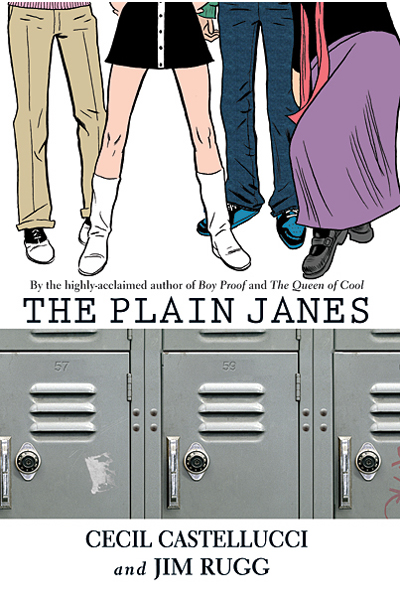
THE PLAIN JANES

# of former girls involved: 1

# of former boys involved: 1

Who are they, and what have they done before?: Writer Cecil Castellucci is a prose novelist responsible for The Queen of Cool, Beige, and Boy Proof (none of which I've read). Artist Jim Rugg is responsible for (too) short-lived series Street Angel, one of the coolest comics in like ever, and has had short peices in a variet of pretty goon anthologies, like Project: Superior

What's it about?: A bomb attack in New York City stand-in Metro City transforms life for protatonist Jane and her family, who move to a suburb. Inspired by a sketchbook from a fellow victim of the attack, Jane decides to devote her life to art, forsaking the popular girls at her new school and forming an all-girl art gang with the three girls at the outcast, all of whom are coincidentally named Jane. The P.L.A.I.N. Janes' anonymous art attacks stoke (unattributed) post-9/11 fears of terrorism, causing a rift between the adults and teens in the small town.

Palpability to manga readers: Other than the digest format and black and white art, there's nothing particularly manga-esque about it. Some of the situations repeat what you'd find in shojo comics, but this book visually has more in common with Western art comics than Japanese pop imports.

Girliness: Mild to strong.

Is it any good?: The art is absolutely perfect. Rugg does his expected strong job, but I think this may be his best work I've seen. He finds a perfect balance between representational and subtle cartoonish exaggeration, turning in a series of character designs that are all distinct, realistic and highly pleasing to the eye.

The story is similarly well constructed, and Castellucci doesn't show any of the weakness typical of some prose writers doing their first comics (telling more of the story through the words than the pictures, using too many words, an omniscient narrator who checks in with various voices, etc.). Some of it struck me as pretty unrealistic in a way that originally grated on me—why use "Metro City" instead of New York? Why use a cafe bombing more typical of the Israeli/Palestinian conflict than 9/11 itself to address post-9/11 fear in our culture?—but that lack of realism coupled with other more highly manufactured elements lends the whole story a sort of fairy tale feel, as if that unreality is quite intentional.

Perhaps Castellucci is consciously telling a half-fable about the conflict of art vs. fear in modern America. I think the story could still be told if she were more direct in her address of issues, without sacrificing the more escapist, entertaining elements. The ending is pretty sudden, and leaves one of the main conflicts—the romantic one—completely unresolved, with a good character seeming to suffer punishment for his goodness, making for a pretty unsatsifying ending to an otherwise quite satisfying story.

Word at Comicsworthreading is that there's a sequel planned for the future, but there's no "to be continued" or official indication of this in the book istelf. If this were manga or an ongoing series from Oni, it would have had a "Volume 1" on the spine to indicate that it would presumably continue at some point, but not so. (Something for DC/Minx to think about in future printings, though).

Will it hit its target audience?: Yes, dead on.