Thursday, September 21, 2006

The Broken Universe: "Batgirl: Destruction's Daughter"


I was pretty surprised when I saw Batgirl: Destruction’s Daughter on the Diamond shipping list for release this week, as I have no idea why DC would actually want the stories within that trade collection to be read by any more readers.

Not because they’re not any good (Re-reading Andersen Gabrych’s three story arcs that comprise the collection this week in one sitting, I was reminded what a strong send-off it actually was for the character, bringing her personal story to a close while clearing her from the board to simplify the sprawling Bat-mythos).

No, I was surprised because it’s downright impossible to enjoy Adam Beechen’s debut story arc as the regular Robin writer after reading “Destruction’s Daughter.” As I’ve pointed out before here, Beechen’s arc presents Cassandra “Batgirl” Cain in a completely opposite manner than the way in which she was presented throughout the entire run of Batgirl, particularly in these last story arcs, "Destruction's Daughter" and "Blood Matters."

For example, in Robin, Tim follows a subtle clue left for him to find Cassie. Inside a fake Batgirl costume that Lynx was dressed in, Tim finds a tiny roll of paper, with Navajo writing on it. In narration, Tim tells us that Batman taught he and Cassie Navajo just in case they ever went up against the Signal Man. Which is odd, because in "Destruction’s Daughter," Oracle and Batgirl again discuss her inability to read (any language, let alone Navajoh), and Oracle even runs experiments on Cassie’s brain, determining that it’s possible for her to learn to read, although it will be difficult.

In Batgirl #67, part two of “Destruction’s Daughter,” Cassandra visits the Bronze Tiger in Detroit, and he lays out to her David Cain’s attempts to train an ultimate assassin in the past. First he tried training a whole crop of kids, but it failed, and he put them all down, the last of which was likened to a “mad dog.” He then tried raising a “few” from infancy, as he did with Cassandra, but ultimately decided that genetics must be the key, and he therefore decided to try with his own child, Cassandra. Near the climax of the Destruction’s Daughter trade, Cassie even faces off against one of these other children of Cain’s, Mad Dog.

But in Beechen’s Robin story, Cassie freaks out at Cain and Robin, ranting, “I thought I was the only one! The only one you trained! The only one you taught! The only one you loved!” Clearly, she knew that she wasn’t the only one for at least a year, so why did the discovery of this Annalea send her over the edge all of a sudden?

In “Destruction’s Daughter,” Nyssa al Ghul and Shiva try to thrust leadership of the League of Assassins on Cassie, but she repeatedly refuses. She’s uncomfortable with killing, obviously, but also with leadership of any kind. When she smashes up Nyssa’s operation and the League-in-training divides into two factions, one looks to Cassie for leadership. It’s a role she’s very uncomfortable with, owing to her poor language skills, and she stumbles through giving them the most basic instructions.

But one year later, in the pages of Robin, not only has she apparently mastered her language skills, never pausing for an elipses as she did throughout the run of her own book, but speaking in complete sentences. She’s also taken over the League of Assassins, and now acts as it’s leader.

More troubling though is her sudden decision to start killing again. Though she was trained from birth to kill, after she committed her first murder, she freaked out and ran away from Cain, spending almost a decade as a mute runaway. After she became Batgirl, succeeding Batman became her number one ambition, although she still felt she was unworthy of life, having taken one herself (a duel to the death with Lady Shiva during which she had a near death experience cured her of this).

Throughout "Destruction’s Daughter” and “Blood Matters,” she continually re-asserts this belief:

“Heroes don’t kill.”

“My heart only knows one thing…killing is wrong. No matter what. Or who. Isn’t it?”

“Killing is killing. And killing is wrong.”

Throughout this last storyline, the villains and supporting characters like Alpha tell her that she must kill, it’s her destiny to kill, and some of them even make the argument that killing is actually the moral thing to do in some cases, if you’re taking a life from someone who would go on to take many more lives themselves.

Cassie seems to become convinced of this at the end, when she agrees to another fight to the death with Shiva, pausing to ask how many Shiva has killed since the last time they fought. And certainly the “Isn’t it?” in the quote above shows that she was at least mildly confused about the absolute “Killing is wrong” line that Batman follows wholeheartedly.

But though she technically kills Shiva, breaking her neck and then impaling her on a hook that immediately begins to rip through her flesh, that hook is over a Lazarus Pit, which magically restores those immersed in it to life (indeed, Shiva appears in Robin even before Cassandra does).

The last page of Destruction’s Daughter says that Cassandra Cain was “born to be something unlike the world had ever seen. A dancing hunter,” an metaphor for her assassin’s training used throughout the last three issues of the series, “But she didn’t want that.”

And yet one year later, she’s doing just that. She also takes lives left and right. She claims to have killed Nyssa, Lynx and Annalea, and either she or David Cain broke the necks of the various ninja henchmen that had assaulted Robin.

It’s perhaps worth noting that between the end of Batgirl and the “Boy Wanted” arc of Robin, DC (unwisely, in my opinion) rebooted their continuity. As part of Infinite Crisis, DC continuity was temporarily unraveled, and then violently put back together, with changes big and small having occurred. So, in effect, Batgirl continuity, like all other DC continuity, was destroyed and rebuilt during the crisis, and the changes to it haven’t been revealed.

It’s quite possible then that contrary to what Oracle said in pre-Infinite Crisis continuity, Cassie could learn language and had learned Navajo in the new post-IC continuity. It’s possible that she was a better speaker and more charismatic leader than we thought. And it’s possible that she really did want to be leader of the League of Assassins after all, and that she didn’t really regard killing as such a big deal after all.

But if that’s the case, why on earth would DC publish Batgirl: Destruction’s Daughter at all? If something was so wrong with Batgirl continuity that it needed to be erased and changed during the Crisis, then why continue to introduce these broken stories to new readers? Clearly one of these storylines is no longer true and should not be read; by publishing this in trade format, DC seems to be implying that it's the Robin arc that gets Batgirl wrong.

On this, then, we agree.

Monday, September 18, 2006

Delayed Reaction: Night Fisher


Night Fisher (Fantagraphics Books), by R. Kikuo Johnson

Why’d I Wait?: The debut work of a newcomer, the book had little to recommend it other than the fact that it had a nice cover and that its publisher, Fantagraphics, tends not to publish much in the way of crap. Still, I never trust writers whose names start with an initial and go by their middle names instead, and I’m always skeptical of graphic novels that are so insecure that need to define what exactly they are on the cover (Night Fisher, for example, insists on being called “a comic book novella” on its cover, instead of a graphic novel).

Why Now?: Facing the prospect of eating dinner alone in a restaurant, I needed to read something, and didn’t have anything on me, so I needed to grab something on the way out of the library, preferably something that was a graphic novel, and that I haven’t read before.

Well?: Coming of age stories are like opinions—everyone’s got one, but not every one is worth listening to. Johnson’s is. While it’s not billed as an autobiography, it certainly feels true, with a lot of details that seem too specific and random to come entirely from the imagination. The book’s title comes form a hobby formerly enjoyed by our protagonist Loren Foster and his friend Shane. As they near the end of their high school careers in Hawaii, and start to grow estranged from one another, however, night fishing becomes a convenient excuse for being out all night. The pair are both ace students at an expensive and prestigious college prep private school, but Shane has begun experimenting with drugs, and has thus grown distant from Loren…at least until he finally invites him into the new world with him.

As a high school geniuses gone wild type of story, it strongly calls to mind Better Luck Tomorrow, but reads more like Fantagraphics’ other works of teenage existentialism and alienation (particularly Daniel Clowes’ works).

Johnson’s black and white art also calls to mind Clowes’ work, though Johnson’s is at once more vague and more realistic; almost impressionistic in its ability to get so much representation out of such minimal line work, particularly when it comes to faces and expressions (Loren, who wears glasses, doesn’t even seem to have any eyes for passages of the book).

Johnson fills in the story with some pretty effective, symbolic imagery and fantasy sequences, including a particularly brilliant visual description of what getting high on “batu” feels like (Sorry, I have no idea exactaly what kind of drug that's slang for, orther than the fact that it's something you smoke).

The exotic setting and details for such a universal tale give Johnson’s coming of age story an instant leg up on so many others, and the minimal nature of the story itself, and the way so many of its conflicts rear their heads and trail off, give this “comic book novella” a powerful emotional impact. Of course, it’s possible Johnson just didn’t know how to end it, but that’s the beauty of the open-ended ending—if the rest of the story is good enough, you can get away with it. Johnson does. It will be interesting to see where he goes next.

Would I Travel Back in Time to Buy it Off the Shelf?: Eh, no, and I probably won’t be adding it to my personal library in the near future. It was certainly a rewarding read, but not exactly a must own book that I could see myself returning to again and again, nor the sort of book I could imagine forcing into the hands of others.

Sunday, September 17, 2006

Things I Learned from Reading Marvel's Civil War Files


--Tony Stark is an arrogant dick. He’s offered dozens of example of his arrogance and dickishness throughout his appearances in the Marvel Universe lately, but man, he even comes across like an arrogant dick in his writing.

--Atlantean history makes for inadvertently hilarious reading. Particularly any and all off-handed references to the Seal People.

--The Marvel character whose physique mine most closely resembles is Speedball. We’re the exact same height, and he only outweighs me by five pounds. The next closest is reporter Sally Floyd. So I guess I either need to start working out more, or get myself some kinetic energy-based powers.

--Just because you’re an arrogant dick doesn’t mean you can’t also be funny sometimes. For example, “In retrospect, I'd have to say that was pretty much the most humbling alien robot fight I’ve ever had.”

--No Marvel artist ever draws Wolverine correctly to scale, if this 5’3 height statistic is accurate.

--Susan “Invisible Woman” Storm is the curviest 120-pound woman in the world. Does she have hollow bones , or what?

--Robbie “Speedball” Baldwin’s powers are really fucking confusing. Even when simply written about in straightforward prose, I still can’t understand them: “The energy permeated Robert’s body, creating a kinetic energy field that enabled him to absorb any impact without harm, but with the disadvantage that sufficient force would activate the field, bubbles of pure and weightless kinetic force surrounding his person, with or without intent. The energy also saturated his clothing, possibly setting up the same atomic-level transfiguration phenomenon integral to unstable molecutles but shaped on the subconscious psionic level, with the result that the field’s activation also transformed his clothing into, for all intent and purposes, a super-hero costume and mask.”

Um, what? And this is part of a daily intelligence briefing for President George W. Bush? Good luck getting him to understand all of that.

Thursday, September 14, 2006

Weekly Haul: September 13th


52 #19 (DC Comics) Well, now I’m even more skeptical about the wisdom of Booster Gold’s death (in the unlikely event that it’s even semi-permanent), as well as the rationale for it DC’s top man Dan DiDio gave in his post-mortem interview with Newsarama.com. If the character is truly no longer relevant to today’s readers, what’s the point of killing him off simply to replace him with someone who looks and acts the exact same? (And if ever there’s a superhero name that doesn’t deserve to be carried on, it’ s “Booster Gold”—what does that even mean?). Aside from my issues with this particular issue, it remains a thrilling read, with one hell of a major twist at the end. No idea what’s up with Supernova, or Bishop Lobo yet, though. The back up is the origin of Animal Man, featuring gorgeous sequential art by the old Animal Man cover artist Brian Bolland. Bolland interiors are just way too rare, and are always a welcome sight. Nitpicks: Colorist Alex Sinclair colors Booster II’s eyes and teeth a weird, solid blue in some panels.

A Man Called Kev #3(DC/WildStorm) Probably the strongest single issue of the five-part miniseries so far, Garth Ennis and Carlos Ezquerra’s “Thin Red Line of ‘Eroes When the Drums Begin To Roll” reveals the real reason the ground invasion of the first Iraq War (the one masterminded by the first Bush Administration) took so long to get started once hostilities commenced. It’s also the reason why someone wants Kev dead so bad. You’ll have to read the issue to find out for yourself, but I will say this is a perfect example of Ennis at his best—a thrilling little war-time adventure story, with some dark bloody humor at its center.

Aquaman: Sword of Atlantis #44 (DC) It’s been a long time coming—so long, in fact, that I’ve forgotten the last time I read an issue of this “monthly” book—but now that it’s finally out, we get to see the first meeting between the new Aquaman and the old Aquaman’s evil brother, Ocean Master. More interestingly, particularly to us Orin fans, is that the Dweller in the Depths seems to be starting to put together the fact that what he thought was a prophecy might actually be memories. Random New Earth Continuity Change: Is Ocean Master’s deal with Neron is null and void, or did the devil simply have mercy on Orm and decide he doesn’t have to hold onto his staff at all times to avoid excruciating pain after all? Nice little speech by the bad guy about why he prefers trying to master the ocean to living on the land anyway.

Civil War Files (Marvel) In a way this is the best Iron Man story in recent memory, as reading his writing about the rest of the world’s heroes and major political powers reveals more about him than you could imagine. He’s cold-hearted and arrogant, he thinks of his peers in terms of their powers and their ability to affect his plans. Everything is ultimately all about him: Could they help him? Hurt him? Could he take them in a fight? Should he have done something differently in the past to guide the path they ultimately ended up taking? Could he ever get around to banging Susan Richards? The seven credited writers do a consistently great job of creating a unified work with a unified voice, essentially 40 mini-essays boiling Marvel history ancient and recent down for readers, making for a great continuity catch up. As a reading experience, I think it’s well worth the $4, though I tend to be resistant to such books. This isn’t a comic book, but prose pretending to be a comic book—When I want to read a floppy, 40-page seven-by-ten inch works of fiction on Wednesday afternoons, I want them to be comics, not prose about comics, damn it! Even worse than the DC Secret Files and Origins Specials, which I almost always regret shelling out the dough for after reading, Civil War Files contains no actual comics/”sequential art” stories within, and no original art at all, save for that kick ass Steve McNiven, Dexter Vines and Morry Hollowell cover. Still, an awful lot of stuff gets covered within, and Marvel editorial apparently takes the opportunity to smooth over some of the inconsistencies that fans are wont to bitch about online. Reading this, it’s clear that Tony Stark realizes he is a changed man, and holds himself responsible for the New Warriors’ irresponsibility. Also acknowledged and addressed are Reed Richards’ seeming change of heart on superhuman registration over the last few years, the fact that the SRA is just a re-named and expanded version of the old Mutant Registration Act and even how Flag-Smasher seemed to appear in Civil War: Young Avengers & Runaways.

The Escapists #3 (Dark Horse Comics) Any comic book that prominently features a break-in of the Plain Dealer’s offices and a discussion of my favorite Ohio newspaper is a must-read in my book (Quick Caleb fact: My first professional writing gig was with the PD, contributing to their old teenage-written “N.E.X.T.” section). Brian K. Vaughan’s cheeky meta-metafictional script, Steve Rolston and Jason Shawn Alexannder’s amazing art, and a sweet cover from John Cassaday should make it a must-read in just about everybody else’s book too, I imagine.

Green Lantern #13 (DC) In this month’s (late) issue, the Cyborg Superman just wants to deliver exposition, but no one seems to want to listen. At one point, he even cuts in with, “All these years and you’ve never once asked me why I chose Coast City for destruction.” Hal Jordan doesn’t really seem to care, but the Cyborg goes ahead and tells him anyway, as well as explaining why Arisia’s not dead after all. (Hal Jordan, meanwhile, spends some time explaining things to readers too, like why it was actually okay that he was sleeping with a 13-year-old alien girl—turns out that on her planet, 13 years is the equivalent of 241 years on Earth. See, he wasn’t robbing the cradle, but the grave). It’s sort of unfortunate that Johns seems to be un-writing the last 20 years worth of Green Lantern history rather than moving it forward, but it’s at least as fun to see it occurring sped up in reverse as it was to watch it originally unfold. The part people will be talking about all month, however, is the second-to-last-panel, with its surprising relevance to one of DC’s best ongoing titles (Reviewed above).

JLA: Classified #27 (DC) The JLA teams up with the president of the United States, and engages in some dog wagging, while their secret identities infiltrate two fictional South American countries on the verge of all-out war using illegal WMDs (That’s Weapons of Meta-Human Destruction). With Wally West and Orin MIA and young upstarts filling in for them, with Kyle Rayner having retired from Green Lantern-ing to do his Ion thing and with J’onn J’onnz dressing like a Skrull and acting like a total dick, it’s a pleasure to see the Big Seven version of the JLA here, particularly as drawn by Plunkett and Nguyen.

Sam Noir: Samurai Detective #1 (Image Comics) I admit I initially wrote this book off based simply on it's title--It's a godawful title, way too obvious by half, and sounds like a limp parody of two genres. Well, if you didn't pick it up on the shops on Wednesday, do yourself a favor, go back to your comic shop, and plunk down your $2.99. It's an incredible read. Manny Trembley and Eric A. Anderson have the sound and look of crime fiction and samurai films and comics down so perfectly that it's more a genre mash-up than parody. And there are lines of half-serious dialogue I can read over and over, and they never seem any less funny. Like, "Nobody ever expects a fella to jump out of his third story window. People should expect those types of things. I do. That's why I jump out of windows. Cuz' nobody thinks of it." And that's just one panel. Easily the book of the week.

Sunday, September 10, 2006

Me 1, Jordan B. Gorfinkel 0


The very first writing about comic books I’d ever done--way back before I’d ever earned my first byline writing about anything, way back in the olden days before the Internet was ubiquitous, when comic books still had letter pages--was as a way too frequent letter hack in the back pages of Batman comics.

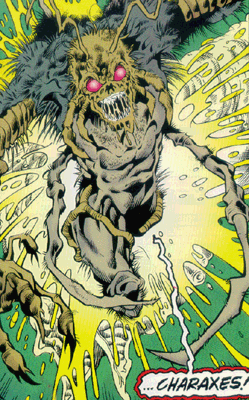
As a teenager, it was still a huge thrill to see my name in print, and an even bigger thrill when the editors would respond to my letters in print (Peter Tomasi and Jordan B. Gorfinkel probably being the two that printed my letters most often). One of the more curt responses I’d ever gotten from Gorfinkel was regarding Robin #23-#24, the “Underworld Unleashed” tie-in issues in which Drury Walker sells his soul to Neron, transforming from Killer Moth into “Charaxes,” a killer moth man monster thing.

Rereading these issues, writer Chuck Dixon did do an incredibly solid job. I didn’t always like the directions he went with Tim Drake, but Dixon was really good at characterization and action plots. But changing Killer Moth into Charaxes seemed like a terrible mistake to me at the time. The essential lameness of a guy dressed like a moth, the incredible idiocy of his very oxymoron of a name, seemed to be what distinguished Killer Moth from so many other villains.

In short, his lameness made him unique, so why take that lameness away (That lameness, by the way, could be exploited to tell good stories—at the time, I was thinking of Alan Grant and Tim Sale’s Shadow of the Bat arc “The Misfits,” in which Killer Moth joined with similar loser villains Catman and Calendar Man to get some respect, but Killer Moth’s lameness has since been key in other cool stories, notably his appearances on Cartoon Network’s animated Teen Titans and in Batgirl: Year One.

Charaxes, on the other hand, was just one more half-man, half-animal monster for Batman and Robin to fight, no different from Killer Croc or the then feral Man-Bat. I wrote a letter saying all of this (and bitching about Tim Drake’s romance—I had a hard time buying a 14-year-old going to high school, serving as a vigilante crimefighter and having time for girls), and Gorfinkel printed it, and disagreed. Rather strongly. I recently revisited my longbox to find the issue it was printed in--Robin #11--to re-read Gorfinkel's thoughts about Charaxes vs. Killer Moth: “I doubt that anything I am going to say now wil change your mind about anything, so I’ll be brief. With Charaxes, we now have a real Player for the Batman, and Robin, to contend with. And what Super-hero comic couldn’t use another true threat to spice up his/her adventures?”

Well, that was about ten years ago. In that time, I don’t think I’ve seen a single Charaxes story told, though the character has appeared in the background of some panels and had some cameos here and there.

Earlier this year in the pages of Infinite Crisis, DC completely rejiggered their shared fictional setting, the DCU, with a new continuity, bringing a lot of dead characters back to life, and changing things big or small within their fictional history.

If you read the eight-part “Face the Face” story that ran through Batman and Detective and was released in a trade paperback collection this week, you’ll notice on page 90 Batman and Robin start flying their Batplane toward a robbery, which Robin descends to solo to bust up. A robbery being committed by Killer Moth. Not Charaxes, who was apparently one of the things changed during the continuity rejiggering, but Killer Moth, in his old, lame suit.

Now, I hate to be the sort of guy who says I told you so, so I won’t. I’ll just say this: In your face, Gorfinkel!

The 9/11 Report, now with more pictures


Sid Jacobson and Ernie Colon's comic book adaptation of the 9/11 Report has garnered plenty of mainstream media attention, and for good reason. Here's some more, from my Las Vegas Weekly column. What I haven't heard much of is the comics press commenting on it. If nothing else, it's a new and unique application of the medium, covering a report, and a challenge to the accepted nomenclature of "graphic novel." It's obviously not a novel, or even novel-like--it's a report. I just called it a "comic book," because "graphic adpatation" isn't the right term either (it's not just graphic). I guess Scott McCloud's term for the medium, "sequential art," really is the best we've got.

Weekly Haul: September 6th


52 #18 (DC Comics) Fans of the more obscure corners of the DC Universe should absolutely love this week’s installment of the company’s most exciting ongoing, 52. Not only do Detective Chimp and the Shadowpact get some nice panel-time along Ralph Dibny and Dr. Fate’s helmet as they set out to unlock the mysteries of life and death in the DCU, but the funeral of Booster Gold features some Z-List Pallbearers. My knowledge of DC’s character catalog was tested and bested this week (anyone who can identify the members of the Croaton Society featured within as well as all six of Booster’s pallbearers—I got Odd Man and Beefeater—in the comment section would earn my undying appreciation). A lot of great stuff this issue, starting with J.G. Jones’ cover (somewhat compromised by the logo and busy cover text) and including Detective Chimp’s patter (“We figured out the ending of “Lost”, we can find one of our own guys”) and Clark Kent’s comments both on Booster’s funeral and 52’s inability to check in with all cast members on a regular basis. The art was a little weak in the consistency department—check out Question’s changing medal on page four—and I was a little disappointed in the choice of his origin artist. Denys Cowan should have topped the list of choices, maybe followed by Bruce Timm (who gave new life to the character through Justice League Unlimited) or Dave Gibbons, for a real elbow in fans’ ribs, since he drew Watchmen, the greatest non-Question Question story ever.

Agents of Atlas #2 (Marvel Comics) Writer Jeff Parker sure seems to have learned how to pack a lot of story into a single issue from his done-in-one run of stories on Marvel’s Adventures line’s Avengers title. In this single issue we get a summary of Marvel Boy’s history in the 616 Universe, the secret origin of Gorilla Man, the reappearance of both Yellow Claw and Venus and the story flies forward. I’m keeping my fingers crossed for an ongoing.

The All-New Atom #3 (DC) This likable new title hasn’t changed a bit since it’s first issue, thankfully—if anything, this issue is simply a little wilder than the last two. Gail Simone’s scripting is still a ton of fun, her asterisk usage is still insane and better off ignored (I stopped reading the lame “footnotes” after the first issue), John Byrne’s art is still good but not great and, as always, distracted from by the byline itself, Olivetti’s covers are still sweet. Plus this issue we get more pilgrim action, praise the Great Giver of Light.

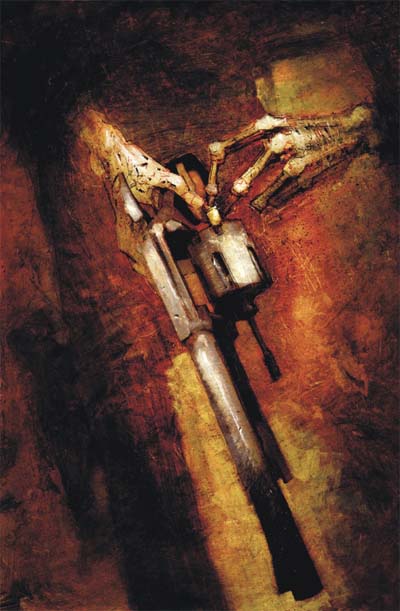
Death Comes to Dillinger #2 (Silent Devil Productions) The text-less image above comes from the cover of this book. Which you should go buy and read immediately. Or, if you haven’t read the first issue for some reason, you should go buy that and read it first, and then pick up #2, the other half of this fantastic, two-part story.

Detective Comics #823 (DC) Okay, maybe I was a little too effusive in my praise of the first Paul Dini-written issue of the series and it’s new creative team, especially considering the fact that the announced artist on the team, J.H. Williams III, has only gotten eexactly one issue out so far, giving way to a string of fill-ins. This issue’s art team is Joe Benitez and Victor Llamas, and while this issue isn’t quite on the level of Williams’ issue, Benitez is one hell of a cheesecake artist, thus perfectly suited for this issue’s villain, Poison Ivy. A typical comic book babe body, extra-dewy doe eyes, and a baby doll-sloped forehead all add up to making Benitez’s version of the vegetable vamp one of the sexier ones. Benitez’s Dark Knight is only so-so (dig that sloping, pointy-nose), but he does a hell of a Robin, too. For his part, Dini tells another complete story in one issue, though this one hews closer to superheroics than the mini-mysteries of his previous issues. It’s somewhat disappointing to see him working the Batman Rogues Gallery so hard so soon after introducing a new villain in his first story, at least this one introduces a new character who may or may not live to threaten Batman and Ivy again in the future.

G.I.Joe: Scarlett Declassified (Devil’s Due Publishing) It’s not often you see an artist getting top billing over the writer on the cover of a comic book, but it certainly makes sense that Phil Noto gets top-billing here—he is unquestionably the star of this special, oversized issue, which reveals the secret origin of the red-headed heroine. I never liked her much at all on the TV show (I was a Lady Jaye man, myself), but writer Mike O’Sullivan presents a rather complex character sketch here, particularly considering how much action he packs in and how little space he gets to work with. The G.I.Joe franchise of comics, under every publisher that has held the license over the years, has always suffered from a wealth of great characters (plenty of whom could probably carry their own title, honestly), so many great characters that too often they all get lost in the shuffle, eclipsed by Snake-Eyes. So it’s nice to see DDP giving some of those characters a chance to shine on their own in formats like this one. Now if you’ll excuse me, I think I need to go start praying for Shipwreck Declassified and Lady Jaye Declassified…

Hero Squared #3 (Boom! Studios) Giffen and DeMatteis continue to bring the Bwa-ha-ha’s with this series, which recaptures the feel of their old JLI collaboration (and is especially welcome now that DC is offing the old JLI cast left and right), and in this issue they even bring some emotional drama too. Their collaborations have grown predictable over the decades, sure, but they’re still predictably enjoyable.

The Lone Ranger #1 (Dynamite Entertainent) Wait, wait, wait…the Lone Ranger? Seriously? Dyanmite grabbed Army of Darkness, Darkman, Red Sonja, Battlestar Galactica, Xena and now the Lone Ranger of all things? Does anyone really want to see a new Lone Ranger comic? Well, I guess so, as I’m proof that the book would sell—at least one issue…out of curiosity. Actually, make that two issues, because after the first, I’m dying to see what happens next. The most well-known (played out?) and iconic (clichéd?) western hero of all time in a new, 2006 comic book series seems like a counterintuitive step to me, but there’s no denying that writer Brett Matthews and artist Sergio Carriello have crafted a gripping first chapter of the story behind the man behind the mask. For the first time in my life, I actually care who that masked man was. The true test of whether or not Matthews and Carriello can make The Lone Ranger work in the post-Unforgiven era of the deconstructed Western won’t come until they take on Tonto,however, which seems to be next issue’s agenda, judging from the cliffhanger ending. John Cassaday covers sure as hell won’t hurt the series, either, even if this first issue one was a little too Watchmen. When you’ve got John freaking Cassaday drawing a cover, why just have him draw a bloody badge?

Marvel Team-Up #24 (Marvel) So this is the end of the “Freedom Ring” arc? I must say, I’m quite disappointed. I give Kirkman’s some props for the twists and turns of the plot—we get a cool, new Marvel hero, only to seemingly lose him, no wait, he’s back in action, no, wait, he’s gone again, etc.—but I would have given him still more props if things ended differently. The breaking of the issue into individual stories that occurs this issue (as it did last issue) is also oddly off-putting.

Savage Dragon #128 (Image Comics) “This place is a fucking madhouse,” the villainous Mr. Rictus says with a smile near the end of this issue of Savage Dragon, “Let’s get the hell out of here.” That pretty much sums up my feelings about the title, which I’ve only read on very few occasions (the Madman and the Atomics crossover and the issue with S.D. clocking President Bush on the cover come to mind), but each time it reads like a fucking madhouse. I mean that in a good way, for the most part, but it’s the kind of madhouse I always feel like getting the hell out of by the time I reach the end and steering clear of in the future. Erik Larsen’s achievements on the book—writing, editing and friggin’ lettering the damn thing—are a wonder to behold, especially considering the fact that he’s running a comic book company at the same time (Joe Quesada has been unable to get just six issues of his Daredevil: Father out) and how long his fellow Image founders lasted as the chief creative forces behind their books (Savage Dragon is truly the last man standing in that regard). I also appreciate Larsen’s zaniness and peculiar art style—if J ack Kirby were working for an independent publisher today, I doubt it would look much different from Larsen’s ongoing. But it’s just so mad, I’m always lost to the point of distraction, even in this issue, the hook of which (as indicated by the cover) is that the villains who starred in Mark Millar and J.G. Jones’ fantastic series Wanted invade Dragon’s dimension . While I’m familiar with all of these characters (each basically a R-rated analogue of a DC character), the story is still couched within the wild stream of conscious plotlines of the Dragon-iverse, so even with so many familiar faces, I still felt like I was in a very hostile environment.

Snake Woman #2 (Virgin Comics) It all starts to come together, as Jessica gets accustomed to her new snakish nature, and the crazy bum poet and mystery villains begin to reveal their real nature. I’m enjoying the Michael Gaydos art and the way this reads and feels like a cross between Marvel/Max’s Alias and DC’s pre-Byrne The Demon series. Confidential to Virgin: That Grant Morrison/Deepak Chopra “The Seven Spiritual Laws of the Super-Hero” SDCC panel you guys were hyping in the back of the issue? For the love of God, adapt it into a comic book!

Thrud the Barbarian #2 I caught up with this issue this week, having missed it’s original release. I’m glad I did. Carl Critchlow’s Conan parody is the only one you really need, and, if you missed #1, don’t worry, both issues are self-contained. Highlights this time out include the monster known as the “Lluddi-Ell” (you may have to shout it’s name to get the joke) and Thrud’s problem-solving skills, shown in a scene where he finds a way to consume beer once it’s been frozen solid.

The Toy Box #1 (Alias) A relatively light week for releases and an interesting cover sold me on this ish. An “all-ages” book in the sense that it’s written for kids, writer Kevin Grevioux crafts the story of a young boy who gets wrapped up in his imagination and playing with his toys who has a stressed relationship with his father, who thinks he spends too much time playing with his toys. The end of the first issue sees the pair of them trapped inside a magic toy box in the world of “Hobbyland.” Grevioux actually has a pretty great idea for a comic book going here, but it’s somewhat hampered by the fact that all the best, most iconic toys are now all owned by corporate entities and licensed to their own comic books (For example, I could never get trapped inside my toy box to play with my He-Man and Star Wars guys, my G.I. Joe and Transformers, my sisters’ Barbies and My Little Pony’s. Regardless, the idea behind the book is still interesting, and especially interesting is that in this story of a child transported to a fantasy world a parent comes along—something rare to the point of uniqueness. Grevioux’s sense of humor is a little too broad and his moralizing a little too transparent for us cynical adult readers, but I’m definitely interested in seeing where he can go with the story in the second issue, which is really all you can ask for from a first issue.

Friday, September 08, 2006

Delayed Reaction: The Abandoned


The Abandoned (Tokyopop), by Ross Campbell

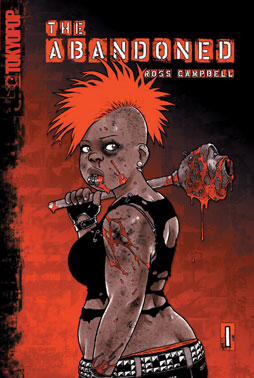
Why’d I Wait?: All I knew of the book from seeing it on the shelf was what I saw on the cover. The image was that of a full-figured black woman with a red mohawk, holding a bloody plunger and splattered with blood. The author credit revealed that the book was created by someone who wasn’t Japanese, meaning it wasn’t really manga, despite the fact that it was published in Tokyopop’s typical manga format. Finally, the back cover included a picture of zombies. As a comic book reader, fan and critic, and as a film critic, I am soooo goddam sick of zombies.

Why Now?:Well, had I flipped through the book in the comic shop the first time I saw it, I probably wouldn’t have waited at all. All it took to sell me on it off the library’s shelf was a quick flip through, which revealed creator Ross Campbell’s awesome, sexy punk character designs, squirmy gore and violence scenes and a gray, white and red palette that was hard to resist.

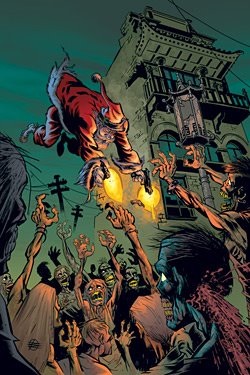
Well?: The post-millennial resurrection of zombies on the big screen is nothing compared to the revival the undead cannibals have seen in comics—hardly a week ever goes without at least one book featuring the slowly walking undead seeing release. At times, it seems like zombies are getting to be the new superheroes, they’ve become so ubiquitous. So if creators are even going to bother with zombie stories these days, they need to have an incredible hook just to be interesting, let alone to stand out from the rest of the crowded field (Walking Dead’s endless nature, The Savage Brothers’ lived-in vibe and The Last Christmas’ use of Santa and his elves as zombie fighters are some pretty good examples of decent hooks).

Campbell’s fantastic art and the hand-crafted feel of the book (his is the only credit, and the letters feel like the intimate, hand-scribed ones of a little indy comic, despite the professional glossiness of the art) are probably enough to push this zombie apocalypse to the top of the heap, but that’s hardly the only selling point to this 200-page epic.

Campbell also has a point to his zombie apocalypse, in the form of a Big Idea like those in the first few George Romero Living Dead movies, and his cast is an incredibly colorful one, filled with the types of characters one sees too rarely in any kind of comics or pop stories, and certainly not in any from this particular genre.

After Hurricane Riley strikes the southwestern United States, turning out the lights in our heroes’ hometown of Savannah, something strange happens. Just about everyone except our heroes suddenly drops dead. But they don’t stay that way long. Moments later, they rise and start seeking out human flesh, which they bite right off whoever is in their way in gory, red chomps (Campbell eschews ultraviolence and over-theatricality in his gore. When someone bleeds from a bite or wound, or, worse yet, has pieces of their flesh removed by the handful, the red stuff looks like it would in real life, I imagine, rather than coming out in gushers and sprays. When someone is eaten here, they seem like terrified meat, rather than a cinematic punchline).

Just why is it that everyone except our heroes have been turned into zombies? The unhappy birthdays some of them suffer spell it out—everyone over the age of 23 dies and comes back. Which brings us to Campbell’s Big Idea: In The Abandoned, we see a modern society which literally eats it’s young; where you die as soon as you enter adulthood, and then sustain yourself off devouring youth. As a metaphor, it isn’t subtle, but there’s little subtlety in The Abandoned, nor should there be, really. As a plot point, it cranks the suspense and drama up from 11 to 1100. Even in the unlikely chance our teenage heroes can somehow survive the constant zombie attacks, it is quite literally only a matter of time before they themselves become zombies.

As for those heroes, the main one is the punk chick from the cover, Rylie. A seventeen-year-old who works at I Scream, a zombie-themed ice cream parlor owned and operated by white sisters Nikki and Cam and who volunteers at an old folks home. She’s ecstatic that her “true-love-to-be” Naomi is moving to town, and arrives the day before the night where everything goes to hell.

Those four, plus fat, mean girl Mae, big, black Ben and his little white ex-boyfriend John comprise the cast. The only ones who’s sexual identity is revealed at all are gay, itself something of a rarity, but they’re also all punk rock Southern teens with accents, something else you rarely see, and though they’re all fairly pop culture savvy (Rylie used to wish for a zombie invasion, and I Scream has flavors like Nut of the Living Dead), they’re not smart-ass know-it-alls like the kids from the Scream movies.

The women are also refreshingly realistic in their proportions and variety. Naomi and Cam are skinny and boyish; Nikki buxom and hippy; Rylie full-figured; Mae zaftig to the point of obesity. Yet Campbell makes them all seem sexy, even the huge, bull dog-faced Mae, in some scenes. Part of it is their sense of style and the tiny clothes Campbell dresses them in, but it’s also the realism and care with which he renders them. When we first meet Rylie, she’s simply wearing her panties and drooling in her bed; when she moves to get up, Campbell draws all of her curves, concentrating and eroticizing the bulge of her belly as she bends just as much as her breasts or butt.

The Abandonded thus ignores the MPAA’s weird double standard where extreme violence is more acceptable than sexuality, homosexuality and nudity. And while the book is definitely sexy in a Suicide Girls kind of way and does contain some romance, it’s a definitely of the zombie apocalypse genre, rather than the romance genre. There are passages of gory panels that are truly horrifying, in part because we got to know the characters getting eaten so well before Campbell killed them off, and in part because he has such a wildly cruel imagination when it comes to hurting them (a bit involving Rylie and a shard of broken glass that I found myself inadvertently shielding my eyes while reading leaps back to mind).

Despite the invasion of zombie invasion books in comic shops today, The Abandoned is the only serious competition The Walking Dead has to its thus far undisputed title as King of All Zombie Comics. Tokyopop’s website says two more volumes are forthcoming, and I eagerly await both, though I’m a little surprised to hear it—the story told in the first volume is so complete, I assumed it was the entire story.

Would I Travel Back In Time to Buy it Off the Shelf?: Hell yeah. But luckily, I don’t have to, as it’s still on sale.

Saturday, September 02, 2006

Getting Lost


This week's column in LVW focuses exclusively on the most major work the medium's produced this summer, Alan Moore and Melinda Gebbie's Lost Girls. Click here to read the review.

Weekly Haul: August 30th


52 #17 (DC Comics)Okay, so based on the cover image, Lobo has taken the cape of Superman, the cowl of Batman, the sword and lasso of Wonder Woman and the coat of Captain Jack Sparrow. 52’s Gang of Four, assisted by Keith Giffen, Chris Batista and two inkers, do an admirable job trying to make the dated, one-joke Lobo seem more relevant, but he just doesn’t really stretch that far (Refreshingly, however, they use the once-overexposed character judiciously, all of his dialogue occurs in the vacuum of space, sparing us any catchphrases). Animal Man raises a great point upon first catching a glimpse of Lobo--how does one smoke a cigar in a vacuum? Lobo’s origin story, this week’s back-up feature, is penciled by his creator Keith Giffen, and is perfectly drawn. Mark Waid, who writes it, captures the spirit of the character’s early appearances in the narration quite well.

Action Comics #842 (DC) You know how annoying people who talk on their cell phones in public are? Well, imagine a giant guy talking on a giant cell phone—that’s the villain of the piece, a sort of alien auctioneer who starts stealing and selling earth stuff, refocusing his attention this issue on the DC Earth’s most valuable resource—superheroes. Superman, Nightwing, Firestorm II, Aquaman II, Livewire, The Veteran, Skyrocket (Woohoo!) and Bluejay (Yay!) are the ragtag team that’s left to save the day. I gotta say, I love me some Bluejay, and it’s great to see Skyrocket too, plus the overall willingness to shine the Superman spotlight so liberally around the dark corners of the DCU. Best line? Probably Livewires’ nickname for the tight-butted Nightwing: “Tightwing.”

All-Star Superman #5 (DC) Another homerun in Morrison and Quitely ongoing synthesis of all previous Superman incarnations into one, ultimate story. Quitely has done amazing things with Clark Kent thus far, and outdoes himself here. This is one Superman story where the “disguise” of Clark Kent isn’t so easy to see through. Physically transforming himself through his posture and facial expressions, Kent seems like a big, doughy lummox, rather than Superman with glasses. The real spotlight here is on Lex Luthor though, and Morrison manages to boil his hatred of Superman down to its most elegantly simple explanation: “How would you feel if someone deliberately stood in your way, over and over?” I’m having a hard time coming up with a favorite moment from this issue. The best I can do is narrow it down to either the appearance of Beppo the Supermonkey (um, sorta), the thing that fell out of Luthor’s pocket and how he uses it, or the joke about Melville.

Black Panther #19 (Marvel Comics) I’d expect more fireworks when the super-powered ruler of Latveria and the super-powered rulers of Wakandia get together for a tête-à-tête. Instead, writer Reginald Hudlin sets Cictor von Doom up as a straw man bad guy who’s not above (one not above making racist remarks to Storm, Panther and Africans in general) and B.P. as defensive about his continent’s cultural and technological achievements. Then there’s a fight with a bunch of Doombots (though the word “Doombot,” one of the most fun words in the Marvel Universe, is sadly used aloud in this issue). The promise inherent in the royal couples world tour is enough to keep me interested and reading for at least a few more issues though. Actually, the next stop is the moon, to visit the Inhumans, so I guess the words “world tour” aren’t exactly accurate, are they?

The Boys #2 (WildStorm/DC) No, I’m still not impressed. I mean, it’s fine and all, it’s just that I’ve seen it all before elsewhere in other Garth Ennis stories. (Like the scene where the Female attacks a house full of bad guys? It’s pretty much the exact same scene that introduced the Russian in “Welcome Back, Frank,” just not as outrageously funny). Maybe this promising series from two incredibly talented creators will finally get somewhere new and interesting next issue, when the team finally goes after some “supes.”

Civil War: Young Avengers & Runaways #2 (Marvel) More fighting, the inevitable make up, and one hell of an unexpected guest appearance. I love Caselli’s visual takes on the characters and the Runaways’ disses of the YA—good to see I’m not the only one who finds their names, costumes, powers and reason for being a little, um—what’s the word I’m looking for?—lame.

JLA: Classified #26 (DC) Howard Chaykin’s story here is awfully similar to Gail Simone’s story arc from just a few issues ago, dealing with how the JLA acts on the stage of world politics, which lines they can’t or won’t cross and which they will and why. In addition to Simone and Chaykin, plenty of other DC writers have tackled the same issues, including Giffen and DeMatteis, Joe Kelly, Brian Azzarello and, most potently, John Arcudi in his superior one shot JLA: Superpower. It would probably behoove DC to finally tell a definitive story about the JLA’s place in the world ometime soon, for consistency’s sake if nothing else. This time, two completely fictional South American countries are at war with one another, and they’re using methahumans as WMDs, which piques the USA’s and the JLA’s interest. The League meets with the President (no, not Bush) in the White House (Wait, Batman, taking a meeting with the President? In the White House?), and they go to the U.N. for permission to fact find. Permission denied, the League decides to go ahead and go in anyway—in plain clothes. The League itself is the Big Seven, apparently right after or near the end of Kelly’s run on JLA (Kyle’s the Lantern, Wally’s still Flash, J’onn’s still Martian and not a Skrull and Aquaman is in his shirtless, necklace-wearing phase). The art, by Kilian Plunket and Tom Nguyen, is nice (even if their cover is anonymously lackluster) and Nguyen is a particularly good choice to ink, as he inked this version of the League when they were starring in JLA.

Justice #7 (DC) This Alex Ross-helmed maxiseries is a strong refutation of DC’s recent impulse to have to remake everything that’s not Superman and Batman. Martian Manhunter and Captain Marvel have both received radical redesigns in an attempt to make the characters work better, but as Ross and company prove here, they’re hardly broken (It’s somewhat ironic that the first issue of Trials of Shazam! drops the same day that Ross proves yet again that Captain Marvel is just as great as the rest of DC’s big guns just the way he is). In this issue, it’s guest-stars galore, including the huge JLA line-up and Captain Marvel, plus the Metal Men, the Doom Patrol, Plas, Metamorpho, Black Adam, some plainclothes sidekicks and Aqualad. Ross’ art, painted over Doug Braithwaite’s pencils, infuses the proceedings with a layer of wonder. For example, check out the two-page spread of the Fortress of Solitude. It’s a setting we’ve visited thousands of times in comics, but really, when was the last time it made you gasp like this? Here it’s like seeing it for the first time. I have no idea who’s slated to helm JLofA after Brad Meltzer’s short run ends, but if they’re looking for a shake-up rather than a continuation, here’s hoping Alex Ross and Geoff Johns are put in charge. Best line: “I hate asking…but my wallet got burned up when you threw me into the sun.”

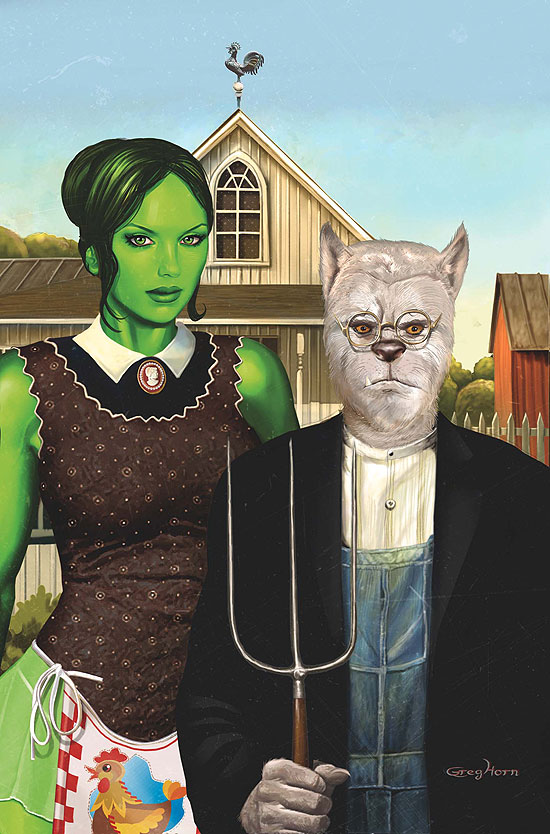
She-Hulk #11 (Marvel) Best. She-Hulk. Cover. Ever. The (super)power couple of She-Hulk and John Jameson are Honeymooners, but he’s spending his howling at the moon in his Man-Wolf form. Their relationship is about to take a turn for the even weirder, it seems, as Starfox’s role in the proceedings is explained and then nullified.

Solo #12 (DC) Uhhh…Hm. I got nothing.

Superman/Batman #29 (DC) Mark Verheiden is—unfortunately—keeping Jeph Loeb’s Throw Everything At The Reader approach to this title. In the second issue of his arc, his first with the series regular artist Ethan Van Sciver, a bunch of random characters attack the title heroes, though in some cases they may be a shape-shifter posing as other characters, as in last issue. There’s The Creature Who Could Not Die, the Caveman from Krypton, Golden Age Lois Lane, and the Green Lantern rings on the fingers of Kilowog and Hal Jordan, apparently controlling the ring-slingers (the slinger has become the slingee!). Ethan Van Sciver is an incredible artist, perhaps the best draftsmen and designer this particular title, which is known for its hot artists, has had, but in this issue we discover his limitations—not even he can make the new Skrullish Manhunter design look remotely cool. And speaking of the Manhunter, since when did J’onn J’onnz become such a dick? Sure, Batman jumps out of the shadows and shoots him in the face with a flamethrower, but J’onn could be a little more professional about it. “Even if I had my suspicions, do you honestly think I would trust them to a human like you?” he tells his long-time friend before blowing him off (Remember the last time you blew off a long-time Justice Legue colleague who lacks superpowers and dresses up in an animal costume, J’onn? That’s right, he got shot in the head and the universe was almost destroyed). I do hope that’s not the last we’ve seen of J’onn this story arc; while I loathe his new look, I’d hate to think he actually responded to news of some sort of shape-shifting alien invasion of earth with a “Yeah, whatever human. I’m out of here.” Confidential to Van Sciver: Lois got a haircut.

Teen Titans #38 (DC) When the subject of new teammates comes up, Rose Wilson finally says what I’ve been thinking since the OYL relaunch: “Does that mean more adults on the Teen Titans like Cyborg? Because the team kinda loses it’s point, doesn’t it?” Geoff Johns ratchets up the OYL mysteries, as the team heads to Russia to meet Red Star (given a new, cool status quo and a look resembling his Cartoon Network style) and search for the missing Raven. They learn that Raven is searching for something that was stolen from titans Tower by one of the 20 young heroes who were Titans during the missing year. There’s a great two-page spread teasing the list of suspects, including two from the Kingdom Come-iverse (Zatara and Offspring), three from the cartoon (Hotspot and Mas y Menos) and one named after a Mel Brooks movie (Young Frankenstein). It should be fun getting to the bottom of this mystery and meeting some of these new characters, although the first issue of this new arc was accompanied by some particularly weak art. The pencils by Carlos Ferreira seemed static and awfully amateurish for such a strong-selling DC book, and some of the pictures were downright confusing (Um, did Risk actually eat a quarter in that one scene, or what?)

Transformers: Evolutions #3 (IDW) Wait, concluded next issue? That’s it? That’s all we get? Four issues of the Steam Age Transformers? Man, it hardly seems worth it. Why waste all that time on Transformers redesign to tell such a short and exceedingly weak story.

Trials of Shazam! #1 (DC) I broke my vow never to buy another Winick DCU book because of my love of Porter’s art (particularly this gorgeous new painterly storybook/comic book fusion style) and the Big Red Cheese outweighed my disdain for Winick’s lazy, lazy writing (the ignorance of continuity, the indistinct characterization, the lack of any research at all). In general, Winick doesn’t seem interested in the occult at all, and when writing about demons, trolls and magic (which he does surprisingly often), he resorts to gobbledygook that sounds like overheard and misunderstood Dungeons & Dragons lingo. He does so here too, but this time around there’s an explanation given for it. The last page shocker, teased at by the end of Infinite Crisis #7 seems to indicate that DC has found a way they can keep telling Captain Marvel stories even though they can’t use his actual name in a title—just change him into Shazam. Like the recent Martian Manhunter redesign and relaunch, this book seems to be a case of fixing something that’s not in the least bit broken, but Winick and Porter haven’t done any real damage to Cap yet, and, unlike Martian Manhunter, I’ll be picking up #2 of this series.

Uncle Sam and the Freedom Fighters #2 (DC) I was extremely skeptical of this particular relaunch, but Jimmy Palmiotti and Justin Grey knew what they were doing all along, and prove it here. I’m not convinced they needed to kill off most of the last FF and shunt the others off into limbo to make way for this version (How is Ray III any different than Ray II, other than being much less likable?), but with the FF now on the run like their ‘70s counterparts, I’m down for #3.

X Factor #10 (Marvel) I still have no idea what’s going on with Singularity Investigations (another strange clue is provided here), but I can’t stop reading this title either. Props to Peter David for teasing out such well-realized characters that the story around them seems completely beside the poing. Art on this book has been especially troubled for a series that’s yet to hit a dozen issues, but these two pencilers seem capable. But I still say give the book to Kevin Maguire and Joe Rubinstein.

Friday, August 25, 2006

This week's column

in Las Vegas Weeklyfeatures reviews of The Drifting Classroom, Phonogram and The Psycho. You can read it here. If you happen to be an editor of an English-language North American altweekly, you can syndicate it by emailing me at the address in the upper right hand corner.

Thursday, August 24, 2006

Weekly Haul: August 23rd


Despite what Mae West said about too much of a good thing, I think I’ve found my limit for reading freshly-released comic books on a Wednesday: It’s about 500 pages. Having done nothing between 11 a.m. and 6:30 p.m., and then another hour and a half of reading after a short break, I can stand to read no more—506 pages is more than enough for one day. I blame Alan Moore and Melinda Gebbie, as I didn’t expect to see the crate full of their Lost Girls waiting for me at my local comic shop today, on top of my normal purchases. After my non-Lost Girls haul, I read 160 pages of the three-volume book before I grew so tired of looking at Gebbie’s drawings of vaginas I had to call it a night…

52 #16 (DC Comics) This week’s issue is probably the closest thing to a Captain Marvel comic DC has put out in quite some time. As Black Adam prepares to wed Isis, he calls on the closest thing he has left to a real family to attend the ceremony. Cap, functioning as the new Shazam, oversees the wedding, Mary Marvel is the maid of honor and Junior works crowd control. Bonus: Tawky Tawny! While most of the issue belongs to the Marvels, Montoya and the Question manage to save the day from a would-be suicide bomber, and the space heroes get two pages that amounts to a sweet impotence joke. The back-up is the origin of Black Adam, the perfect choice for the issue. Perhaps DC has straightened out the editorial problem that has had origins of characters who have nothing to do with the preceding stories running?

Action Philosophers! #6: The People’s Choice (Evil Twin Comics) Fred Van Lente and Ryan Dunlavey’s sixth issue is full of plenty of little pleasures, just as the first five were. I particularly liked Dunlavey’s Wittgenstien, who’s so intense that waves of intensity radiate out of his forehead at all times, and his Kierkegaard, who looks like a total nut. But as funny as AP!, I always find myself learning something. The most shocking thing I learned this issue? St. Thomas Aquinus was fat. Really fat. I never learned that in college, and I went to a Catholic school.

Astonishing X-Men #15 (Marvel Comics) Best. Kitty Pryde. Cover. Ever. As for the rest of the issue, well, John Cassaday’s art is still gorgeous, but increasingly I find myself wishing I’d waited for the trade. Joss Whedon just doesn’t pack much story into each issue, and when a book publishes as infrequently as this one does, you need an incredibly dense read to keep caring.

Batman #655 (DC) The gut-punch of a conclusion comes as a bit of an anti-climax, at least if you’ve read the solicits for future issues (and took the title of this story arc literally). Writer Grant Morrison does have one great idea here, however, and that’s to stage a Batman fight in an art gallery showing off comics-inspired art, so that huge, Lichtenstein-esque canvases read “Blam!” in the background of the panels. Morrison plays levels of reality and their interaction with each other like a piano in this fight scene, and it overshadows virtually all other aspects of an otherwise solid comic book—Andy Kubert’s art, Batman’s sarcastic narration and the dozens of ninja Man-Bats he fights. (Wait, what's the plural of "Man-Bat?" Is it Man-Bats, or Men-Bat?).

Batman and the Mad Monk #1 (DC) Is it just me, or has DC been going out of it’s way to have characters smoking ever since Marvel E.I.C. Joe Quesada announced their company’s anti-smoking policy? Regardless, this instance comes with an anti-smoking message: Captain Gordon goes out to the roof for a smoke, and gets attacked by corrupt cops. Luckily this is a Batman comic and not a Jim Gordon solo title, or else the captain might not have had a guardian vigilante to save him. Matt Wagner continues his Year One era story of Batman right where he left off, nicely decorating this issue with a gorgeous homage to one of the best covers in Bat-history.

Birds of Prey #97 (DC) As much as I love Dayton, Ohio-based heroine Black Alice, this current story arc started fairly weak, and ends even weaker. Four Birds fight three Society villains with Alice caught in the middle, and there’s so much stuff going on that it feels like nothing.

Doc Frankenstein #5 (Burlyman Entertainment) Frankenstein begins to find his faith just as one of his enemy priests begins to lose his. In this issue, Steve Skroce draws all kinds of ultra-violent madness in the past and present as Doc slays packs of werewolves, and we learn the secret origin of Jesus.

Eternals #3 (Marvel) Come one Marvel, I know you guys are really pushing this Civil War story, but does it have to be in every comic? I mean, you get Neil frigging Gaiman to write a miniseries for you, and you have to have civil war crap here too? I suppose we’re lucky they allowed this issue to ship without the special CW trade dress.

JSA: Classified#16 (DC) Is being omnipotent worth it if your obesity directly correlates to your power? Would you still want to be all-powerful if it means you’d have a third chin like a bullfrog’s swollen throat? Amos Fortune apparently would. In the final chapter of Steve Englehart’s weird, messy JSA story, things get weirder and messier. Vixen and Gypsy show off superpowers you never knew they had, Wildcat is the greatest fighter in the world (boxer, maybe), Stargirl knows all kinds of stupid-looking martial arts and The Wizard’s a weakling. I think I’ll be keeping this story arc with my pile of kindling rather than in my longboxes…

Justice League of America #1 (DC) I had a lot of reservations about Brad Meltzer taking over a book that used to be my favorite superhero comic, and I mean a lot of reservations, from my worries that he’d simply revert to the Satellite Era line-up, or simply ignore the last 20 years of continuity, or how on earth you can justify the “of America” making any sense in 2006, tor that he might “break” the concept as he broke some DC toys (I still can’t look at Hal Jordan and Black Canary and much of the “Power Pact” in a positive light after Identity Crisis). But his first, over-sized issue was pretty engrossing. I could babble about it endlessly, but I’ll save it for a full review elsewhere, and here simply accentuate the negative. The covers? Reeeeeee-diculous. All three are bad, but the two I was forced to choose between, each showing half a picture, are just awful on their own. DC should have kept the picture in one piece and used it as a wraparound. Secondly, while it’s fantastic to see Roy “Arsenal” Harper get the nod, and finally join the big league, his new costume and his R-shaped belt buckle on two of the covers points to him going by “Red Arrow” in the near future (Unless that “R” is simply for “Roy,” or, even better, “Roy Arrow”). When he changed his name from "Speedy" to "Arsenal," he began using his superior aim with other weapons beside the bow and arrow, differentiating him from his mentor. If he puts "Arrow" back into his name, he loses that something special that differentiated him from Green Arrow, making him just one more archer. It's a little like Nightwing changing his name to Batguy or Tempest changing his to Aquafellow.

The Last Christmas #3 (Image Comics) Santa finally starts to get his shit together, but it may be too late to save the few human survivors left in San Francisco, let alone Christmas. This issue is most notable for the disturbing detail writers Gerry Duggan and Brian Posehn add to zombie lore. Everybody knows that the only way to kill a zombie is to destroy their brains, but did you know that zombies feared images of Dr. Phil with breasts? Now you do.

Lost Girls (Top Shelf Productions) I’m not even done reading this thing, let alone thinking about enough to review it here yet. All I can say at this point? The packaging is gorgeous, it’s as wonderfully complex and challenging as Alan Moore’s best work, and even though it’s by far the most expensive comics-related purchase I’ve ever made, I don’t feel ripped-off in the least.

New Avengers #23 (Marvel) God, I hate this book. So why can’t I stop reading it? Anyway, despite the title, the only Avenger to actually appear is Spider-Woman, unless you count Iron Man, who appears in a few panels being a total dick. Nothing terribly pertinent or interesting really happens, other than we find out which side Jessica Drew lands on (Cap's; there, I saved you three bucks). The thrust of the issue is simply Brian Michael Bendis un-building the build up he had built up in New Avengers #14 amd #15. His artistic collaborator this time out is Olivier Coipel, whose line work is wonderful, but he and Bendis completely lost me on two separate occasions in this same issue, the confusing battle spiral on pages five and six and the conversation on pages 17 and 18 (I followed the top tier all the way across).

Ultimate Spider-Man #99 (Marvel) God, I love this book. Brian Michael Bendis has written 98 issues of it already, and yet this one has more “Holy shit!” moments than all of them combined. His willingness to stay on this title so long repeatedly pays off, as it does again in this issue—when a twist has been building for this long, it hits you that much harder. If he can end this story arc on the same high notes that he started it, the words “Clone Saga” may not be dirty ones to Spider-Man fans for much longer.

Wonder Woman #2 (DC) Oh yeah, DC has this superheroine named Wonder Woman with her own title, don’t they? I’d nearly forgotten, it’s been so long since #1. This issue is jam-packed with action and guest stars, as Batman, Robin and Wonder Girl join Wonder Woman, “Diana Prince” and Nemesis to do battle with amped-up Wondy rogues Dr. Psycho, The Cheetah, Giganta, Dr. Posion, Osira and Dr. Cyber. Whew! Plus, there’s a totally out of left field guest-star appearing at the end, one wearing a fantastic costume redesign. Terry Dodson’s design work and wonderful rendering (inked by Rachel Dodson) continue to be the selling point here. As for the story, it’s surprisingly simple, and requires perhaps too much suspension of disbelief even for a Wonder Woman comic book (Diana, one of the most well-known superheroes and political figures on the planet, adopts a secret identity and a Clark Kent-simple disguise to go to work for a federal government agency whose sole job is to study metahumans…like Diana).

Wednesday, August 23, 2006

"We hope your holiday is ruined whenever you read it."


So says Gerry Duggan, who, with Brian Posehn, has written the completely crazy post-apocalyptic Christmas tale The Last Christmas. To read an interview with Duggan, and TLC penciler Rick Remender, be sure to click to bamkapow.com. It goes kinda like this:

And speaking of "Christmas" vs. "X-Mas," why didn't you go with the latter? Comics with "X’s” in the title have always sold better than comics with the word "Christ" in them.

I just decided that any sequel will be titled: "X-Mas Men"…everybody knows that Gary the Snowman is the new Wolverine. I read it on a message board.

Fred Van Lente, man of action...and philosophy


Get thee to bamkapow.com to read my interview with Fred Van Lente, the writer behind the hilarious Action Philosophers! comic. I was pretty bummed when I learned it's winding down, ending with #9. At least until I learned what Van Lente and his AP! co-creator Ryan Dunlavey have up their collective sleeve. Be sure to check it out. Here's a sample exchange to whet your interview-reading appetite:

This week's issue is the "People's Choice," in which the most requested philosophers to get the Action Philosophers' treatment. When you were collecting suggestions and votes for it, did you get any that really threw you?

Oh yeah, like every week—still! (laughs) Somebody writes in recommending someone who I guess turned them on in college but Ryan and I have never heard of before, usually obscure lefties. People have also suggested we do an All-Vegetarian Issue and an All-Feminism Issue, but it doesn't look like that's going to happen.

The one name that keeps coming up is the Marquis de Sade … Jesus, I'm like, people, people: Wanting to fuck everything that moves is NOT a philosophy!

It's an important life goal.

Delayed Reaction: Batman: Under the Hood


Batman: Under the Hood (DC Comics), by Judd Winick, Doug Mahnke, Tom Nguyen and others

Why’d I Wait?: Writer Judd Winick has been responsible for some great creator-owned work, particular Pedro and Me and The Adventures of Barry Ween, Boy Genius, but his DC work all seems to fall somewhere between mediocre (Blood and Water, Green Lantern), bad (Green Arrow, most of Outsiders) and downright repulsive (“Lightning Strikes Twice,” the John Walsh-guest starring issues of The Outsiders). So despite the stellar art team inside and out, this seemed like a story to avoid—particularly once rumors started circulating that it would be about the resurrection of Jason Todd, perhaps the one character in the entire DC Universe that should never be resurrected for any reason.

Why now?: Since they really went ahead and resurrected Jason Todd (I was so sure they wouldn’t actually go through with it), morbid curiosity made me want to find out exactly how well executed The Worst Idea In DC Comics History actually was. Plus, I’d just put down the first volume of The Winter Soldier, which I guess put me in the mood to read about resurrected boy sidekicks.

Well?: This is a hard book to read, and a harder book to review, because the central idea—Jason Todd, back from the dead!—is so hard to get past. It’s just so wrong on so many levels, from the fact that he suffered the most unequivocal death in comics (beaten to near-death by a crowbar, then dynamited), to the fact that Batman comics don’t have the sort of science fiction or supernatural underpinnings that so many other comic books do, to the fact that Todd’s death was the result of a 1-900 phone poll (making Jason Todd’s death perhaps the only one in comics history that the fans decided on, rather than the writers and editors) to the simple fact that the death of the second Robin has been a pivotal event in Batman’s history, leading to some 20 years worth of character development.

Well, putting all of that aside, Winick does weave a fairly dramatic reveal here. The volume opens with Batman fighting a new Red Hood, who unmasks off-panel, and then we flashback to what lead up to the battle.

There are an awful lot of unanswered questions here, including why Jason Todd is still alive, why he’s a grown man instead of the age he was when he died and why he’s suddenly become evil. He sets himself up as a relatively nice crime boss (You can sell drugs, but not to kids), but he has a savagery that makes him seem as bad as, if not worse than, the villains. When he takes over a racket, for example, he does so by handing the old bosses a duffle bag full of the severed heads of their associates.

Winick writes some fairly exceptional character moments between Batman and Nightwing, particularly during their fight with an Amazo android, and there are some wonderfully sharp exchanges between Batman and members of the so-called “Power Pact” that mindwiped him in Identity Crisis.

Winick’s Black Mask has a nice, rhythmic sense of black humor in his back-and-forths with his underlings, even if his character is simply Winick Stock Villain Boss. And his use of Mr. Freeze is criminal. He writes him as Winick Stock Mercenary Villian, which is a damn shame, considering the character’s potential (The best use of which was in the first season of Batman: The Animated Series).

The main problem with this graphic novel as a whole, however, is that it relies too much on other stories. If you haven’t read at least “Hush,” Identity Crisis and Batman: A Death in the Family, little of this story will make sense. What separates a decent story arc from a great one will always be how readable it is on its own, and Under The Hood just doesn’t stand up by itself.

Regarding the art, the team of Doug Mahnke and Tom Nguyen (responsible for a fine run on JLA and the underappreciated Justice League Elite) have simply done the work of their careers here, and Matt Wagner’s covers are all exceptional.

Confidential to DC: Ever put any thought into a Matt Wagner omnibus? Maybe “Faces,” Trinity, his Demon miniseries, his random Batman short stories and all the covers he’s done over the years? Think about it.

Would I travel back in time to buy the original issues off the shelf?: Oh, hell no.