Sunday, November 28, 2021

On 2002 Elseworlds series JLA: Destiny

1.) I'm not entirely sure how I missed it, but I blame the covers. JLA:Destiny was a four-issue, prestige-format Elseworlds Justice League comic by writer John Arcudi and artist Tom Mandrake that was published in 2002. I did not read it, nor do I remember even being aware of it, back then.

I find this odd for a few reasons.

First, in 2002 I was living in Columbus and visiting The Laughing Ogre religiously each Wednesday, where I looked over the new rack in its entirety, even though I generally already knew what I wanted that would be out on any given week, given the fact that I made a habit of reading the solicitations when they were released each month. I also read Previews on a weekly basis and the comics news sites on a daily basis, and this was when those sites were almost entirely focused on comics to the exclusion of all the other forms of entertainment that now confuse their coverage.

Second, I was a JLA fan. While I didn't read every Elseworlds special with the team's name in the title, I generally at least took notice of any JLA comics' existence. For frame of reference, 2002 was when Joe Kelly and Doug Mahnke took over the title from Mark Waid, so while the title was far-ish away from its heights under Grant Morrison, Howard Porter and company, it was still a good two years away from becoming an anthology title, during which time each and every arc read a little like an Elseworlds story, they were all so unmoored from continuity.

Third, I was a Tom Mandrake fan. As I mentioned in the previous post, I had admired Mandrake's art ever since I first encountered it in a 1990 issue of  DC/TSR's Advanced Dungeons & Dragons, and my esteem for him had only grown after reading he and John Ostrander's excellent The Spectre and, even more in my wheelhouse, JLA spin-off Martian Manhunter, which this series almost immediately followed. 

So a Tom Mandrake-drawn JLA series certainly seems like something I would have wanted to read in 2002 but, like I said, I don't remember even noticing it at the time. 

What can account for this? I don't know, but I'm going to blame the covers. 

That of the first issue is above, here are those for the rest of the series:


As you can see, there is a pretty uniform sense of design to them all: A close-up image of a character's face in a heavily shadowed, background-less space, with an extremely limited color palette. They are striking images, and would have, one imagines, stood out sharply from many of the other superhero comics they would have been sharing shelf space with on the weeks of their release. 

What they don't look like, at all, of course, are JLA covers. None features more than a single character on them, which means one can't tell by looking at them that they are essentially about a team of superheroes, and none save the last features a member of a familiar version of the Justice League, although, because of how stylized the image is, you might not even recognize that as a close-up of Green Lantern Guy Gardner, his ring lighting the Black Mercy flower attached to his chest.

I like each cover well enough individually, but it's not hard to see how poorly they convey the fact that they are JLA comics. If they ever collect the series, and I find it unlikely that they will unless it appears in an Elseworlds: Justice League collection,  one hopes they'll commission a new cover showing either the book's Justice League posing, or engaged in battle with the other team of super-people they spend most of the book fighting.  

2.) There are basically two kinds of Elseworlds stories, and this one is something of a blend of both. The best Elseworlds comics tend to change one thing in a familiar story, and then follow that line of thinking to wherever it leads, crafting a compelling story in the process. This might be, for example, that the rocket that sent Kal-El to Earth was found not by Jon and Martha Kent, but instead by Thomas and Martha Wayne, or that Bruce Wayne was chosen to be Earth's Green Lantern instead of Hal Jordan. Often times it may be a simple change of setting, putting Batman in, say, cowboy times or on a pirate ship, for example.

The other kind generally just scramble things at random; they may still have a premise that boils down into a pithy pitch, but the many changes to the milieu and the characters have more to do with the general preferences of the creators than the nature of the Elseworlds story. These can be fun, even great, but are also sometimes confused, and their quality relies much more on their execution than on the strength of the concept. (Think, for example, Kingdom Come, or the Dark Knight sequels, or Sean Murphy's Batman comics).

There's an easily articulatable, "What If...?" style premise behind Destiny, and its the one that appears on the back cover. The first two lines seem to be the starting point for the plotline, but here's the whole thing: 
A world without Superman. 

A world without Batman.

A world where their absence has had as great an impact as their existences has had in this reality.

A world where the super-criminals are less afraid, more confident, better organized, and more focused.

A contentious, frightening world, where global terrorism masquerades as super-politics.

A world that desperately needs a Justice League of its own.

Or does it? 
Some of what makes the setting of Destiny unique follows from that removal of Superman and Batman from the DC Universe, but much of it just seems scrambled at random. 

For example, Arcudi first has to remove them from the proceedings. This he does by having Jor-El testing the escape rocket himself when Krypton explodes, and, with his wife and infant son thus killed, he takes it to Earth himself. And as for getting rid of Batman, here the mugger murders Martha and Bruce, but Thomas Wayne survives.

Superman and Batman's dads have a great deal of influence over the world of superheroes and the story told in Destiny, but how does the world change without Superman and Batman?

Some characters are completely unchanged, like Wonder Woman and The Flash Wally West (although they dress differently). Some changes follow, like, perhaps, that the alien J'onn J'onnz decides to pose as a human superhero rather than coming out as an alien, perhaps because he doesn't have the example of the alien Superman to follow. Others don't, like Aquaman being a heroin addict working for a foreign leader against the interests of the U.S. 

Much of the state of this world seems to be the way that it is because that's the way Arcudi wants it, though. There is a swathe of minor Golden Age character reintroduced as modern age characters, which I can't really see Superman or Batman having otherwise somehow prevented, and something of a divide between the super-powered and the non-powered  heroes but, again, it's somewhat foggy as to how that follows the absence of the World's Finest. 

3.) There are some pretty interesting characters chosen to appear in this story.
These include new versions of Midnight, a Golden Age Spirit pastiche created by Jack Cole, reimagined as a paramilitary type with, at least in flashback, a costume that seems to blend those of Batman and Judge Dredd and to have an "M" and skull motif (that's him on the cover of the first issue, and to the right of the above image); The Clock, who Wikipedia says is the first masked crime-fighter to appear in American comics, but here somewhat resembles Deadshot; Mr. Scarlet, the Golden Age Fawcett hero reimagined as a monstrous-looking magician of some sort; Manhunter, the Paul Kirk version in the costume familiar from the Archie Goodwin and Walter Simonson comic; Nightshade, the Silver Age Charlton character, here a retired vigilante plagued with apocalyptic visions of the future; Widow, a black warrior woman wearing a fishnet and W-theme, with a huge-ass axe; The Human Bomb, the Golden Age Freedom Fighter who here uses his ability to detonate himself as an incredibly effective terrorist targeting the United States; and Captain Thunder, a black version of Captain Marvel.

Many of these are extremely minor character who have little or nothing to do with the proceedings of the comic itself, but simply fill up the ranks of the super-teams involved. Some don't even have lines, or appear only in brief flashbacks. Still, it's noteworthy to see any attempt at using, say, Midnight or The Clock, who are otherwise mostly just waiting around in the dustier corners of DC's character catalog, waiting for some writer somewhere to remember them. 

4.) This is the story. After his wife and young son are killed in a mugging gone wrong, Thomas Wayne devotes his wealth to the creation of The Justice League of Gotham, which here consists Midnight, The Clock, Nightshade, Mr. Scarlet and Manhunter. After they all but eradicate all crime in Gotham, Wayne realizes the world might benefit from such a team, and he thus creates the Justice League of America which, in the present, includes Midnight, Widow, Marksman, Captain Thunder, Wonder Woman, Triumph, The Flash and The Unknown (the last of whom isn't around long; he seems to bear more in common with The Spectre than Neon The Unknown, but lacks the former's omnipotent powers).

This Justice League is most concerned with the constant attacks by launched from the rogue Middle Eastern state of Kamburu, and it's mysterious shadow leader Khouriga Edjem. In addition to The Human Bomb, Edjem's agents include super-people Black Adam (here a robot built by Dr. Sivana, as is mentioned in passing), Kondor, Aqualord, Wildfire and the vaguely Norse mythological figures, the  Thor-like Thane and a pair of trolls. 

The League has an edge in their battles against this anti-league from former Nightshade's psychically-derived intel, which warns them ahead of time of various attacks. 

Meanwhile, "Lex Luthor", seen in his older, fatter version and here sporting a white beard, giving him a Santa-like appearance, apparently had some sort of change of heart during a terrible accident that badly scarred him. No longer the amoral weapons-developer he once was, he devotes his time and genius to creating inventions of benefit to all mankind....and has his work funded by Wayne. As it turns out, he is not the real Luthor at all, but Jor-El, who gave the real Luthor access to his rocket and knowledge of space travel to get rid of him, and took his place on Earth.

It is this move that inadvertently created "Edjem," however, as the space conqueror Mongul encountered Luthor in space, and then targeted his home world, where he attempted to take over in a, for him, new and novel way, transforming a poor, desert country into a paradise of sort, and then engaging in geo-politics and international terrorism as part of a long-term plan to conquer the world. Wheat harvests are involved, as is the goddam Black Mercy, an Alan Moore invention that DC writer simply can't stop revisiting. 

There are multiple superhero fights and a few out-of-left field revelations, but ultimately Edjem/Mongul is defeated, and Jor-El takes him off into space, to apply super-capital punishment. 

It's fine, but I found myself far more interested in seeing panel-time given to the minor characters than to the pursuits of Batman and Superman's dads. I think Destiny's greatest point of interest today is probably as an early attempt to reckon with real-world terrorism like that of 9/11 in a superhero universe. 

5.) Some of the costume designs are kind of neat. 
I already mentioned the Midnight redesign and that of The Clock and Widow, the latter of whom Wikipedia insists is a new version of the Golden Age character Spider Widow, a Quality Comics character that technically belongs to DC now (That's her above, on the right).
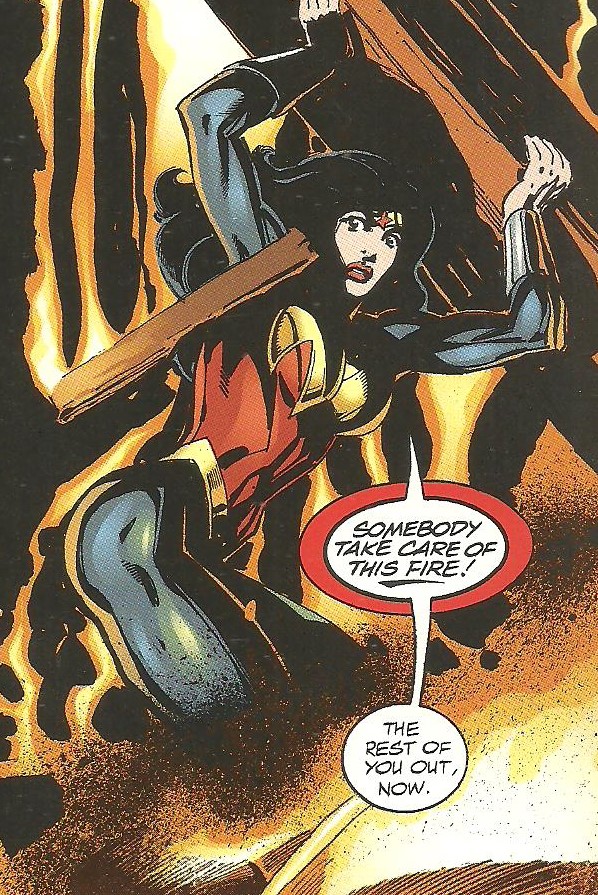
Wonder Woman's costume is of note in that it presages later redesigns for the character. She wears the same red and gold bustier with a W-shape that she usually does, but rather than star-spangled shorts or panties she sports a black pair of tights. She also has long black sleeves under her wristbands, so that it looks like she's wearing a black body-suit under her bustier. 

With the long sleeves, it rather resembles the costume worn by current Wonder Girl Yara Flor in some respects, and it also pre-figured Wonder Woman's brief, New 52 flirtation with black pants. 

For some reason, she doesn't have her lasso in the story. 
The Flash is generally drawn in movement, so that more often than not he appears on the page as multiple images flowing into one another, the character having an almost liquid quality. It's interesting that Mandrake gives Wally his own Flash costume, rather than having him inherit Barry's. Rather than a cowl covering his head, his hair is exposed, and he has a Cyclops-like visor.
I like Captain Thunder's costume okay. It's not as strong as the original Captain Marvel costume, a classic it's hard to compete against, but it's less busy and complicated-looking than the current Captain Marvel Shazam costume. 
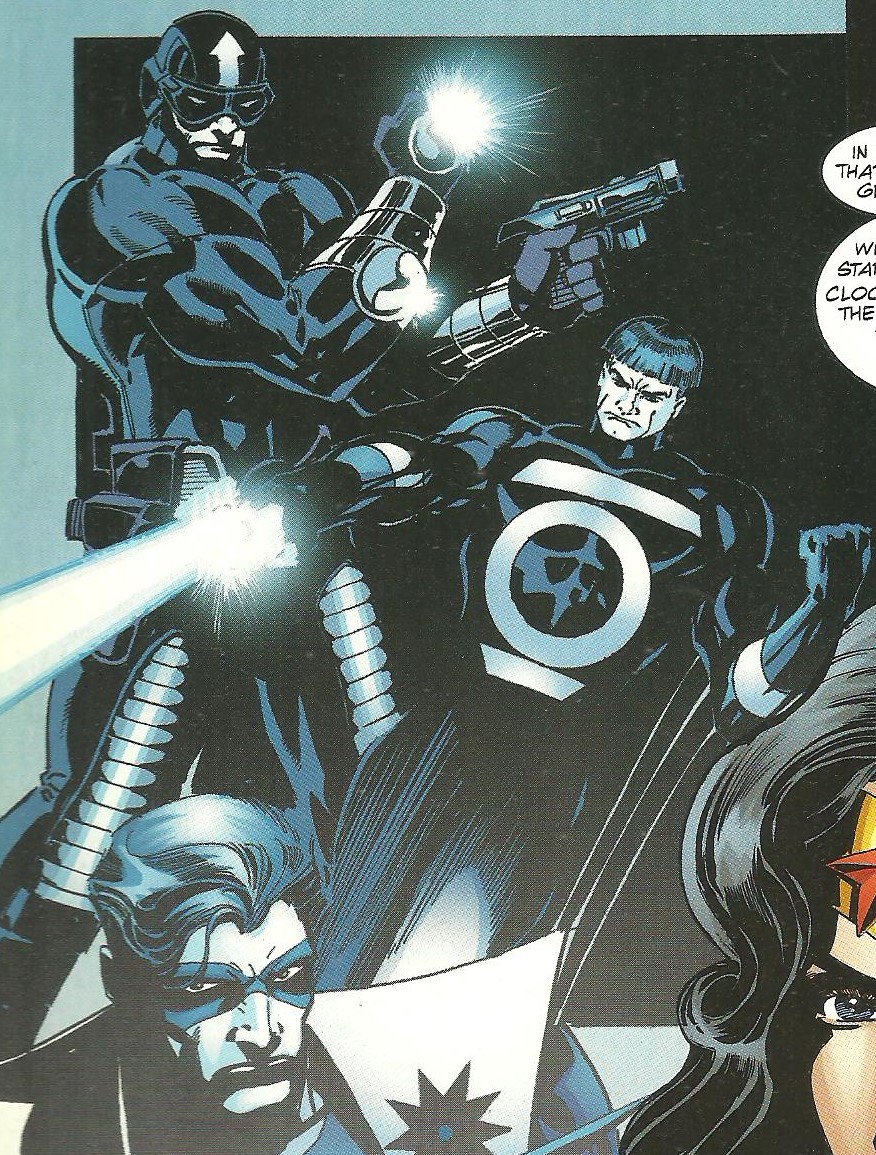
I also rather liked Green Lantern's costume, which has a Frank Miller-like quality to it, in how stripped-down to the essentials it is. It's basically just a black body stocking with a huge Green Lantern symbol on it. That's The Clock next to him above, by the way.

Saturday, November 27, 2021

The short career of Pagan, the feminism-themed Gotham vigilante

Von Eeden/Giordano

Every once in a while I'll remember the character Pagan, and wonder what some of the more vocal members of the modern, extremely-online comics readership would have made of this character had she debuted in, say, 2005 or 2019 instead of way back in 1992. 

Pagan was on the many, many original creations of long-time Batman writer Alan Grant, although she is one those many creations that never caught on with other writers (along with the likes of Joe Potato, Wilde Chancer), unlike the handful of Grant creations who became mainstays in Batman comics (Mister Zsasz, Scarface and The Ventriloquist, Anarky). 

A brutal vigilante who played too rough for Batman's taste, Pagan's "theme" was essentially a cartoonish version of feminism. Not only did she dress like a female gladiator and wear the symbol for woman over her left eye, but she would spout dialogue like "Very clever--for a man!" and, after he introduction, seemed to devote herself to the protection of the women of Gotham City from being preyed on by men.

You can see why she's an interesting comic book figure to consider in the twenty-first century, given how much superhero comics have become more welcoming to female readers, the backlash against it from certain, terrible but vocal corners of the fandom and, of course, the way the comics industry itself and certain terrible creators have targeted and victimized women in a variety of ways.

So, like I said, I often wonder how the character would be received today, and if Alan Grant and artist and co-creator Tom Mandrake might have presented her were they introducing her twenty years later, or if they even would have created such a character in the 21st century.

There are certainly aspects of the character that seem potentially problematic—including her origin, which is a sort of "fridging" with a twist—perhaps foremost among them being the fact that she was, of course, the creation of men who appeared in a comic targeted towards teenaged boys, and thus her brand of radical, ultraviolent feminism has more than a touch of the cartoonish about it.

Of course, this was at a time when Batman was presented as, if not exactly a pacifist, not nearly as violent as he would later be depicted, and was as adamant that vigilantes use minimum force as he was that other superheroes stay out of Gotham (Batman's main issue with The Huntress at the time, you may recall, was that she was too rough on criminals).

Pagan made her first appearance in Batman #479, late in Grant's run on the title. His long-time collaborator Norm Breyfogle had recently left the title, and, after a two-part fill-in by writer John Wagner, Grant would do just two more issues before the title was turned over to writer Doug Moench for a few more issues, before the build-up to the "Knightfall" saga began (Grant would leave Batman, but not Batman, launching his own, new title Batman: Shadow of The Bat with Breyfogle).

This issue, then, was the penultimate one of his Batman run, and was pencilled and inked by artist Tom Mandrake, with Adrienne Roy providing colors. Let's read it together, shall we...? (If you don't have a copy of your own, it's being collected in Batman: The Caped Crusader Vol. 6, scheduled for a February release; you can come back to this post then, if you like. It will still be here waiting for you. Promise.)

Mandrake
COVER: There are a couple of interesting notes about the cover. It depicts the new character Pagan at its center, but Batman's still present in the form of his instantly identifiable shadow, falling across the new character, whose response to it shows that they appear to be in a somewhat adversarial relationship.

It's a pretty nice drawing. I've been a fan of Mandrake's since I first saw his work in the pages of 1990's Advanced Dungeons & Dragons #23, a fill-in issue on the series his wife was working on (and the first comic book series I read regularly), and I liked seeing him drawing superheroes. His depiction of Batman was pretty great, working within the design so perfected by Breyfogle, where the character was at once at thoroughly human-looking figure form the neck down, but with an incredibly expressive, almost alive-looking cape and cowl attached to him, through which he seemed to channel a more fantastical visual appearance (a taste of that is evident in the shadow on the cover, where you see the very human-looking broad shoulders, bunched with muscles, but every other element is an abstracted, grasping-looking shape of a giant nightmare bat).

As nice as the figure work on Pagan might be, you've probably already noticed it is a pretty classic example of the "brokeback" pose, in which the (usually male) artist draws a woman twisting her spine in a way that is maybe technically possible, but extremely uncomfortable unless your back is, you know, broken. This is usually done so that the artist can highlight both the character's ass and breasts in the same image. 

It's ironic to see the image applied to this character, in one of only two covers she will ever appear on, because, as I said, her costumed crimefighting "theme" is feminism.

Also of interest may be the fact that she is wearing tights on the cover, but not inside the comic. Were here bare legs deemed to sexy for a mass market comic book aimed at younger readers in the year 1990? Wonder Woman dressed similarly though, and always had bare legs; did Mandrake simply draw the character's thong too small, necessitating editorial to have the colorist color her legs and ass so that it looked like she was wearing tights...?

PAGE 1: The first page of the issue is as silent splash-page, in which a nude man is seen bound and hanging from a fire escape, Batman posed dramatically just below him, and a newspaper headline in the background, with the headline "MISSING BANKER FOUND NEAR-DEAD!" 
Mandrake
PAGES 2-3: Batman and Lieutenant Kitch, a member of the GCPD who often appears in Grant's Batman comics, visit the missing banker, Bob Buick, in the hospital. He was missing for over a week and, the doctor says, had been "whipped-- beaten-- and there are definite signs of severe emotional distress!"

Mr. Buick is drawn covered in bandages, and is extremely cagey with Batman and Kitch, eventually throwing himself into his pillow and saying "Leave me alone! I don't remember anything! Please-- Just leave me!"

When the nurse comes in to ask them to leave, Buick reacts poorly: "Y-you stay away from me! I want a male nurse-- A male, do you hear?"

Batman and Kitch compare notes briefly in the parking lot, and then Batman throws a Batarang with rope attached off-panel, sailing up into the night like a kite. This is a pretty neat image by Mandrake, in which Batman's lower body seems to disappear within his cape, and he all but transforms into his own bat-symbol.

Mandrake
PAGE 4:
Batman wasn't leaving, though. He was just swinging up to the ledge outside Buick's room to spy on him. He witnesses Buick dial a number , and leave a frantic message for a Peter, telling him it's  urgent and that Peter could be killed.

Batman, who saw and memorized the number he dialed, then sails off into the night in search of this Peter.

Mandrake repeats the image of Batman on his bat-line, but here from a greater distance, and we see the shadow he casts on the side of the hospital, which resembled the bat-symbol exactly.

Mandrake
PAGES 5-7:
Meanwhile, Peter is leaving The Glitz Club, his friends asking if he wants to go to Fat Martha's next, which is a weird name for a club. Peter declines, gets in his sports car and heads for home—until he's run off the road and directly into a lamp post. He's in the middle of yelling importantly at whoever totaled his car when the other driver opens the door and he slides out to behold the woman on the cover of the comic book.

"You can crash into me anytime!" he tells her. "You sure dress to please, sweetheart!" 

"I dress to please myself," she says before kicking him in the face (BOOF!).

"I'll show you, girl--!" he responds in a fury, to which she replies, "The name is Pagan"  and judo tosses him over his shoulder and directly onto the pavement (KRAAK).

PAGES 8-9: Batman follows some clues, starting with the wrecked sports car.

Mandrake
PAGES 10-13:
 Peter is in an abandoned warehouse somewhere, with Pagan beating the shit out of him, taunting him as she does so, "Not very nice when someone makes you plead, is it? Makes you sick when you realize they have all the power and you have none, doesn't it?"

The scene jumps back and forth between Pagan and Peter and Batman. While she's beating on him, Batman finds her vehicle and realizes from the small footprints at the scene that it's a woman who took Peter. 

He calls Kitch to see what ties Peter to Buick, and Kitch says bother appeared in court together a couple of years ago, "Case not proven. They walked." 

The charge? "Assault and battery... on a girl."

Meanwhile, Pagan asks Peter if he remembers Sondra, and he begins to plead anew, "L-look-- we were drunk! It... it was an accident!" 

"Beating a seventeen-year-old girl unconscious was an accident? You lying rat! Is that how you salved your conscience?"

Mandrake
PAGES 14-16:  Pagan and Batman both talk about Sondra now. 

Pagan does so to Peter, crawling over the prone figure and noting the inherent unfairness of the judicial system when it comes to rich white guys accused of rape: "The judge was a man! He was guaranteed to believe two wealthy respectable yuppies! Of course the under-age drunk was lying! She was only seventeen. You left scars that could never heal. You stole her life!"

Meanwhile, Batman visits Sondra Mercer's parents, who talk about what those "animals" did to their daughter, and how she ruined them...and their whole family.

I should note here that the script never mentions the word "rape," only "assault," but it seems pretty clear that Sondra Mercer was raped. If the two men had really tortured her in some other way, well, the story doesn't really make sense unless she was sexually assaulted, but the Grant and/or DC seem reluctant to come right out and say the word "rape," even in the story that revolves around a rape.

Batman obviously expects Sondra might be the woman behind the abductions, and tells her parents that it's important he find her. 

Her father responds, "Is this some kind of bad joke? Sondra committed suicide a week after the trial!"

This causes Batman to make a very weird sad/aghast/surprised face, furrowing the forehead of his cowl in a way that Jim Aparo excelled at drawing. 

Mandrake
PAGES 17-20:
Batman's on the hunt again, there's a great seven-panel sequence in which we see him from afar, a bat-shape drifting over a scary urban environment, pausing long enough to note clues, and hurrying towards his appointed destination.

Pagan has pulled a knife on Peter, when Batman punches open the door, shouts "That's enough!" and batarang's the knife out of Pagan's hand. 

The two argue, Batman telling her he knows she's really Marian, Sondra's sister. Here then is a case where a female character is raped and dies to motivate a character to action (i.e. "fridge"), but it's a female character motivated to action, rather than a male one. 

"I'm not Marian!" Pagan screams, then continues:
She's dead-- buried in the same grave as Sondra!

I'm Pagan! I've turned my back on your so-called civilization Pagan, do you hear!

Batman is still trying to talk her down when she throws Peter at him, then kicks him in the face in a pose that looks...not quite right to me, but hell, I can't recall seeing anyone being kicked directly in the face like that, so I can't really judge.

Batman just blocks and dodges her blows, eventually tripping her. She rants about how her breaking the law and beating the hell out of these two men will be worth it if even if just one man stops to think about what she did before hurting another woman, Batman saying she needs help and that she's broken the law and just has to pay. She then throws herself out the window. 

There's a line outside the window though, which she grabs and slides down to her waiting motorcycle. 

"A little forward planning Batman!" she tells him, and then, as she's about to ride off, "But you haven't heard the last of me! Gotham's a man's city-- it needs a woman to redress the balance!"

Batman doesn't need anyone to tell him the virtues of forward planning, of course. He had tied her motorcycle to a lamp post, so that when she sped off and the line grew taught, she flipped off her bike and hit the ground, knocked unconscious. 

Mandrake
Peter rushes to thank Batman, but he shoves him away to arms length: "--Don't ever thank me again!"

Was that the last we heard of Pagan? 

No, no it was not.


She reappeared in 1993's Batman: Shadow of the Bat Annual #1, the title's tie-in to the "Bloodlines" summer event that introduced the "New Blood" heroes and villains to the DC Universe (That's her real tiny under the clock face on Brian Stelfreeze's cover). 

The annual's New Blood was Joe Public, a public school gym teacher who fashions himself a vaguely patriotic costume and who is inspired to take down the local drug dealer who he holds responsible for a student's overdose death. A total amateur who Batman advises to go home and watch TV after he gets in his way, Joe Public gets a super-power from the Parasite alien: After he's bitten, he has the ability to temporarily 'borrow" strength and stamina from those around him, retroactively making sense of his name (Fun fact: I hated Joe Public when I first read this, particularly his design, with his shaved mullet hairstyle, but re-reading it today, I kinda like the idea of a coach-turned-hero, and even the patriotic get-up; taken together, he's like a local, bargain version of Captain America).

Batman encounters Pagan as she's beating up a trio of thugs who threatened her in a typically comic book way ("What's the hurry, sister? All rush an' no fun makes Jill a dull girl!"). Afterwards, she catches him up on what she's been up to since Batman #479: She was acquitted, the jury saying she was justified in beating up the men who drove her sister to her death.

Von Eeden/Giordano
"I vowed then to help the women of this city against the beasts that pray on them," she says to Batman. "That's why Marian Mercer became Pagan. It's a vow I'll keep till I go to my grave!"

As to why she's in an alley in the first place, she was acting as a decoy, hoping to find the mystery slasher who has been attacking people in Gotham lately, a slasher we already know is actually the Parasite on the cover. His name is Gemir, and he's the coolest-looking of the Parasites, all of which look like a cross between H.R. Giger's Aliens, which obviously inspired them, and dinosaurs; Gemir was red and looked a bit like a half-fossilized dragon. In his human form, he looked just as dumb as all his fellow Parasites. 

Batman suggests they team up, to which Pagan agrees, reluctantly: "If this is some kind of patronizing trick, so you can keep an eye on me..." They eventually spot Gemir flying off to Blackgate Island with one of his latest victims; there he's storing the victims it doesn't kill and drain immediately in a sort of larder. 

Batman tells Pagan to call the cops while he straps on a bat-shaped hang-glider and gives chase. She doesn't listen, but commandeers a boat to follow, ultimately saving his life with a bolo and a well-placed kick when Batman tries fighting Gemir hand-to-hand.

Von Eeden/Giordano
Ultimately Joe Public saves the day, when his powers trigger, and he borrows enough strength from the crowd of victims to punch Gemir through the wall, survive a direct hit from him and chase him off.

"I'm just a phys ed teacher from the East Side--" Joe tells Batman as the Dark Knight theorizes about his sudden onset super-powers, "And after tonight's little drama , you can bet that's where I'm heading back! In the future, I'll leave crime to professionals!"

Despite that, Joe would return a few more times...including in the very next place Pagan appeared!


Her last appearance is more of a cameo really, and occurred in 1996's Batman: Shadow of The Bat #50. Alant Grant reteamed with five artists he had worked on the title with before (including Caleb-favorites Norm Breyfogle and Vince Giarrano) for this anniversary story that both introduced a new villain and included a premise that allowed for the appearances of all the villains and vigilantes that had previously appeared in the book and from throughout Grant's career on the character. 

That new villain is named Narcosis, and he's vaguely Scarecrow-like, which might be the reason we never saw him again after this three-issue arc. He gases Batman in an in media res chase, after which Batman thinks he sees Clayface (the Ultimate Clayface that Basil Karlo became at the climax of "The Mud Pack"). Then he turns around and sees The Ventriloquist and Scarface! Than Amygdala, The Tally Man, The Corrosive Man and the demon Mahakala, until he finally realizes that he's dreaming—Narcosis' schtick, as we'll become aware, is to use chemicals to put people to sleep and subject them to terrible nightmares. At that point, Batman realizes that "if my mind can create villains-- --it can also create the means to defeat them!"

At that point we get a pretty great double-page splash in which a bunch of characters from Grant-written comics appear, Batman summoning an army of allies to help him against the army of villains. These include Robin Tim Drake and Commissioner Gordon, of course, and Anarky, but also plenty of minor characters, like The Human Flea, Joe Potato, Wilde, The Hood and, of course, Joe Public and Pagan. 

Kitson, probably
It's a pretty awesome image though, with almost every figure in it a particular one from a Grant-written or co-written comic, all fighting in a single, silent moment. I don't think there are many Batman writers who have created enough name heroes and villains to fill a crowd of this size, even 25 years later. I think it's penciled by Barry Kitson, but I'm not 100% sure; the artists involved aren't given credit for which pages they drew.

Kitson, I think
And that seems to be the last we see of Pagan. 

Outside of Batman's dreams, he's able to defeat Narcosis, who plans to poison Gotham's milk supply with his nightmare potions, and he does so with the help of Gordon, Alfred and Robin, not Pagan.

Hopefully she's still out there beating up would-be rapists in an alley somewhere...

Saturday, November 20, 2021

DC's February previews reviewed

At first glance I thought this cover for Action Comics #1040 featured a bunch of heroes trying to pull Superman and Plastic Man apart because they were going to get in a fight, but they're obviously just arm-wrestling, and all those other heroes are helping out. Not that their help amounts to much against the Man of Steel, of course. 

It's a pretty great image by Julian Totino Tedesco, but sadly the contents of the book don't reflect the cover, and none of the characters on it will be appearing within...save for Superman who, according to the solicitation, is still engaged in Warworld business. 


I like that Black Manta #6 apparently finds the villain with such a, um, distinctive-looking helmet fighting a dude with an even more distinctive-looking helmet.


This is a pretty great cover by Ryan Sook on Blue and Gold #7.


According to the solicitation copy for John Ridley and Ken Lashley's I Am Batman #6, Gotham's new, extra Batman Jace Fox will be relocating to New York City. This strikes me as a very good idea, and a good way to keep the narrative going, keep it interesting, and keep from having to stumble over the existing Batman's status quo, mythology and narrative every issue. 

Severing Batman from Gotham—any Batman, or even just the idea of Batman—also just seems like a neat move, given how linked the two have become. We've seen Batman on individual overseas adventures, or visiting other cities, but we've never seen him essentially start over in a new city, or even spend a sustained amount of time in a new city. The fact that this city is a real one only makes it more interesting. 


I liked Minh Le and Andi Tong's first Green Lantern graphic novel, Legacy, the one that introduced readers to new GL Tai Pham. It's kind of too bad it's not officially canon within the DCU continuity, but then, that's the way I feel about a lot of these made-for-younger-readers ogns that DC has been pumping out. At least it looks like it's going to be generating its own, bigger-than-one book continuity, with this sequel that looks like it is going to be introducing a brand-new speedster.


Is James Stokoe seriously the first artist to think of posing The Joker upside down, as in a tarot deck, on the cover of a comic book? It seems like, in retrospect, such an obvious ides that one would assume someone had done it before, but I honestly can't think of an example.  Anyway, that's a pretty great cover on Joker #12.


Well it's about damn time that The Monkey Prince #1 showed up in solicitations, the character making his much ballyhooed debut almost a year previous to the release of this issue. Gene Luen Yang and Bernard Chang's answer to the mythological character first showed up as a classmate of one Billy Batson's, but it looks like in this issue he's found a new school, in Gotham (Billy is apparently busy at the moment anyway, as we'll see below).

I've been looking forward to this series for a while now. I do hope it's good. 


Speaking of, check out this particularly gorgeous variant cover for Monkey Prince #1, by Zao Dao.


Hmm. I'm of two minds regarding The New Champion of Shazam! #1, in which Mary becomes, well, the new champion of Shazam, and, presumably, will start going by the name Shazam (I'm not sure if DC ever actually got around to giving her a new superhero name in the pages of its short-lived, post-New 52 Shazam series; if she ever went by Mary Marvel or Mary Shazam or...what.)

On the one hand, the status quo of the franchise seems so unsettled still since it's last big revamp attempt (although that will be some seven years or so old by the time this issue sees release), but, on the other hand, it's so unsettled what's another big shake-up, really...?

I honestly think the only thing that will really work for the franchise is a return to basics—it's about the only thing they haven't tried for longer than a one-shot or special here and there—and I suppose by shifting the focus from Captain Marvel to Mary Marvel is a way that it can be both back-to-basics and somewhat fresh and new simultaneously. 

It will all depend on the execution, though. I'm not familiar with the work of Josie Campbell enough to hazard a guess as to how she'll do on this (her name's not "Mark Waid" or "Grant Morrison", the two names of writers I would be most comfortable with on a Marvel Family title), but artist Evan "Doc" Shaner is one of the best artists one could hope to find attached to such a project.

I'm not crazy about the costume redesign there, but it's better than the last thing Mary was wearing, I guess. Those costumes are hard to redesign, because they're so perfect as is, it's liking fussing around with Superman or The Flash's costume; any little difference looks like unwelcome tinkering  pushing them to look off-model, like Elseworlds versions of themselves or something.

I'm big enough a Marvel fan that I'll want to try this out in trade though. Best of luck to all involved! I have high hopes, and I'd rather them not be dashed!


Their symbols in the background may be a bit too much, obscuring a nice idea for a cover well-executed, but otherwise, this is a pretty great cover by Bruno Redondo on Nightwing #89. I'll catch up on that series eventually, I swear. 

Friday, November 19, 2021

Marvel's February previews reviewed

I confess: I think the emojis on this new Goblin Queen's staff, seen here on the cover of Amazing Spider-Man #88, are pretty neat. 


Quick, what do the spider that bit Peter Parker and Jason LaTour have in common? Both are radioactive! 

Or, at least, one would hope LaTour would be radioactive these days, but Marvel's going to go ahead and publish an Edge of Spider-Verse #2 Facsimile Edition. 

Does its writer LaTour get royalties? Is there an easier money to put money in the hands of a weird sex creep? I don't know, but Marvel gives us another opportunity to associate them and their characters with a weird sex creep, so, um, good job Marvel...? 


Last Ghost Rider and current Avenger Robbie Reyes appears on two of the 11 (Eleven!) covers for Ghost Rider #1, but it looks like the new title will actually star original Ghost Rider Johnny Blaze. The new series comes courtesy of Benjamin Percy and Cory Smith. Hopefully this won't affect Robbie's place on the Avengers, as I kinda like that kid and his haunted car. 


Is it me, or are the wings on Thor's head  on the cover of The Marvels #9 fucking gigantic?


Greg Land demonstrates the imagination, hard work and commitment to his craft that makes him a fan-favorite in these four variant covers for Spider-Gwen: Gwenverse #1. 


Wait, Lockjaw, Lockheed and Frog Thor....? Is this just a coincidence, or do the Pet Avengers guest-star in Thor #22...?


Hey Wolverine, why don't you quit posing and start picking up all that litter on the cover of X Lives of Wolverine #3? Those claws are just as good for picking up aluminum cans and putting them in the recycling as they are for stabbing people. 


Kevin Eastman provides a "Lives of Wolverine Variant Cover" to X-Lives of Wolverine #4. Wait, I said that wrong. It should be "Kevin Eastman provides a 'Lives of Wolverine Variant Cover' to X-Lives of Wolverine #4!!!"


Finally, a title with an "X" in it I can get excited about! The X-Force/X-Statix team of Peter Milligan and Mike Allred return with X-Cellent #1!

Does anyone know if this is a one-shot or part of a series? Not sure if I should order it or wait for a trade, if there's going to be a trade...

Saturday, November 13, 2021

Okay, so I read as much of Marvel's King In Black comics as I could stand.

King In Black is very much a Venom story guest-starring a bunch of other Marvel characters, as is of course appropriate, given that it is the culmination of writer Donny Cates and artist Ryan Stegman's years-long work on the character. I say that even though Venom Eddie Brock himself spends the middle section of the book unconscious on his deathbed; even while he's temporarily K.O.-ed, the story follows the rest of the heroes' attempts to deal with his villain and protect his son Dylan.

Despite all of the build-up in previous comics, and occasional references to events within them, the five-issue series is remarkably straightforward. Brock, through Venom, can feel the arrival of Knull, the titular King In Black, an evil space god responsible for the creation of the symbiote aliens like Venom and his ilk, and his giant army of black, slimy, Venom-like dragons. Venom calls Captain America, who calls the Avengers and a bunch of other heroes, and they prepare to fight Knull.

That's...basically the entirety of the story. Knull rains black goo on the Earth, covering all of New York City in whatever material Venom is made out of and, in short order, he encases the entire Earth in it, completely blotting out the sun. He takes over Captain America and a mess of other heroes with said symbiote stuff, temporarily turning them all evil. The familiar Marvel event series beats are all played; Captain America and Black Panther talk battle plans with the various leaders and brains. Iron Man and Mister Fantastic work on weapons and high-tech solutions. Thor acts divinely.* In a straight repeat of  one of the weirder event series, Siege, The Sentry is re-killed, apparently torn in half as he had previously torn Ares in half. (Knull accomplishes this early in the series to establish his Big Bad bona fides but, oddly, is unable to repeat the trick when he gets his claws on Thor; presumably Sentry is uniquely vulnerable to him because of The Void within him...?).

Despite all this, Cates manages to keep the focus on Knull, Brock and his son Dylan, who has a special power over the black goo and is of special interest to Knull. The resolution to the conflict is ultimately a stray bit of Marvel trivia that Cates incorporates into the mythology of Knull, something that sounds a bit out of left-field when just laid out, but makes a degree of sense when one considers its host/symbiote aspects and how it compares to the basic idea of Venom (Sorry if I'm sounding vague; I'm trying not to completely spoil the series). 

Structurally, it all works quite well, and is an extremely, even refreshingly complete story, with very little in here that suggests one even need to read any tie-ins at all, just two pages in the second issue suggesting that various plans are all going to be attempted to stop Knull (and likely play out in other comics). 

Having little to no interest in Venom, and having not followed anything leading up to it, I wasn't particularly interested in King In Black until I started reading it, but I ended up finding it a fairly satisfying read, providing the expected pleasures of a Marvel crossover series—that is, a whole bunch of Marvel characters in the same story, including a few that don't normally get much spotlight in these sorts of stories, like X-Men who aren't Wolverine and The Silver Surfer—and without any glaringly stupid or nonsensical moments, like, um, some crossovers I could name. 

I'm not a particular fan of Stegman's art style, but he draws it well, and the storytelling in this book is easy enough to read and get lost in. I imagine it was a blast for fans of his, especially those who have been following the Venom goings-on for so long now, getting to see him draw so much of the Marvel Universe. 

I was quite impressed with one double-page splash, pages 10 and 11 of the collection, in which the Fantasticar and two Quinjets speed towards New York City over the black sea, the dark sky filled with dragons pointed like arrows down at the city. It's an apocalyptic image, and a nice use of the space to present the reader with arresting communication of what's going on.

I have no idea what the Hulk is doing on the cover. I don't think he appears in the story at all. 


King In Black: Atlantis Attacks could hardly have less to do with the overall King In Black storyline. In fact, it's main connection seems to be its title and the "King In Black" logo in the upper left corner of the cover. Literally only two if it's 100 pages has anything like a mention or allusion to the events of the series it's titled after. On the very last pages of the five-issue series, Jimmy Woo is shown looking up at some holographic projections of the weird Venom dragons that serve as foot soldiers for Knull, and he says to his gathered allies, "Agents of Atlas...it's time to help a king..." and, then, on the facing page, which scans more like an ad than a part of the comic proper, his sentences concludes in a narration box, "...fight the King In Black." and we see Woo and his allies fighting shoulder to shoulder with Namor against the slobbery dragons.

And that's it, making this perhaps the most shameless "red sky"-style tie-in to an event crossover story I've ever seen. I can only imagine how disappointed and irritated anyone who picked up this series specifically because it was labeled as a King In Black tie-in must have been. 

In reality, it is actually an Agents of Atlas comic, and it seemingly follows plotlines not merely from 2019's War of The Realms: New Agents of Atlas, which I did read, but also from that same year's later miniseries Agents of Atlas and several issues of Sword-Master and Aero, all of which I did not. 

That said, writer Greg Pak's plot is easy enough to make sense of, even without the two paragraph of prose on the title page summarizing the set-up. The new Agents, which is composed entirely of heroes of Asian descent and who were more or less commissioned by Jimmy Woo in the War of The Realms tie-in series, are the protectors of the high-concept setting of "the portal city of Pan," an independent city-state with semi-magical portals that open up into various Asian cities and communities and was founded and lead by a shady tech billionaire type.

The city runs on dragon power, and has an Atlantean dragon chained up against its will, its constant ARRROOOO-ing tickling Agents leader Amadeus Cho and the other heroes consciences...and eventually summoning Namor there to start throwing punches and leveling threats. Atlantis wants its dragon back, so Pan better figure out how to run on something other than captive dragon within 24 hours, or the cover of the trade paperback is going to happen. (Say, wait a minute. Namor wears black now, and he's a king....is he the "King In Black" mentioned in the title? No, that wouldn't explain the use of Knull's logo in the corner...)

To help Cho's team, Woo shows up with his team, the original Agents of Atlas (the team loosely based on 1978's What If? #9, the one that writer Jeff Parker and Leonard Kirk introduced in 2006). Contrary to the laws of superhero team team-ups, they don't do battle—Gorilla-Man does mention the possibility, though—although there is a distinct lack of trust between the two teams.

There's also another faction of underwater people, the Sirenas, who want to attack Atlantis, preferably with the help of some of the Agents of Atlas.

Writer Greg Pak juggles something like a dozen and a half superheroes, most of whom prove pretty unnecessary to the plot, only a half-dozen or so characters getting any substantial lines or panel-time. Still, he does an admirable job with such a huge cast (this is the sort of comic which labels each new character upon each appearance each chapter, and which does so necessarily), and with such a confused narrative, which seems to be the second half of an Agents of Atlas limited series that was instead advertised as a King In Black crossover, which, as stated, it most assuredly is  not. 

Ario Anindito and Robert Gill provide the artwork, and it is all fine and readable, but unremarkable, with a somewhat disappointing lack of distinction between the two groups of Agents, one of which is weird and dated, the other of which is exotic, slick and of the moment. 

I ultimately liked the comic okay, but man, what an instance of the label not matching the contents...


King In Black: Avengers collects a half-dozen different one-shots that tie in to King In Black. The word  "Avengers" is here seemingly used as a stand-in for Marvel heroes, as only three of the heroes whose names are in the titles of the one-shots are technically current Avengers (Black Panther, Captain America and Iron Man), while a generous reading of the word might include The Hulk, who was a founding Avenger, and Hulkling and Wiccan, former Young Avengers who were on a New Avengers line-up before their current status quo. Also featured is Ghost Rider, but not the Robbie Reyes version who is currently on the Avengers; instead, it's the original Ghost Rider, Johnny Blaze. 

The best of the stories is probably writer Al Ewing and artist Aaron Kuder's King In Black: Immortal  Hulk, and, perhaps coincidentally, it is the furthest removed from the goings-on of the title event. A three-paragraph summary of the Hulk's status quo that prefaces the comic—each story has a similar paragraph or so explaining either the events of King In Black as they relate to the characters or the characters' status quos—explains that the Hulk's many historical personalities and forms have been whittled down to two, the child-like Savage Hulk and Joe Fixit, "the former gray Hulk who now manifests in Banner's body."

That's about all one needs to know to follow the story, which is completely wordless. On the snowy streets of an otherwise ordinary New York City (which differs sharply from the black goo-covered hellscape of the other stories set at the time), the Hulk, here drawn so that he is oddly tall, thin and elongated, encounters a symbiote-infected creature, distracting him from his interest in Christmas with horror. He then encounters policemen, who are infected by the creature, and they give chase to him.

As with the Immortal Hulk title, it's an effective bit of body horror, and the symbiote menace that is such a part of the King In Black storyline fits in quite nicely, as it involves ordinary people turning into horrifying monsters. Kuder's art is incredible, not only at rendering the wince-inducing transformations—the Hulk basically turns himself inside out when changing forms these days—but in the storytelling. As he would have to be here, or the story wouldn't work otherwise. It works, and does so quite well.

Of course, I said that those three paragraphs are all one really needs to know to follow the story, which is so far removed from the goings-on of King In Black that the reason there is a human-infecting black gooey creature isn't even relevant to the story, but that's not quite true; I mean, you'd still have to know a bit about Joe Fixit and the Hulk's multiple identities and so on, wouldn't you? 

In that respect, none of the stories in this collection are completely self-contained, or written for brand-new readers (Not that there's much danger of a brand-new reader picking up this collection anyway, no matter what Stan Lee supposedly said about every comic being someone's first). They're all in media res, with most continuing from wherever the character was left off in some point of the overarching crossover: Captain America is still trying to shake off having been possessed by Knull and not letting his partners/replacements Falcon and Winter Soldier down; Black Panther is once again defending his unconquerable nation of Wakanda from an alien invasion set on conquering it; Iron Man has built a new armor out of a symbiote and his Extremis armor and is feeling sad about Eddie Brock, who he feels he let die.

Oddly, the remaining stories also begin in media res, picking up from ongoing storylines, but not from King In Black, and thus can be fairly disorienting, if you haven't been following the characters (and I haven't). 

King In Black: Ghost Rider opens with the title character dragging Mephisto from the back of his bike—Mephisto, who I last saw in the pages of Avengers, where he was the bad guy behind all of the various sub-plots—and basically has him getting distracted from his mission of rounding up escaped demons from hell by the events of the crossover. The second Ghost Rider, Danny Ketch, shows up in a weird new costume that looks like a medieval Daredevil costume and asks to be called "Death Rider"; he speaks in hard-to-read white-on-brown dialogue bubbles. A handful of other name characters are with him; this seems to follow on the heels of whatever miniseries the characters last appeared in, although it is mostly confusing here (Surprisingly, a fairly big development occurs, as Blaze relinquishes the crown of hell to Mephisto.) 

King In Black: Wiccan and Hulkling finds the characters where Empyre left them (and I did read that one!), as the kings of the new combined Skrull/Kree Empire. They try to go on a honeymoon, but it is rather immediately interrupted by a swarm of the giant Venom dragons and a few Venomized astronauts. Oddly, this is the final story in the collection, although, sequentially, it would have had to be the first to happen, as the dragon swarm was on its way to Earth when it invades their honeymoon planet.

All of the stories in the collection are competently written and drawn, the only real weakness evident being that a reader needs to have a pretty good idea what's going on in the Marvel Universe, or at least with the characters concerned, to make sense of them. This is a problem with Big Two super-comics in general, though. 

Beyond the Immortal Hulk special, my favorite were probably King In Black: Iron Man/Doctor Doom and the Wiccan and Hulkling special. The former is written by Christopher Cantwell and drawn by Salvador Larroca, the latter by Tini Howard and Luciana Vecchio. The Iron Man special quite randomly has the two armored characters confronted by a symbiote-possessed Santa Claus and eight oily reindeer. Those are fun characters anyway, and while I think Cantwell dropped the ball on a line or three of Doom's, he more than makes up for it with this delightful bit of comic book-iness:

As for Wiccan and Hulkling, I've never been terribly fond of either character, but Howard writes them both well as down-to-earth, sincere young people in love and with intact senses of humor, somewhat overwhelmed by their current stations. There are lots of fairly effective jokes riffing on an invention of their fellow former New Avenger Roberto Da Costa's, and superior superhero art by Vecchio, whose style is my favorite of the half-dozen who contribute to this book, even if Kuder's is, perhaps, technically the best-told story in the book. 


King In Black: Planet of the Symbiotes collects the three-issue anthology series by that name, plus King In Black: Black Knight #1, because it had to be collected somewhere, and King In Black: Avengers was already all full. Each issue of Planet was split in half, telling two ten-page stories of what one of several extremely minor characters were up to during the events of the crossover series, with some of them seeming to set in motion events that seem like they must be important elsewhere. 

The characters featured are Scream, (some of those associated with) Ravencroft Institute For the Criminally Insane, American Kaiju**, Hornet, Cloak and Dagger and Toxin. 

Of these half-dozen short stories, the most personally appealing was probably the American Kaiju story by writer Marc Bernardin and artist Kyle Hotz. Bernardin admirably lays narration over the events in an attempt to make the story about something other than a extremely-spikey Godzilla variant screaming "YEWWWW- ESSSSS- AYYYY!" in red, white and blue font over and over while killing Venom dragons—about how U.S. foreign policy is like a clumsy giant monster trying to do good but doing lots of bad in the process— but I don't think he succeeds; it's hard to counter-program against such monster-on-monster violence, particularly when drawn with the gusto Hotz approaches the subject matter with.

Other than that, I'm afraid nothing in these short stories really spoke to me. I suppose artist Guiu Vilanova managed a horrifying variant of the symbiotes in the Scream story, after four symbiotes—Riot, Agony, Lasher and Phage***—Voltron into one big, vagina-mouthed composite symbiote, and the Ravencroft story is interesting in that I guess astronaut-turned-werewolf-turned star god John Jameson is in charge of Marvel's Arkham Asylum for some reason ("What do ya think of Jameson?" one guard asks, to which his fellow replies, "I dunno. He seems like a decent enough guy...werewolf stuff aside.")

The Black Knight special seems to be the most potentially important story in this collection by far. Written by Simon Spurrier and drawn by Jesus Saiz, it features the on-again, off-again Avengers character—referred to as an "Avengers adjacent" hero by the characters in the story itself—battling against a Venom dragon, which should be right up his alley, then losing his Ebony Blade somewhere in Shanghai (I'm not sure how fast those dragons are supposed to fly, but this one gets the Black Knight from the skies above England to Shanghai in the space of about two pages). 

There he meets newer heroes Aero and Sword-Master, who kinda sorta attempt to help him retrieve his blade, while he reels with a revelation about it and his bloodline that Knull offers him in his head. Spurrier does a pretty good job of making the character interesting while simultaneously making him appear like a crazy person. 


I reviewed King In Black: Thunderbolts in this post, before I read King In Black proper, but I thought I should at least include a link to it here for the sake of completeness. If you don't click over to read or re-read it, jus let me say here that it is excellent, and stands on its own without having to read King In Black.


*Captain Marvel, oddly enough, is all but MIA. She appears in a few panels, but just standing by the other Avengers. She doesn't get any lines, and doesn't seem to take any sort of leadership position the way that many of her fellow Avengers, including Blade, do. 

**Who I just realized didn't have an entry in Marvel Monsters: Creatures of the Marvel Universe Explored. 

***They all sound like high school metal bands, don't they?