No one believes her...again, as often happens in horror movies. But it turns out, naturally, that there is a Slithery, which we finally get a look at on the last page, where it appears to be some kind of giant, mutant eel with little arms.
It's a pretty cool-looking design, but Daniel's version isn't nearly as horrifying as the one on Campbell's cover, which appears to have far larger arms and a far scarier, droolier, toothier face. I mean check it out:
Yikes.
Finally, let the record show that Daniel draws great Mousers:
BORROWED:
Black Panther and The Agents of Wakanda Vol. 1: Eye of the Storm (Marvel Entertainment) The twin organizing principles of Jason Aaron's Avengers line-up seem to be popularity and diversity, with
She-Hulk Hulk Jennifer Walters the only member who hasn't had at
least one movie of her own. Captain America, Iron Man, Thor, Black Panther, Captain Marvel, Ghost Rider, Blade and the aforementioned She-Hulk-turned-Hulk is a pretty great line-up, even if they're somewhat lacking in the weirdness department.
To makeup for that, Aaron introduced the concept of Avengers Chairman Black Panther's Agents of Wakanda, specialists lead by Okoye of the Dora Milaje who serve as security, spies and scientists, doing all of the things just below the level of Avenger-ing that help keep the world running. This also allowed Aaron to kinda sorta expand his Avengers line-up, and go deeper into Marvel's character catalog, pulling out interesting characters from the strangest corners, so that in addition to original Wasp Janet Van Dyne, the Agents include the likes of Man-Wolf, Gorilla-Man, Ka-Zar, Broo, American Eagle and others.
With this book, by writer Jim Zub and pencil artists Lan Medina and Scot Eaton, those characters get a larger share of the spotlight than they generally do in the pages of Avengers proper, with the Panther being the only "official" member of the Avengers line-up sharing panel-space with them here.
This first volume collects the first six issues of the series, and if the mandate is simply to get a bunch of these crazy characters in front of readers as makeshift team with a flexible line-up, well, Zub and company succeed, offering up a trio of two-parters.
In the first, the Panther, Okoye, Wasp and Fat Cobra investigate a strange reality warping event, and find a void-possessed Sentry at the middle (Thor is called in for an assist on this one, as someone who can trade punches with The Sentry). In the second, Broo and Gorilla-Man are trapped on the moon, and Panther, Okoye, Man-Wolf and Mockingbird must come to the rescue, discovering a challenge that can't be overcome with brute force, at least, not comfortably and morally. Finally, Panther, Okoye and The Wasp are joined by former SHIELD agent Roz Solomon, Dr. Nemesis and, randomly, a mission-crashing Deadpool to deal with a robot Nick Fury and characters that sounded like a bunch of Adam Warren creations to me...and with good reason, as they were introduced in the Warren-written Livewires (which I've yet to read, but I guess I should correct that).
It's not a spectacular super-comic series by any stretch of the imagination, but Zub seems to do a rather fine job of coming up with conflicts that are in the same ballpark as those that Aaron throws at the Avengers in the book this spins-out of, and he has a good handle on what makes all of these characters from so many creators across the decades fun in the first place. Casting about for something to compare this too, it reminded me a bit of 1993's Secret Defenders, but without the pretense of seriousness.
Crisis On Infinite Earths: Paragons Rising The Deluxe Edition (DC Comics) I confess to a degree of curiosity about the recent so-called Arrowverse's answer to
Crisis On Infinite Earths, in which the casts of the four to six different TV shows based on DC Comics characters and concepts all participated in a single story line, one that seemed to rope in a surprising number of actors to reprise their roles from other DC TV shows, each of which was apparently being presented as an alternate "Earth" in the Arrowverse's version of the Multiverse.
Honestly, it was kind of hard not to be impressed, and even a little excited, by the scope of the thing, when every day my Twitter feed would link to articles at the various news sites announcing something weird, cool or unexpected about it: Brandon Routh is playing Superman again! Kevin Conroy is Batman, in live-action! The existence of the Birds of Prey TV show is being acknowledged!
It was enough that I kinda sorta wanted to maybe try watching it, despite knowing next-to-nothing about most of the participating shows—I think I've probably mentioned before that I've watched the first season and some of the second season of Supergirl, one episode of The Flash and...that's about it, really.
I was also kinda curious about DC's solicitations of a two-issue comic entitled Crisis on Infinite Earths Giant, as the giants generally combine a couple of new stories with related reprints, and it was hard to parse exactly how the 1986-87 crossover event series would fit in that format (I'm still not entirely sure of what those Crisis giants might have looked like and what reprints they were filled with, having never seen one in the wild).
This is all just three-paragraph way of saying I was pretty curious about this collection, which is comprised of the pair of new stories from the Crisis giants, both of which are spin-offs of the TV event, although perhaps "spin-off" isn't quire the right word; based on one of the prose pieces that introduce these two stories, they both take place "during act one of hour two (Batwoman)", and therefore seem to be something akin to deleted scenes presented as comics stories, or, perhaps more generously, stories set between sections of the main story that was dramatized on television.
The comic, it turns out, is really quite bad, surprisingly, even shockingly bad—and it gives me no pleasure saying that, given the amount of talent involved in its creation, and my respect for the folks that made it. I wasn't expecting much given the comic's provenance, but apparently even by not expecting much, my expectations were still too high.
The pair of stories are entitled "Crisis On Infinite Earths" and "Infinite Luthor." Both are co-written by Marv Wolfman, the writer responsible for the original COIE series, and Marc Guggenheim, a comics writer who apparently also writes for these TV shows. Both men have been responsible for a lot of great comics over the years—Wolfman more than Guggenheim, of course, given how long he's been writing comics—and they seem like a pretty good team for this particular project, obviously.
The first story is penciled by Tom Derenick and inked by Trevor Scott and Andy Owens, while the other is pencilled by Tom Grummett and inked by Danny Miki. Again, that's a lot of talent! Grummett has drawn some of my favorite superhero monthly series, and I really like Derenick's style a lot, even though he seems to get some real bum assignments; more often than not, I wonder if he's specifically chosen for particular DC comics because of his speed, and am curious what his work might look like on a more high-profile book than, well, than a book like this, a tie-in comic to a TV show based on other comics.
That first story bears quite a bit of resemblance to the original Crisis. There's Pariah and Harbinger, The Monitor and The Anti-Monitor, Shadow Demons and alternate Earths, which are each the settings of particular past DC stories, being disintegrated one by one. Felicity Smoak, a character from Arrow, and other characters with familiar names like The Flash, Kid Flash, The Ray, The Atom and Batwoman, are aboard a ship called The Waverider, and they're apparently sad about the death of (Green?) Arrow Oliver Queen, something that happened before this story began. Smoak, our narrator, learns from The Monitor that this group must find Pariah's anti-matter doppelganger, named Outkast. With a K. Like the hip-hop duo. Yes. For real.
Outkast, in turn, will be able to help them find the "paragons," a group of characters that have the ability to spark the resurrection of the worlds that the Anti-Monitor has already destroyed, and this is extremely relevant to Smoak's interests, as she wants to resurrect Ollie somehow...because he's the father of her baby daughter, who is also an adult, I think...?
So the weird group of heroes bops around the Multiverse a little, eventually landing on Earth-12, the setting of the 2011 Green Lantern movie. Ryan Reynolds' Hal Jordan isn't there though. They spend their time on the movie version of Oa with Smoak berating the Guardians to let her look at the Book of Oa, while the movie versions of Green Lanterns Sinestro, Kilowog and Tomar-Re help The Ray fend off invading Shadow Demons. Eventually Smoak learns that Ollie may be dead, but he's also...The Spectre?

(Guys, that's kind of crazy and really cool. The splash page revealing this just shows a basic white guy with stubble wearing a green, hooded cloak looming behind Smoak's easy chair, but I envisioned Stephen Amell with opaque contact lenses and painted white, wearing The Spectre's green trunks, gloves and booties beneath the cloak...sadly, they redesigned the classic costume. This being a "deluxe edition," there's a ton of back matter related to the TV shows, including images of Ollie as The Spectre. It's actually pretty lame looking!)
There are stops on other alternate Earths, and these are intriguing. The book begins with the destruction of Earth-N52, which is apparently the New 52-iverse (a hurried looking version of the Geoff Johns/Jim Lee Justice League appears on a billboard in this Earth's version of Times Square; sadly, I assume the paragons spark the recreation of that world at some point later).
There are also brief scenes set on TV or film worlds like an Earth-F (which seems to be the setting of the 1940s Fleischer Superman cartoons), an Earth-X (home to the Arrowverse's Freedom Fighters, like The Ray and that janky-ass Red Tornado that fought Supergirl once) and Earth-76 (setting of the Wonder Woman TV show).
There's also also a stop on Earth-1985, which looks like its a version of the DC Comics Universe during the original Crisis, as the Arrowverse's Anti-Monitor is huge and fighting a vast array of characters who look like their comic book selves, including the original Ray in his original costume, Harbinger, Lady Quark, Superman, Captain Marvel, Martian Manhunter and others (Here Smoak comes face to face with The Phantom Stranger, and she yells at him to take her to Oa).

Finally, there's a version of Crisis' Earth-D, in which a Justice Alliance battles Shadow Demons. These include Black versions of Superman, Supergirl, Wonder Woman and Flash, as well as a Green Lantern with a vaguely Kyle Rayner-like feel, whose ethnicity is impossible to determine (The "D" was apparently for "Diversity," as the original Justice Alliance was an ethnically diverse one).
These visits could and should be fun, but the artwork doesn't take much time to accentuate them as distinct places. For example, the Superman of Earth-F only appears in about a panel, and I only guess that he's the Fleischer Superman based on the clue of the Earth's designation and the coloring of his S-shield; if this were televised, would he and his world have been animated? Could Derenick not have drawn this Superman and his Lois and his Metropolis in such a way to ape the style of those cartoons? The same goes for all the alternate Earths; I only recognized Earth-77 because of the way Wonder Woman transformed in the background (and, of course, the designation clue). I only knew the Oa was that of the movie because of how long the Guardians' robes trailed from their tiny bodies, draped over their massive, tower-like thrones.
This could have been an amazing jam issue by multiple artists, or truly impressive work by a chameleon-like artist like, say, R. Sikoryak (um, not that it seems like the sort of thing he would do, or DC would hire him to do), but instead it's all just kind of blah, every world looking the same...there's not even any real separation between the comic book worlds and the movie worlds, beyond the fact that the comic book worlds generally have better-looking costumes.
When the story does slow down to focus on the characters, they are necessarily characters whose story beats are just briefly mentioned in here, and whose motivations are mostly mysterious to me—like, I still don't know who the fuck Felicity Smoak is, despite reading a whole story about her. The Arrowverse characters are all generally boring-looking, both in their character designs as well as costume design, owing, I suppose, to the necessity of cheaper television costuming budgets. I wouldn't have ever guessed Harbinger was Harbinger, had they not referred to her as such (once or twice; more often they use her real name, Lyla).
I'm tempted to blame the comic's weakness on the art, which all too often seems hurried, in fact, they almost look as if Derenick's roughs or layouts were inked or colored, but never finished (which isn't the case; there are pages of his full pencils, un-inked and un-colored, in the back matter; one page accidentally reveals a lack of care, though. The splash page set on Earth-1985 earlier in the book features an unrecognizable character with membrane-like "wings" attached to the costume; in the pencils, it's clear that is comic book Kid Flash Wally West, and the lines under his arms were meant to be speedlines, not part of his costume).
The fact of the matter is, however, that the story is more or less gobbledygook if you don't know the characters or their relationships. I can pick out the obvious homages to the original Crisis comics that inspired it, and, with context clues, spot other homages to past DC comics and adaptations, but that doesn't help me understand or care about this particular Crisis or these "paragons" (Who don't rise so much as "are learned about by Felicity Smoak" in the lead story).
The 14-page "Infinite Luthor" is much tighter, with a smaller, more focused plot, but it suffers from many of the same problems as the other story, with no real introduction to its place in a greater plot.
After a two-page sequence set on Earth-1938, wherein a Luthor is vaporized while trying to escape prison (I guess this is meant to be the original Luthor, although it's obviously not meant to be 1938, based on Grummett's art), we jump to The Waverider spaceship on Earth-74, where Harbinger/Lyla is playing chess with an incarcerated Lex Luthor, this one with a beard (This is, I suppose, Jonathan Cryer's Luthor from Supergirl...? After all, he too had a beard.)
He's rescued by another Luthor, one from the original cycle of Superman movies, and he is then taken to a secret base on Earth-99, where the Council of Luthors is awaiting his arrival. They want to join forces and use the opportunity of the crisis to take over the multiverse and kill all the Supermen on every Earth, but John Cryer-Luthor argues that they need to work with the Supermen and other heroes to stave off the end of all existence if they ever want any of their plans to reach maturity.
To that end, he approaches his Superman, who is also approached by a multiverse's worth of Supermen (Look, there's Kingdom Come Superman! And there's Electric Blue Superman! And ant-headed Superman! And...Beppo, the Super-Monkey...?). Eventually all the Supermen fight all the Luthors, and, thanks to "our" Luthor siding with the Supermen, the good guys win, and the story ends with Luthor back in his cell, as if the whole adventure had never happened.
Grummett's inspirations for the various Supermen and Luthors are much easier to spot (though some of 'em stumped me), and, in that regard, it's more fun to look at it and pore over than the preceding story, which didn't really reward the extra attention (and often frustrated it). The fact that this is a kind of cul-de-sac story, taking place entirely between scenes of the overall story, with Luthor beginning and ending it in the same place, his guard seemingly unaware that anything was ever amiss, also means that it's not as dependent on foreknowledge of any characters or the wider plot—I mean, it probably helps to know the specifics of this Luthor and this Superman, but they don't seem to vary all that much from all previous versions of the characters.
Though I thought the back-up was a lot better than the preceding story, it's also not exactly worth seeking out, although it did make me wonder if maybe that wouldn't have been a better template for tie-ins to the TV shows' Crisis than the lead story. I imagine there is a lot of fun comic book story potential in the existence of a DC Comics TV and film adaptation multiverse that could be realized in comics that could never be realized in a TV show—all those alternate Luthors and Supermen never could have been been put on a TV screen as they are in comics panels—but, well, a concept or a setting alone isn't ever going to be enough to carry a book. Like, the comics still have to be good. Unfortunately, this one wasn't.

Justice League Elite Vols. 1-2 (DC Comics) Like the 1993
Batman annual reviewed in
the previous installment, it was the
Justice League Task Force collection that inspired me to re-read this 12-issue series from 2004 and 2005, and to read it in collected form for the very first time. The reason why should be pretty obvious, as the premise of writer Joe Kelly and artist Doug Mahnke's book overlapped with
Justice League Task Force in certain ways, being a mission-specific, kinda sorta black ops version of the League; in fact, I think you can draw a fairly straight line from the original
Suicide Squad comic of the 1980s to the early issues of
Justice League Task Force to
Justice League Elite.
The main story that Kelly crafts is much more engaging read in one or two sittings like this, and free of the context of which they were originally being published which, if I recall correctly, was something along the lines of, "What the fuck is going on with JLA these days...?"
If you were reading DC comics back then, you will likely recall the strange state of DC's flagship team book (and if you weren't, I'm going to tell you about it). From about 1997 to 2003, JLA was a rock-solid title, launched by Grant Morrison, Howard Porter and John Dell, it restored the idea that the League line-up should consist of the publisher's top heroes, and it passed from Morrison to Mark Waid to Kelly, always remaining of a fairly high quality, its main weakness probably being the occasionally inconsistent art, particularly during Waid's run (when artist Bryan Hitch would start an arc, but fill-in artists would finish it).
That rather abruptly changed with 2004's issue #91, the first chapter of a three-issue fill-in arc by Denny O'Neil and Tan Eng Huat, after which the title became something akin to Legends of The Dark Knight, but not always with the most high-prestige creative teams. Rather, it seemed to feel more and more like DC was just filling it up with inventory stories: Six issues by John Byrne (scripted, with some fanfare at the time, by Chis Claremont), an anniversary special by the Kelly/Mahnke/Tom Nguyen team, six issues by Chuck Austen and Ron Garney, eight issues by Kurt Busiek (an excellent candidate to follow Kelly, actually) and Ron Garney. At that point, Identity Crisis was published, and the last issues of the series were concerned with the fall-out of that book and the dawning Infinite Crisis. Geoff Johns, Allan Heinberg, Chris Batista and Mark Farmer produced a five-issue arc concerned with the somewhat unresolved Identity Crisis plotlines, and then Bob Harrass, Tom Derenick and Dan Green ran out the clock with a completely unmemorable six-issue arc that sort of reacted to aspects of Infinite Crisis.
Justice League Elite was occurring alongside the Byrne issues, and the other inventory-like stories that followed, officially kicking off in JLA #100, before the new JLE got it's own 12-issue series. In a sense, it became the actual Justice League ongoing series, and the JLA creative team merely changed tracks, focusing on a different set of characters, mostly occupying a space adjacent to the official Justice League, members of whom would make up part of the "Elite" team and regularly appear in the book in often adversarial roles.
This is a long of way saying that what exactly Kelly was writing was a lot easier to engage with when one wasn't half-wondering why this story is appearing here instead of in the pages of JLA, or why JLA is suddenly an anthology title, and why the main Justice League title was almost completely unconnected form the goings-on of this title and the goings-on in the rest of the DCU publishing line for the first time in five years. (The one exception is the lead story from JLA Secret Files 2004, which appears in the first volume here; it features both Leagues working the same case from different angles, and has Byrne drawing the JLA team, while Mahnke draws the Elite team.)
The collections still leave the saga of Kelly, Mahnke and Nguyen's Elite a little adrift, however, precisely because the first pages are devoted to their "What's So Funny About Truth, Justice and The American Way?" story from 2002's Action Comics #775, the lauded story in which Superman faces off against an amoral, might-makes-right super-team that was created to act as stand-ins for Warren Ellis, Bryan Hitch and company's The Authority (Ironically, several members of the original Authority were stand-ins for various Justice Leaguers, and, even after The New 52 fully integrated the WildStorm characters into the DC Universe, the Justice League and The Authority never shared a crossover).
It's not hard to see why that story was so popular, particularly with Superman fans and DC readers. It was essentially a retort to the cynical, smart-ass anti-heroes of Ellis and Mark Millar's The Authority and similar comics, and to the general attitude that DC's stable of caped do-gooders were old-fashioned, out-of-date and irrelevant. And it came in the form of a traditional fight-filled super-comic. (It was weird re-reading that story today, though; I couldn't stop thinking about that quote from former DC head honcho Dan DiDio (listed as "VP-Exectuive" editor in the fine print of Volume One) about how people should feel nervous when Superman enters a room, or the dozens of Superman-gone-bad stories DC has published in the almost 20 years since "What's So Funny...").
I suppose there's something to be said about the fact that DC was so enamored with the fake Authority that Kelly and Mahnke invented, lead by a gender-flipped answer to Jenny Sparks, that the eventually asked Kelly to do a whole series featuring them. Individual creators can comment on aspects of the super-comic market, but publishers are going to try to make money where they can.
So volume one opens with a reprint of "What's So Funny," in which Superman eventually triumphs over Manchester Black and his Elite (The Hat, Coldcast and Menagerie). Between that story and the kick-off of the Justice League Elite story, however, was "Ending Battle," an eight-part Superman comics storyline in which Black returns and tries to goad Superman into killing him ("I didn't want anyone else using him anymore," Kelly writes of killing Black off in the Super-books in the introduction that comes in Volume One. "He was a one-note villain. Maybe two at best.")
So reading these collections, one misses that middle chapter of the Superman vs. Black rivalry, and the light vs. dark, hopeful vs. cynical superhero comics argument they represent. Both are in Justice League Elite, but Kelly and company don't use them as the primary representatives of that argument anymore. Rather, it occurs mainly within the head of Sister Superior, Black's little sister (with high-tech cyborg arms) and the leader of the new and improved Elite, and the other characters that fill up the new, bigger roster of the hybrid Justice League/Elite team. They would all wrestle with how to be heroes instead of villains, in ways far closer to what the market's predominantly adult readers themselves might wrestle with in terms of guilt and morality (if not the specifics, of course).
It feels somewhat late Bronze Age, like a more sophisticated and more comfortable take on 1970s relevant comics and 1980s grim and gritty comics, but far more dramatically satisfying than the flippant, embarrassed-to-be-superhero comics superhero comics that inspired Kelly's creation of The Elite.
So after the reprint of "What's So Funny...", the collection then follows with JLA #100, in which the then-current Justice League team that Kelly had built-up during his run on the title (adding reformed villain Major Disaster, time-lost shaman Manitou Raven and the mysterious Faith to a line-up consisting of Plastic Man and the Big Seven, minus the temporarily dead-ish Aquaman) are confronted by the sort of big, Morrisonian apocalyptic event that the team dealt with during that volume of the series: Mother Earth herself has given up on humanity, and is ready to end it all.
While this is happening, Sister Superior appears with a new iteration of The Elite (Coldcast, a different-looking The Hat, and a new Menagerie), kicking the JLA's collective ass ("Back to the funny papers, you lot") and giving the governments of the world 12-hour notice to surrender their authority to them or be conquered.
It is all, we'll find out, a clever ruse initiated by Vera "Sister Superior" Black, with the reluctant assistance of the JLA, to rally the entire world around a single enemy, The Elite. Sure, it's a common trope, but it's executed rather amusingly here, as the entire world literally shows up for the same fight scene at the climax, with the League having every military in the world at their backs as they surround the Elite for a fight scene that convinces Mother Earth there is hope for humanity after all.
Vera gets a taste for world-saving, and thinks she has more to offer, but Superman and company aren't convinced...at least, not until The Flash Wally West follows her out the door, and Superman declares "That's it then...the end of The JLA as we know it." (I'm not sure if that was Kelly telegraphing DC's publishing plans to readers at the time or not, but Superman was right; JLA #100 was really the last real issue of the series, and the next few years worth of the title was just fill-in stories and crossover tie-ins.
That's followed by the first issue of Justice League Elite; the rest of the first volume and the second volume are filled by the 12 issues of the series, plus the story from the previously mentioned Secret Files and Origins special.
Vera gradually assembles a team that includes not only Coldcast and Menagerie II, but Justice Leaguers Major Disaster, Manitou Raven (and his wife Dawn, who plays a pretty big role in the series), and The Flash, who would pull double-duty on both Leagues. Rounding out the team are former Justice Leaguer Green Arrow Oliver Queen, and new characters "Kasumi" (who, I don't think it should count as a spoiler to reveal over 15 years later is actually Batgirl Cassandra Cain, placed on the team by Batman as a spy for the League) and Naif al-Sheikh, an intelligence officer who is essentially the team's Amanda Waller.
Rather than continue the pose of an all-powerful anti-hero team that they struck in JLA #100, the new Elite is basically an undercover team, posing as villains as needed for particular missions. In a neat twist that separates them from previous DC Comics black-ops super-teams, they have a pretty strict no killing rule, which would seem pretty hard to pull off, were it not for the hyper-competence of the millennial Justice League; The Flash's incredible speed is used in one instance to achieve elaborate special effects to make it look like Vera and Kasumi are killing people left and right, for example, and Cassandra's martial arts skills allow her to use nerve strikes to incapacitate soldier after soldier without ever cutting them with the blades she carries.
While there are only two real missions in these 12 issues—three, if you count the story from the aforementioned Secret Files special—there's an overarching plotline regarding a traitor in the roster who broke the rule against killing, and Vera wrestling with the legacy of her brother. That he had incredible mind-control powers only makes it worse, as when she feels compelled to do something bad, she has trouble figuring out if the visions she sees of him are her own brain, or things he implanted in her.
All of the characters struggle to varying degrees with their own demons. Coldcast did lots of bad things in Manchester Black's original Elite, and was apparently a criminal before he got his powers. Kasumi/Cassandra has her guilt of being raised an assassin by David Cain, and taking a life. In addition to being a recovering supervillain, Major Disaster is an alcoholic. Manitou Raven is a shitty husband. Al-Sheikh is a misogynist. And so on.
Interestingly, not even the most good of good guys is completely spared. Oliver Queen, lifelong superhero, is there to act as the conscience of the team, but he rather quickly starts flirting with Raven's wife Dawn, and the two begin an affair. While not the same sort of sin as, say, killing people, Kelly uses Green Arrow to show the myriad of ways in which people can be flawed and do the wrong thing, even justifying it to themselves to make it seem right...or, at least, righter.
The Flash is the one character who remains more-or-less unsullied, although that allows him to be used as the point-of-view character, a baseline superhero through which to judge the others.
Kelly manages to resolve all of their individual conflicts satisfactorily—I was pretty bummed about Manitou Raven dying, as I liked the idea of him as a prehistoric super-shaman and canonical version of Super Friends' Apache Chief character—but he's replaced by his wife, the new Manitou Dawn...although I don't think she appears again after the end of this series (DC continuity was all deleted during the New 52 reboot, and now it all seems up in the air, especially the more "recent" stuff like that from the '00s and forward).
As much as I enjoyed it this second time around, and in this format, I remain curious about what was going on behind the scenes at DC at the time. I wonder if this was always meant to be a 12-issue limited series, or if it could have become an ongoing series, were DC not planning the rather soft reboot/continuity rejiggering that followed Infinite Crisis. The Justice League book that accompanied it, a new volume of Justice League of America by Brad Meltzer, Geoff Johns and Ed Benes, turned out to be goddam terrible, launching with a 13-part origin story to put the team together, and then descending even further into chaos. It, naturally, completely ignored Kelly's Justice League Elite and JLA.
I think I'd definitely recommend it to anyone who enjoyed Kelly's JLA run, or to anyone who is a particular fan of some of these characters. Regarding the "missing" part of the Superman vs. Manchester Black story, between Kelly's intro and in-story flashbacks and summaries, I think the necessary information is all there, but, if one wants to experience that storyline, the Superman: Ending Battle trade can simply be read between "What''s So Funny..." and JLA #100.
The Way of The Househusband Vols. 1-2 (Viz Media) Kousuke Oono's new series is one of those manga with one basic, central joke, and then each and every chapter is devoted to telling a different version of that joke. Such series are, when done well, an incredible pleasure to read, as there's a sort of suspense involved with watching a talented manga-ka constantly finding new and different angles on a premise, so that even though a predictably can set in, cumulatively the series can get more impressive the longer it runs.
The joke in The Way of The Househusband is a simple clash of expectations. "The Immortal Dragon" was a legendary yakuza at the top of his game when he decided to retire from a life of crime and instead devote himself to his new wife, and become a "househusband," attacking the routines of daily life—cooking, cleaning, laundry, grocery shopping—with the same level of devotion and intensity that he once brought to beating people up during his life of crime.
He still looks and dresses as he always did, save that now he always wears an apron over his black suit, and while he is a somewhat changed man, the rest of the world finds it difficult to see him as a simple househusband, continuing to judge his book by his cover.
And so police hassle him when they see him giving away packets of herbs he grew in his garden, and flinch when he reaches into his jacket pocket, even though it's just to pull out a coupon to give them. Fellow gangsters think he's threatening them with horrific violence whenever he bumps into them on the streets. And the housewives he encounters when shopping or in cooking or exercise classes are never sure what to make of him; despite his kind heart and enthusiastic embrace of their—and now his—culture, he's also incredibly scary looking, with his most genuine smile looking like a threat.
In these stories, he encounters a door-to-door knife salesman, has an incident with a Roomba, repeatedly encounters a young man from his old life who calls him "boss" and reluctantly becomes an on-and-off pupil of his, babysits a neighbor kid (teaching him to gamble and, when they accidentally break one of his wife's figurines, how to dispose of a "body") and takes a cooking class and an exercise class.
By the second volume, he repeatedly meets some rivals from his old life. These including "Tora, The Steel Tiger Fist", his one-time rival from his old life who has also taken a different path. Tora now sells crepes from a food truck. The two battle it out in the most fitting way: They make their signature desserts, take pictures of them to post on Instagram, and wait to see who gets the most likes (after two hours, the Dragon gets one, and the Tiger none). Additionally, he and the ladies from his exercise group play volleyball against a yakuza boss.
Near the end, we meet his father-in-law, with whom he has a strained and strange relationship, and who turns out to be just as intense as he is.
Within and without the premise, there are lots of little jokes that work quite well. Perhaps my favorite was from the first volume, when the Dragon's protege walks into an enemy gang's turf, and asks them to wait a minute while he googles the search term "fight many opponents."
REVIEWED:
Betty and Veronica: The Bond of Friendship (Archie Comics) Would I have bought and read this original graphic novel were it not an all-ages book, and thus a candidate for
review at Good Comics For Kids...? You
bet I would have. It's drawn by Brittney Williams, the brilliant artist of Marvel's short-lived
Patsy Walker, AKA Hellcat, who is one of those artists whose presence on a book alone is enough to command my attention. She does not disappoint in this instance, as writer Jamie Lee Rotante (
Betty and Veronica: Vixens) has the girls spending career day imagining possible futures for themselves, and thus Williams gets to draw not only a large swathe of the Archie cast (plus Katy Keene and the latest, female version of The Shield), but also to draw Betty, Veronica and the others as young adults in various situations, like being America's first co-presidents. It looks great, and is a pretty great read, too.
Kerry and The Knight of the Forest (RH Graphic) This is a comic by Andi Watson, which is really all you really need to know about it .If you insist on more information, I can tell you it is an all-ages fantasy adventure, and it is beautifully made. You can read my full review
here.
Tiananmen 1989: Our Shattered Hope (IDW Publishing) This is one of the far too many books I've read this past year or so that
should just be a comic about a particular period of history, but, unfortunately, is newly relevant (See also
They Called Us Enemy,
Superman Smashes The Klan,
Kent State: Four Dead In Ohio, etc). I was reading this in the days after the Trump administration violently cleared protesters and media from Lafayette Square for a photo op, and former national security advisor John Bolton's allegations that Trump had accepted and even encouraged Xi Jinping's concentration camps for Uighur Muslims in China. For someone like me, for whom the events of Tiananmen Square have been condensed into that single image of the man standing before the oncoming tank, this book offered much-needed information and context.
As a comics work, I found it wanting, although that doesn't mean it's not an important one. And, again, a sadly relevant one.


 Current Aqualad Jackson Hyde will be the Aquaman of the near-future, training the teenage Andy Curry in the Aquaman miniseries by Brandon Thomas and Daniel Sampere. Based on Andy's place as Aquawoman in the Justice League book, I guess this is set sometime before that book.
  Future State: Batman/Superman #1 is noteworthy for being written by the great Gene Luen Yang, the writer responsible for one of the best Superman comics I've read (Superman Smashes The Klan) as well as one of the best comics I've read so far this year (Dragon Hoops). His in-continuity Superman comics haven't been all that good, however, as he was writing Superman during a post-Flashpoint period where the character had given up his secret identity and been de-powered, but maybe the Future State milieu will give Yang enough freedom to do something interesting with the World's Finest...? He'll be working with artist Ben Oliver, and it's probably worth noting that this Superman and Batman are the old ones, Clark Kent and Bruce Wayne, ss this is set during "the early days" of Future State, before Jonathan Kent and [REDACTED] assumed the mantles.
  Don't worry about original Batman Bruce Wayne, though. His sleeves might not have made it into the Future State, but he seems to be okay, starring as he does in Future State: Dark Detective, by Mariko Tamaki and Dan Mora. Each issue of the series will have a back-up, one featuring Jason Todd and the other feature former WildStorm character and WildCAT Grifter, for some damn reason.
 In the future, Harley Quinn will...be even younger than she is now? At least, based on this cover for Future State: Harley Quinn. The solicitation doesn't mention that there's a new Harley, so shruggy emoji, I guess.
 I haven't read any of Brian Michael Bendis' Legion of Super-Heroes revival yet, but I like the way Riley Rossmo, who joins him for this, draws things, so this should, at the very least, be very interesting to look at.
  The solicitation for Future State: The Next Batman by John Ridley and Nick Derington (one of the best Batman artists drawing for DC at the moment, as Batman Universe proves ) continues to play it mysterious, mentioning only "a new Dark Knight" with "a connection to former Batman weaponeer Lucius Fox." The identity of said mysterious new Dark Knight is, dollars to doughnuts, that of Luke Fox, who was rumored to be the star of a new Batman series written by John Ridley for some time now.

 Supermen look weird without capes, don't they? This younger, slimmer Superman is Jonathan Kent, son of Superman Clark Kent and Lois Lane. Where is Conner Kent, the Superboy from the pages of Young Justice? Like some of his fellow teammates, he's MIA in the solicits.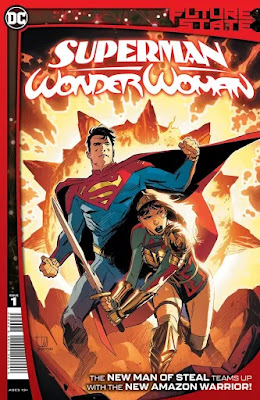
 The solicitation copy for writer Tim Sheridan and artist Rafa Sandoval's Future State: Teen Titans sounds vaguely X-Men-like, although there have been periods in recent-ish Teen Titans history in which the older, adult Titans sought to mentor younger, still-teen Teen Titans (Devin Grayson's too-short run being the first that leapt to my mind, although Geoff Johns did something similar not too long afterwards).
 Look, I know Jim Lee is popular and all, but of all the images DC could have possibly chosen for the cover of their Green Arrow: 80 Years of The Emerald Archer The Deluxe Edition collection, they really chose to go with Lee's cover for 2012's Justice League #8, which addressed the question of whether or not Green Arrow would join the new Justice League (no, he would not).
  Amanda Conner and Jimmy Palmiotti's Harley Quinn and The Birds of Prey series gets collected as Harley Quinn and The Birds of Prey: The Hunt For Harley. I didn't care much for the pair's take on Harley in her own book, but I was nevertheless pretty curious about this weird-looking book, which seems to take the comic book version of the characters who were all randomly chosen to plop into a Harley Quinn movie entitled Birds of Prey, and to smoosh them into a new narrative that I think is meant to be set in the comics continuity, rather than the movie continuity...?