Tuesday, November 12, 2013

I just saw Thor: The Dark World.

Whoever dressed Alexander for the premiere was more daring and imaginative than whoever designed Sif's costume for the movie.
THE BAD:

—The general, action-driving plot really seemed like it was still in pre-first draft, "just spit-balling here" form. As I understood it, long, long ago in a Lord of the Rings-style, Anthony Hopkins-narrated prologue, an army of space orcs had gotten their hands on a powerful, existence-ending weapon, but before they could use it, Odin's dad and his army wiped them all out. This one guy was like, "Hey, should we destroy this weapon or something?" But Odin's dad was all like, "No, let's just hide it somewhere no one will ever find it."

Instead of putting it in the Asgard weapons vault where they kept the maguffin from the first Thor movie—The basic plot of the two movies was pretty much identical, right? Ill-defined ancient weapon from their super-viking ancestors falling into the wrong hands?—or even a safety deposit box or a rented storage unit or a high school locker with a combination lock from K-Mart, they just stuck it in the middle of an abandoned warehouse in a dodgy part of London?

And then the weapon gets stuck inside Thor's girlfriend and the space orcs awaken from hibernation and want to get it back and so there's a bunch of fighting.

—Both Thor movies have big, expansive, awesome supporting casts...and little for any of them to do. Renee Russo as Thor's mom has a lot more to do here (I just had to check IMDb to see if she was even in the first movie), as does Idris Elba as Heimdall, but poor Sif (Jaimie Alexander; see above) and the Warriors Three don't have any more to do then they didn't have to do last time. Each gets at least one decent, several seconds-long scene, and Zachary Levi's Fandral gets a few quips, but they're all fairly wasted. Poor Hogun the Grim's entire contribution to the film is telling Thor early on that he's pretty much gonna sit this film out, thanks.

I guess Marvel will have to do a spin-off if The Warriors Three are ever really going to get their due. Given how much people seem to love Tom Hiddleston's Loki, maybe they'll eventually do a Loki or Tales of Asgard movie, just featuring Hiddleston, Sif and the Warriors Three, with Thor and Odin sitting the movie out...?

Ooh, or maybe they could do a Sif and The Warriors Three show on cable? That would certainly be a lot less boring than Agents of SHIELD show looks, right? Marvel meets Game of Thrones, winds up somewhere in the vicinity of Hercules: The Legendary Journeys/Xena: Warrior Princess...?

—I thought the Cursed (Or was it spelled Kursed?) looked pretty dumb. His mask reminded me a bit of the one the Predator wears, which is kinda weird, because the alien runes flashing in the space orc ship look like the red alien writing that appears in Predator ships.

—As with Iron Man 3, and, I suspect, all of the post-Avengers Marvel "Cinematic Universe" films from here on out, this one suffered a bit from leaving unanswered the question of just where the hell the rest of the superheroes were.

I mean, there was a straight-up alien invasion of London, and no one shows up but Thor and two fighter jets? Where was Iron Man? Where was the Hulk? Where was Nick Fury and SHIELD? Once you establish the fact that these guys all know each other and occasionally get together to defend major cities from alien invasions (and repeatedly make reference to that throughout your film), it feels a little...weird when no one shows up to help Thor save London from alien invasion.

—Needed more shirtless Hemsworth.

Yes, he looks good shirtless or in a cape and armor, but he cleans up nice too.
THE GOOD:

—I liked the creepy white masks the space orc footsoldiers wore. High-five, whoever designed those!

—Pretty much all of the performances were either really good, or rather effective for conveying what little emotional content they were called on to portray.

Hiddleston stole the show; the audience I saw it with laughed at pretty much every line of dialogue he was given. Kat Denning was a definite highlight, and, I think, was to Natalie Portman's Jane Foster what Hiddleston's Loki was to Hemsworth's Thor: Someone more vibrant and engaging you would prefer to see a movie about (Really glad they not only had her return, but gave her more to do this time around).

Portman was good, and gave the movie some star power and all (ditto Anthony Hopkins), but her character seemed almost crowded out of the film. There's just not enough room to explore her character and her character's relationship with Thor, even though that's meant to be the emotional core of the film franchise. Ah well.

I do kinda wish Hopkins wasn't playing Odin though; I would love to see what a Liam Neeson Odin woulda been like.

—The big battle sequence in which the space orcs attack Asgard was pretty awesome. I liked their ships, and the way those ships moved around, and the mixing of the sci-fi and fantasy elements into something that felt appropriate, like if you squinted one eye and titled your head, you could see how all of these figures would have seemed like gods and monsters to some, and if you squinted the other eye and maybe tilted your head the other way, they just seemed like space aliens.

The battle, with its whizzing, rotating space ships that resembled giant flying swords, really reminded me of Star Wars, and the entire sequence had a sort of Star Wars + Lord of the Rings aesthetic and feel to it.

—I think they managed to find an Iron Man-like tone to this film a bit better than in the original. There's a lot of quipping and sarcasm, sure, but there's a light touch to almost everything, including the apocalyptic battle between the forces of light and dark at the end of the film. Despite the serious, even grim title, Thor: The Dark World was fun.

—Thor hanging his hammer on the coat rack was maybe my favorite part of the film. That was the point where I thought, "Yes, this $5 bill and few hours of your life was well spent, Caleb!"

—Stellan Skarsgård nude scene!

How weird is it that for all the gorgeous human beings in this movie that millions of people would enjoy seeing, and happily pay money for the opportunity to see, in various states of undress—Hemsworth and Hiddleston for the ladies, Portman, Denning and Jaimie Alexander for the gentleman—it was Skarsgård who had the only nude scene, and plays  the only character that spent the majority of the film not wearing any pants?


Oh, and let's make sure Denning's character appears in that Thor-less spin-off movie I was imagining earlier, okay?
SO, THAT MID-CREDITS TEASER?

Honestly, I was kind of hoping for Rocket Raccoon, but I have to admit to being surprised to the point of shock with that particular character appearing. I'm assuming that's setting up something in Guardians of the Galaxy or Avengers 3, but, well, that's just not one of the top, say, 75 Marvel characters I would think to see appearing in a movie in any capacity at all.

The scene is short, but holy smokes it really seemed like part of an entirely different Cinematic Universe than the one all the Marvel Studios films up until this point have shared.

Sunday, November 10, 2013

Some picture books of note:

Mustache Baby (Clarion Books; 2013): Writer Bridget Heos and artist Joy Ang tell the story of Billy, a little baby born with an unusual feature: A full head of gingery hair. Oh, and a matching mustache. Alarmed, Billys parent's looked to the nearby nurse, who told them they'll have to wait and see "whether it is a good-guy mustache or a bad-guy mustache," and Ang draws a bushy gray, cookie-duster style mustache with a halo floating over it and a long, dark mustache curled up at the ends, bearing red devil horns and a red, spaded tale emanating from it.

It sure looks like a good-guy mustache, and Billy's behavior is determined by the style of his mustache. At first, he plays cowboy for four pages. Then there's a two-page spread filled with pictures of Billy with various mustaches, each determining his temperament and style of play: circus ringleader, Spanish painter, etc (near the edges of the page, we get fragments of two pictures, one suggested mustache baby is a Mario-style plumber/adventurer, wearing a red shirt and blue coveralls and carrying a plunger, but we can't see if he's wearing a matching hat or not, the other showing him shirtless and in orange pants, with a long Fu Manchu mustache, suggesting he's a kung fu master). Then there's another sequence in which he plays cop, as his mustache changes shape into a policeman's mustache.

And then comes the first of the book's two strongest visuals. There's a five page sequence which begins with the words, "But a funny thing happened. As Billy got bigger..."

The page is dominated by an over-the-shoulder view of the right-half of Billy's head, his eyes facing away from us, and only the right edge of his mustache visible  peeking around his cheek. The background is a bright, pale green field.

Turn the page, and a two-page spread is revealed, the "camera" seemignly zooming in on Billy's face, so we see him in the same angle, but now the mustache has grown longer, and the background is a darker orange. Turn the page again, and there's another two-page spread, this one even closer up, and the edges of his still-longer mustache has curled up, while the background bleeds from a dark red to a darker and darker shadowed red, becoming black in the upper right corner.

"His parents' worst fears were realized. Billy had a..." turn the page for the dramatic reveal, "BAD-GUY mustache."

This leads him to misbehave for a while, but, like his other mustaches, it changes again, and his mother tells him, "There, there...Everybody has a bad-mustache day now and then."

I'm fairly fascinated by the premise of the book, that mustache style determines behavior, rather than the reverse, that people with particular occupations or outlooks might generally wear a particular style of mustache, that would then become associated with them. I kinda like the idea that a mustache style, like a new hairstyle for a woman, can determine not only the way you might be perceived, but your very behavior (I've never found this to be the case, having only worn about four different mustaches: A  thin cookie-duster, a Hitler/Chaplin (for an afternoon, spent entirely around the house and seen by no one but my roommates), a Chester A. Arthur mustache/muttonchops combo and a waxed, pointy, up-turned villainous mustache. At no point did I feel anti-semitic/like a little tramp, presidential or villainous.

Aside form that five-page, three "panel" sequence of mustache transformation, the book's other great gag comes on the last page, but I won't spoil it. Suffice it to say that Heos and Ang have some diverting ideas about the nature of facial hair, and even if one isn't amused by all of their gags, many of which failed to strike me, there are a few bits of execution that are easy to admire.

The Gunniwolf (E.P. Dutton; 1970): This is a very old book. The copyright on the illustrations, by William Wiesner, are copyright dated 1967. The text copyright date is 1918 and 1946, and I suspect the story is still older, as author Wilhelmina Harper's credit says "Retold by" rather than simply "by" or "written by."

A (very) little bit of online research seems to indicate that Harper did not invent the story, but that it was an older American folktale, sometimes said to be Appalachian in origin, at other times to be African-American, but I couldn't find a definitive answer to its origins. Harper was a librarian as well as a writer, and this version is apparently the one she used in her story times.

The story is quite simple. A little girl who lives alone with her mother near the jungle is one day left alone, with the instruction to never, ever go near the jungle. Picking flowers, the little girl keeps seeing more and more beautiful flowers closer and closer to the jungle, and, before she knows it, she's rather deep into the jungle and approached by The Gunniwolf, a large, quadrapedal predator animal/monster.

He demands she stay still and sing for him, and she does...until he falls asleep. At which point she bolts and, waking, he pursues, asking her why she's moved away. She denies doing so, and, again upon his demand, she sings again, and he falls asleep. This happens several times until she is safely home.

I was attracted to the book—which I had never encountered as a child myself—by the cover and the title. Wiesner's Gunniwolf, whatever exactly that is, looks like a very large wolf, but with a man and tail like a lion. Inside, where there are many more, clearer pictures of the Gunniwolf, we see that it also has tufts of fur about it's ankles (almost as if it were a very shaggy animal shaved somewhat like a large poodle), and that it's mane drapes rather far down.

I was curious about the animal, but there's no real information about him in the book: He lives in the jungle, he can talk, he likes the sound of a little girl singing and he seems to be pretty sleepy, perhaps even narcoleptic.

The appeal of the story, it seems, is in its sounds, and it is a book meant to be told aloud to children, as in addition to repeating bits of action—the sing, sleep, run, chase, catch and repeat cycle of events—nonsense-like, sing-songy words are repeated for certain actions.

The girl sings "Kum-kwa, khi-wa," she runs "pit-pat, pit-pat," and the Gunniwolf runs "hunker-cha, hunker-cha."

This telling makes the origins of the story seem older than American, but perhaps those elements were just the flourishes of the storytellers who told it before Harper, and, here choices made by Wiesner.
The action takes place near a jungle, rather than a woods or forest. The dark-haired girl looks like she might be Asian, and her mother wears a shawl that covers her head and carries a jug of water that seem to place her somewhere around the setting of The Jungle Book, I would have guessed as a child.

The syllables the girl sings certainly sound more Eastern than Western, and the way she and the Gunniwolf talk certainly isn't perfect English. "Little Girl, why for you move?" he asks her. And she responds, "I no move." And he responds, "Then you sing that guten sweeten song again."

Regardless of its origins, I really like Wiesner's artwork, particularly the design of the Gunniwolf, who seems as playful and mischievous as he does scary, particularly when he falls asleep, and grows particularly anthropomorphic.

Halloween (Little, Brown and Company; 2002): Well, this is a weird little book. Written by Jerry Seinfeld and illustrated by James Bennett, it reads very much like a kid-friendly stretch of a Seinfeld stand-up routine*, focusing on Halloween (And by "kid-friendly" I mean not only is it not blue—does Seinfeld even ever work blue?—it doesn't concern itself with the social mores of the adult world that seems to be Seinfeld's comedy at its most Seinfeldian).

It's therefore not entirely a story, at least not as much as it is a series of anecdotes, with an introduction/conclusion structure based on the somewhat dubious assertion that children being able to consume a great deal of candy is something extraordinary enough to bear comparison to Superman (and/or be worthy of a story book at all).

So Seinfeld discusses how much he loved candy as a child, and how all-consuming his passion for consuming it was, and the joy of originally discovering the concept of trick-or-treating ("What is this? What did you say? Someone's giving out candy? Who's giving out candy? Everyone we know is just giving out candy?"). He talks a bit about costumes, and I wondered after a passage in which he discusses the sorts that came with the hard plastic face masks and plastic cellophane smocks, of a sort that only parents of a certain age would be able to relate to (Although his complaints about having to cover up his Superman costume with a coat are perhaps something more relatable to today's kids).

Superman figures rather prominently in the story, so much so that the small print includes a Superman created by  Jerry Siegel and Joe Shuster credit, a copyright and trademark notation that he is DC Comics', and that he is here being "Used with permission."

Artist James Bennett, a prolific illustrator who has had his work published in Mad magazine, gets a few chances to draw Superman, appearing in a store display advertising Superman Halloween costumes, and in a pair of fantasy sequences, through young Jerry Seinfeld's imagination.

Bennett is good at what he does, but his isn't a style I'm particularly fond of. Here it's something between that of a caricature artist and a fine painter, and I found his Jerry Seinfeld-as-a-little boy rather disturbing, given how much it looks like Seinfeld, but not, like some sort of cloned, homunculus version of the comedian.

Halloween: Is It For Real? (Tommy Nelson; 1997): It was the title that got me on this one. I just liked the sound of it. It made me laugh. Like, what exactly is it asking? Is Halloween a real holiday? Yes, obviously it is. Is everything people say about Halloween for real? Uh, I don't know; does anyone say much of anything about Halloween?

The confused looking little kid on illustrator Jane Kurisu's cover sure looks confused about something. Is she or he wondering if that ghost and that witch are real? Or if He or she is really a cat now?

The "note to parents" from author Harold Myra on the first page only made me more interested:
Halloween is an odd mixture of creepy creatures, costume parties, and harvest fetivals. It is a confusing holiday for Christians.
Okay, sold. I checked it out of the library and took it home for me. I understand that "Halloween" has a somewhat shaky reputation in some public spaces and places now, specifically because some Christian faiths object to it. I'm not particularly well-traveled, but even I've been around more than a few institutions that forbid its celebration in any way, or at least have done away with the word, using things like "Fall Festival" or "Harvest Party" to describe a day of events that might include, say, dressing up in costumes and trick-or-treating.

I was raised in the Catholic faith, attending Catholic schools from Kindergarten through my last year of college,  but the tradition I grew up in has always been a very post-Vatican II one, so I am often both intrigued and bewildered by certain beliefs and practices of certain Christian sects or groups, particularly since "Christians" are generally referred to monolithically when discussed in the press.

Heck, even that intro—Halloween is a confusing holiday for Christians? Is it? I've lived my whole life around Christians, and I've never heard anyone express even the slightest bit of confusion regarding this wholly secular holiday (The closest I've come is in discussing holidays with a friend who was raised in the faith of the Jehovah's Witnesses; they don't celebrate any holidays, save an annual one around the time of Easter, not even their own birthdays).

So—Halloween, real or unreal?

Here's the rest of Myra's introduction:
Should parents encourage the celebration of a holiday that traces its roots to pagan practices and beliefs?
What, you mean like Christmas and Easter...?
The challenge for Christian parents is to each our children to use this holiday to celebrate God's victory over evil and evil spirits. It is my hope that this book will help.
That's a noble sentiment, really, and if the extremely devout can find a way to balance celebration of a fun, kids holiday with their faith that doesn't mean simply forbidding them to join in the innocent fun of the rest of the world, well, more power to them.

I was also kind of excited when I read that second-to-last sentence, as I wondered if this kids book might feature a section on The Harrowing of Hell, something I never heard of until reading about medieval legends and suchlike as a college student (That's the semi-apocryphal belief that, between dying on the cross on Good Friday and being resurrected on Easter Sunday, Jesus descended into hell, kicked Satan's ass, and freed all the virtuous pagans and/or everyone who had died up until that point, allowing them to ascend into heaven or purgatory or wherever. In some versions, Jesus even chains up Satan in hell, and hands governorship over to one of Satan's lieutenants or to angels. It's an awesome story that exists only as potential one in my imagination, really, as I've seen no real fleshed-out, dramatic version of it before. It's a story, but not a very detailed one, I guess).

Myra's story starts with a family—mom, dad and kids Greg, Todd and Michelle—discussing the fun parts of Halloween. On the second page, one of the kids ask why anyone celebrates it, and another chimes in that "Ive heard that it is called the devil's holiday."

"It all started long ago, before Christ was born," Dad explained. "People believed that a lord of death sent evil spirits into animals to play terrible tricks on people. To escape them, people wore disguises."

There aren't any sources listed at the back of the book (This is a 24-page picture book for children, rather than a scholarly work, I guess), so I can't really check on that. Personally, I always dated the pagan practices associated with Halloween—many of which I think are a sort of invented tradition, or at least partially invented to justify or explain traditions that the explainers don't really know the origins of anymore—to after the death of Christ, but I suppose that's simply my ignorance, born of a Western-centric understanding of world history.  The story of human history I've always been taught moves from the middle east to Greece and Rome before moving northward to Europe.

Dad explains that "Christians tried to change the holiday into a festival of joy" and that Halloween comes from All Hallow' Eve, with "All Hallows" meaning all holies or all the saints.

When one of the boys interjects that he thought the holiday was about ghosts, the parents explain that "It's about people who have died...But saints aren't ghosts. They're alive with Jesus, who rose from the dead and has a real body."

The kids host a Halloween party, and when the kids get talking to their friends, the subject of death comes up, and mom brings up heaven, "We miss our loved ones...But they're not sad. They're happy in a different world."

Man, I hope I have my hair back in heaven, and won't be as jowly as grandpa in that picture. I'd kinda like to be 19 again, physically, if that's alright.

When the party ends, everyone sings "Amazing Grace," and when the kids go to bed, they talk about feeling scared, and ask why people tell scary stories. Mom answers in a way that I sure as hell wouldn't want my mother to have answered any questions I might have had about monsters, Bigfoots, aliens, owl men and the other sorts of things I was scared of as a child:
"Most stories are told in fun," said Mom. "But there is a supernatural world."

"Evil spirits do exist. And temptations."
Temptations? No big deal. But what's all this about evil spirits? You mean to tell me that creaking sound right outside my bedroom window that dad said is just the tree branch rubbing against the phone line in the wind is definitely not a dinosaur or monster, but it might be an evil spirit?

The parents then teach the kids a Bible verse, 2 Timothy 1:7, "God did not give us a spirit that makes us afraid. He gave us a spirit of power and love." "If you memorize the verse, you can say it to yourself when you get scared," Dad tells the kids.

I'm not in love with that verse, and don't know if it woulda helped me when I was a terrified child trying to go to sleep at night, but I bet psychologically having a spell or mantra-like phrase to repeat over and over might have helped.

And that's pretty much the end, save for the happy ending last page.

Personally, I found the book a little over-preachy—I prefer my Christian messages to be more Chronicles of Narnia style than as overt as this—and don't think I would have dug it as a child, but I think the solution Myra comes up with is probably the best one: Embrace the fun parts of Halloween, but it, like anything else in the secular world, can be used as a springboard to remember or meditate on aspects of your faith.

Kurisu's art didn't do anything for me, and I don't think the book had to look as generic as it does, but then, this was a message-first, art-second sort of book, so it's not as surprising or disappointing as it is not what I would have most wanted to see in a book on the subject.

The Monsters' Monster (Little, Brown and Company; 2012): Cartoonist/children's author alert! This is the latest picture book from Patrick McDonnell, creator of Mutts, and therefore, likely the best cartoonist whose work is appearing on your local paper's funnies pages, depending on where you live and the exact roster of the cartoonists whose work is still appearing in your paper.

This particularly charming book, which steers clear of his Mutts characters and his usual animal cast, is a good book for the post-Halloween, pre-Thanksgiving part of fall, as it's contents and aesthetic are generally Halloween-esque, but it's moral more of a Thanksgiving-esque one.

A trio of cute little monsters named Grouch (a little devil in a red pair of long underwear, with a bulbous red nose and long, striated horns), Grump (a hairy, bean-shaped creature evocative of Captain Caveman, with horns and a spaded tail) and little Gloom 'n' Doom (the smallest monster, who looks a bit like a two-headed mime) all though they were the most monstrous monsters.

As it reads on McDonnel's first two-page spread, of a castle emanating exclamation points, swirls, lighning bolts and little swirls of angry emotion, on a barren hill above a peaceful, six-building town emanating sweat drops and exclamation points:
They lived in a dark monster castle, high atop a dark monster mountain, overlooking a monster-fearing village.
They're days were mostly occupied with being monstrous, and occasionally their monstering would get competitive, with the three fighting over who was the most monstrous. To settle the argument once and for all, they decide to build their own monster, a monster to end all monster.

They essentially build their own Frankenstein's monster, who dwarfs them all in size (he can lift all three in a single hug, and have room for another three monsters of their size in his arms). To their surprise, he's polite and kind and showed no inclination towards monstrosity:
"But Monster didn't think he was a monster," the text reads. "He didn't think he was anything...but thankful to be alive!"
After a suspenseful final act, Monster's disposition proves contagious, and he is able to convert the little monsters to his point of view, with the help of doughnuts and the beauty of the natural world.

It's always a treat to see McDonnell working so big, in the great big size and color that picture books allow him, and his beautiful, present line is on perfect display here. It's an additional treat to see him drawing monsters instead of cats and dogs and people, just for a refreshing change of pace.

Sally Gets A Job (Abrams; 2008): Another of  the late, Columbus-born Stephen Huneck's many Sally books, which also include Sally Goes to the Beach, Sally Goes to the Farm and so on, this one finds the titular Labrador retriever watching her family go off to work and school and wishing she could go to.

"Maybe I should get a job," Sally thinks. That's pages one and two. Most of the remainder of the book consists of Sally imagining different jobs she might like to do, and what might be good and bad about them; some of these are based on her interests (She likes digging, so perhaps she could be an archaeologist; on the other paw, she really likes bones, so maybe she should just focus on them and become a paleontologist).

Each occupation is generally accompanied by an image of Sally performing it, and many of these are quite humorous, thanks to Huneck's deadpan presentation of a perfectly normal, not-at-all anthropomorphized dog in a setting or performing an activity that a dog cannot. Like looking at the want ads, as she does on the cover, or, for example, driving a tractor:
Huneck's artwork is accomplished through the creation of woodblocks and, in the case of this particular book, colored pencil. Despite the obvious artifice involved—note the white lines in Sally's black coat approximating her hairiness—Huneck's style is very realistic in its portrayal of the character and settings, which gives the book much of its humor.

For example, at one point she thinks, "Though I have never seen one, I think it would be fun to be a hip-hop star." This is the picture that accompanies that page of text:
Yes Sally, that is exactly what a hip hop star is.

Ultimately, Sally realizes she already has the very best job of all.

....

No, no it's not children's book star.


Unicorn Things He's Pretty Great (Hyperion; 2013): EDILW favorite Bob Shea's latest is a great one. How great, well, the cover pretty much tells you everything you need to know about it: The characters, the conflict, the look and the brilliant colors (What an online image might not reveal is the twinkly glitter in the frosting on those cupcakes, the cover image reflecting a scene in the book when Unicorn literally makes it rain cupcakes, the silver ink on the little sparkles and the dotted motion lines, and the fact that cupcakes and title are slightly raised, giving the book a pleasing tactile feel).

The story is told by Goat, whose life is turned upside down upon the arrival of Unicorn, who, despite having one less horn than Goat, seemingly has a lot more going for him, like all of his magical powers, his wonderful prancing ability and the fact that he emanates rainbows.
Shea's Unicorn is basically a big, thick, white capital P with details drawn on, intimating a simple, even child-like drawing style. The other characters follow suit, although Goat is a little more complex in his basic body shape (Their friends/classmates consist of anthropomorphic versions of a puppy, a kitty, a slice of bread, an piece of fruit and a bear. Each is infinitely more simple than the stars, essentially being a colored shape with details drawn on; both he puppy and the kitty, for example, are mushroom shapes of color, with cat or dog ears, paws, tails and faces drawn on).

After repeatedly (and seemingly inadvertently) showing up Goat, one day Unicorn notices Goat eating pizza, and is shocked and delighted to discover goat cheese.

"What?! Goats have cheese? Unicorns don't have cheese." Unicorn continues to discover things about Goat of which he is jealous ("Whoa! What is up with your hooves? Those things are out of control!" "Oh, these? These bad boys are 'cloven.'"). Meanwhile, Unicorn reveals what he feels are his own shortcomings.
Naturally, the two discover that, for all of their apparent differences, they actually have a lot in common  and become friends.

Shea's artwork, is as simple and charming as ever, and the more careful use of color makes its sudden bursts—the bulk of which accompany Unicorn—all the more powerful. Adding to the contrast, Goat's dialogue is rendered in what looks like a generic type-writer font, usually black in color, with stress words rendered in blue or something appropriate (When he uses the word "gold, " for instance, the word is presented in gold type). Unicorn starts off all of his dialogue with a big, fancy font, each letter a different color, and surrounded my sparkles of magic.

This is probably my favorite children's book at the moment, and, of Shea's, I think it may be my favorite, although Cheetah Can't Lose is hard to beat, and I did so enjoy Dinosaur Vs. Bedtime...

Well, whether or not its Shea's best, it's safe to say that Unicorn Thinks He's Pretty Great is indeed pretty great. 

Up in Heaven (Doubleday; 2003): Hey, anyone who has ever had a pet die! Do you feel like bawling today? Well have I got a book for you!

Cynthia Rylant's Dog Heaven has long been my go-to comfort book when thinking about the loss of a dog, and/or as a way to comfort someone who has just lost their dog, and Emma Chichester Clark's Up In Heaven covers some similar ground, although there's more of a story to it, and Clark's book is set both on earth and in heaven.

I lost Yogi, my mother's dog from the time I was in college until last year or so (and who was my housemate for about a year near the end of her life; I drew her in a few comics from that time, as you can see here and here), to complications related to extremely old dog-age (She was pushing 18 when she died), and my nieces lost their beloved shih tzu to a horrible car accident a few months back, so, um, the death of dogs has unfortunately been on my mind too much of late.

So Clark's book started working on me immediately, as it shows a happy but now too-old dog in the park with the little boy she lived with:
Daisy was devoted to Arthur, but she couldn't keep up with him anymore.

She was slowing down because she was very, very old. And she didn't always feel well.

One night, she went to sleep as usual, but when she woke up...she was in heaven!
So I was bawling by page four; that is exactly how I used to wish and pray Yogi would go, but, unfortunately, there was a trip to the vet involved before she (hopefully) woke up in heaven.

Daisy finds herself in a bright, beautiful world not unlike Rylant's dog heaven, and she's as young and full of energy and free of pain as when she was younger. There are all sorts of other dogs up there that she befriends, and while the environment is all trees and fields and flowers, there are at least a few signs of human life: Furniture the dogs can sit on.

As happy as Daisy is, she continues to look in on poor Arthur, who is having a really rough time without his dog with him anymore. Daisy is able to try and comfort him though, by sending him dreams  of where she is, and how much fun she's having there, and while these comfort him for a while each morning, his melancholy soon returns. Finally, Daisy sends him a dream of her bringing him a puppy and, after thus showing him its okay with her if he gets another dog, he does, and names it Maisy after Daisy.

So in addition to imagining a heaven specifically suited for dogs, this book also imagines a continued relationship between the dead dog and her living humans. That is, in fact, the real thrust and drama of the book.
I really liked Clark's artwork, which is somewhat flat and cartoony or comic book-y in its design and rendering, although thoroughly fleshed out in generally bright and warm colors (Earth and heaven actually look much the same). While much of the story is told in regular prose-style sentences hovering above or within the images, she gives the characters dialogue balloons occasionally, and I like how heaven seems to exist in a sort of expanded, comic book thought bubble atop the images, as if it were an entire realm of character thought bubbles.

*Oh. No wonder it seems like a stretch of a Seinfeld stand-up routine. It's essentially an edited, illustrated version of a Halloween-themed routine.

My favorite part of that Alan Grant/Tim Sale Shadow of The Bat arc

I scanned this for the post I did on Tales of The Batman: Tim Sale that I did the other day, but I ended up not having any room for it. In this scene, Catman has just brought new recruit Chancer back to the hideout to meet the rest of the gang, which, of course, includes Calendar Man.

I love everything about that sequence, from Calendar Man's explanation that the reason he screamed  was that he doesn't like cats (and not that a huge black panther just snuck up on him roared in his ear), to Catman's puns, to Calendar Man's framing of costume choice as something akin to a civil right (and the fact that he gets angry at Catman rather than firing back with cat-puns) to the way Sale draws those wonderful costumes and looks on their faces.

It occurs to me that this kind of story is something of a casualty in an era of more "realistic" comic books, wherein supervillains now generally have complicated motives involving revenge and life and death situation and psychological trauma (rather than, you know, "I happen to like dates"), and they've largely abandoned goofy costumes in favor of body armor and the like (See The Wrath from the 1980s and The Wrath from the current story arc of Detective Comics for a good example).

While this Catman's costume is still fairly bad-ass (and itself a more serious revision of his original costume, with a big C on the chest), the Catman of Secret Six wore one with obvious signs of tinkering: He didn't have a big cat face on his chest, but instead a bloody claw wound symbol. He fought with vicious, razor weapons he used like claws, and had an incredibly bleak origin story involving child abuse. He also didn't hang out with a panther named Sasha.
The last Calendar Man story I read, in the digital-first-and-then-print Legends of the Dark Knight, featured an iteration the tattooed version of the character (ironically, designed by this very artist) wearing an Uncle Sam suit appropriate to his Fourth of July terrorist plot.

The storyline this image is from, "The Misfits," was about a group of minor, sad-sack Silver Age villains trying to gain respect in a world that's left them behind. Tonally, it has some overlap with that Neil Gaiman/Bernie Mireault Riddler story from 1989's Secret Origins Special #1, or an issue of one of the JLI-era League books guest-starring Flash villains Captain Cold and Heatwave.

I suppose these sorts of stories haven't completely gone away, Superior Foes of Spider-Man is definitely telling a long-form version of one (although their costumes are all pretty updated and cool-looking, save for The Shocker), but I do lament DC's knee-capping of their possibility.  I understand the drive to make every villain more modern, more serious, more evil and more like something you might see in a video game or movie adaptation, but there's certainly something to be said for, say, just letting Kite Man be Kite Man, you know?

Friday, November 08, 2013

And over at Comics Alliance...

The third installment of "Assessor Evil," our monthly summary of the events of each issue of Forever Evil, is up at Comics Alliance today, if you'd like to go read it. It's the issue in which Bizarro, who isn't called Bizarro, because that's too silly a name, I guess, gives Lex Luthor a flower. Also, some other stuff happens (Ultraman and Black Adam fight, Deathstorm and The Rogues fight, Catwoman sasses T.O. Morrow, etc).

Thursday, November 07, 2013

Meanwhile, at Robot 6...

It's the first Thursday of a new month, which means I have an installment of "A Month of Wednesdays" at Robot 6, reviews of every new graphic novel released in the previous calendar month that I read but didn't review elsewhere. So click here to read shorter-ish reviews of Avengers: Endless Wartime (pretty good, or pretty great relative to 21st century Avengers comics), Batman Vol. 3: Death of the Family (pretty great), JLA: Earth 2: The Deluxe Edition (still great), The Joker: Death of the Family (not so much), Palookaville #21 (pretty great), The Smurfs Christmas (pretty smurfy) and Tropic of the Sea (great).

The above image is from the Joker collection, and is taken from the included Batman and Robin arc, drawn by Patrick Gleason, with either Mick Gray or Keith Champagne inking it. Gleason is the all-around champion face-less Joker wearing his own face drawing champion.

Speaking of which, I'd like to ask a question of any of the Batman readers in the audience. Okay, so "Death of the Family" is set one year after the events of Detective Comics #1, in which Joker had his face skinned off. Was TEC #1 set in the present at the time (i.e., Year Five of the New 52's new five-year timelie?), or was it at some undetermined point in the past...?

Because if TEC was set in the present (Year Five), that means an entire year has already passed in The New 52, and we're already on Year Six. According to the text boxes in the "Zero Year" tie-ins, "Zero Year" is six years ago. But does that mean Zero Year is set the year before Year One of the New 52, or during Year One of the New 52? (I guess that would depend on how close to the beginning of the year The Joker had his face flayed off...?)

The new, shorter continuity really does my head in, and I think makes things even more complicated than a 10-12 year sliding timeline ever did.

For example, Barbara Gordon was paralyzed for three years, so how long was she actually Batgirl, counting the time she spent as Batgirl before and after her paralysis...? Less than two years? Maybe three, if a year passed between Batman #1 and "Death of the Family"...?

And how quickly did her dad James Gordon shoot up through the ranks of the Gotham City Police Department that he made commissioner in, what, a year or two? (He would have been Commissioner when Barbara was shot, right?)

I was not aware of this.

Rather high on the list of subjects I don't know a damn thing about it is botany, and therefore I was quite surprised when I arrived at this passage from the story "Nothing Lasts" from Seth's Palookaville #21 the other night:
It's a passage during which Seth is recounting the various species of animals and plants found by a creek he used to explore and play near when he was a child. Until I reached that fourth panel, I assumed that the trillium was a made-up flower, given that it is the title of cartoonist Jeff Lemire's latest series for DC Comics' Vertigo imprint. 

In it, they're sort of magical flowers found near a temple in South America and a in some other planet that allow those who ingest them to share their thoughts or memories or meld minds or something. There's also some kind of alien race that rather resemble flower people that tend them. 

But no, turns out there's really a real flower called trillium, and Lemire did not invent them nor their science fiction-ready name. 

Trillium, it turns out, is the emblem and official flower and the official symbol of Ontario, the Candaian province where both Seth and Lemire are from.  

And while Ohio's state flower is the scarlet carnation, apparently we also have a state wild flower, and do you know what it is? Go on, guess. 

Tuesday, November 05, 2013

Review: Justice League Beyond: Konstriction

There's a scene during the denouement of this trade when the now-elderly Bruce Wayne finds his successor Terry McGinnis unconscious and naked as a result of the climactic, apocalyptic battle. Wayne tosses Superman's cape over him, like a rescue blanket, and when another character asks where he got that, Wayne says he took it from someone who wasn't using it anymore.

The appearance of Superman's cape here is sort of emblematic of creators Dustin Nguyen and Derek Fridolfs approach to their sprawling next generation Justice League story: No opportunity for a wink, nod or elbow to the ribs to DC fans is passed up, even when it comes to something as innocuous as using Superman's cape as a minor prop.

Set in the world of the 1999-2001 Batman Beyond cartoon, where a retired Bruce Wayne coaches college student McGinnis through an ear piece as the new Batman of Neo Gotham, Justice League Beyond includes an extrapolation of the 2001-2006 Justice League cartoon continuity as well (exhaustingly so, in the case of at least one of the back-up stories, which I don't want to discuss here).  The new Batman fights alongside a new Green Lantern, the daughter of Aquaman (Aquagirl, naturally), the son of Green Lantern John Stewart and Hawkgirl (Warhawk...not Hawk Lantern or The Green Hawk) and the original Superman and Big Barda, whose alien origins have kept them relatively young...they just dress a bit different in this generation.

The driving conflict involves the Kobra cult, which is employing a magic book and Boom Tube technology to summon a world-ending, giant super-serpent monster, an invincible Ouroboros, which rampages through the Multiverse for practice before turning its attentions to Earth.

Along the way, the League visits Dinosaur Island/the setting of the War That Time Forgot strips, New Genesis, Apokalips, Neo Gotham and Metropolis. The now elderly Amanda Waller and Jimmy Olsen are involved. All of the Fourth World characters of New Genesis and Apokolips unite with the League to try and make a stand against the serpent, most getting little more than cameos, but Highfather, Darkseid, Orion, Bekka (who Nguyen and Fridolfs previously drew in the Alan Burnett-written "Torment" arc for for Superman/Batman), The Female Furies and Mister Miracle having relatively large roles.

Cameos are made by Aquaman and Lex Luthor...and Kamandi, The Challengers of the Unknown and Atlas. Cadmus is involved early on, and Etrigan the Demon appears near the climax. The book reads an awful lot like a love letter to Kirby's contributions to the DC Universe and character catalogue.

Nguyen and Fridolfs, who co-write the story with the former pencilling and the latter inking, do a fine job of toy-box storytelling, perfectly structuring their story from a standard introduction of the characters in action to an ever-escalating threat, with the serpent defeating an entire planet of super-gods being the second act. The artwork is superb, and their voracious inclusion of as much of the DC Universe as will fit is appreciated, given the opportunities it presents them to draw their versions of, say, Steppenwolf or Oberon or a Batman Beyond villains or dinosaurs or what-have-you.

Several of the characters get new, temporary costumes, with Batman wearing a caped-version of his red-and-black uniform, Aquagirl putting on battle armor and Barda wearing a nicely modified version of her original, Kirby-designed armor (She usually just wears her Kirby-designed casual outfit: An interdimensional bathing suit).

The artwork is perhaps at its most fun during the scenes with the New Gods, as Nguyen's character designs seem to take their cues from both Mike Mignola, who drew many of these character's during 1988's Cosmic Odyssey (Particularly stout, brick wall of a Darkseid), and Bruce Timm's cartoon designs (Particularly for the Female Furies).

At the climax, as the U.S. Air Force Squad nicknamed "Hal's Hellions," the Green Lantern Corps and Thanagarian Hawkpeople join the Justice League in fight to the finish with the world-destroying snake-monster,  Batman flies a Bat-plane into action and remarks "Now this feels like a Justice League!" I was thinking pretty much the same thing; despite the new and different setting and the variations on so many of the characters, this story featured the ever-escalating stakes, world-building synthesis of generations of comics-makers and trivia-conscious care-taking that so many of my favorite Justice League stories have.

*********************

One complaint though: Jimmy's signal watch should go "ZEE ZEE ZEE" not "BEEP BEEP BEEP" though.

Okay, two: "Konstriction" is a pretty lame name for this storyline; it sounds awfully small given the scope and scale of the story. It's sorta about a Justice League vs. Kobra conflict, but it's more about all the heroes in the universe vs. an apocalyptic threat, in which case, I don't know, Justice League Beyond: Ouroboros might have been better. Plus, "snake eating its own tail" is pretty much a perfect symbol for a superhero story like this, isn't it? A comic book extrapolation of a cartoon adaptation/extrapolation of comic book heroes and concepts created generations ago?  This was a lot of fun and very well-made, but it's still a sterling example of serpent-devouring-itself comics-making.

Monday, November 04, 2013

Quick question.

So I just read Batman Vol. 3: Death of the Family, which collects Scott Snyder and Greg Capullo's five-part story arc in which The Joker attacks the extended Batman Family. In the climactic scene, The Joker has captured not only Batman, but also Robin, Nightwing, Red Robin, Red Hood, Batgirl and Alfred Pennyworth (Who, we are told, was taken not because The Joker knows Bruce Wayne is really Batman, but because of Wayne and Pennyworth's association with Batman Inc).

The Joker's grand design is, he repeatedly proclaims, to rid Batman of all his sidekicks, spin-offs and hangers-on, who he feels are dragging Batman down, making him soft and, perhaps not incidentally, taking up too much of Batman's time and attention, time and attention that he would rather Batman spend on him.

I also just read The Joker: Death of the Family, a massive tome which collects The Joker's battles with and captures of all of the above, plus his encounters and conflicts with Catwoman, Harley Quinn, The Teen Titans (in their capacity as Red Robin's teammates) and Arsenal and Starfire (in their capacity as Red Hood's teammates).

So here's my question: Where was Batwoman?

I understand that the title Batwoman, like Batman, Inc, has been largely spared inclusion in Batman events and even having to acknowledge most of the rectons that accompanied The New 52 reboot, but in-story, Batwoman in conspicuously absent from The Joker's attentions and plans.

I understand why The Joker didn't track down every member of Batman, Inc, as the Batmen of France and Japan and Africa are a little remote for even someone with The Joker's planning abilities and resources to round-up and sit around a dinner table with the Gothamites, but Batwoman's right across town, isn't she?

I also understand that Batwoman Kate Kane isn't in the Batman Family the same way the others are—I don't think she even knows Batman's secret identity yet, does she?—and doesn't work with any of them very often, but The Joker wouldn't know that, would he? (Spoiler for "Death of the Family": No). How does Batwoman differ from Batgirl in his eyes, exactly?

I'm not saying she should have been included in Snyder's story arc, as it was already pretty crowded (Personally, I wish Jason Todd was never resurrected and he wasn't there; sorta weird that The Joker's greatest past blows to the Batman Family—killing Todd, paralyzing Batgirl—have been reversed).

Nor do I wish DC editorial forced J.H. Williams III and W. Haden Blackman to take a month or five off their ongoing storyline in order to whip up a Joker story, or surrender their book to another creative team for someone else to do a Batwoman vs. Joker story.

It's just that her lack of involvement seems a little glaring, and no one seems to have provided an in-story reason or excuse for this. At least, not in any of the 500 or so pages worth of "Death of the Family" comics I read.

Sunday, November 03, 2013

Review: Tales of The Batman: Tim Sale

Despite the somewhat awkward title, this collection is a pretty valuable one, compiling all of the odds and ends of artist Tim Sale's work on the Batman character that aren't already available in standalone graphic novels. His two long-form, "Year One" era mysteries with writer Jeph Loeb—The Long Halloween and Dark Victory—are both available in various collected forms, and the trio of Legends of the Dark Knight Halloween specials that lead up to those—1993's Batman: Legends of the Dark Knight Halloween Special #1, 1994's Madness and 1995's Ghosts—have all been compiled into Batman: Haunted Knight. The Long Halloween/Dark Victory sorta  spin-off, Catwoman: When In Rome, has also been collected.

This, then, is everything else, including Sale's earliest work on the character and rare examples of his work on the modern Batman, rather than the solo "Dark Knight" era Batman, so we get to see him draw the likes of Robin Tim Drake, Bane, Mr. Zsasz and Batgirl Cassandra Cain.

I've already read all of these stories repeatedly, and own them all in their original, serially-published format, but as I wanted to take a look at the "Madmen Across The Water" story from Showcase '94, I borrowed the trade for the library the other day and, as long as I had it, thought it might be worth re-reading some of those stories and discussing them here for anyone who wasn't an active Batman consumer in the early '90s, and/or love Time Sale but haven't got around to this trade yet (It does feature some pretty great work the artist and a few shorter works of particular note, but Long Halloween and Dark Victory, despite some of their plot flaws and logical shortcomings, remain Sale's must-read Batman work).

As an added bonus, each story has an individual introduction by Sale, and it's so thorough that it contains his runs as the cover artist for Detective Comics and Batgirl (Correct me if I'm wrong when I reach the end of this post, but I'm pretty sure this is everything Batman-related that Sale's done that hasn't been collected elsewhere, with the exception of covers from the line-wide 2001 "Last Laugh" crossover story).

Let's look at it, bit by bit.

COVER

This is a really strong image of Batman in action. I like how Sale draw's Batman so that his cape becomes a sort of flat, planar, design element, here trailing him like the tail of a black comet, and he's so small in all that red that he really pops out as a human in action in a big city (If you look at it from a distance though, it looks a little like he's swinging and trying to reach that DC Comics logo in the lower right corner).

Like I said, I don't really like that title much, but I'm not sure how to improve it. The Rest of Tim Sale's Batman Comics..? The Brave and The Bold: Batman and Tim Sale...? I don't know.

I feel a little bad that Sale is billed as "The Artist of BATMAN: THE LONG HALLOWEEN and TV's HEROES." That's a hell of a thing to have your entire career reduced to, contributing a tiny bit of work to that dumb-ass, boring, already mostly-forgotten show.

I'm somewhat embarrassed to say that I spent quite a bit of time trying to puzzle out the credits of his co-writers at the bottom there, which, if you can't read the cover so well, say "with Darwyn Cooke, Alan Grant, Kelley Puckett, James Robinson."

Now, there were, in my mind, two basic ways to credit Sale's collaborators: Either by the amount of their contributions, or their perceived statue (You know, whose name would sell the most comics).

Grant wrote the most of any of the four, scripting three issues of Batman: Shadow of the Bat and the two shorter stories that make up "Madmen Across The Water" (about 90-ish pages, all together) closely followed by James Robinson, who wrote three issues of Legends of the Dark Knight (66 pages). Cooke and Puckett, meanwhile, only contribute one short story apiece.

And yet Cooke gets top-billing. So surely the relative fame or market value of the creator was their criteria, but, hold on, if so, why is Robinson billed fourth, below Grant and Puckett, two talented writers, to be sure, but neither of whom have amassed a body of works including as many hits as Robinson.

And then I realized they were simply listed alphabetically, and that I was an idiot.

"Madmen Across The Water"

This is the Arkham vs. Blackgate story from Showcase '94 I discussed a few weeks ago, written by Grant, inked by Jimmy Palmiotti and colored by Bernie Miereault.

For our purposes here, I just wanted to note Sale's introduction to the piece, in which he rather diplomatically discusses his trepidation about unearthing such early work of his for the purposes of the book. He does note that as much as his style might have changed over the years, he notes several instances where the choices he made penciling this early nineties story are the same ones he would make were he drawing it today.

This story is also, apparently, the last time anyone has inked Sale's work, which for some reason I found sort of astounding. He compliments Palmiotti's work, saying that he gave Palmiotti a lot less to work with than pencilers usually give inkers, and he calls Palmiotti's work "manly" here. Which...well, I have to admit, as much as I liked the art in this story, when I read it in 1994 and when I reread it a few weeks back and every time I've read it between, I never really noticed any particularly manly aspect to the lines in it.

"Blades"

This is a 1992 three-issue Legends of the Dark Knight arc that Sale drew, working with writer James Robinson and colorist Steve Oliff (who, for trivia's sake I will point out, is the first colorist whose name I noticed, due to his skill and my curiosity about why the colors in a particular comic book were noticeably better than those in others; Todd Klein was the first letterer's credit I ever noted, although he didn't letter this comic. I'm just saying. He did letter the next one).

This is also one of the earlier LDK comics to earn collection, along with two other shorter arcs in 1994's Batman: Collected Legends of The Dark Knight, and also the only comic in this book that's already been collected elsewhere (to my knowledge).

I reviewed the arc recently enough that I don't want to re-review it here, but t I will simply point out the plot revolved around Robinson and Sale's reinvention of minor Batman villain The Cavalier in the continuity-light milieu of LDK's "Year One" setting. The character was distinct enough from the other Cavalier that it could be read as a retcon, making this guy Cavalier I, and the villain who looks more like one of the Three Musketeers Cavalier II.

The art in the story looks so much like Sale's that, at this point, it's easy to see that this is the very same artist who would go on to do Long Halloween.

"The Misfits"

The Alan Grant/Norm Breyfogle creative team was my gateway into Batman, the DC Universe and superhero comics in general, and when Shadow of the Bat launched in 1992, I was extremely excited: Not only was this the first new Batman title in forever (at the time), it was apparently going to be one completely devoted to showcasing the work of that particular creative team month in and month out; at the time, I was still buying whatever I could find of theirs from the back issue bins, so I was happy to know I'd be able to get a fresh, new book from the pair every month...one that didn't smell quite so...aged.

Unfortunately, Breyfogle only drew the first five issues (The four-part "Last Arkham" arc that introduced Jeremiah Arkham and Mr. Zsasz, and "The Black Spider," which killed off the 1970s Bat-villain), and, eight issues later, would return for Shadow of The Bat #13, his last issue on the title.

I didn't generally like the other guys they got to draw Shadow arcs as much as Breyfogle, particularly at that time as a young, unsophisticated reader of comical books—Dan Jurgens, Joe Stanton, Brett Blevins—with a few exceptions. One was Vince Giarrano, and the other was this Tim Sale guy, who drew the title's second, multi-issue storyline, "The Misfits." (This is the one Todd Klein lettered; Adrienne Roy colored it).

The misfits of the title were a trio of minor, then little-seen old Batman villains—Killer Moth, Calendar Man and Catman (The latter of whom was appearing here for the second of his three post-Crisis, pre-Brad Meltzer appearances. Grant wrote him in a Breyfogle-illustrated issue of Detective Comics, and then later in a rather messy crossover between this title and Catwoman which involved Batman, Catwoman, Catman and The Ratcatcher).

Unable to make it big on their own, they join forces to execute an ambitious kidnapping plot, their targets being Bruce Wayne, Commissioner Gordon and the mayor. Grant and Sale introduces a pair of new characters, neither of whom I think ever reappeared: One was Chancer, a super-villain with a dice logo on his chest who claimed to be lucky, and the other was Nimrod The Hunter (it's in the Bible), a vigilante with a Predator-style, light-bending invisibility suit and a vendetta against Chancer.
This story really instilled in me a curiosity about and love for Calendar Man, wearing a stream-lined version of his awesome costume (this was well before Sale would design a fey, tatoo-ed version of the character for Dark Victory, a version that seems to have become the preeminent one), and Catman, who was still wearing the Breyfogle-designed costume.

Killer Moth was portrayed as the least charming of the characters involved, and working on living up to his name. I didn't get his costume at all, which Sale really struggled with, essentially giving him some kind of big monster head (To be fair, his is a super-goofy costume, one few artists actually draw well).
As a showcase of Sale's work, I think this is a particularly interesting story because it was a pretty rare example of the artist working in-continuity; this is the only time I've seen him draw Robin Tim Drake, for example. You can see a bit of the later, Long Halloween Sale in the work here, particularly in the posing of the characters, and the urban playground look of Gotham City's rooftops and alleys: There are all kinds of balconies and ledges and fire escapes and fences and chimneys to run on, jump off or pose upon.

"Date Knight"

This is the Cooke-scripted short from Tim Sale's issue of the short-lived (and much-missed) Solo series; an 11-page romp in which Batman chases Catwoman all over Gotham City, which is exactly what she wanted him to do when she planned a crime to get his attention. It's a fun little story, one that is almost all Gotham-as-playground setting, despite a few instances of Cooke trying a little too hard for a joke (The story would work perfectly well without any dialogue).

It's also a pretty ideal demonstration of the Batman/Catwoman relationship, particularly as it's evolved over the last two decades, where she's become less of a criminal and supervillain and more of a Robin Hood-style thief and super-frenemy.

According to Sale's introduction to this piece—which was colored by Dave Stewart and lettered by Richard Starkings—this was the very first comic that Cooke had written for another artist to draw (The pair would later reunite for a problematic six-issue, 2007-2008 story arc in the short-lived Superman Confidential title, that I'm pretty sure they helped sink; it's perhaps most memorable for running in Confidential #1-#5 and then finishing in #11, with two other story arcs running between the penultimate and final chapters of their story).

This story is also noteworthy for featuring Sale's Catwoman in her current costume, rather than the modified "Year One" version he gave her in Long Halloween and Dark Victory. It is a costume that Darwyn Cooke of course designed, for the Catwoman title that preceded the current volume.

"Night After Night"

This was Sale's 2001 contribution to the second volume of Batman: Black and White, which he worked on with Batman Adventures writer Kelley Puckett. An eight-page Batman vs. Joker story, it is about as perfect a distillation of the pair's relationship as the preceding story was for Batman and Catwoman.

Aside from Joker's clever takedown of Batman ("You've really got to stop sneaking up on me. It's so predictable"), there's a bravura six-panels sequence in which Batman is caught in death trap with a bragging, braying Joker trying to goad him for a few panels, in which a silent Batman quickly turns the tables on him completely, Sale using only variations in the angles of Batman's eyes and frown to communicate his initial irritation with The Joker and then his smug triumphalism.

COVER GALLERY

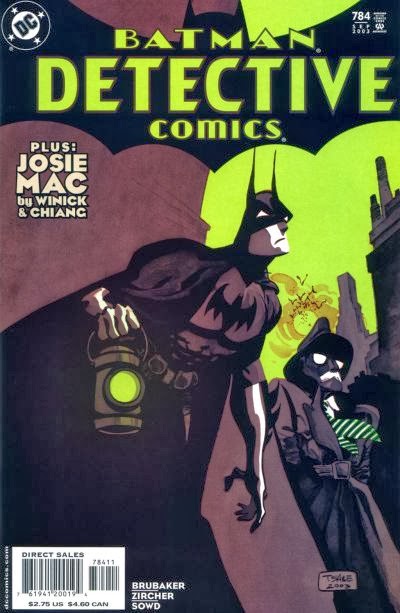
Included in the back of the book are Sale's covers for Solo, Detective Comics (11 of those he contributed in 2003 and 2004, during Ed Brubaker's run) and for Batgirl.
The ones chosen are certainly the strongest, and it's interesting to note that with the exception of Catwoman, who appears in her Cooke costume, the villains he draws are his own versions, including the Joker with gigantic, domino teeth and the tiny little Penguin with too-few fingers and a mouth full of tiny pointy teeth.

Here are a few of the TEC covers that didn't make the cut and thus aren't included:


They're of note, I think, because they show Sale working farther afield than his normal place of strength, drawing characters he's not really associated with (Green Lantern Alan Scott, Stephanie Brown as Robin, Mr. Zsasz again, the female version of Tarantula that was briefly a supporting character in Nightwing and thus the rest of the Batman line; not sure why they didn't include the Mad Hatter cover, with its nice cover version of John Tenniel's of Jabberwocky)

There are also a handful of covers from the end of the 2000-2006 (Cassandra Cain-starring) Batgirl series, for which Sale drew the last five covers. Oddly enough, Sale did not provide the best covers of that series, as James Jean had a wonderful, 17-issue run as cover artist. Still, that's one of the weirder places I've seen Sale's cover work show up at DC, with the exception of, say, this:

Saturday, November 02, 2013

New 52 Vs. DC Super-Pets: Animal Man

Carmine Infantino's Animal Man from the pages of Strange Adventures
Created by writer Dave Wood and artist Carmine Infantino for a one-off feature in 1965's Strange Adventure's #180, Buddy Baker was a man temporarily gifted with the power to borrow the abilities of animals in his vicinity (See Brian Cronin's post on Comics Should Be Good here for a scan-filled history of the character in the Silver Age).

He proved popular enough to return a handful of times, eventually earning a proper superhero name and costume, although he remained an extremely minor, even obscure character until writer Grant Morrison and company's late-eighties revival of the character.

The original costume featured an orange, blue and black color combination, which wasn't exactly popular among superheroes, but that was probably what helped generate it: By the late 1960s, they were running out of color combinations for new superheroes.

In the Superman tradition, Animal Man had the first letter of his name emblazoned on his chest, but it's pretty fully integrated into the design, rather than being a logo that looks hung there. He wore goggles and an unusual, head-hugging half-cowl that allowed his hair to breathe (The goggles were no doubt functional as well as identity-concealing, and it looks like he's got some ear-protection built in).  Note the scale-like texture of the costume, and the shape of his gloves and boots.

Brian Bolland's cover for 1990's Animal Man #19

In 1988, DC awarded Animal Man his own title, by writer Grant Morrison and pencil artist Chas Truog. His costume was little changed, the major innovation being the addition of a leather jacket over his costume. Well, given Animal Man's vegetarianism and support of animal rights, it was more likely a pleather jacket. The material of the costume gradually gave way to your more standard superhero spandex as well.

And that was pretty much what Animal Man looked like from then on, save for a few story-specific costume changes, as when he became a "dark" version of himself near the end of Morrison's run, or when he assumed a chimerical form during Jamie Delano's run and finally quit wearing his costume and grew his hair long and white near the end of the first volume of his series in the mid-1990s. In all of his subsequent appearances, he'd look like the version from the Morrison run, sometimes wearing the jacket and sometimes not.
Steve Pugh's cover for 2012's Animal Man #0

Animal Man earned a second, ongoing series when DC relaunched their line under "The New 52" banner in September 2011. The character saw one of the more drastic character redesigns, keeping only the large A design element and the partial cowl. His colors were now blue and white, he no longer wore goggles and rather than having a glove-like element to his costume, the white arms were more sleeve-like, extending up to his torso.

I personally don't like it much, mostly because of how far divorced it is from the original costume that it makes him look like an entirely different character. He looks rather like an X-Man to me ("A" aside), and while orange, blue and black might not have been the best color combination in the world, Animal Man did sort of own blue and orange, whereas blue and white is a color combination that a lot of super-characters use (particularly villains and characters with cold powers).

I don't think the change makes very good business/character evangelization sense, either (The same goes for most of the New 52 redesigns). I understand the idea of signaling the drastic change by so thoroughly redesigning everything—costume tweaks and changes have long been a way to call attention to an old character or a new storyline—but in this case, Animal Man no longer looks like the character that appears in the critically-acclaimed Grant Morrison-written graphic novels (or any of the other Animal Man trades, or in the collections of 52, which featured him among its cast). Nor does he look like the Animal Man in the DC Nation shorts, Animal Man's only real appearance outside the comics medium.

Personally, I prefer the following design.

Art Baltazar's Animal Man from the DC Super-Pets Character Encyclopedia

Animal Man makes an appearance in the DC Super-Pets Character Encyclopedia, as the "Superhero Owner" of Super-Pet King (a lion).

Baltazar keeps the basic color combo—orange suit, blue A, black accessories—as well as the half-cowl and goggles. He streamlines it quite a bit though, so those amoeba-like tendrils at the borders of the boots and gloves that Infantino gave his costume are gone, replaced by straight edges or triangular shapes.

I especially like the little animal touches he adds, like the big, rounded goggles (suggesting an insect's eyes), the leopard or cheetah-like spots near the gloves and boots, and even the little lines suggesting a paw-like boot. There all just little flourishes, but each signal "new" and "different" without actually radically changing the costume (They're more like adding a yellow circle behind Batman's bat-symbol, or taking that yellow circle away, rather than, say, giving Wonder Woman a pair of black pants or Hawkman a suit of golden armor).

I also really like the torn vest, which replaces the problematic leather/pleather jacket (even if it's fake leather, it looks like leather), and might have different connotations to different viewers. With the vest, Animal Man's got a cool accessory to wear over his costume to signal he's a little more hip than the characters who just wear their spandex costumes.

Maybe the next Animal Man series will see Animal Man wearing a costume more like this than his blue and white, New 52 togs. Not much point in re-dressing the current Animal Man in the cooler, Baltazar-designed costume. From what I've read, the new, New 52 Animal Man isn't a very good comic, and seems to be repeating plot lines from the original series (and Swamp Thing), and doing the sorts of things Morrison parodied and criticized in superhero comics during his Animal Man run, without a trace of irony or understanding.

This is, by the way, Example #1 for why Art Baltazar should be the next person DC calls to redesign all their characters, rather than Jim Lee and company.

Friday, November 01, 2013

Meanwhile...

While I don't think I agree that Mr. Dressup could literally kick Big Bird's ass in a real fight (Big Bird's closely related to the Phorusrhacids, right? And his best friend is a wooly mammoth?), he was my favorite television star when I was a toddler. The above scene is from Elaine M. Will's Look Straight Ahead, which is about a teenager suffering from mental illness, and not about Mr. Dressup, whose only appearance is in the cameo I sampled above. For my review of Will's graphic novel, you can visit Robot 6.

I also have a new review up at Good Comics For Kids; it's of The Simpsons' Treehouse of Horror #19, Bongo's annual Halloween-themed horror anthology special, so make sure you read it before the night is out, because it will no longer be relevant come November 1.