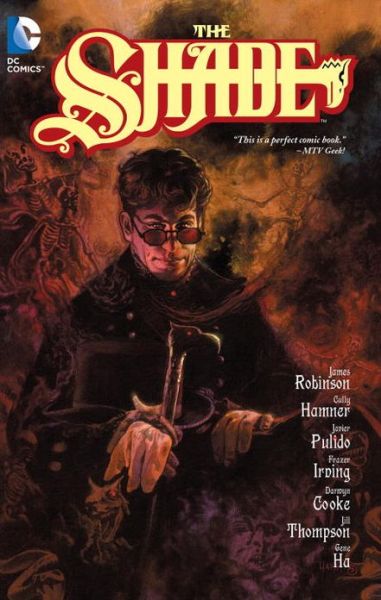
It's hard to think of a single comic that was worse served by DC's "New 52" initiative than writer James Robinson's The Shade, a 12-issue series starring one of best and most colorful supporting characters from his critically-acclaimed and rather well-liked Starman, perhaps the single series in DC Comics history that made the most and best use of the publisher's long, sometimes tangled fictional history and the concept of legacy heroes (In Starman, being the superhero Starman was more-or-less the family business, and Robinson's story and huge cast of characters continually called back to that history).
Robinson kinda sorta returning to Starman was, of course, a good thing, and a rather big deal—trade collections of his run remain strong-ish, particularly for a character who isn't Batman or the Justice League—but it was completely knee-capped by the New 52 relaunch, which did away with the rich history that Starman was built of and most of the characters (or at least the stars) of the series. Timing, of course, didn't help; it was released in the fall of 2011, right at the height of DC's unprecedented PR blitzkreig proclaiming The New 52, with the implicit and explicit messaging that all of the comics DC published were no good and no one really wanted to read them (Starman and Robinson's Justice League of America run included), but these new comics by the same people as the old people (plus Greg Capullo, Rob Liefeld and Scott Lobdell!) were going to be awesome!
It's sales started off sluggish and, if I'm remembering correctly, took quite a tumble throughout the year, whether it was that fact that the book was jettisoned from the DCU and sold accordingly (note sales on DC's non-DCU Vertigo and kids comics), or Robinson's reputation suffering so horribly over the course of his last high-profile DC maxi-series, or simply DC's and DC's readers' attention being elsewhere at the time. (Todd Allen tried to puzzle out the exact reasons in this November 2011 post at The Beat, following warnings from Robinson that sales looked so poor he was no longer sure DC would allow the 12-issue series to last 12 issues).
I personally had, at that point, pretty much given up on James Robinson. Clearly DC editorial had a very heavy hand in his writing on almost every project since his 2006 return to regular writing for the company, with the "One Year Later" Batman story "Face The Face," as could be clearly demonstrated by how much his ongoing Justice League comic, originally meant to run alongside Justice League of America changed between the time it was announced and the time it became the miniseries Cry For Justice, or, how radically and jarringly his JLoA series could change from issue to issue, once he inherited the main title from the departing Dwayne McDuffie (Perhaps the best example of Robinson being jerked-around on that title was the fact that he introduced a big, new line-up in issue #41, only to have at least half of those characters taken out of the book with little to no in-story explanation within two issues, of which was a crossover with other goofy titles like the much-mocked Rise of Arsenal).
(Above: The Justice League that existed for about three issues, and then the League after it was almost immediately halved and, over the course of a story arc, picked up a few new members)
So while I enjoyed certain aspects of his JLoA, more of which I read in trade paperbacks borrowed from libraries than in monthly installments I bought the week of release, I know I wouldn't have been the least bit enthusiastic about his Shade series, were it not for the artists he would be working with: Cully Hamner, Javier Pulido, Jill Thompson (!!!), Darwyn Cooke (Back before Before Watchmen, when his byline didn't make me as queasy as it does now), Frazer Irving and Gene Ha.
I waited for the trade on it, and, just last Wednesday, the trade came out.
Whether because Robinson was back on very sure footing, or because DC editorial gave him a wide berth (nothing in this series "mattered," any longer, as it was already rebooted away) or some other reason, the Robinson who showed up to script this one seemed more like the Robinson of Starman and JSA then the one of Action Comics, Cry and JLoA (two of the three of which also featured Shade).
After having read it, I wonder if the serial structure might have further hurt sales. In the first issue, drawn by Hamner, we see Shade talking with the newest Starman, the blue alien one from Robinson's JLoA in Opal City, and talking with his lover Hope, name-checking many of the characters from Starman.
The end is of the shocking, gratuitous, gory kind—Deathstroke the Terminator, whose design looks like Cully Hamner's attempts to cover Simon Bisley's version of the New 52 'Stroke, first chops off The Shade's hands, and then beheads him. And that's the end of the first issue.
The Cry and Arsenal example of shock-seeking violence, the uncomfortable co-existence of The New 52 and the old DC continuity—I'm not sure how this book would have looked in October of 2011, but I'm pretty sure "promising" wasn't it.
As it turns out, the particular design of Deathstroke was the only aspect of The New 52 to intrude on the series. Otherwise, it is quite clearly a continuation or spin-off of Starman, featuring the exact same version of The Shade. This was simply an old-DCU comic that DC published right after they made a big deal about the old DCU being rearranged into The New 52U.
Deathstroke is, obviously, unsuccessful in his attempts to kill The Shade, but his attempt to do so sets the plot of the next ten issues in motion, after a first issue reintroducing us to The Shade and his particular tone of voice and his own supporting cast and home base of Opal.
Naturally, The Shade wants to know why someone hired one of the world's greatest assassins to kill him, and he begins a globe-trotting trip to find out just that, along the way flashing back to previous adventures involving his descendants, two of whom figure rather prominently in the attempt on his life. In a sense, this is a story about The Shade's dealings with his family over the decades, and learning that maybe it's better to keep in touch, if the results of not keeping touch involve any of them attempting the sort of evil that even he during his Golden Age worst would have never attempted.
He travels from Opal to Paris to Australia to Barcelona to London, and on several occasions the story travels back in time to the 19th century and, on one occasion, to the 1940s. The multiple artists are employed quite smartly, so that a change in artist coincides either with a change in place or a change in time (or both). There are obviously wide (troublingly so) gulfs between the styles of Hamner and Cooke and Ha, but the shifts smooth it over (Cooke, Pulido and Thompson all draw in a similar enough style that their art seems to belong grouped together, while Irving and Ha's realistic art similarly works in complimentary fashion; the editors group it smartl, so we move from Hamner to Pulido Cooke and Thompson and then, finally, to first Irving than Ha).
Robinson involves a fairly incredible amount of guest-stars, more of whom seem to be created by he and his artistic collaborators than pulled from the DC character stable something that, given the damage Robinson inflicted on that stable during Cry, is nice to see. There are actually quite a few of these, many of them international heroes, and I suppose I should do a more thorough Googling before declaring them all Robinson creations, as its possible they are simply extremely obscure DC characters (Robinson is the man who resurrected Jay Garrick's Golden Age sidekicks simply to ice them in Cry, for example, and used characters from DC's 1970s 1st Issue Specials prominently in his Action Comics run).
Barcelona's champions were probably my favorite, both springing from the Pulido-drawn sections of the book. These are La Sangre, a teenage (looking) vampire who is the city's beloved champion (and kinda sorta The Shade's adoptive daughter) and Montepellier, a snake-themed detective hero of the Batman mold, whose costume looks a little like a Frank Miller design from Dark Knight Strikes Again, a design just goofy enough to still be sort of cool.
(Above: Montepellier, by Pulido)
A handful of pre-existing characters do appear, of course, aside from the aforementioned Starman characters and Deathstroke.
During the Cooke-drawn adventure in the 1940s, there is a nice, dynamic scene involving the original Vigilante (I love that guy, by the way, and Cooke makes him look ten times more awesome than usual) and, surprisingly enough, Golden Age cross-dressing crimefighter Madame Fatal, whom I didn't realize DC actually had the rights to use (I last saw her appear in The Quality Comics companion, which I guess would make her a DC character now). Interestingly, rather than a little old lady, this Fatal is drawn as a busy amazon, albeit one with white hair.
The book is pretty great, featuring a very distinct lead with a very singular voice, and, as mentioned a series of great artists. It's not perfect, of course, and I'll always find something to complain about. Robinson's dialogue can occasionally be too precious, too obvious in its construction.
Format-wise, this is an eleven-issue story arc, with a tacked-on 12th issue, purporting to be the never-before-told origin of The Shade. The story is perfectly wrapped-up by the last page of the eleventh issue, and the twelfth begins with still perfectly human Richard Swift in the late 1830s, hanging out with his pal Charles Dickens, his own lovely family and a mysterious dwarf named Simon Culp. There's a ritual to invoke a goddess, at which Swift was to be a sacrifice, but instead he gained his Shade powers and his immortality. Exactly what went on to give him those powers isn't really discussed here, allusions are made to explanations existing elsewhere (likely in Starman or perhaps the four-issue, 1997 Shade miniseries; it's been a while since I've read either).
The only disappointing bit on the art side of the equation, which is mostly superlative, came during a section Pulido drew in which The Shade visits his elderly, dying great-grandson in Australia, and a conversation between the pair is illustrated in a two-page spread, assembled from a single drawing repeated over and over and over, slightly edited each time to try (and fail) to invoke a sense of differing panels; it's a clumsy, lazy trick I've seen in Brian Michael Bendis-written comics a lot, and generally employed because there's some time crunch with the books.
That is, thankfully, the only negative aspect of any of the art in this 12-issue storyline though (Well, I might have colored Shade's blood black rather than red in the first issue, when Deathstroke is chopping him into pieces, since the fact that The Shade doesn't possess blood any more is something of a plot point later in the series).
When finishing a shared-setting super-book like this, one of the most exciting aspects is imagining what will come next. I, for example, would really like to read more about some of these newer characters (and/or older characters, recreated or refurbished), and The Shade, like the Starman legacy, is exactly the sort of character-vehicle that would allow a writer like Robinson plenty of space to fill-in dozens and dozens of story (there's room for a lot of adventures between the years 1837 and 2013, after all).
Sadly though, the current state of the DC line would seemingly make something like, say, a sequel or a Shade ongoing by Robinson and Pulido unlikely, if not impossible. The publisher could continue to publish comics outside of their New 52 status quo, of course, but, thus far, they haven't been all that eager to do so, and, in the year and a half or so since the change, this remains one of—or only?—old-DCU comics stories they've published.
On it's own though, this was a really rather great little comic series, filled with great art from great artists who simply do not produce enough superhero genre stuff (It was such a treat, for example, to see Thompson working in the "straight" style of her old Sandman contributions, for example, or Cooke doing another DCU period piece).
It's also, by the way, a pretty compelling argument against a one-generation only DCU—there's just so much raw material to mine when you've almost the entire 20th century full of super-people, rather than restricting yourself to a superhero history that exists only from 2008-2013, you know?)
***********************
I thought it worth noting that James Robinson did not create The Shade, even if he quite thoroughly and completely recreated him over his years and years of writing him. According to Wikipedia, The Shade first appeared in a 1942 issue of DC-to-be National's Flash Comics, and his creation is credited to an E.E. Hibbard.
I'm having trouble thinking of another character who was adopted in the manner that Robinson adopted The Shade, essentially transforming the character so much that the later creator's creative stamp seems to have all but obliterated the original conception of the character.
I'm sure one could think of many if one spent a while doing so, though. Off the top of my head, Alan Moore and company's work on Swamp Thing and Grant Morrison, Jamie Delano and company's Animal Man spring to mind most immediately.
*********************
Hey, speaking of the New 52U's compressed superhero timeline, in which there weren't any superheroes until Superman started running around Metropolis in 2008, maybe late 2007. That's really, really weird when one considers the fact that All-Star Western features super-powered masked men like El Diablo and colorful, masked crimefighters with codenames like Nighthawk, Cinnamon and The Barbary Ghost, isn't it?
Basically, there were superheroes in the late 19th Century (and the Dark Ages, as per Demon Knights, but I'm not sure if they would count as superheroes, given the fact that they are all magical in nature), but not a single individual decided to wear a mask and fight crime between, say, 1900 and 2006...?
That has nothing to do with The Shade, of course. Only that this series' inclusion of The Vigilante, Madam Fatal, and the title character's 100+ year career as a super-human had me thinking about a fictional history of superheroes, and read while writing about a New 52 cowboy series sort of drove home the fact that there seems to be a very big and hard to account for gap in New 52U continuity.
Monday, March 11, 2013
Saturday, March 09, 2013
Review: All-Star Western Vol. 1: Guns and Gotham
DC's relatively long-running Western comic starring Jonah Hex by the writing team of Jimmy Palmiotti and Justin Gray was changed somewhat slightly by the publisher's "New 52" refurbishing, its name being changed from Jonah Hex to All-Star Western (it was also expanded by about ten pages, with Palmiotti and Gray written back-up features starring various other super-cowboy types).
Although "All-Star Western" is the name of an old DC comic book, the title was less precise than Jonah Hex was and, given the change of setting from the Old West to late 19th Century Gotham City, not entirely accurate—the lead stories were only "Westerns" in the sense that they had a cowboy in them, otherwise they were technically Easterns. Given the general quality and perception of the 2010 film Jonah Hex, perhaps its understandable that DC would want to distance themselves as far from that particular title as possible.
So despite the new title, the tweaking of format and price tag and the new setting, Palmiotti and Gray were joined by a new artist in the form of Moritat, and Hex was joined by an unlikely partner, buddy cop style, in the form of Amadeus Arkham (who would eventually found the asylum that Batman's enemies are kept in when his writers and artists aren't using them).
It is sometime in the 1880s, and Hex has come to Gotham City in pursuit of a vicious, Jack The Ripper-like serial killer who is also of interest to young alienist Arkham, and the two form an unlikely and uneasy alliance to get to the bottom of a great deal of bizarre criminality in young Gotham: In addition to the ritualistic killings, there's a secret society, mass kidnappings and forced labor.
Like the inferior Demon Knights, this is an example of the historical superhero comic, and while the mode is that of the Western (again, defined as "containing at least one cowboy"), Palmiotti and Gray make great use of DC continuity and shared setting in order to form unexpected and unlikely connections to other DC Comics.
In addition to Arkham, a character Grant Morrison more or less created in 1989's Arkham Asylum graphic novel, other references to Morrison's work include the Crime Bible and the religion devoted to it, as written about in 52 and elsewhere by 52 writers Morrison and Greg Rucka, and the inclusion of The Miagani, an indigenous tribe of bat-worshiping Native Americans that live in caves beneath Gotham City, and a monstrous giant bat, which played small roles in Morrison's Batman run (Particularly in Batman: The Return of Bruce Wayne). Nods are also made in the direction of Scott Snyder and company's Batman: Gates of Gotham series, and the prominent families of early Gotham, which Snyder would devote more time to in his Batman run (and Palmiotti and Gray would base more stories around in the future).
This book contains the first six issues of the series, accounting for about two adventures of Hex and Akrham in Gotham. Moritat's art helps place this among the strongest of the 2011 relaunched line. His storytelling is impeccable, and he fills establishing shots and long shots with rich detail.
The writing is, as it was in the 70-issue Jonah Hex series, decent genre fare; rarely if ever transcending the expectations of a dark, scarred killer cowboy hunting and fighting human monsters for money and/or justice, but the change of setting and verbal sparring partner/point-of-view character certainly give it a new coat of paint, which has a relatively restorative effect on Palmiotti and Gray's Hex.
Like all comics though, this one lives or dies by the art, and, thanks to Moritat, it's quite vital. As with Action Comics Vol. 1, the back-ups are collected and included at the back of the book. The serial format of these seems to be about eight pages of story per issue, starting with All-Star #2.
There's two full stories here. The first stars the original El Diablo, the character Lazarus Lane created in 1970 by Robert Kanigher and Gray Morrow (Modern versions of the character were attempted by Gerard Jones and Mike Parobeck in 1989 and by Jai Nitz, Phil Hester and Ande Parks in 2008). This one features Lane as the whip-wielding spirit of vengeance, pitted against a zombie horde raised by native magic. It's drawn (impeccably) by Jonah Hex vet Jordi Bernet.
The second stars The Barabary Ghost, an apparently new creation by Palmiotti, Gray and artist Phil Wil Winslade (oddly, she's the only character to get "created by" credits; not even star Jonah Hex gets a "Created by Tony DeZuniga and John Albano" credit). She's a Chinese immigrant whose large family was whittled down in a violent war of attrition with a crime boss from the old country; to avenge them she dresses like the 19th, Chinese-American version of Dark Horse's Ghost and pretends and uses fireworks as weapons. More-or-less straight genre fare, although I suppose there's always something to be said for striving for diversity in big publisher genre characters, and Winslade's art is pretty great, but his style is not as much to my liking as that of Moritat or Bernet (Make no mistake, Winslade is an excellent artist, but I have greater personal affection for the styles of the other two artists involved in this book).
Of the handful of "New 52" relaunches I've sampled in trade paperback form, this is one that made me happy I read it. It's head and shoulders above most of the others I've read, and if the writing isn't as inspired, ambitious or fun as that in Action Comics, it makes up for that deficiency by boasting better and more consistent artwork.
Although "All-Star Western" is the name of an old DC comic book, the title was less precise than Jonah Hex was and, given the change of setting from the Old West to late 19th Century Gotham City, not entirely accurate—the lead stories were only "Westerns" in the sense that they had a cowboy in them, otherwise they were technically Easterns. Given the general quality and perception of the 2010 film Jonah Hex, perhaps its understandable that DC would want to distance themselves as far from that particular title as possible.
So despite the new title, the tweaking of format and price tag and the new setting, Palmiotti and Gray were joined by a new artist in the form of Moritat, and Hex was joined by an unlikely partner, buddy cop style, in the form of Amadeus Arkham (who would eventually found the asylum that Batman's enemies are kept in when his writers and artists aren't using them).
It is sometime in the 1880s, and Hex has come to Gotham City in pursuit of a vicious, Jack The Ripper-like serial killer who is also of interest to young alienist Arkham, and the two form an unlikely and uneasy alliance to get to the bottom of a great deal of bizarre criminality in young Gotham: In addition to the ritualistic killings, there's a secret society, mass kidnappings and forced labor.
Like the inferior Demon Knights, this is an example of the historical superhero comic, and while the mode is that of the Western (again, defined as "containing at least one cowboy"), Palmiotti and Gray make great use of DC continuity and shared setting in order to form unexpected and unlikely connections to other DC Comics.
In addition to Arkham, a character Grant Morrison more or less created in 1989's Arkham Asylum graphic novel, other references to Morrison's work include the Crime Bible and the religion devoted to it, as written about in 52 and elsewhere by 52 writers Morrison and Greg Rucka, and the inclusion of The Miagani, an indigenous tribe of bat-worshiping Native Americans that live in caves beneath Gotham City, and a monstrous giant bat, which played small roles in Morrison's Batman run (Particularly in Batman: The Return of Bruce Wayne). Nods are also made in the direction of Scott Snyder and company's Batman: Gates of Gotham series, and the prominent families of early Gotham, which Snyder would devote more time to in his Batman run (and Palmiotti and Gray would base more stories around in the future).
This book contains the first six issues of the series, accounting for about two adventures of Hex and Akrham in Gotham. Moritat's art helps place this among the strongest of the 2011 relaunched line. His storytelling is impeccable, and he fills establishing shots and long shots with rich detail.
The writing is, as it was in the 70-issue Jonah Hex series, decent genre fare; rarely if ever transcending the expectations of a dark, scarred killer cowboy hunting and fighting human monsters for money and/or justice, but the change of setting and verbal sparring partner/point-of-view character certainly give it a new coat of paint, which has a relatively restorative effect on Palmiotti and Gray's Hex.
Like all comics though, this one lives or dies by the art, and, thanks to Moritat, it's quite vital. As with Action Comics Vol. 1, the back-ups are collected and included at the back of the book. The serial format of these seems to be about eight pages of story per issue, starting with All-Star #2.
There's two full stories here. The first stars the original El Diablo, the character Lazarus Lane created in 1970 by Robert Kanigher and Gray Morrow (Modern versions of the character were attempted by Gerard Jones and Mike Parobeck in 1989 and by Jai Nitz, Phil Hester and Ande Parks in 2008). This one features Lane as the whip-wielding spirit of vengeance, pitted against a zombie horde raised by native magic. It's drawn (impeccably) by Jonah Hex vet Jordi Bernet.
The second stars The Barabary Ghost, an apparently new creation by Palmiotti, Gray and artist Phil Wil Winslade (oddly, she's the only character to get "created by" credits; not even star Jonah Hex gets a "Created by Tony DeZuniga and John Albano" credit). She's a Chinese immigrant whose large family was whittled down in a violent war of attrition with a crime boss from the old country; to avenge them she dresses like the 19th, Chinese-American version of Dark Horse's Ghost and pretends and uses fireworks as weapons. More-or-less straight genre fare, although I suppose there's always something to be said for striving for diversity in big publisher genre characters, and Winslade's art is pretty great, but his style is not as much to my liking as that of Moritat or Bernet (Make no mistake, Winslade is an excellent artist, but I have greater personal affection for the styles of the other two artists involved in this book).
Of the handful of "New 52" relaunches I've sampled in trade paperback form, this is one that made me happy I read it. It's head and shoulders above most of the others I've read, and if the writing isn't as inspired, ambitious or fun as that in Action Comics, it makes up for that deficiency by boasting better and more consistent artwork.
Thursday, March 07, 2013
Meanwhile...
That's a page from Philippe Coudray's Benjamin Bear in Fuzzy Thinking, one of the three books I discussed in the latest installment of Robot 6's "What Are You Reading?" column, which you can read here.
Also at Robot 6 this week, I reviewed Age of Ultron; you can read that piece here.
And over at Good Comics For Kids this week, I have a review of The Baby Smurf here and an interview with Joey Weiser about his recently released Mermin Vol 1: Out of Water here.
Also at Robot 6 this week, I reviewed Age of Ultron; you can read that piece here.
And over at Good Comics For Kids this week, I have a review of The Baby Smurf here and an interview with Joey Weiser about his recently released Mermin Vol 1: Out of Water here.
Wednesday, March 06, 2013
Comic shop comics: March 6

Ame-Comi Girls #1 (DC Comics) DC decided to make this book an ongoing monthly, and arbitrarily decided to do so with what appears to be the penultimate chapter of the Everyone Vs. Brainiac storyline that Jimmy Palmiotti, Justin Gray and a variety of artists have been producing and DC had previously been publishing as a mini-series.
I meant to drop it when the miniseries ended, but forgot to do so, so I bought one more issue, so as not to stick my local comic shop with one more copy of this book where a bunch of scantily-clad super-ladies fight Brainiac, who has boobs, because everyone else in the comic does.
In this issue...well, nothing of note really happens. Wonder Woman keeps fighting Dark Supergirl, then all the villains (except Brainiac) team-up with all the heroes, to continue fighting Brainiac.
It's drawn by Eduardo Francisco, who does a fairly great job of drawing sexy, shapely ladies in skin-tight clothes. They all look alike, unfortunately, and he does resort to at least one instance of full-on brokeback posing, but it was Powergirl, and she's Kryptonian, so maybe they have rotating spine joints that we earthlings don't have.
Age of Ultron #1 (Marvel Entertainment) Since there were so few comic books that I planned on purchasing coming out this week, I told myself I'd either pick up Joe Casey and Piotr Kowalski's Sex #1 of this gold foil embossed monstrosity from Marvel Comics, knowing I'd read them both in trade someday. Well, my shop didn't order any copies of Sex, so I went with this—It's a $3.99/29-page book, so I guess the embossed foil cover didn't add to the manufacturing costs...?
So this comic is basically Hawkeye shooting people between the eyes or in their open mouths with arrows and crossbow bolts for about 20 pages, followed by nine pages of The Avengers living like Morlocks and being scared of Ultron. It reads like an issue of New Avengers co-plotted by Mark Millar, and it looks like an issue of The Ultimates. It's not as bad as it sounds....? I'll have more to say on it tomorrow.
Green Lantern #18 (DC) The art team of Dough Mahnke and his seventeen inkers are MIA this month (really curious what he's going to be drawing when the GL books get new creative teams). It's been replaced by two other art teams. One is Szymon Kudranski, who drew that truly awful Penguin miniseries, as colored by Alex Sinclair. It is, like that Penguin comic, awful, but since its set in "The Dead Zone" (if you acknowledge you're using a phrase another writer came up with for something else, is it still lame to use it...?) inside the Black Ring or Book or Wherever, it only really matters when he tries to convey action of any kind, like above.
Oh, and there's a funny part where Sinestro mentions that they seem to be trapped in the Dead Zone with a hundred or so others (Kudranski never draws more than like six vague shapes milling around in the background), and Undead Tomar Re says "A Hundred? There are millions of them here," and the "camera" pulls back to reveal maybe eight vague shapes milling around in the background.
There are a few pages set outside the Dead Zone; these are drawn by Ardian Syaf and Mark Irwin (with Tony Avina coloring) and they look pretty great compared to the rest of the comic.
Legends of The Dark Knight #6 (DC) While past issues of this anthology series have seemed to be something akin to new talent showcases, this particular issue features a trio of stories from established professionals, providing a trio of very solid, very visually striking stories featuring Batman, lurking behind a dramatic cover by Guillem March, of a good-old-fashioned gray-and-blue Batman.
First up, there's the Atlas/Red Hulk creative team of Jeff Parker and Gabriel Hardman, presenting a ten-page story that is little more than an extremely dramatic, kinetic, well-choreographed sequence of Batman chasing down and capturing some crooks who have just robbed a liquor store.
That is literally all there is to it, and yet Hardman draws the hell out of it, and together with Parker he's installed so many cool little moments that it works, slight as it is, to define some of Batman's many virtues.
Like I said, there are only ten pages to it, but I'm having a hard time narrowing down a list of favorite moments in it any narrower than three.
I have no idea whey these two aren't super-ultra-exclusive at Marvel, but here's hoping they get a chance for bigger, longer Bat-comics in the future.
That's followed by a pretty silly Batman vs. A Dragon story by Michael Avon Oeming, in which, um, Btaman fights a dragon, but is well worth your time for Oeming's artwork. There's another artist who was pretty much born to draw Batman.
The final story is "Look Inside," written by Rob Williams and drawn by Juan Jose Ryp. It introduces an incredibly scary new villain with an incredibly scary (and unique) gimmick. There's a bit of a story cheat to that gimmick, and the way Batman gets around it, but, thanks to Ryp's highly-detailed, highly-stylized artwork, it really works, and that last panel is absolutely chilling.
The Shade (DC) This is the trade collection of that very long mini-series (do they still use the word maxi-series?) James Robinson wrote about his Shade character that DC started publishing at the exact moment that they realgined their fictional setting so that The Shade and all of those characters James Robinson got popular writing never really existed, and thus didn't "count" anymore. That was post-Cry For Justice James Robinson, too, so I trade-waited it (Even if James Robinson was still writing like Cry For Justice James Robinson more than Starman James Robinson, the series still had artists like Javier Pulido, Jill Thompson and Before Watchmen's Darwyn Cooke drawing it).
Normally I would have purchased this trade through an online retailer, because I would have gotten it at a dramatic discount and also I am cheap and terrible, but I decided to buy it from my local comic shop today, in an effort to be less terrible a consumer.
I did not read it yet, so I can't really offer any review at this point. Wait, let me at list flip through it—Okay, I see Cooke drawing The Vigilante (nice), Pulido seems to rule (yes), New 52 Deathstroke is in it for some reason...Eh, I'll let you know in a few weeks.
Superman Family Adventures #10 (DC) General Zod and the Phantom Zone criminals open up a hot dog stand, both of Superman's dads are revealed to still be alive (or at least alive-ish), Terra-Man cameos and there are some giant, sentient hot dog monsters. As a vegetarian, I don't dig on swine, but that cover makes me want to try a veggie dog in a poppy seed bun.
Tuesday, March 05, 2013
Review: Justice League Vol. 2: The Villain's Journey
With the second volume of the relaunched Justice League, the problem of Geoff Johns replacing a shared, public continuity with a secret continuity only he himself knows is only compounded.
It is now five years after the events of Origin, but it might as well be the next day. The seven Leaguers haven't changed much physically (Aquaman shaved his sideburns and took off his necklace) or emotionally, and the team doesn't seem to have evolved much at all. Most of them still don't know one another very well, and most of them don't seem to like one another at all. No one has joined the team, or even been on the their satellite headquarters, not even Steve Trevor, Agent of ARGUS, who has become their one man PR-team/support staff/government liaison (Last night I kept going back in forth in my mind over whether it would be more or less hilarious if instead of Steve Trevor Johns and Lee used a grizzled, bad-ass version of Snapper Carr in this role).
The only exception to the no-one-but-us rule was, apparently, The Martian Manhunter. "We all know what happened when we let someone else onto this satellite and into the Justice League," Batman says in one panel, which leads directly to a two-page splash of Manhunter fighting the entire League by himself (Hey, in the New 52 J'onn can apparently use his Martian vision, make part of his body intangible and part of his body super-strong, all at the same time!).
What was that all about? It's one more of those little snippets of a secret history that is so often referred to, along with what the League has been up to for five years, what happened with Barbara Minerva, the untold story of Aquaman's hatred of Green Arrow, why Superman has a special enmity for The Key and so on. The idea seems to be to tease readers with these little flashes of a story, but it's a strategy that only really works if anything at all of interest is going on around it. Like, that sort of storytelling might have worked on Lost (I didn't watch Lost; did it work on Lost...?) because people wanted to know what was up with that fucking island.
Do people want to know why Martian Manhunter wears a loincloth and lost his spot on the League to a Teen Titan?
I don't know.
This is also the volume where Lee's presence can be seen starting to evaporate completely, and it's odd that he leaves the title without giving it much of a look...beyond the characters' terrible new costumes, of course. There isn't, for example, a single exterior or establishing shot of the Justice League's satellite watchtower headquarters; not that he drew, anyway (There's one, by I think Ivan Reis, who just draws three pages of one issue, and it's in the second issue of the collection, after scenes set on the satellite). That's sort of weird, isn't it?
(Maybe it's simply a matter of my living with them longer, or because DC used to publish maps and suchlike, but I can tell you what the tables they used to sit around in in the original cave HQ, the Bronze Age Satellite HQ, the JLI Embassy or the lunar Watchtower looked like; I can picture the rooms of those bases, but all we get here are a couple of generic interior drawings of metallic rooms.)
This volume contains the second six issues of Justice League, two standlone done-in-ones by guest-artists leading into the four-issue title story.
The first is by artist Gene Ha, which lays out the relationship between the U.S. government, Trevor and the Justice League and doesn't make any goddam sense. Apparently, the U.S. funds the League, but is angry they have no control over it. So why don't they just stop funding it? I don't know.
Nor do I know why Etta Candy looks like this now, aside from The New 52's unspoken "No Fat Chicks" rule:
Nor do I know why Supereme Court Justice Antonin Scalia is a member of congress all of a sudden:
The second is by Carlos D'Anda, whose smooth, clean art is a welcome respite from all the little lines of Lee and even Ha's work—it's a stubble-free issue!Probably the highlight of the volume, D'Anda's issue #7 involves Green Arrow's attempts to join the Justice League (which really seems more like a "Year One" rather than "Year Five or Six" story, but maybe I'm just thinking that because Mark Waid and company had Green Arrow attempting to to join the Justice League in their first year during Justice League: Year One), mostly by showing up at their various conflicts and lending a hand, only to be told to buzz off in various ways.
Lee returns for the "Villains' Journey," in which the David Graves character kinda sorta introduced in the previous volume is reintroduced as a supervillain that looks a bit like a white Martian crossed with a devil (he gets more and more devilish-looking as the arc progresses) and who and goes by the villain name of, um, Graves.
He was a Justice League fan who lost his family and developed cancer during the Darkseid invasion (they caught a rare form of cancer by inhaling the ashes of the destruction; you know, like the real-world malady suffered by many 9/11 first responders, only made silly), and while fashioning himself into a villain discovered a strange place that gave him a strange power involving the creation of pseudo-ghosts.
Props to Johns and Lee for creating a new villain (old ones, like The Weapons Master, Amazo and the previously mentioned Key appear in passing), and for coming up with one with a fairly distinct look, motivation and power-set, but at the end of its first year worth of issues, the Justice League book still doesn't seem like it's coalesced yet.
I can't shake the feeling that I'm reading something akin to an Elseworlds project, an Ultimate Justice League, and I realize that there's a very strong possibility that that is simply me as a reader. That said, however, the fact remains that this isn't a very good comic book—there's a talented writer, but he's producing probably his worst scripts ever, and there's a talented artist (three, in this volume, actually), but he's playing fast and loose with basic storytelling conventions, producing decent art that doesn't function as it should.
Giving Johns and Lee and company a year on the title seems like a more than fair amount of time by which to judge it, and I've read it in its final, collected form, the form it was apparently being written for, and I'm sad to say it still doesn't really work.
This volume concludes with another "What's up with this Pandora lady?" story, this one involving what looks like The New 52 Wizard Shazam and The Question, as well as a few "trailer" pages for future Justice League stories and a two-page ad for Justice League of America.
It is now five years after the events of Origin, but it might as well be the next day. The seven Leaguers haven't changed much physically (Aquaman shaved his sideburns and took off his necklace) or emotionally, and the team doesn't seem to have evolved much at all. Most of them still don't know one another very well, and most of them don't seem to like one another at all. No one has joined the team, or even been on the their satellite headquarters, not even Steve Trevor, Agent of ARGUS, who has become their one man PR-team/support staff/government liaison (Last night I kept going back in forth in my mind over whether it would be more or less hilarious if instead of Steve Trevor Johns and Lee used a grizzled, bad-ass version of Snapper Carr in this role).
The only exception to the no-one-but-us rule was, apparently, The Martian Manhunter. "We all know what happened when we let someone else onto this satellite and into the Justice League," Batman says in one panel, which leads directly to a two-page splash of Manhunter fighting the entire League by himself (Hey, in the New 52 J'onn can apparently use his Martian vision, make part of his body intangible and part of his body super-strong, all at the same time!).
What was that all about? It's one more of those little snippets of a secret history that is so often referred to, along with what the League has been up to for five years, what happened with Barbara Minerva, the untold story of Aquaman's hatred of Green Arrow, why Superman has a special enmity for The Key and so on. The idea seems to be to tease readers with these little flashes of a story, but it's a strategy that only really works if anything at all of interest is going on around it. Like, that sort of storytelling might have worked on Lost (I didn't watch Lost; did it work on Lost...?) because people wanted to know what was up with that fucking island.
Do people want to know why Martian Manhunter wears a loincloth and lost his spot on the League to a Teen Titan?
I don't know.
This is also the volume where Lee's presence can be seen starting to evaporate completely, and it's odd that he leaves the title without giving it much of a look...beyond the characters' terrible new costumes, of course. There isn't, for example, a single exterior or establishing shot of the Justice League's satellite watchtower headquarters; not that he drew, anyway (There's one, by I think Ivan Reis, who just draws three pages of one issue, and it's in the second issue of the collection, after scenes set on the satellite). That's sort of weird, isn't it?
(Maybe it's simply a matter of my living with them longer, or because DC used to publish maps and suchlike, but I can tell you what the tables they used to sit around in in the original cave HQ, the Bronze Age Satellite HQ, the JLI Embassy or the lunar Watchtower looked like; I can picture the rooms of those bases, but all we get here are a couple of generic interior drawings of metallic rooms.)
This volume contains the second six issues of Justice League, two standlone done-in-ones by guest-artists leading into the four-issue title story.
The first is by artist Gene Ha, which lays out the relationship between the U.S. government, Trevor and the Justice League and doesn't make any goddam sense. Apparently, the U.S. funds the League, but is angry they have no control over it. So why don't they just stop funding it? I don't know.
Nor do I know why Etta Candy looks like this now, aside from The New 52's unspoken "No Fat Chicks" rule:
Nor do I know why Supereme Court Justice Antonin Scalia is a member of congress all of a sudden:
The second is by Carlos D'Anda, whose smooth, clean art is a welcome respite from all the little lines of Lee and even Ha's work—it's a stubble-free issue!Probably the highlight of the volume, D'Anda's issue #7 involves Green Arrow's attempts to join the Justice League (which really seems more like a "Year One" rather than "Year Five or Six" story, but maybe I'm just thinking that because Mark Waid and company had Green Arrow attempting to to join the Justice League in their first year during Justice League: Year One), mostly by showing up at their various conflicts and lending a hand, only to be told to buzz off in various ways.
Lee returns for the "Villains' Journey," in which the David Graves character kinda sorta introduced in the previous volume is reintroduced as a supervillain that looks a bit like a white Martian crossed with a devil (he gets more and more devilish-looking as the arc progresses) and who and goes by the villain name of, um, Graves.
He was a Justice League fan who lost his family and developed cancer during the Darkseid invasion (they caught a rare form of cancer by inhaling the ashes of the destruction; you know, like the real-world malady suffered by many 9/11 first responders, only made silly), and while fashioning himself into a villain discovered a strange place that gave him a strange power involving the creation of pseudo-ghosts.
Props to Johns and Lee for creating a new villain (old ones, like The Weapons Master, Amazo and the previously mentioned Key appear in passing), and for coming up with one with a fairly distinct look, motivation and power-set, but at the end of its first year worth of issues, the Justice League book still doesn't seem like it's coalesced yet.
I can't shake the feeling that I'm reading something akin to an Elseworlds project, an Ultimate Justice League, and I realize that there's a very strong possibility that that is simply me as a reader. That said, however, the fact remains that this isn't a very good comic book—there's a talented writer, but he's producing probably his worst scripts ever, and there's a talented artist (three, in this volume, actually), but he's playing fast and loose with basic storytelling conventions, producing decent art that doesn't function as it should.
Giving Johns and Lee and company a year on the title seems like a more than fair amount of time by which to judge it, and I've read it in its final, collected form, the form it was apparently being written for, and I'm sad to say it still doesn't really work.
This volume concludes with another "What's up with this Pandora lady?" story, this one involving what looks like The New 52 Wizard Shazam and The Question, as well as a few "trailer" pages for future Justice League stories and a two-page ad for Justice League of America.
Labels:
gene ha,
geoff johns,
jim lee,
justice league,
new 52
Monday, March 04, 2013
Review: Justice League Vol. 1: Origin
One of the ironies of DC Comics' 2011 reboot of their shared-setting's history is that they didn't simply scrap the oft-tweaked 25-year-old continuity in order to start over from scratch. Instead they scrapped that continuity, the knowledge of which was shared between their readers and creators, and replaced it with a new continuity that only the writer of a particular story seemed to know much of anything about.
Justice League, the flagship book of the publisher's "New 52" direction, was the first to be released, and featured a story that was set "Five years ago," back "when the world didn't know what a super hero was." It is also a fairly perfect example of that the trading of a common continuity for a secret one.
There is quite clearly a lot of story that has occurred off-panel before this book begins. History and events of various degrees of importance that the readers aren't privy to are alluded to with various degrees of urgency throughout the first two story arcs, "Origin" and "The Villain's Journey" (More on that second one tomorrow night).
From a new reader's perspective, there doesn't seem to be a whole lot of difference between not knowing about Wonder Woman's origin because you never read a particular trade paperback collecting books from the late 1980s (or any of the many re-tellings of the story that have appeared since) and not knowing it because DC never published a version that "counts"; whether you don't know about the first meeting of Barry Allen and Hal Jordan because you didn't read The Flash and Green Lantern: The Brave and The Bold or because there is no story of that meeting any more, the effect is still the same. You still feel like you're walking into a movie that's half over and trying to catch up; the main difference here is there's no other movies you can go back to watch in order to get up to speed.
This title was particularly frustrating when originally released serially, as it was our first glimpse of the new universe, and these all-new versions of the characters, but it was a) set five years in the past of the other 51 books that constituted the new universe and b) was set after all of these heroes already existed (with the exception of Cyborg, the rest of the Justice League members were already active adventurers at the time this book takes place, some of whom have even already met one another).
It took six months for writer Geoff Johns and artists Jim Lee and Scott Williams to tell the story of how the Justice League first came to be, and it was a very, very simple story of seven individuals showing up to the same fight at the same time, with readers joining their stories already in-progress.
In this particular volume, Superman is already wearing his final uniform from the climax of Action Comics Vol. 1: Superman and The Men of Steel (so this took place after that story, which ends with people learning what a superhero really is, thanks to Superman and Steel); Green Lantern and Flash have already teamed-up and learned one another's secret identities; Wonder Woman has already come to Man's World and been semi-adopted by military liaison Colonel Steve Trevor and, weirdly, Aquaman is a skit on Conan O'Brien, but, like Batman, no one was sure if he really existed or not (The characterization and the information presented in this story greatly differs from that of these characters' individual books; this Superman isn't the same one in Grant Morrison and company's Action, this Wonder Woman isn't the same one in Brian Azzarello, Cliff Chiang and Tony Akins' Wonder Woman and, strangest of all, this Aquaman isn't the same Aquaman that appeared in Aquaman, which was simultaneously being written by Geoff Johns. One could blame the time difference for some, but not all of that, and it wouldn't excuse "historical" facts that seemingly conflict).
This is the story of Origin.
The Gotham City Police Department is chasing Batman, who is chasing some kind of alien cyborg monster thing (the word "Parademon" is never used, but old DC readers will recognize it as a redesigned version of such). Green Lantern Hal Jordan arrives and the two heroes reluctantly team-up, despite not liking one another.
When Green Lantern's ring tells him that the alien cyborg monster thing is an alien, he and The World's Greatest Detective decide they should go ask Superman about it, as "they say he's an alien." So they fly to Metropolis.
Meanwhile, high school football star Vic Stone wins a big game and college scouts are lined up to meet with him, but his scientist father didn't show up, so he's sad.
In Metropolis, Superman punches out Green Lantern, and then picks a fight with Batman (which Johns and Lee weirdly decide not to show; we get a two-page splash of Superman saying "Your belt's empty, Batman", rather than using any of that comic book real estate to show the reader Superman and Batman meeting and fighting for the very first time).
Green Lantern calls his friend the Flash to help them fight Superman.
The young Stone confronts his father, and they have an argument. Then there are explosions, and an army of those alien cyborg monster things arrive in Metropolis, while Vic explodes in a burst of red light.
Wonder Woman, who is portrayed as Marvel's version of Hercules, cheerfully joins the monster fight. Vic's dad turns him into Cyborg in order to save his life. Then Aquaman joins the fight. Then Cyborg joins the fight.
Then a giant gray guy wearing a football uniform appears in a sideways double-page splash, one that requires the reader to turn the comic book on its side, as if they were looking a centerfold. "I Am Darkseid," he says.
Then Darkseid kicks their asses for a while. Superman gets eye-beamed and kidnapped by a monster. Batman reveals his secret identity to Hal Jordan for some reason, takes off his Batman costume for some other reason, and gets himself captured in order to give Superman a peppy enough pep talk to convince the Man of Steel to get up and help them fight Darkseid.
When they learn that Cyborg is able to control the little boxes that teleport Darkseid and his monster army around (They don't use the words "Mother Boxes" and "Boom Tubes," but, again, those already familiar with all this shit will recognize them as such), he tries to teleport all of the invaders away against their will, but he can't do it.
You can do it, Batman tells him. So he does do it.
And that's pretty much it.
There's a three-page epilogue in which President Bush congratulates them for saving the day, and the seven heroes reluctantly decide to form a team.
The last page features a close-up of a book entitled "Justice League: Gods Among Men" by David Graves. On its cover is a horrible, horrible drawing of this Justice League fighting Starro.
Rounding out the trade is a one-page sequence which was redrawn and re-ran in the recent Justice League of America #1, a nonsenseical back-up story in which a lady named Pandora with face tattoos and magic guns fights The Phantom Stranger about nothing that is explained, a shitty variant cover gallery, a bunch of weird prose pieces premised as secret dossiers and suchlike and costume redesign notes.
This one cover from the gallery is quite striking when viewed today:
That was released on a comic that came out 18 months ago, and seems to suggest a Justice League consisting of not only the seven heroes from Origin, but also Deadman, Element Woman, Firestorm, Mera, Hawkman, a male Atom and a goatee-rocking Green Arrow. That hasn't happened yet, although two of those characters have appeared in JLoA #1; when an Atom does show up in Justice League, it looks like it will be a new, female version, and that Green Arrow doesn't look a bit like the New 52 Green Arrow (Also: Wonder Woman was still wearing pants at that point).
Weird piece of art, really, and perhaps one more piece of evidence that this whole reboot was planned about as meticulously and far in advance as you've planned what you'll be having for dinner tomorrow night.
It's difficult to judge the quality of the content of this trade without comparing it to other Justice League origin stories, and, by that metric, it ranks among the worst (Brad Meltzer, Ed Benes and company's Justice League of America Vol. 1: The Tornado's Path being its only real competition).
Very little of any real significance occurs, and there's little more to it than a gradually increasing pile of action figures on a child's playroom floor. We get no sense of who or what Darkseid is, and even the Justice Leaguers are blandly defined as violent, paranoid, unlikeable jerks.
And that's what I found most surprising about the endeavor. Rather than boil the characters down to their essences, the way that, say, Paul Dini and Johns' sometimes collaborator Alex Ross had done in books like JLA: Liberty and Justice or Justice, Johns seems to be attempting to reinvent the DC stalwarts as Silver Age Marvel characters with a grimmer,'90s Marvel edge
So no team-up can proceed without first having a fight, and all fighting will be intense and brutal. I've expressed surprise over this aspect of the New 52 before, but re-reading the entire first story in one sitting, it is genuinely shocking how violent the Justice League is in response to Darkseid's army.
Superman tears off their wings and limbs and decapitates them—"C'mon...That's it. Smile for me," he taunts them before smashing them into gory pieces.
Wonder Woman and Aquaman have generally been shown as warriors willing to take the lives of foes (at least during the past few decades), so it's less shocking to see Wonder Woman wading into battle strangling foes with her lariat and severing limbs with a sword, but it's still weird to see her going for deathblows as a first resort.
Aquaman first appears after impaling a monster, summons giant sharks to eat a half dozen more, and then shoves his trident into another's head.
Even The Flash Barry Allen resorts to deadly force, vibrating through a monster and letting the eyebeam that is chasing him strike the monster, essentially using a Parademon as an inhuman shield.
During the battle with Darkseid, Aquaman and Wonder Woman put out his eyes. Flash throws Aquaman at Darkseid's face, Aquaman he shoving his trident into one of the bad guy's eyes. Wonder Woman puts her sword sword into the other.
In fact, flipping through this again, I think Batman may be the only member of the team to not take the life of any of their foes, foes who, it should be noted, aren't out for blood themselves, but are intent on capturing humans and super-humans alive.
If this is some of Johns' worst writing, playing directly against his greatest strengths (super-familiarity with DC history, the ability to project and sell his own hero-worship of the characters) and into his worst tendencies (over-the-top violence, creating something new), it's not Jim Lee's best either.
Seeing Lee draw the biggest stars in the DC constellation isn't quite as exciting here as it might have been, after we've already seen his Batman, Superman and All-Star Batman and Robin, The Boy Wonder...in addition to all of the design work he put into the DCU Online game, which translated the characters into his style (For the New 52, he re-designed these characters).
I was amused to see him referred to as "godly" in a blurb used on the cover of the trade paperback, and I suppose it's worth noting his work gets less and less divine throughout this volume, apparently as deadlines loom. There is an over-reliance on splash pages that was annoying in the comic books, where fans were paying about 20-cents per page, but it doesn't read all that great in trade.
Johns was clearly trying to provide big, poster-worthy moments for Lee to draw throughout the book, but because everything is treated that big—Batman jumping from one rooftop to the next, Superman confronting Batman, Aquaman standing on a dock, etc—none of them have that much impact. By volume's end, it was the reading equivalent of watching an action movie with the volume turned up way too loud.
Things don't get any better in the second volume.
Justice League, the flagship book of the publisher's "New 52" direction, was the first to be released, and featured a story that was set "Five years ago," back "when the world didn't know what a super hero was." It is also a fairly perfect example of that the trading of a common continuity for a secret one.
There is quite clearly a lot of story that has occurred off-panel before this book begins. History and events of various degrees of importance that the readers aren't privy to are alluded to with various degrees of urgency throughout the first two story arcs, "Origin" and "The Villain's Journey" (More on that second one tomorrow night).
From a new reader's perspective, there doesn't seem to be a whole lot of difference between not knowing about Wonder Woman's origin because you never read a particular trade paperback collecting books from the late 1980s (or any of the many re-tellings of the story that have appeared since) and not knowing it because DC never published a version that "counts"; whether you don't know about the first meeting of Barry Allen and Hal Jordan because you didn't read The Flash and Green Lantern: The Brave and The Bold or because there is no story of that meeting any more, the effect is still the same. You still feel like you're walking into a movie that's half over and trying to catch up; the main difference here is there's no other movies you can go back to watch in order to get up to speed.
This title was particularly frustrating when originally released serially, as it was our first glimpse of the new universe, and these all-new versions of the characters, but it was a) set five years in the past of the other 51 books that constituted the new universe and b) was set after all of these heroes already existed (with the exception of Cyborg, the rest of the Justice League members were already active adventurers at the time this book takes place, some of whom have even already met one another).
It took six months for writer Geoff Johns and artists Jim Lee and Scott Williams to tell the story of how the Justice League first came to be, and it was a very, very simple story of seven individuals showing up to the same fight at the same time, with readers joining their stories already in-progress.
In this particular volume, Superman is already wearing his final uniform from the climax of Action Comics Vol. 1: Superman and The Men of Steel (so this took place after that story, which ends with people learning what a superhero really is, thanks to Superman and Steel); Green Lantern and Flash have already teamed-up and learned one another's secret identities; Wonder Woman has already come to Man's World and been semi-adopted by military liaison Colonel Steve Trevor and, weirdly, Aquaman is a skit on Conan O'Brien, but, like Batman, no one was sure if he really existed or not (The characterization and the information presented in this story greatly differs from that of these characters' individual books; this Superman isn't the same one in Grant Morrison and company's Action, this Wonder Woman isn't the same one in Brian Azzarello, Cliff Chiang and Tony Akins' Wonder Woman and, strangest of all, this Aquaman isn't the same Aquaman that appeared in Aquaman, which was simultaneously being written by Geoff Johns. One could blame the time difference for some, but not all of that, and it wouldn't excuse "historical" facts that seemingly conflict).
This is the story of Origin.
The Gotham City Police Department is chasing Batman, who is chasing some kind of alien cyborg monster thing (the word "Parademon" is never used, but old DC readers will recognize it as a redesigned version of such). Green Lantern Hal Jordan arrives and the two heroes reluctantly team-up, despite not liking one another.
When Green Lantern's ring tells him that the alien cyborg monster thing is an alien, he and The World's Greatest Detective decide they should go ask Superman about it, as "they say he's an alien." So they fly to Metropolis.
Meanwhile, high school football star Vic Stone wins a big game and college scouts are lined up to meet with him, but his scientist father didn't show up, so he's sad.
In Metropolis, Superman punches out Green Lantern, and then picks a fight with Batman (which Johns and Lee weirdly decide not to show; we get a two-page splash of Superman saying "Your belt's empty, Batman", rather than using any of that comic book real estate to show the reader Superman and Batman meeting and fighting for the very first time).
Green Lantern calls his friend the Flash to help them fight Superman.
The young Stone confronts his father, and they have an argument. Then there are explosions, and an army of those alien cyborg monster things arrive in Metropolis, while Vic explodes in a burst of red light.
Wonder Woman, who is portrayed as Marvel's version of Hercules, cheerfully joins the monster fight. Vic's dad turns him into Cyborg in order to save his life. Then Aquaman joins the fight. Then Cyborg joins the fight.
Then a giant gray guy wearing a football uniform appears in a sideways double-page splash, one that requires the reader to turn the comic book on its side, as if they were looking a centerfold. "I Am Darkseid," he says.
Then Darkseid kicks their asses for a while. Superman gets eye-beamed and kidnapped by a monster. Batman reveals his secret identity to Hal Jordan for some reason, takes off his Batman costume for some other reason, and gets himself captured in order to give Superman a peppy enough pep talk to convince the Man of Steel to get up and help them fight Darkseid.
When they learn that Cyborg is able to control the little boxes that teleport Darkseid and his monster army around (They don't use the words "Mother Boxes" and "Boom Tubes," but, again, those already familiar with all this shit will recognize them as such), he tries to teleport all of the invaders away against their will, but he can't do it.
You can do it, Batman tells him. So he does do it.
And that's pretty much it.
There's a three-page epilogue in which President Bush congratulates them for saving the day, and the seven heroes reluctantly decide to form a team.
The last page features a close-up of a book entitled "Justice League: Gods Among Men" by David Graves. On its cover is a horrible, horrible drawing of this Justice League fighting Starro.
Rounding out the trade is a one-page sequence which was redrawn and re-ran in the recent Justice League of America #1, a nonsenseical back-up story in which a lady named Pandora with face tattoos and magic guns fights The Phantom Stranger about nothing that is explained, a shitty variant cover gallery, a bunch of weird prose pieces premised as secret dossiers and suchlike and costume redesign notes.
This one cover from the gallery is quite striking when viewed today:
That was released on a comic that came out 18 months ago, and seems to suggest a Justice League consisting of not only the seven heroes from Origin, but also Deadman, Element Woman, Firestorm, Mera, Hawkman, a male Atom and a goatee-rocking Green Arrow. That hasn't happened yet, although two of those characters have appeared in JLoA #1; when an Atom does show up in Justice League, it looks like it will be a new, female version, and that Green Arrow doesn't look a bit like the New 52 Green Arrow (Also: Wonder Woman was still wearing pants at that point).
Weird piece of art, really, and perhaps one more piece of evidence that this whole reboot was planned about as meticulously and far in advance as you've planned what you'll be having for dinner tomorrow night.
It's difficult to judge the quality of the content of this trade without comparing it to other Justice League origin stories, and, by that metric, it ranks among the worst (Brad Meltzer, Ed Benes and company's Justice League of America Vol. 1: The Tornado's Path being its only real competition).
Very little of any real significance occurs, and there's little more to it than a gradually increasing pile of action figures on a child's playroom floor. We get no sense of who or what Darkseid is, and even the Justice Leaguers are blandly defined as violent, paranoid, unlikeable jerks.
And that's what I found most surprising about the endeavor. Rather than boil the characters down to their essences, the way that, say, Paul Dini and Johns' sometimes collaborator Alex Ross had done in books like JLA: Liberty and Justice or Justice, Johns seems to be attempting to reinvent the DC stalwarts as Silver Age Marvel characters with a grimmer,'90s Marvel edge
So no team-up can proceed without first having a fight, and all fighting will be intense and brutal. I've expressed surprise over this aspect of the New 52 before, but re-reading the entire first story in one sitting, it is genuinely shocking how violent the Justice League is in response to Darkseid's army.
Superman tears off their wings and limbs and decapitates them—"C'mon...That's it. Smile for me," he taunts them before smashing them into gory pieces.
Wonder Woman and Aquaman have generally been shown as warriors willing to take the lives of foes (at least during the past few decades), so it's less shocking to see Wonder Woman wading into battle strangling foes with her lariat and severing limbs with a sword, but it's still weird to see her going for deathblows as a first resort.
Aquaman first appears after impaling a monster, summons giant sharks to eat a half dozen more, and then shoves his trident into another's head.
Even The Flash Barry Allen resorts to deadly force, vibrating through a monster and letting the eyebeam that is chasing him strike the monster, essentially using a Parademon as an inhuman shield.
During the battle with Darkseid, Aquaman and Wonder Woman put out his eyes. Flash throws Aquaman at Darkseid's face, Aquaman he shoving his trident into one of the bad guy's eyes. Wonder Woman puts her sword sword into the other.
In fact, flipping through this again, I think Batman may be the only member of the team to not take the life of any of their foes, foes who, it should be noted, aren't out for blood themselves, but are intent on capturing humans and super-humans alive.
If this is some of Johns' worst writing, playing directly against his greatest strengths (super-familiarity with DC history, the ability to project and sell his own hero-worship of the characters) and into his worst tendencies (over-the-top violence, creating something new), it's not Jim Lee's best either.
Seeing Lee draw the biggest stars in the DC constellation isn't quite as exciting here as it might have been, after we've already seen his Batman, Superman and All-Star Batman and Robin, The Boy Wonder...in addition to all of the design work he put into the DCU Online game, which translated the characters into his style (For the New 52, he re-designed these characters).
I was amused to see him referred to as "godly" in a blurb used on the cover of the trade paperback, and I suppose it's worth noting his work gets less and less divine throughout this volume, apparently as deadlines loom. There is an over-reliance on splash pages that was annoying in the comic books, where fans were paying about 20-cents per page, but it doesn't read all that great in trade.
Johns was clearly trying to provide big, poster-worthy moments for Lee to draw throughout the book, but because everything is treated that big—Batman jumping from one rooftop to the next, Superman confronting Batman, Aquaman standing on a dock, etc—none of them have that much impact. By volume's end, it was the reading equivalent of watching an action movie with the volume turned up way too loud.
Things don't get any better in the second volume.
Sunday, March 03, 2013
It's come to my attention that a Popeye movie is being developed.
While I am not, nor have I ever been a professional casting agent, I think I may be able to offer some assistance in the difficult task of casting such a film.
POPEYE...
...JASON STATHAM
OLIVE OYL...
...KRYSTEN RITTER
J. WELLINGTON WIMPY...
...JOHN HODGMAN
BLUTO...
...RON PERLMAN
THE SEA HAG...
...CLINT EASTWOOD
ALICE THE GOON...
..."STONE COLD" STEVE AUSTIN
POOPDECK PAPPY...
...JASON STATHAM AGAIN
EUGENE THE JEEP...
...UGGIE
Wait, what's that? It's going to be animated...?
Aw man, I was really getting excited about the possibility of seeing Statham in a sailor suit trading punches with Austin and Perlman, and Ritter in a tight, red blouse...
Saturday, March 02, 2013
Comic shop comics: February 27
FF #4 (Marvel Entertainment) The bulk of this issue is devoted to a date between She-Hulk and Wyatt Wingfoot, both of whom Mike Allred make look so good I was really rooting for them to hook up, a date that a handful of the Future Foundation kids are intent on stopping at all costs. Matt Fraction also moves a handful of sub-plots forward. I only read a handful of comics from the shop this week, all of which were pretty good, but this one was by far the most fun. Fraction, the Allreds and the Fantastic Four characters are a match made in comic book heaven.
Guardians of the Galaxy #0.1 (Marvel) I don't normally buy comics just to write about 'em, but I did in this case. I also tend to avoid $3.99 comics at all costs, but at least this one had 31-pages of story in it.
It's essentially the origin of Star-Lord, which segues smoothly into a three-page sequence in which we see Star-Lord pitching Iron Man on some joint endeavor on a spaceship, while the current Guardian line-up (Gamora, Rocket Raccoon, Drax the Destroyer and Groot) are seen in the background.
It's a fine, well-crafted story, one that avoids many of the most annoying tics that usually frustrate me about writer Brian Michael Bendis' writing.
Pencil artist Steve McNiven's work, here inked by John Dell and colored by Justin Ponsor, looks pretty good. I don't care for the costume designs, which look more or less like generic body armor of the sort that characters in a videogame like, I don't know, Halo or something might wear. I really liked the more retro look sported by most of these folks in the previous, Dan Abnett/Andy Lanning/Paul Pelletier volume of Guardians of the Galaxy.
I do like Iron Man's new costume better than his other new NOW! costume, the black and yellow one.
Hawkeye #8 (Marvel) This was seriously a great week for Marvel Comics; if they published Daredevil this week as well, they would have had all of their all-around best books available.
Artist David Aja rejoins writer Matt Fraction (him again!) for a resumption of earlier plot points, including Cling Barton's war against the Tracksuit Draculas and the red-headed lady named Cherry, from the car chase/trick arrow issue.
Scenes are all set up by full-page illustrations by Annie Wu replicating romance comics (but featuring Clint, Cherry and other characters), but because Aja packs so many information-filled panels into each page, even interrupting a 20-page comic with five splash pages doesn't seem to cost the book any story-telling value. (I wish everyone involved at the Big Two would study the living hell out of Fraction and Aja's Hawkeye comics in order to see how you can make a 20-page comic read like a much longer one).
Colorist Matt Hollingsworth does an incredible job of setting scenes with unifying colors, so that the Hawkeye-dominated bits are full of purples, the Cherry bits full of reds, and a two-page bit at the end in which New York City's criminal elements have a meeting about how to get rid of Clint are full of blacks and whites.
It's another all-around great package of a comic book, and it's fun to see some characters from the wider Marvel Universe appear (Black Widow, Mockingbird and Spider-Woman in street clothes, plus Kingpin, Mr. Negative and some bad guys).
Joe Kubert Presents #5 (DC Comics) This is the penultimate issue of what looks like it's going to be the late, great Kubert's last work from DC. included within are a "last" Sgt. Rock story written by Paul Levitz (with a few pages of behind the scenes info about it), a nine-page Sam Glanzman U.S.S. Stevens thing, an Angel and The Ape origin story by Bob Oksner, another chapter of Kubert's whaling ship story Spit and a 12-page story about a troubled biker who tries to spend the night in a rather haunted house (this one too has some behind-the-scenes info, including a neat Kubert family portrait (above).
Young Avengers #2 (Marvel) This issue is completely free of Kate, Miss America and Noh-Varr, focusing instead on the predicament Billy and Teddy got themselves into last issue, and Loki's attempts to get them out of it. There's a really rather brilliant sequence where the characters are trapped in some sort of interdimensional prison cells that are basically just small, equally-sized and spaced comics panels in a perfectly white page (Props to colorist Matthew Wilson, here).
The art team of Jamie McKelvie "with" Mike Norton continues to do an amazing job on this book. I've been re-reading as many Young Avengers comics as I could find between the time the first issue of this new series came out and now (still gotta get to Children's Crusade), and Teddy and Billy have never looked this good.
The Uncanny Avengers also make a brief appearance in this issue, which I believe is the longest exposure I've had to a NOW! Avengers team. Scarlet Witch's costume looks awesome (not sure how her head thingee works though), and Captain America's looks completely ridiculous, like he's cosplaying himself or something.
Guardians of the Galaxy #0.1 (Marvel) I don't normally buy comics just to write about 'em, but I did in this case. I also tend to avoid $3.99 comics at all costs, but at least this one had 31-pages of story in it. It's essentially the origin of Star-Lord, which segues smoothly into a three-page sequence in which we see Star-Lord pitching Iron Man on some joint endeavor on a spaceship, while the current Guardian line-up (Gamora, Rocket Raccoon, Drax the Destroyer and Groot) are seen in the background.
It's a fine, well-crafted story, one that avoids many of the most annoying tics that usually frustrate me about writer Brian Michael Bendis' writing.
Pencil artist Steve McNiven's work, here inked by John Dell and colored by Justin Ponsor, looks pretty good. I don't care for the costume designs, which look more or less like generic body armor of the sort that characters in a videogame like, I don't know, Halo or something might wear. I really liked the more retro look sported by most of these folks in the previous, Dan Abnett/Andy Lanning/Paul Pelletier volume of Guardians of the Galaxy.
I do like Iron Man's new costume better than his other new NOW! costume, the black and yellow one.
Hawkeye #8 (Marvel) This was seriously a great week for Marvel Comics; if they published Daredevil this week as well, they would have had all of their all-around best books available.Artist David Aja rejoins writer Matt Fraction (him again!) for a resumption of earlier plot points, including Cling Barton's war against the Tracksuit Draculas and the red-headed lady named Cherry, from the car chase/trick arrow issue.
Scenes are all set up by full-page illustrations by Annie Wu replicating romance comics (but featuring Clint, Cherry and other characters), but because Aja packs so many information-filled panels into each page, even interrupting a 20-page comic with five splash pages doesn't seem to cost the book any story-telling value. (I wish everyone involved at the Big Two would study the living hell out of Fraction and Aja's Hawkeye comics in order to see how you can make a 20-page comic read like a much longer one).
Colorist Matt Hollingsworth does an incredible job of setting scenes with unifying colors, so that the Hawkeye-dominated bits are full of purples, the Cherry bits full of reds, and a two-page bit at the end in which New York City's criminal elements have a meeting about how to get rid of Clint are full of blacks and whites.
It's another all-around great package of a comic book, and it's fun to see some characters from the wider Marvel Universe appear (Black Widow, Mockingbird and Spider-Woman in street clothes, plus Kingpin, Mr. Negative and some bad guys).
Joe Kubert Presents #5 (DC Comics) This is the penultimate issue of what looks like it's going to be the late, great Kubert's last work from DC. included within are a "last" Sgt. Rock story written by Paul Levitz (with a few pages of behind the scenes info about it), a nine-page Sam Glanzman U.S.S. Stevens thing, an Angel and The Ape origin story by Bob Oksner, another chapter of Kubert's whaling ship story Spit and a 12-page story about a troubled biker who tries to spend the night in a rather haunted house (this one too has some behind-the-scenes info, including a neat Kubert family portrait (above).
Young Avengers #2 (Marvel) This issue is completely free of Kate, Miss America and Noh-Varr, focusing instead on the predicament Billy and Teddy got themselves into last issue, and Loki's attempts to get them out of it. There's a really rather brilliant sequence where the characters are trapped in some sort of interdimensional prison cells that are basically just small, equally-sized and spaced comics panels in a perfectly white page (Props to colorist Matthew Wilson, here).
The art team of Jamie McKelvie "with" Mike Norton continues to do an amazing job on this book. I've been re-reading as many Young Avengers comics as I could find between the time the first issue of this new series came out and now (still gotta get to Children's Crusade), and Teddy and Billy have never looked this good.
The Uncanny Avengers also make a brief appearance in this issue, which I believe is the longest exposure I've had to a NOW! Avengers team. Scarlet Witch's costume looks awesome (not sure how her head thingee works though), and Captain America's looks completely ridiculous, like he's cosplaying himself or something.
Friday, March 01, 2013
Meanwhile...
For Robot 6 this week, I had a piece on the death, or, perhaps "death" of Damian "Robin" Wayne, as well as a piece introducing the Guardians of the Galaxy who appeared in the first issue of the Brian Michael Bendis/Steve McNiven volume of the series (a first issue numbered #0.1, rather than #1, because...I don't know, why).
You guys know that Guardians of the Galaxy is the next Marvel super-team movie, right? I know they didn't put "The Avengers Created by Stan Lee and Jack Kirby" in the opening credits of The Avengers, I wonder if they Guardians movie have "Based on the team created by Arnold Drake and Gene Colan, and featuring characters created by Steve Engleheart, Jack Kirby, Larry Lieber, Steve Gan, Keith Giffen, Bill Mantlo, Dan Heck, Mike Friedrich and Jim Starlin, and recently popularized in comics by Keith Giffen, Dan Abnett and Andy Lanning"....?
Anyway, I'm kind of fascinated by how old all of those characters are (They were all created between 1960 and 1976), and how recent their (relative) popularity is, and the fact that the new writer isn't one of the writers that made them so (relatively) popular.
Well, that's mostly all I wrote about Big Two superheroes this week, aside from the too-few posts here on EDILW.
Over at Good Comics For Kids, I participated in a roundtable discussion about Derf's My Friend Dahmer with fellow contributors Robin Brenner, Esther Keller and Mike Pawuk.
In this week's Las Vegas Weekly, I have a review of Geneviève Castrée's quite excellent Susceptible.
And, finally, at ComicsAlliance I have a review of Nemo: Heart of Ice, Alan Moore and Kevin O'Neill's latest comic from the world of their League of Extraordinary Gentlemen.
You guys know that Guardians of the Galaxy is the next Marvel super-team movie, right? I know they didn't put "The Avengers Created by Stan Lee and Jack Kirby" in the opening credits of The Avengers, I wonder if they Guardians movie have "Based on the team created by Arnold Drake and Gene Colan, and featuring characters created by Steve Engleheart, Jack Kirby, Larry Lieber, Steve Gan, Keith Giffen, Bill Mantlo, Dan Heck, Mike Friedrich and Jim Starlin, and recently popularized in comics by Keith Giffen, Dan Abnett and Andy Lanning"....?
Anyway, I'm kind of fascinated by how old all of those characters are (They were all created between 1960 and 1976), and how recent their (relative) popularity is, and the fact that the new writer isn't one of the writers that made them so (relatively) popular.
Well, that's mostly all I wrote about Big Two superheroes this week, aside from the too-few posts here on EDILW.
Over at Good Comics For Kids, I participated in a roundtable discussion about Derf's My Friend Dahmer with fellow contributors Robin Brenner, Esther Keller and Mike Pawuk.
In this week's Las Vegas Weekly, I have a review of Geneviève Castrée's quite excellent Susceptible.
And, finally, at ComicsAlliance I have a review of Nemo: Heart of Ice, Alan Moore and Kevin O'Neill's latest comic from the world of their League of Extraordinary Gentlemen.
Subscribe to:
Posts (Atom)