Sunday, April 10, 2011

Some thoughts on Feeding Ground...and on various depctions of werewolves

I didn’t really like the first issue of Feeding Ground, a still in-progress six-issue series from Archaia by Swifty Lang, Michael Lapinski and Chris Mangun*. That was the only issue I really tried to review here, and, as I said at the time, the book has its attributes—it’s a great value ($3.95 for an ad-free, 29-page story, which repeats in Spanish, forming the second half of a flip-book, for 58-pages total), it has really weird art, it’s unlike many of its fellow direct market comics and always boasts very striking covers.

Archaia has been sending me reviews copies of each succeeding issues—the fourth of six being the last to come out—and I keep reading them with interest, although I’m afraid my esteem for the series hasn’t increased any.

It’s very confusing, the art makes me uncomfortable in its degree of reference and little about either it or the verbal aspects of the story are very well communicated.

It wasn’t until somewhere in the second issue that I realized this is a sort of werewolf story, for example, something you’d probably want to get out there somewhere in your first issue.

Part of me thinks that Feeding Ground will be much easier to follow and thus enjoy when its all collected, and each chapter follows immediately on the heels of the previous one, so there aren’t weeks to forget what little I poorly understood between installments, but then, as I stated above, the packaging itself is kind of fun, and that aspect would be lost in the trade (although clarity is probably more important than packaging).

Here’s a pretty good example from what’s wrong, what’s right and what’s weird about the story, from issue #4, the one with this swell piƱata cover:This is a two-page sequence from the climax of the book. To set it up, the man in the hat is seeking to protect the little girl in his arms. The pair of them and her family were first ambushed by border guards, and then by werewolves:See the first panel on page two? Yeah. What the hell happened there, exactly? Is the knife coming out of his chest, hilt first? Was it thrown into his chest? Did it appear there? Is it “real”? Is it subjective reality? Is it how he feels? Is the girl wolf hissing in reaction to the image, or did her hiss cause it?

I have no idea. And that’s kind of cool and exciting, and it’s definitely a nice-looking panel, but even still, that’s a lot of questions for a panel to suggest and not offer any answers for.

Here’s something I really liked about the book. I mentioned how awesome the cover is already, but look closely at the little winged insects on the bottom of the page; I think they’re supposed to be bees.I love how they’re drawn, like little signatures in the shapes of bees. I wish that sort of spontaneity and live was evidenced in more of the interior art.

One think I don’t really like about the book is the way the werewolves are drawn. This is from an early scene in Feeding Ground #4: Lapinksi creates a much more interesting monster in Feeding Ground #3, when he draws a failed werewolf that didn't quite take:Not much of a werewolf, obviously, but a pretty great, scary image, and some wonderful dialogue, too!

****************************

Have you ever thought much about werewolves, how they would look in real life, how they should look, and how you personally like them to look?

I think about that subject an awful lot. Pretty much every time I see a movie or read a comic book with a werewolf in it, which is fairly often, considering.

These werewolves are of the original, 1941 The Wolf Man variety, basically just hairy humans with sharper edges here and there (If you look close, I guess these are a bit removed from the heavily made-up Lon Chaney Jr. version, as they have little muzzles that give them a slightly baboon-like appearance).

I don’t like that sort of werewolf, and not even the impressive version of it in the 2010 not-really remake The Wolfman (which I just happened to watch a few weeks ago), a version which ran about on all fours as easily as it walked on two legs and had long fingernails capable of knocking dudes’ heads around like volleyballs really sold that version of a wolf man to me.

I prefer my werewolves with wolf-like heads—long pointed muzzle, and long pointy ears near the top of their heads. Troubled 2005 release Cursed** or, better still, 2002’s Dog Soldiers are pretty good examples of wolf-headed wolf-men style werewolves (actually, I think Dog Soldiers had one of my favorite designs for a movie werewolf…their height and skinny bodies and limbs really added to the alien, off-putting horror of the monsters).

The most recent comic book version of such a werewolf I’ve seen was in Driver for the Dead #3, another recent comic I didn’t really like, although the ways in which it was a poor comic weren’t as interesting as the ways in which Feeding Ground is a poor comic.

Anyway, here’s Leonardo Manco, Kinsun Loh and Jerry Choo’s Loup Garoux from Driver for the Dead:
The thing about those sorts of werewolves, however, is that they never seem quite right to me—like, even accepting the man-who-turns-into-a-magical-wolf-monster, for some reason the wolf/human hybrid look is just a inch too far for me to really embrace. Basically, they tend to seem very ape-like to me, particularly in film, and that’s an entirely different mammal, you know?

I guess it’s a byproduct of having been born and raised so long after Darwin, but bestial humans seem like they should be ape-like to me, rather than wolf-like. Part of this too may simply be because of the limitations of special effects that Hollywood dealt with for so many decades—as long as they wanted to have an actor under werewolf make-up, it was pretty hard to come up with anything that didn’t look a little like something somewhere in the spectrum between a petite-footed Bigfoot and a gorilla with pointed snout and teeth.

So werewolves that seem the most “right” to me are simply monstrous wolves that display human intelligence.

Like, a man that turns into a wolf isn’t that scary—a wolf could totally kick my ass in a fight, after all, but if I had a gun or a stick or was near a car I could climb on top of, I probably wouldn’t faint in horror or anything. A wolf’s not a bear or a tiger. So, it would have to be a man that turns into a really, really big wolf.

In movies, I think the best werewolves I’ve seen are, according to my own personal werewolf aesthetic tastes are the ones in the Twilight movies (I’ve only seen part of the second film, but those seemed like big, bear-sized werewolves) and the just-released Red Riding Hood, which was a huge, black, fast, nimble, cunning wolf.

My ideal werewolf design, if any one cares, would be a wolf the size of a horse, with something of a mane, and big paws like a bear’s paws, which would be able to manipulate some objects, without giving the beast the ability to, like, play piano or shoot a pistol. Also, like a bear, it would be able to stand. That would be a scary fucking werewolf. And one I could believe in as a super-scary, monster wolf that would legitimately threaten people in our post-scared-of wolves society.

I think werewolves that are just wolves that can talk and walk around on their hind legs would be scary as hell too, I guess. Like a whole pack of normal, regular-sized wolves, all running around on their weird, backward-kneed canine legs, their forepaws held in front of ‘em like kangaroo hands, crowding around you and snapping at you? That would be some freaky shit.

I haven’t seen either of these (personal) ideal werewolves in films yet. I think the scariest wolf I’ve ever seen in a movie wasn’t actually a werewolf, but the wolf Gmork in The Never-Ending Story, but that may have had something to do with me being seven-years-old when I saw him for the first time.

As for my favorite werewolf design that I have seen somewhere other than in the back of my head while I’m half-watching horror movies, I think that would probably be this one:It’s definitely of the human/wolf hybrid variety, but I really like how inhuman it is—with the exception of the torso and maybe parts of the hips and shoulders, there’s no part that you could really isolate as belong to a human being.

It would be fairly difficult to put that particular wolf in a movie and have a man inside it…unless maybe the actor’s head would be somewhere in the middle of the neck/mane area, with an animatronic werewolf head on top of the actor’s head, and they could do something with puppetry and CGI on the legs, maybe digitally erasing the actor’s human legs….?

The source of that image is a rather unlikely one, by the way. It’s a drawing by Ellisa Martin which was used to illustrated Narnia Solo Games #4, The Lost Crowns of Cair Paravel. These were something between a Choose Your Own Adventure book and a role-playing game for someone with no friends with whom to play. They were in the shape and form of slim paperback books, and were essentially playable prose novels written in second person, set in the world of C.S. Lewis’ Narnia series.

I only had two of this series, and it’s that drawing of a werewolf that I remember most clearly about them. Flipping through the yellowed copies, I see they were copyrighted 1988, which would have made me 11 at the time of purchase. I see also that they were only $2.95 a piece—less than the cheapest 22-page comic books you can buy today!

Anyway, those are some of my thoughts on Feeding Ground, and some more of my thoughts on werewolves. Thank you for indulging me.


*Mangun is a great name

**Have you already seen Cursed, and think you’ve wrung all the enjoyment out of it there is to wring out? Well, try watching it again now in 2011, only pretend that Christina Ricci and Jesse Eisenberg are Elizabeth Wurtzel and Mark Zuckerburg, respectfully. Wurtzel and Zuckerberg vs. werewolves is an entirely different movie

Friday, April 08, 2011

What the--is that Extrano?!

This is the cover of Flashpoint: Secret Seven #2, as revealed on DC's Source blog today: That's Amethyst, Princess of Gem World with the sword, and behind her is...is...is that really Extrano? Because it looks an awful lot like Extrano.

This is Extrano, the controversial openly-gay bundle of gay stereotypes/Peruvian superhero sorcerer/New Guardian introduced in DC's 1988 Millennium miniseries: Flashpoint: Secret Seven is written by Peter Milligan, features pencil art by George Perez and, as was revealed on the first cover, will feature the Vertigo version of Shade, The Changing Man, in addition to Amethyst and, perhaps, Extrano.

Man, I'm really glad I pre-ordered this Flashpoint spin-off series...

Plas, is that you...?

At DC's Source blog today. Kinda glad I planned on skipping that particular Flashpoint spin-off series now...

Thursday, April 07, 2011

Meanwhile, at Blog@Newsarama...

I reviewed the first volumes of two new manga series from Tokyopop, Butterfly, which isn't all that great, and Clean-Freak: Fully-Equipped, which I thought was pretty great. You can read them by clicking here, if you want.

And speaking of Blog@, look who's back.

...as did her little sister, my other niece.

(Her work can be a bit...avant garde. I'm going to try to translate from memory. The title is...something about Spring. Oh, wait, "A Spring Day." Then she put her byline on it two or three times.)

It is a spring day

...

In spring you can go splash in the water

In the spring Easter is in spring

In spring it is people's birthdays

In spring it is April Fool's Day

In spring baby animals come outside

Tuesday, April 05, 2011

Muddying the waters

In Savage Tales #1, cover-dated May 1971, Marvel comics readers were introduced to Man-Thing, a shambling swamp creature created when a chemist working in a laboratory in the swamp had a terrible accident with some of his chemicals, and fused with the muck of the swamp. In House of Secrets #92, cover-dated July 1971, DC comics readers were introduced to Swamp Thing, a shambling swamp creature created when a chemist working in a laboratory in the swamp had a terrible accident with some of his chemicals and fused with the muck of the swamp.

Man-Thing—created by Stan Lee, who came up with the name, and Roy Thomas, Gerry Conway and Gray Morrow—has the earlier cover date, which would seemingly make Swamp Thing the imitator, although complicating things a bit was the fact that one of Man-Thing's creators, Conway, was living with one of Swamp Thing's creators, Len Wein, at the time. Wein also wrote Man-Thing stories in the early'70s.

Despite the many similarities, the fact that the two characters came out almost simultaneously has generally been regarded by people who care to think of such things as just one of those weird coincidences that occasionally occur when you have two rival comic book companies who share a city, talent pool and audience. (The other most prominent example is probably Marvel and DC's dueling teams of outsider superheroes lead by middle-aged men in wheelchairs, The Doom Patrol and The X-Men, which debuted three months apart in 1963).

I've recently been working my way through Showcase Presents: Justice League America Vol. 5, and had just arrived at JLoA #91, which contains this panel: Forgive the poor scan (The Showcase Presents line is full of great blog fodder, but very, very difficult to scan images from if they fall too close to the middle of the book). As you can hopefully make out, the narration box refers to Solomon Grundy as "The Macabre Man-Thing."

Writer Mike Friedrich is quite enamored of the expression, using it over and over during the course of the two-part story that begins in JLoA #91 and continues into JLoA #92. In fact, I counted five references to Grundy as a "Man-Thing" in Friedrich's narration (followed up by "Marshland Monster" and "Swampland Savage").

These two issues were cover-dated August and September of 1971, mere months after Man-Thing appeared in a Marvel comic, although JLoA writers have been referring to Grundy as a "Man-Thing" for years prior (Also of interest: Friedrich dedicated his two-part story to Roy Thomas, who, as we already mentioned, helped create Man-Thing, although Friedrich's dedication was for introducing him to the Golden Age JSA characters, and thus not swamp monster related). Here's a panel from a collection reprinting the Gardner Fox-written "Crisis Between Earth-One and Earth-Two!" that was originally published in 1966's JLoA #46 and #47 (which I discussed at some length here):That's Fox calling Solomon Grundy "The Macabre Man-Thing" some five years before Marvel's Man-Thing appeared in Savage Tales. Did Stan Lee steal, or unknowingly appropriate, the nickname of a DC swamp monster to give to a brand new Marvel swamp monster?

Maybe...but probably not. A Marvel's 1960-published Tales of Suspense #7 featured a story called "I Fought The Molten Man-Thing!," which was also the cover feature:Jack Kirby drew that particular story, and Stan Lee edited that comic, and thus might have written or dialogued that story. So maybe Stan Lee borrowed the name from himself...or from Kirby...? But let's not get into that here. Anyway, that's as far back as I can trace the etymology of the name "Man-Thing."

**********************

Speaking of Marvel and Showcase Presents: Justice League of America Vol. 5, it was interesting to come across this panelin a DC comic. It's from JLoA #95, which contained the story "The Private War of Johnny Dune!" (Also written by Friedrich, and, like the black and white Grundy panels above, drawn by Dick Dillin and Joe Giella).

Johnny Dune is a Vietnam vet turned protest singer with the ability to control people with his voice. Where did he get this miraculous super-power? He was apparently born with it. He was a mutant.

Mutants are, of course, Marvel's thing, and though there are mutants in the DCU, and one does see the word used to refer to characters here and there throughout DCU history, this is a pretty rare example of a Marvel-like mutant. That is, an otherwise normal-looking person getting a super-power during a time of stress basically for no reason other than possibly genetics. Super powers in the DC Universe generally require an origin of some sort.

***********************

Justice League of America #91-#92 is of interest for more reasons than the number of times their writer called Solomon Grundy "Man-Thing." They're also the story in which Robin Dick Grayson gets a new costume from his older, extra-dimensional counterpart that none of the readers seem to like very much.

Those issues were one of the annual JLA/JSA crossovers, in which the Justice Leaguers of Earth-1 (i.e. the "real" DC Universe of the time, where the majority of the line was set) and the Justice Society members of Earth-2 (a parallel universe where the Golden Age characters lived). The JSA brought along their Robin this time, and he meets up with his Earth-1 counterpart, who has torn his uniform.Luckily, he has a spare:Dick seems to like it okaybut I guess readers didn't. Near the end of the story, Robin thinks to himself, "Well, back to my interrupted case--and my original uniform! Funny thing, though--I kinda like this one--I just may keep it!"

A narration box at the bottom of the same panel asks, "What do you think, readers? Would you like Robin to switch to this new costume? Write us--Let us know!"

I assume few wrote in to say he should keep it, as this is the only time I've seen the costume. It looks better in black and white than in color, I think, but I don't care for the Gambit-like mask-thing. Interesting to see the ways in which it presages some of the Nightwing costumes he'd wear years later, especially in the gliding feature.

*******************

Finally, here's a splash panel from the first page of JLoA #94, one of the several pages in it drawn by Neal Adams: The narration begins like this: "A simple man...a simple face."

Man, that face is many things, but simple it is not.

Monday, April 04, 2011

Some quick thoughts on some WonderCon announcements that caught my eye

There’s probably some really easy jokes to make about what DC’s upcoming “Retro-Active” specials say about the audience they’re pursuing and where they’re priorities might lie, but I’m not going to make any of them—this actually sounds really cool to me, and I only have any personal affection for or experience with one of those three decades the specials will be recalling.

And the logos look like a lot of fun! That's the 1980s one above). The Source ran them, along with the writers and the franchises and decades they will be involved with in this blog post.

I’ll have to wait to hear who the artists on each of these are before I get too excited about any of these individual books. The CBR story mentions a few of the artists on a few of the projects, and they’re the ideal choices—Jon Bogdanove working on the ‘90s Superman story with Louise Simonson, Kevin Maguire working with Keith Giffen and J.M. DeMatteis on the 90’s Justice League comic.

I hope those choices are indicative of the others; I can’t imagine the Alan Grant-written ‘90s Batman story without Norm Breyfogle art, for example, although I’ve long been curious about why we don’t see Breyfogle Batman art anymore, and assumed it was because there was some sort of weird blood between DC and the artist. There are a lot of great Batman artists from the ‘90s I’d love to see more from—Mike Manley, Bret Blevins, Graham Nolan, Mark Buckingham, Kelley Jones—but none of them are as associated with Grant’s scripting as Breyfogle.

I do hope this gives some exposure to some of the great talents who worked on these characters in the past few decades, and maybe serves as a springboard for more work for them (I can’t help wondering how much better that Steel vs. Doomsday one-shot that Ed Benes drew a few months back woulda been if Bogdanove drew it, for example).


—Warren Ellis and Marvel’s Secret Avengers sound like a really good fit. It’s been an awful long time since I’ve read anything by Ellis, particularly on a regular basis, in large part because of the cost of his recent Marvel work and the issues with delays that have plagued much of it.

I’ve yet to read any Secret Avengers, but I wouldn’t mind reading Ellis take at all. I would normally wait for the trade for this sort of thing, but it sounds like Ellis is going to be doing an all done-in-one run, and working with different artists on each. The first of those artists is apparently going to be Jamie McKelvie, so if they can keep that caliber of creators working with Ellis, then this could quite easily become the most interesting of the, what, 62 Avengers books…?


—Doesn’t this exact thing happen in every single X-Men story in which both Cyclops and Wolverine appear?

Also, this is probably an appropriate point to mention that every time I see a Jason Aaron comic now, I have a hard time not thinking, “Hey, it’s the that guy who told Alan Moore to go fuck himself.” (Actually, I guess Aaron is more “the guy who wrote ‘Go fuck yourself, Alan Moore,” in an article Alan Moore will never read on a website that Alan Moore has probably never visited).

I like a lot of the Jason Aaron comics I’ve read (just some early volumes of Scalped, a few Wolverine stories at t his point, and I’m trying to read his Ghost Rider right now), and I sort of understand where Aaron was coming from, since Moore often sounds ignorant of comics when he dismisses comics as a whole, but, on the other hand, I also know Moore sounds ignorant of comics when he dismisses them, and is either genuinely disconnected, or exaggerating for effect, or using “comics” to narrowly mean “superhero shit, like I used to write.”

Still, as good as Aaron is—that is, from what I can determine thus far, he writes better Wolverine comics than most of his peers—I don’t think he’s quite in the position to say, “Go fuck yourself, Alan Moore” and not sound silly doing it.

Maybe you don’t have to have written a Watchmen before you can tell the guy who did to go fuck himself, but you should at least turn out a League of Extraordinary Gentleman or Swamp Thing first. Or at the very, very, very least, not devote yourself to telling the story of Cyclops vs. Wolverine.


—In general, a comic entitled Hulk Vs. Dracula seems like something I’d be pretty excited to read, but Marvel’s just-announced Fear Itself: Hulk Vs. Dracula will be a story within the Fear Itself story, and so the Hulk fighting Dracula won’t be the one I know and like, but the one with his own ur-Thor hammer and a Tron-like, glowy redesign. Putting aside my uncertainty about Fear Itself (that is, how do I know I want to read spin-offs of it until I know if I want to read Fear Itself itself?), I'm not all that excited about this version of the Hulk meeting Dracula.

If half of the characters named in a ______ Vs. ______ comic are going to be off-model, what’s the point?

Also, where’s Marvel Dracula’s mustache…?


—Some day I’m going to see something pertaining to the upcoming live-action Green Lantern movie that is going to get me mildly excited and make me actually look forward to watching it, but I’ve yet to see that something. This isn’t it. And neither is this.

At this point, I think I’d settle for seeing something pertaining to Green Lantern that doesn’t make me actively dread the film.


—“TMNT at IDW” was the most interesting collection of letters I read this past weekend. It wasn’t all that long ago that Mirage quit publishing their latest volume of a regular, ongoing Turtles book, but when they did call it quits and the rights were sold to…Disney, wasn’t it? Or Nickelodeon?…I assumed we wouldn’t be seeing any new Ninja Turtle comics for a while.

I have an enormous amount of affection for the original volume of Kevin Eastman and Peter Laird’s Teenage Mutant Ninja Turtles; it was one of the comics that first got young Caleb into a comic shop, and excited about the medium.

One thing I’ve noticed over the years, however, is that as much as I love Turtles comics, I’ve never really been able to get into one of the ongoings and stay into it for very long. I’m trying really hard not to go off on a 2,000-word tangent or anything, but a large part of what I liked about the original volume of the comic was the anthology feel of it.

After the first 11 issues or so of the series, the creators, settings and even the premise of the books started to vary quite widely from story arc to story arc and issues to issue. There was something enormously exciting to go from Eastman and Laird to Michael Dooney to Eric Talbot to Mark Bode to Eastman, Laird, Talbot and Jim Lawson to Mark Martin to Rick Veitch; from Michael Zulli to Bode again to Richard Corben to Rich Hedden and Tom McWeeney. And Matt Howarth!

Even during those first 11 issues, when it was mostly just Eastman and Laird and there was a greater deal of continuity, with stories and a status quo stretching between issues, the time between issues, the changes in the artists’ styles and the genres they were riffing on made almost every issue seem different from the one before it.

That might be why I had trouble getting into almost any of the more continuity-conscious stories to follow. I read and dug the big “City at War” storyline that started in 1993, but I couldn’t really get into the color series, or the Image series, or the most recent Mirage series. (I wouldn’t mind trying again via cheap trades though, IDW!)

So I have some reservations about another new Turtles ongoing series. Especially when IDW hasn’t announced anything regarding the creators yet.

I’ll be keeping a very interested eye on the series though.

Oh, as I was putting the finishing touches on this post, I saw Comics Alliance's post about it mentions that IDW will not only be collecting the early Mirage material, but also the Archie comics. That's great news. There are still a few of the Mirage comics I haven't found in back-issue bins yet (#12, #14-16, #44-#48), and I've been hoping for a collection of the Archie comics for pretty much ever (I thought the word was that the original comics disappeared at some point though, and a collection was impossible...? Am I misremembering? I think one of you guys told me that).


—IDW’s other big announcement of the weekend just sounds insane to me. I seriously don’t understand IDW publishing Marvel comics at all, especially since this particular Marvel comic isn’t a lapsed license (like the Marvel Star Wars, G.I. Joe or Robert E. Howard comics that Dark Horse and IDW have been publishing) or something with a relatively minor, cult appeal.

The $100 price tag might be a clue, in that this is perhaps going to be a rather small print run, and perhaps something that was too small or too unprofitable for Disney-owned Marvel to screw around with, but more in line with IDW’s niche in the market. But then, Marvel pretty regularly publishes $50 or more masterworks editions of obscure Golden Age and Atlas-era comics, so I don’t know. Huh and Weird is really all I have to say about this announcement, I guess.


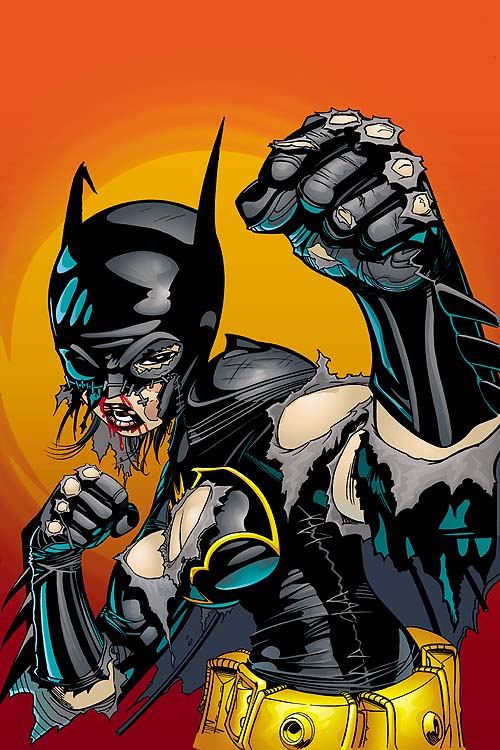
—That’s a pretty swell Batgirl costume, although I see the right ear is drooping a bit in that picture of it. Drooping bat-ears are usually an indication of either a sad Bat-person or a battle-damaged Bat-person.


—Hey, check out this post on Andy Kubert’s design for the Flashpoint Aquaman; Kubert gave his Aquaman a collapsing trident, like several of the artists who redesigned Aquaman for Project: Rooftop’s “Sea Change” contest. (Also, I can’t help but notice that Kubert’s Aquaman isn’t quite as cool as a whole bunch of those P:R redesigns).


—In other superhero fashion news, check out Nate Bellegarde’s great Jubilee design, and Alan Kistler’s Agent of STYLE column devoted to “The 7 Worst-Dressed Batman Enemies.” Kistler includes my second favorite Bat-villain costume (after The Scarecrow’s), Calendar Man’s, and the awesome, original Killer Moth costume, and the also awesome original Signal Man costume.

The premise of the column is rogues who “would need some serious redesign if they were ever translated into live-action media, so I guess I can’t really argue with that (Although I have a feeling it’s not just the costumes that will keep the likes of Kite-Man, Crazy Quilt or The Ten-Eyed Man out of the next Batman movie).

Sunday, April 03, 2011

Comic shop comics: March 23-30

5 Ronin #4-#5 (Marvel Entertainment) I previously wrote about the first three issues of this neat weekly miniseries by Peter Milligan at Blog@. These are the two concluding chapters, featuring original characters kinda sorta inspired by/reverse-engineered and retrofit into the samurai genre modern Marvel characters Psylocke and Deadpool.

The Psylocke book features amazing art by Goran Parlov, and is probably worth the purchase simply to read Parlov’s art. The story is, however, kind of icky—which I suppose is in keeping with the setting but that doesn’t really make it all that fun to read.

The Pyslocke character is actually half-English, half-Japanese young woman who calls herself Butterfly and works as a prostitute. Like the three previous ronin, who actually were ronin, she and her family were wronged by the Daimyo, and she seeks revenge.

Her plan is this: She will be the best prostitute she can possibly be, until she’s so good the Daimyo himself sends for her, in order to have sex with her, and then she’ll kill him.

Like the previous issues, this one strips all trace of superpowers out of the proceedings, but gives the lead character an ability somehow reminiscent of one her namesake had. This woman isn’t psychic, but has grown so adept at reading body language and behavior that she can usually tell what a man is thinking, and how to get him to do what she wants.

Unlike the previous issues, the wise fool character what is presumably going to end up being the Deadpool-derived character is absent, which seems a strange omission, as for three of the first four issues he appeared, nudging warriors toward confronting the Daimyo. Instead, the Wolverine character shows up, and he has sex with the Psylocke character, which leads to a page in which Butterfly narrates about the Wolverine ronin’s love-making abilities which, uh, isn’t something I really wanted to read (Here, I’ll share: “He is not without skill himself. Though his love-making is unpolished. More suited to the roadside than the parlor.”

The final issue, the one with “Deadpool” on the cover, is a bit of a disappointment. Not that it’s not fairly well written and not that Leandro Fernandez’s art is anything less than great, it’s just an odd, deflating sort of conclusion to the series. For four issues, we’ve seen a mysterious, scarred fool character seeking out powerful ronin and urging them to attack the daimyo through subtle means, and met a woman with her own plans for kill the daimyo.

In this issue, the Deadpool character confronts and kills the daimyo himself, which makes one wonder what the point of lining up all those other warriors were. Basically, the Deadpool character builds up an arsenal of human weapons, and then doesn’t use them. Dramatically, narratively, it’s not very satisfying.

The other four ronin all appear in the book, but only in an epilogue appearance sort of fashion, declaring what they will do now that the Daimyo is dead.

All in all, it was a really great showcase for a lot of great artists, and a rather interesting creative writing exercise to watch a skilled writer like Peter Milligan engage in.

If you’ve any affection for the samurai genre at all, I’d recommend picking up an issue or two here or there (One need not real all five, or any in any particular order; they’re all stand-alone stories…more so, it turns out, than even the structure of the earlier issues might have hinted).


Green Lantern #64 (DC Comics) Tucker Stone quite thoroughly reviewed this particular issue on Savage Critics earlier this week, and I liked the piece so much that I feel disinclined to write much about the comic book myself beyond noting that you should probably go read Tucker’s piece (That is the exact reason why, when I was working as a film critic, I never ever read reviews of anything until after I had filed my own story, and why I avoid reviews of comics I’m going to be reviewing professionally—but hell, this is just Green Lantern #64).

Of greatest import is, I suppose, that the regular art team of pencil artist Dough Mahnke and his running crew of inkers are back after a month/issue off, so Green Lantern is back to looking top-notch once again.

It’s probably also worth noting (again) that writer Geoff Johns really, really, really needs to cut down on splash panels, and try to work in some six to nine panel grids, because this comic takes about a minute and a half to read. There are two (2) two-page splash spreads, a one-page splash (so, that’s almost a fifth of the book devoted to just to just three panels), and two other pages have only two panels on them—big, splash-sized panels and small, horizontal panels along the bottom.

Mahnke’s a hell of an artist, and the book is well drawn and brilliant in its glowing colors, but the splashes all seem like wasted real estate, not really revealing anything of note. For example, two whole pages are drawn showing Salaak and some other Green Lanterns flying in space, and then the one-page splash is wasted on showing them arriving. Three pages to say “Salaak and some Green Lanterns are off to arrest Hal Jordan for sucking”…?

The other two-page splash is devoted to reveling that Krona has control of The Entities, which we’ve already seen in previous issues.

If you’re just reading for the plot summary, this is the paragraph for you! Hal Jordan and the “New Guardians” (the otherly-colored Lanterns) find Krona’s copy of Kramer’s Ergot #7, out of which pops “The story vampire, Lyssa Drak!” (Congratulations Johns; that is an awesome phrase). The book eats everyone except Hal Jordan, who escapes by terrorist fist-jabbing Sinestro, which naturally causes an explosion. On Oa, Krona stuffs The Entities into The Old Guardians and puts Parallax into the main power battery, which for some reason I don’t understand turns the Green Lanterns’ eyes yellow and makes them hate Hal Jordan more than usual. I think Parallax or Krona is somehow controlling all of the Lanterns who aren’t Hal Jordan…? Not sure how that works, since we’ve spent years learning about how yellow and Parallax are fear, and what does fear have to do with mind-control?

You can read the next issues of Green Lantern Corps and Green Lantern: Emerald Warriors to find out! Or, like me, you can not! I don’t care! (Hopefully Tucker reads and reviews ‘em though; maybe then I’ll know what the hell is going on when Green Lantern #65, part four of this inter-book crossover story, shows up in my pull-file.

Oh, Ivan Reis’ cover featuring a bunch of GL’s fighting one another is worth a close look, as it show’s just how hardcore the “War of the Green Lanterns” is going to be.

For example, John Stewart isn’t just gonna fight Kyle Rayner, he’s going to ring-magic up a green pistol, with which to shoot Kyle’s girlfriend with!
The Green Lantern Who Is Also a Giant Jellyfish is going to attempt something unsavory with Arissa!
Salaak is going to tear his shirt off!
And a space cricket is going to backhand Bd’g, who is the space squirrel replacement for Ch’p!


Jimmy Olsen #1 (DC) This is where I would normally write a couple hundred words about this comic book, but I’ve already talked about it at probably too great length over at Blog@, so if you would like to read my babbling on and on about how good Nick Spencer, RB Silva and company’s Jimmy Olsen is, I’d recommend you visit Blog@ and read it there, if you haven’t already.


Namor: The First Mutant #8 (Marvel) For two issues now, I’ve been complaining about Ariel Olivetti’s art on this series, so you would think I’d be happy when the third and final issue of the “Namor Goes To Hell” story arc comes out sans Olivetti, right?

I would think that. Unfortunately, I thought wrong. This issue, while not drawn/photo-collaged by Olivetti, is illustrated by three different pencil artists and three different inkers, with Antonio Fuso inking his own art. That’s a grand total of five artists on these 22 pages, with a sixth artist (Olivetti) handling the previous chapters.

So this story arc that looked like hell now looks like late, rushed hell that changes art styles on a regular basis every few pages in the final chapter.

Suart Moore’s story might be much more engaging than it looks, but it’s really hard to divorce a comic script completely from comic art. I suppose it’s worth noting that Moore is taking “The First Mutant” part of the title, and the X-Men franchise’s adoption of Namor over the last few years, to heart. This has read an awful lot like a Namor book and an X-person book, with X-characters showing up throughout and, in this issue, Cyclops showing up in Atlantis to argue with Namor about the sorts of things Cyclops and Namor probably argue about a lot.